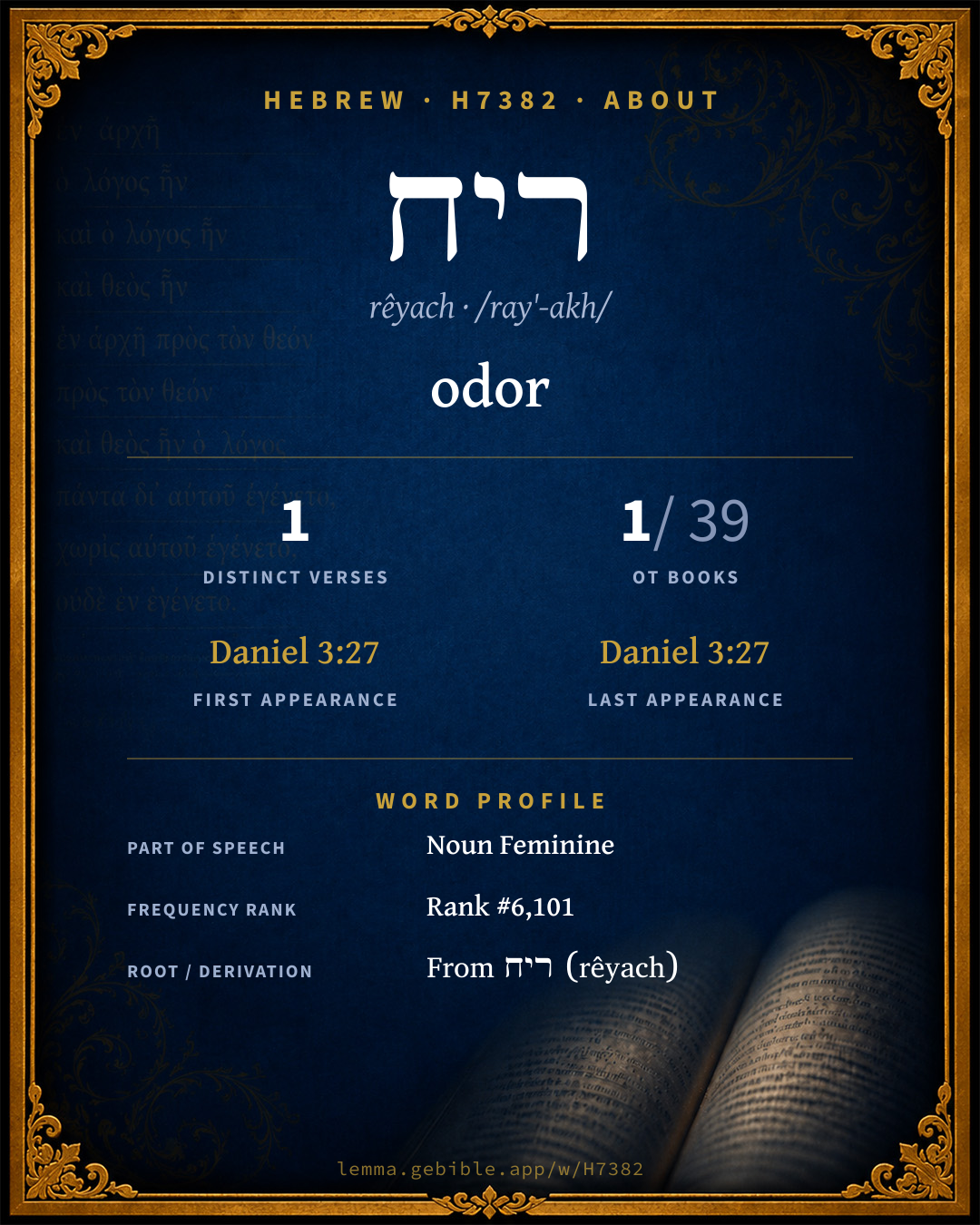
רֵיחַ
odor
Full lexicon entry — Brown-Driver-Briggs (BDB)
From Brown-Driver-Briggs (BDB)
Where this word appears
Grammar key — what these labels mean
Noun type
- Common
- A common noun — a general class of person, place, or thing (“king,” “city,” “water”), not a specific name.
State
- Construct
- A noun bound to a following noun in a possessive / “of” relationship (the construct chain).
Gender
- Feminine
- Grammatically feminine.
Number
- Singular
- One.
Every verse where H7382 appears — 1 distinct verse across 1 book. Click any verse to open its interlinear word-by-word view. Verse text shown in the World English Bible for context — . Each verse’s Hebrew form is shown with its reference; the English is not keyword-highlighted, since the data carries no word-level English alignment. Use “Compare translations” on any verse to read it across multiple English versions. This concordance covers the Hebrew Bible; Septuagint (Greek Old Testament) occurrences are not indexed here.
Daniel 1 verse
About this entry
At a glance — auto-summarized from this page’s data, not written by a person. Every figure links to its source below. This summary describes the numbers; it doesn’t interpret them.
“odor” is the headline sense of the Hebrew noun ריח (rêyach). With only 1 verse it sits in the long tail of Hebrew Bible vocabulary. More than three-quarters of its appearances fall in Daniel. A true hapax — its single appearance is Daniel 3:27. The sections below give every sense, occurrence, and version rendering.
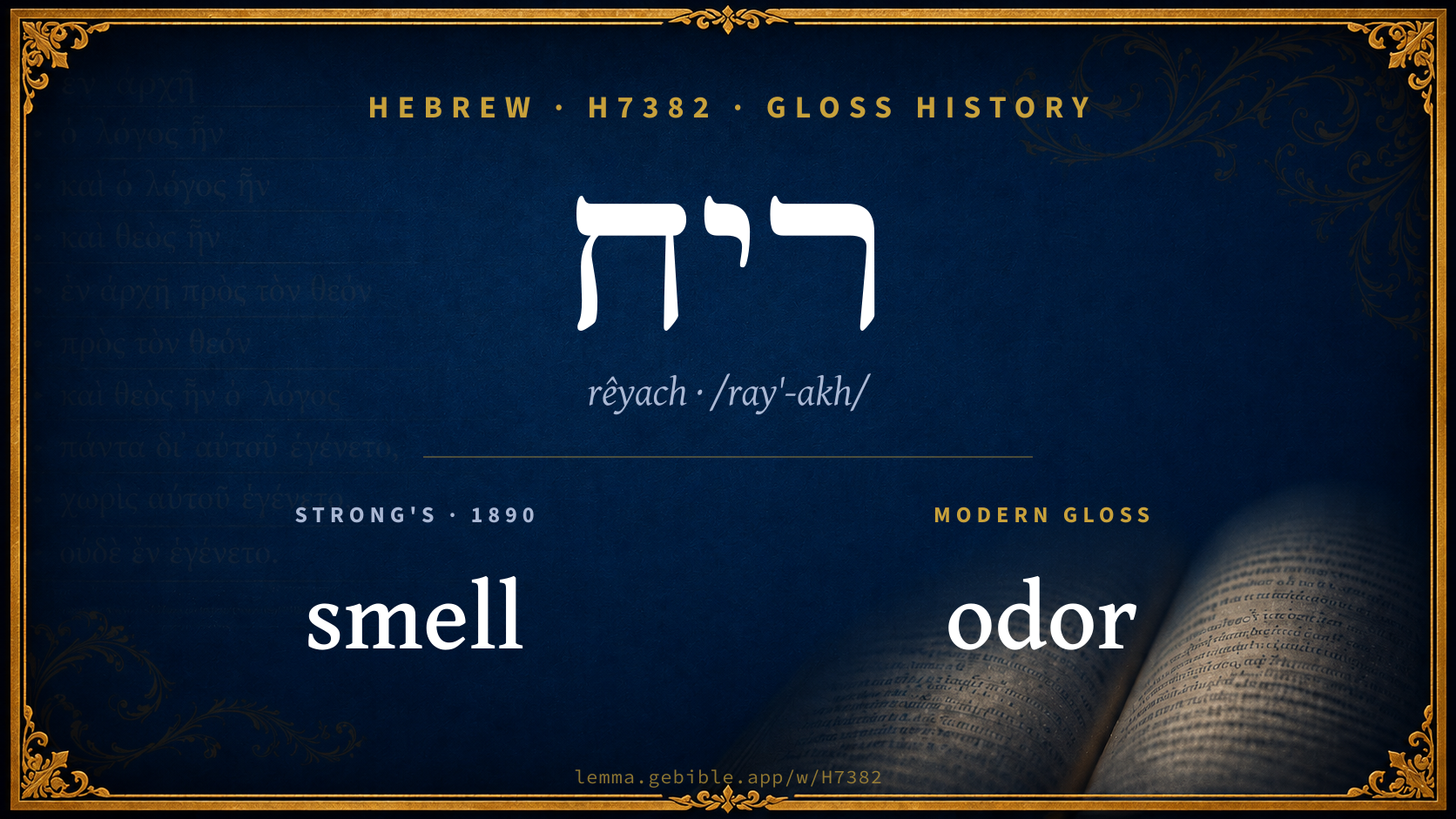
Gloss history
Strong's 1890 vs modern scholarship
About this word
Strong's H7382 catalogs a Hebrew word from the Hebrew Old Testament.
These counts are not copied from any lexicon or concordance. They are computed here, from the morphology-tagged Hebrew Old Testament. What Lemma adds →
- 1
- distinct verses
- The word appears in 1 distinct verse.
- 1 / 39
- OT books
- The word appears in 1 of 39 Old Testament books.
- #6,101
- by frequency
- Rank #6,101 (rank 6,101 of 8,640 Hebrew words by occurrence).
View all 1 occurrence in the concordance →
Most concentrated in
- Daniel 1 verse 100%
By section of the Old Testament
By traditional corpus
Conventional, traditional groupings — biblical authorship is debated, so this is a traditional corpus grouping, not an authorship claim. Each share is this word’s portion of its verses in that division of the Hebrew canon. Each figure is a share of the word’s 1 distinct verse.
- Writings (Ketuvim) 1 verse · 100%
How translations render this word
Counts come from each version’s own published word-to-Strong’s tagging or interlinear alignment — an approximate guide to how each version renders this word, not a word-level alignment the data otherwise carries. Because each total is that version’s own tagged count, the per-version totals vary from one another and need not match the appearance or distinct-verse counts above. These counts may also differ from a printed concordance because Lemma counts each distinctly tagged rendering and does not collapse phrase taggings into a single head-word total. This is a fixed set of word-tagged versions (KJV, ASV, BSB, ULT) and does not change with the reading translation you choose elsewhere. Each version’s license is shown beside its name below (and on Sources).
- King James Version: Smell 1×
- American Standard Version: Had the smell 1×
- Berean Standard Bible: Smell 1×
- unfoldingWord Literal Text: Smell of 1×
King James Version Public Domain
Renders H7382 across 1 tagged occurrence — most commonly:
American Standard Version Public Domain
Renders H7382 across 1 tagged occurrence — most commonly:
Berean Standard Bible Public Domain
Renders H7382 across 1 tagged occurrence — most commonly:
unfoldingWord Literal Text CC BY-SA 4.0
Renders H7382 across 1 tagged occurrence — most commonly:
Senses in the full BDB
What do BDB’s symbols mean?
BDB uses these scholarly abbreviations:
| Symbol | Meaning |
|---|---|
| 𝔊 | the Septuagint (the ancient Greek translation, LXX) |
| 𝔙 | the Vulgate (the Latin translation) |
| 𝔖 | the Syriac version (the Peshitta) |
| 𝔗 | the Targum (the Aramaic translation) |
| ψ | the Psalms |
| √ | root (the underlying root or stem) |
| ‖ | parallel passage (a synonymous or contrasted parallel) |
| † | the dagger: every passage where the word occurs is cited |
The 2 senses and sub-senses the full Brown-Driver-Briggs lexicon distinguishes for this word, in lexicon order (not ranked by frequency), with BDB’s own verbatim wording and sub-sense lettering. Shown in Hebrew script with BDB’s own scholarly abbreviations. The condensed entry is in the Lexicon Entry tab.
- 1. scent, odour, of plants and fields Gn 27:27 (JE) Ct 1:12; 2:3; 4:11; 7:14 Ho 14:7, of ointments Ct 1:13; 4:10, of pers. and garments Gn 27:27(×2) (JE) Ct 4:11; 7:9, of water Jb 14:9; fig. of influence, reputation Ex 5:21 (J) Je 48:11. e.g. Genesis 27:27
- 2. term. techn., רֵיחַ נִיחֹחַ odour of soothing (to God), tranquillizing odour (of ascending sacrifices, v. נִיחֹחַ) Gn 8:21 (J), elsewhere Ez 6:13; 16:19; 20:28, 41 and P: Ex 29:18, 25, 41 Lv 1:9 + 16 times Lv, Nu 15:3 + 17 times Nu. e.g. Genesis 8:21
Senses from the full Brown-Driver-Briggs lexicon (Brown, Driver, Briggs; Oxford 1906 — public domain), digitized via Sefaria, supplemented by the OpenScriptures HebrewLexicon (CC BY 4.0). Full attribution on Sources.
Word origin
n.m. Je 48:11 scent, odour (proposes breath);—abs. Ct 2:13 +, usually cstr. Gn 8:21 +; sf. רֵיחוֹ Je 48:11 Ct 1:12, רֵיחֵנוּ Ex 5:21;—
— Brown-Driver-Briggs (Oxford 1906, public domain), digitized via Sefaria, supplemented by the OpenScriptures HebrewLexicon (CC BY 4.0). See Sources.
Derived from ריח (rêyach) (H7381) — fragrance.
Jastrow Dictionary
A second Hebrew/Aramaic lexicon for comparison, covering Aramaic and post-biblical (Talmudic, Targumic, Midrashic) usage that the biblical-Hebrew BDB does not. Matched by lemma rather than by Strong’s number, so a lemma may carry more than one Jastrow headword (shown separately below), and the entries cover usage well beyond the Bible.
רִיחַ
- (b. h.) to breathe, waft, blow.—Denom. רוּחַ.
- to scent, smell. Gen. R. s. 34 הלך וַהֲרִיחָהּ (not וריחה) he went and smelled of it. Ib. (ref. to Gen. VIII, 21) ה׳ ריחו של אברהם וכ׳ he smelled the savor of Abraham, our father, rising from the fiery furnace (foresaw the self-sacrifice of Abraham); ה׳ דורו של שמד he smelled the savor of the generation of persecution (foresaw their martyrdom). Snh. 11ᵃ ה׳ ריח שום he perceived the smell of garlic. Zeb. 62ᵃ הֵרִיחוּ ריח קטרת they smelled the savor of frankincense (at the place where the Temple had stood). Nidd. 58ᵇ כל המוללו מֵרִיחַ בו whoever crushes it, smells its odor. Snh. 109ᵃ לערב באין ומְרִיחִין אותו וכ׳ in the evening they came and scented it (the balsam) like a dog. Yoma VIII, 4 עוברה שהֵרִיחָה וכ׳ a woman with child that smelled (a dish on the Day of Atonement, and has a morbid desire for it) must be given to eat, until she feels restored. B. Bath. 146ᵃ bot. ריח צנון אני מריח בגליל I smell a radish in Galilee (have a strong appetite for a Galilean radish); a. fr. e.g. Genesis 8:21
רִיחַ ²
- Af. אָרִיחַ, אָרַח same.—Part. מְרִיחַ, מוֹרַח, מָרַח. Targ. Gen. XXVII, 27. Targ. Ex. XXX, 38. Targ. Job XXXIX, 25; a. fr.—Sot. 49ᵃ מוֹרְחִינָא ריחא וכ׳ I smell &c., v. דַּהֲנוּנִיתָא. B. Bath. 73ᵇ ומוֹרַח ביה, v. עַפְרָא. Snh. 93ᵇ (ref. to Is. XI, 3, sq.) במשיח כתיב דמורח ודאין of the Messiah it is written that he smells (of a man) and judges (of his guilt or innocence); ניחזי אנן אי מרח ודאין let us see whether he (Bar Koziba) smells &c.; כיון דחזיוהו דלא מריח וכ׳ when they saw that he could not judge by the scent, they killed him; Yalk. Is. 284. Ber. 43ᵇ האי מאן דמורח באתרוגא וכ׳ he that smells an Ethrog …, must say the benediction &c. Yoma 82ᵇ ההיא עוברא דאָרְחָא a woman with child that smelled, v. preced. Sabb. 110ᵃ דמורח ריחא וכ׳ (not דמירח) when it (the snake) smells it &c.; a. e. e.g. Isaiah 11:3
רֵיחַ
- preced.) flavor, scent, odor; sense of smell. Ber. 43ᵇ (ref. to Ps. CL, 6) איזהו דבר … זה הר׳ what is the thing which the soul enjoys and from which the body has no material benefit? It is smell. Ib. עתידים … שיתנו ר׳ וכ׳ in the future the young men of Israel shall give forth sweet savor (of purity) like the Lebanon (ref. to Hos. XIV, 7). Lev. R. s. 30; a. v. fr.—Trnsf. (cmp. אָבָק) slight resemblance, a suspicion of. Gitt. 86ᵇ אף ר׳ הגט אין בו it has not even the slightest resemblance to a letter of divorce (by which the woman concerned might be precluded from marrying a priest); Y. ib. IX, 50ᵇ top אפי׳ ר׳ פסול אין בה there is not a suspicion of disqualification in her case. Y. Sot. I, 16ᵈ top מר׳ ערוה נגעו בה something of the odor of incest has touched her (the rival wife of a faithless woman); a. e.—Pl. ריחוֹת. Cant. R. to I, 3 כל … ר׳ היו וכ׳ all the songs which the ancients recited before thee were merely sweet savors, but we (say), ‘oil that is poured forth is thy name’; כל המצות … ר׳ היו וכ׳ all the pious deeds … were merely flavors, but &c.; a. e. e.g. Psalms 150:6
רֵיחַ ²
- Targ. Gen. XXVII, 27; a. e.—Ab. Zar. 66ᵇ רֵיחֵיה חלא וכ׳ if a liquid has the smell of vinegar and the taste of wine. Ib., a. e. ר׳ מילתא היא, v. מִילְּתָא. Pes. 76ᵇ משום דקשיא לר׳ וכ׳ because it is bad for a bad-smelling breath and for leprosy. Sot. 49ᵃ, v. דַּהֲנוּנִיתָא; a. fr.—Trnsf. pride. Zeb. 96ᵇ, v. אַלְקַפְטָא.
A Dictionary of the Targumim, the Talmud Babli and Yerushalmi, and the Midrashic Literature (Marcus Jastrow; London, Luzac, 1903) — Public Domain. Digitized via Sefaria. Digitized via Sefaria. Full attribution on Sources.
Septuagint verse parallels
This word appears in 1 verse that also exists in the Greek Old Testament (Septuagint), out of the 1 Hebrew verse it occurs in. You can read those verses in Greek by switching the Old Testament edition to the Septuagint.
Read these verses in the Septuagint
This is a verse-level parallel only — the same verses exist in both the Hebrew and Greek Old Testaments. No word-level Hebrew↔Greek correspondence is claimed: the data carries no such alignment, so no Greek word is shown as this Hebrew word’s translation. Coverage is not total — the Septuagint omits the deuterocanon and renumbers the Psalms, so some Hebrew verses have no direct Greek parallel.