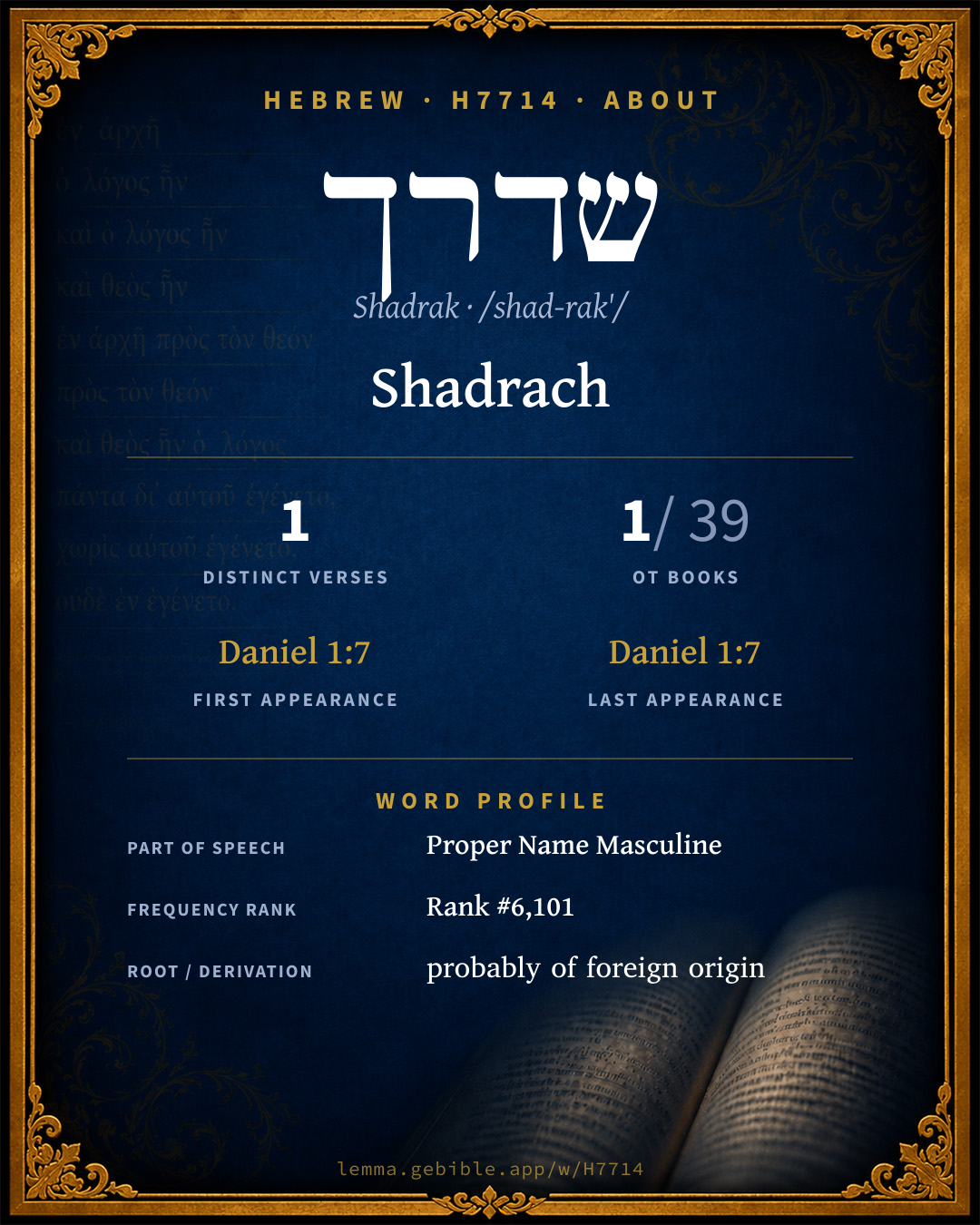
שַׁדְרַךְ
Shadrach
BDB lists 2 entries for ‘Shadrach’ fuller range ↓
Full lexicon entry — Brown-Driver-Briggs (BDB)
From Brown-Driver-Briggs (BDB)
Where this word appears
Grammar key — what these labels mean
Part of speech
- Noun
- A naming word — a person, place, thing, or idea.
Noun type
- Proper
- A name of a specific person, place, or people (e.g. Abraham, Zion, Israel).
Every verse where H7714 appears — 1 distinct verse across 1 book. Click any verse to open its interlinear word-by-word view. Verse text shown in the World English Bible for context — . Each verse’s Hebrew form is shown with its reference; the English is not keyword-highlighted, since the data carries no word-level English alignment. Use “Compare translations” on any verse to read it across multiple English versions. This concordance covers the Hebrew Bible; Septuagint (Greek Old Testament) occurrences are not indexed here.
Daniel 1 verse
About this entry
At a glance — auto-summarized from this page’s data, not written by a person. Every figure links to its source below. This summary describes the numbers; it doesn’t interpret them.
שדרך — transliterated Shadrak — is a Hebrew name carrying the sense “Shadrach.” A scarce word — 1 verse in all of the Hebrew Bible. Its uses cluster heavily in Daniel (100% of all occurrences). It occurs only once, in Daniel 1:7. Each statement above links to its evidence; the full detail follows below.
Gloss history
Strong's 1890 vs modern scholarship
About this word
Strong's H7714 catalogs a Hebrew word from the Hebrew Old Testament.
These counts are not copied from any lexicon or concordance. They are computed here, from the morphology-tagged Hebrew Old Testament. What Lemma adds →
- 1
- distinct verses
- The word appears in 1 distinct verse.
- 1 / 39
- OT books
- The word appears in 1 of 39 Old Testament books.
- #6,101
- by frequency
- Rank #6,101 (rank 6,101 of 8,640 Hebrew words by occurrence).
View all 1 occurrence in the concordance →
Most concentrated in
- Daniel 1 verse 100%
By section of the Old Testament
By traditional corpus
Conventional, traditional groupings — biblical authorship is debated, so this is a traditional corpus grouping, not an authorship claim. Each share is this word’s portion of its verses in that division of the Hebrew canon. Each figure is a share of the word’s 1 distinct verse.
- Writings (Ketuvim) 1 verse · 100%
How translations render this word
Counts come from each version’s own published word-to-Strong’s tagging or interlinear alignment — an approximate guide to how each version renders this word, not a word-level alignment the data otherwise carries. Because each total is that version’s own tagged count, the per-version totals vary from one another and need not match the appearance or distinct-verse counts above. These counts may also differ from a printed concordance because Lemma counts each distinctly tagged rendering and does not collapse phrase taggings into a single head-word total. This is a fixed set of word-tagged versions (KJV, ASV, BSB, ULT) and does not change with the reading translation you choose elsewhere. Each version’s license is shown beside its name below (and on Sources).
- King James Version: Shadrach 1×
- American Standard Version: Shadrach 1×
- Berean Standard Bible: Shadrach 1×
- unfoldingWord Literal Text: Shadrach 1×
King James Version Public Domain
Renders H7714 across 1 tagged occurrence — most commonly:
American Standard Version Public Domain
Renders H7714 across 1 tagged occurrence — most commonly:
Berean Standard Bible Public Domain
Renders H7714 across 1 tagged occurrence — most commonly:
unfoldingWord Literal Text CC BY-SA 4.0
Renders H7714 across 1 tagged occurrence — most commonly:
Senses in BDB
The 2 senses BDB distinguishes for this word, in lexicon order (not ranked by frequency or importance). The full entry — with sub-senses — is in the Lexicon Entry tab.
- Shadrach = "royal" or " the great scribe"
- the godly friend of Daniel whom Nebuchadnezzar renamed Shadrach…
Word origin
n.pr.m. Bab. name given to חֲנַנְיָה, one of Daniel’s comrades Dn 1:7 (from and meaning dub.; Dl (cf. COT Dr) Šudur-Aku, command of Aku; JenTh LZ 1895, 329 thinks Pers. [*Khšatraka]; KohlerZA iv (1889), 50 conj. מרדך, so WklAltor. Forsch. iii. 47. 57 ZimKAT3. 396).
— Brown-Driver-Briggs (Oxford 1906, public domain), digitized via Sefaria, supplemented by the OpenScriptures HebrewLexicon (CC BY 4.0). See Sources.
Origin: probably of foreign origin
Jastrow Dictionary
A second Hebrew/Aramaic lexicon for comparison, covering Aramaic and post-biblical (Talmudic, Targumic, Midrashic) usage that the biblical-Hebrew BDB does not. Matched by lemma rather than by Strong’s number, so a lemma may carry more than one Jastrow headword (shown separately below), and the entries cover usage well beyond the Bible.
דָּרַךְ
- (b. h.) to tread, stamp, walk. Ter. I, 9 ונמלך לדוֹרְכָן and after consideration decided to use them for pressing. Ex. R. s. 15 עתיד לִדְרוֹךְ וכ׳ He will tread with His shoe upon &c.; a. fr.
- to be trodden, pressed. Ter. I, 8 ענבים הנִדְרָכוֹת (Mish. ed. הנִדְרָכִים) grapes in the press or intended for the press.
- to lead, rear, train. Snh. 76ᵇ; Yeb. 62ᵇ המַּדְרִיךְ בניו וכ׳ he who leads his sons … on the right path.
דְּרַךְ
- 1. same. Targ. O. Deut. I, 36. Targ. Is. LIX, 8; a. fr.—Keth. 60ᵇ bot. דדָרְכָא על וכ׳ who stepped upon &c. Sabb. 109ᵃ דדרכא ליה וכ׳ Ms. M. (ed. דדריכא) that an ass had stepped on his foot. [Y. Maas. Sh. IV, 55ᶜ top יתיב מדרך, read: מְרַמֵּךְ, v. דְּמַךְ.—Lev. R. s. 27 דרכת עד, read: אוֹרְכַת, v. אֲרִיךְ I.]
- 2. to overtake, v. infra.
- 1. to thresh. Targ. Is. XXVIII, 27 sq.; a. e.
- 2. to lead. Targ. Prov. XXII, 6, v. דְּכִי Af.—Targ. Ps. XXV, 9; a. e.
- 3. to trace, overtake. Targ. Prov. VI, 11; XXIV, 34 ותַדְרְכָיךְ (ed. Lag. ותִידְ׳, Var. ותדרוך, ותדכיך, ותרכיך, h. text כמהלך).—Keth. 60ᵇ; Ab. Zar. 15ᵇ ולא אַדְרְכֵיה and did not find him.
דֶּרֶךְ
- c. (b. h.; preced.) way, road; method, manner. Kidd. 2ᵇ ד׳ לשון וכ׳ derekh is feminine gender &c. Ib. דַרְכּוֹ של אישׁ וכ׳ it is man’s way to carry war, and not woman’s.—Y. Ned. I, beg. 36ᶜ, a. e. התורה דיברה כדַרְכָּהּ, v. לָשׁוֹן. Succ. II, 1 לפי דַרְכֵּינוּ by our way (incidentally). Ab. Zar. 15ᵇ כד׳ שאסור … כך וכ׳ Ms. M. (ed. כד׳ שאמרו אסור) on the same principle that &c.; a. v. fr.—דֶּ׳ אֶרֶץ (abbrev. ד׳'א) the way of the land, a) good manners; b) secular occupation, trade; c) (euphem.) sexual connection. Ab. II, 2 study עם ד׳'א combined with a trade. Tosef. Sot. VII, 20 לימדה … ד׳'א וכ׳ the Torah teaches incidentally the proper conduct that one must first build a house &c.—Gitt. 70ᵃ bot. ד׳ וד׳'א וכ׳ travelling, marital connection &c. Gen. R. s. 18, end. Gen. R. s. 22, beg.—Ib. s. 80 כדַרְכָּהּ natural gratification of sexual appetite, שלא כד׳ unnatural. Ib. s. 18, end; a. fr.—Snh. 31ᵇ העביר עלי את הד׳ mutilated me (oth. interpret.: wronged me in business).—Pl. דְּרָכִים. Kidd. I, 1. R. Hash. 17ᵃ פירשו מדַּרְכֵי ציבור they deviated from the ways of the community, became heretics.—דרכי אמורי, v. אֱמוֹרִי.—דרכי שלום ways of peace (ref. to Prov. III, 17); מפני ד׳ ש׳ because the ways of the Law are ways of peace (differ. fr. משים איבה, v. אֵיבָה), i.e. it is a demand of equity, good manners &c., though no special law can be quoted for it. Gitt. V, 8 sq.; a. fr.—(ד׳'א) דרך ארץ Derekh Erets (Manners), name of a treatise attached to Talmud editions, divided into Rabba (Large), and Zuta (Small). e.g. Proverbs 3:17
A Dictionary of the Targumim, the Talmud Babli and Yerushalmi, and the Midrashic Literature (Marcus Jastrow; London, Luzac, 1903) — Public Domain. Digitized via Sefaria. Digitized via Sefaria. Full attribution on Sources.
Same root — word family
Other BDB entries built from the same root as H7714, grouped by Strong’s listed origin. These share a root / origin per the lexicon — not necessarily a shared meaning. Each links to that word’s own entry.
Proper names from this root
People and places named from this root — a name, not an additional meaning of the word.
Compare all same-root words → 1 of the same-root words is a proper name (a person or place). They share a root, not necessarily a meaning.
Bible dictionary
Public-domain dictionary articles matched to this entry by name (Shadrach). A biblical name can be shared by more than one person or place, so an article may treat several.
Easton's Bible Dictionary · M. G. Easton, 1897
Aku's command, the Chaldean name given to Hananiah, one of the Hebrew youths whom Nebuchadnezzar carried captive to Babylon (Dan. 1:6, 7; 3:12-30). He and his two companions refused to bow down before the image which Nebuchadnezzar had set up on the plains of Dura. Their conduct filled the king with the greatest fury, and he commanded them to be cast into the burning fiery furnace. Here, amid the fiery flames, they were miraculously preserved from harm. Over them the fire had no power, "neither was a hair of their head singed, neither had the smell of fire passed on them." Thus Nebuchadnezzar learned the greatness of the God of Israel. (See ABEDNEGO.)
Smith's Bible Dictionary · William Smith, 1863
(royal, or the great scribe) the Hebrew, or rather Chaldee, name of Hananiah. The history of Shadrach or Hananiah, as told in Dani 1-3 is well known. After their deliverance from the furnace, we hear no more of Shadrach, Meshach and Abednego, except in (Hebrews 11:33,34) but there are repeated allusions to them in the later apocryphal books, and the martyrs of the Maccabaean period seem to have been much encouraged by their example.
Hitchcock's Bible Names Dictionary · Roswell D. Hitchcock, 1869
tender, nipple
Classic public-domain reference works; full attribution on Sources.
Septuagint verse parallels
This word appears in 1 verse that also exists in the Greek Old Testament (Septuagint), out of the 1 Hebrew verse it occurs in. You can read those verses in Greek by switching the Old Testament edition to the Septuagint.
Read these verses in the Septuagint
This is a verse-level parallel only — the same verses exist in both the Hebrew and Greek Old Testaments. No word-level Hebrew↔Greek correspondence is claimed: the data carries no such alignment, so no Greek word is shown as this Hebrew word’s translation. Coverage is not total — the Septuagint omits the deuterocanon and renumbers the Psalms, so some Hebrew verses have no direct Greek parallel.