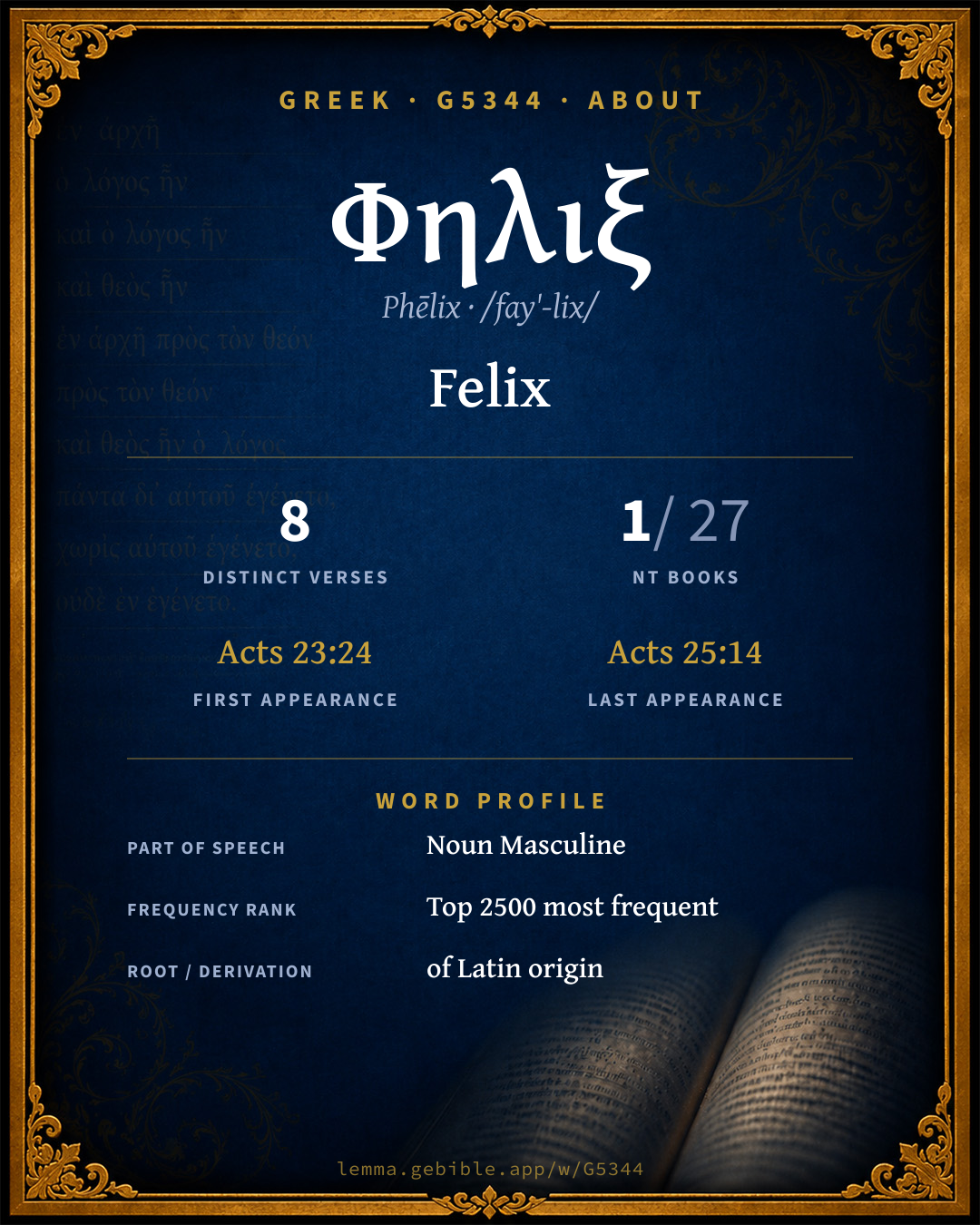
Φῆλιξ
Felix
Thayer's lists 2 entries for ‘Felix’ fuller range ↓
Full lexicon entry — Thayer's Greek Lexicon
From Thayer's Greek Lexicon
Where this word appears
See every Nominative-case word in the Greek New Testament →
Grammar key — what these labels mean
Part of speech
- Noun
- A naming word — a person, place, thing, or idea.
Case
- Nominative
- The case of the subject (and the predicate nominative).
- Accusative
- The case of the direct object and of extent.
- Dative
- The case of the indirect object, means, or location — “to / for / with / in.”
- Genitive
- The case of source, possession, or “of” — answers “whose / from what.”
- Vocative
- The case of direct address (“O Lord”).
Gender
- Masculine
- Grammatically masculine.
Number
- Singular
- One.
Grammatical forms
- Noun, Nominative, Singular, Masculine 5 times (56%)
- Noun, Accusative, Singular, Masculine 1 time (11%)
- Noun, Dative, Singular, Masculine 1 time (11%)
- Noun, Genitive, Singular, Masculine 1 time (11%)
- Noun, Vocative, Singular, Masculine 1 time (11%)
Parsed forms decoded from the imported morphology (Robinson–Tischendorf, public domain), counted across 9 parsed occurrences — not distinct verses.
Every verse where G5344 appears — 8 distinct verses across 1 book. Click any verse to open its interlinear word-by-word view. Verse text shown in the World English Bible for context — . Each verse’s Greek form is shown with its reference; the English is not keyword-highlighted, since the data carries no word-level English alignment. Use “Compare translations” on any verse to read it across multiple English versions. This concordance covers the Greek New Testament; Septuagint (Greek Old Testament) occurrences of this word are not indexed here.
Acts 8 verses
- Acts 23:24 Φήλικα n acc sg masc He asked them to provide animals, that they might set Paul on one, and bring him safely to Felix the governor.
- Acts 23:26 Φήλικι n dat sg masc "Claudius Lysias to the most excellent governor Felix: Greetings.
- Acts 24:3 Φῆλιξ n voc sg masc we accept it in all ways and in all places, most excellent Felix, with all thankfulness.
- Acts 24:22 Φῆλιξ n nom sg masc But Felix, having more exact knowledge concerning the Way, deferred them, saying, "When Lysias, the commanding officer, comes down, I will decide your case."
- Acts 24:24 Φῆλιξ n nom sg masc But after some days, Felix came with Drusilla, his wife, who was a Jewess, and sent for Paul, and heard him concerning the faith in Christ Jesus.
- Acts 24:25 Φῆλιξ n nom sg masc As he reasoned about righteousness, self-control, and the judgment to come, Felix was terrified, and answered, "Go your way for this time, and when it is convenient for me, I will summon you."
- Acts 24:27 Φῆλιξ Φῆλιξ n nom sg masc n nom sg masc But when two years were fulfilled, Felix was succeeded by Porcius Festus, and desiring to gain favor with the Jews, Felix left Paul in bonds.
- Acts 25:14 Φήλικος n gen sg masc As he stayed there many days, Festus laid Paul's case before the king, saying, "There is a certain man left a prisoner by Felix;
About this entry
At a glance — auto-summarized from this page’s data, not written by a person. Every figure links to its source below. This summary describes the numbers; it doesn’t interpret them.
The Greek name Φηλιξ centers on the idea of “Felix.” The word gravitates to Acts (100%). It appears 8 verses across 1 book of the Greek New Testament, among its uncommon vocabulary. Its earliest occurrence is Acts 23:24. Dig into 8-verse concordance and the renderings breakdown below.
Gloss history
Strong's 1890 vs modern scholarship
About this word
Strong's G5344 catalogs a Greek word from the Greek New Testament.
These counts are not copied from any lexicon or concordance. They are computed here, from the morphology-tagged Greek New Testament. What Lemma adds →
- 8
- distinct verses
- The word appears in 8 distinct verses.
- 1 / 27
- NT books
- The word appears in 1 of 27 New Testament books.
- #1,140
- by frequency
- Top 2500 most frequent Greek words (rank 1,140 of 5,347 Greek words by occurrence).
View all 8 occurrences in the concordance →
Most concentrated in
- Acts 8 verses 100%
By section of the New Testament
By traditional corpus
Conventional, traditional groupings — biblical authorship is debated, so this is a traditional corpus grouping, not an authorship claim. Some books belong to more than one corpus (Luke is in both the Gospels and the Lukan corpus, and so on), so these shares overlap and need not total 100%. Each figure is a share of the word’s 8 distinct verses.
- Lukan (Luke–Acts) 8 verses · 100%
How translations render this word
Counts come from each version’s own published word-to-Strong’s tagging or interlinear alignment — an approximate guide to how each version renders this word, not a word-level alignment the data otherwise carries. Because each total is that version’s own tagged count, the per-version totals vary from one another and need not match the appearance or distinct-verse counts above. These counts may also differ from a printed concordance because Lemma counts each distinctly tagged rendering and does not collapse phrase taggings into a single head-word total. This is a fixed set of word-tagged versions (KJV, ASV, BSB, ULT) and does not change with the reading translation you choose elsewhere. Each version’s license is shown beside its name below (and on Sources).
- King James Version: Felix 8×
- American Standard Version: Felix 8×
- Berean Standard Bible: Felix 9×
- unfoldingWord Literal Text: Felix 9×
King James Version Public Domain
Renders G5344 across 9 tagged occurrences — most commonly:
Plus 1 rendering that appears only once — usually multi-word phrases or single function words the recovered tagging swept in, not distinct renderings.
American Standard Version Public Domain
Renders G5344 across 9 tagged occurrences — most commonly:
Plus 1 rendering that appears only once — usually multi-word phrases or single function words the recovered tagging swept in, not distinct renderings.
Berean Standard Bible Public Domain
Renders G5344 across 9 tagged occurrences — most commonly:
unfoldingWord Literal Text CC BY-SA 4.0
Renders G5344 across 9 tagged occurrences — most commonly:
Senses in Thayer's
The 2 senses Thayer's distinguishes for this word, in lexicon order (not ranked by frequency or importance). The full entry — with sub-senses — is in the Lexicon Entry tab.
- Felix = "happy"
- a Roman procurator of Judea appointed by the emperor Claudius in A.D. 53. He ruled the province in a mean…
Word origin
Origin: of Latin origin
Of Latin origin; happy ; Phelix (that is Felix ) a Roman : - Felix.
— Strong’s Exhaustive Concordance (1890), public domain.
Forms in the corpus
The 4 distinct written forms G5344 takes in the Greek New Testament, most frequent first — each parse links to that case’s occurrences in the concordance.
| Form | Parsing | Example | Uses |
|---|---|---|---|
| Φῆλιξ Phē̂lix | Noun, Nominative, Singular, Masculine | Acts 24:22 | 6 |
| Φήλικα Phḗlika | Noun, Accusative, Singular, Masculine | Acts 23:24 | 1 |
| Φήλικι Phḗliki | Noun, Dative, Singular, Masculine | Acts 23:26 | 1 |
| Φήλικος Phḗlikos | Noun, Genitive, Singular, Masculine | Acts 25:14 | 1 |
Bible dictionary
Public-domain dictionary articles matched to this entry by name (Felix). A biblical name can be shared by more than one person or place, so an article may treat several.
Easton's Bible Dictionary · M. G. Easton, 1897
Happy, the Roman procurator of Judea before whom Paul "reasoned" (Acts 24:25). He appears to have expected a bribe from Paul, and therefore had several interviews with him. The "worthy deeds" referred to in 24:2 was his clearing the country of banditti and impostors.
At the end of a two years' term, Porcius Festus was appointed in the room of Felix (A.D. 60), who proceeded to Rome, and was there accused of cruelty and malversation of office by the Jews of Caesarea. The accusation was rendered nugatory by the influence of his brother Pallas with Nero. (See Josephus, Ant. xx. 8, 9.)
Drusilla, the daughter of Herod Agrippa, having been induced by Felix to desert her husband, the king of Emesa, became his adulterous companion. She was seated beside him when Paul "reasoned" before the judge. When Felix gave place to Festus, being "willing to do the Jews a pleasure," he left Paul bound.
Smith's Bible Dictionary · William Smith, 1863
(happy), a Roman procurator of Judea appointed by the emperor Claudius in A.D. 53. He ruled the province in a mean, cruel and profligate manner. His period of office was full of troubles and seditions. St. Paul was brought before Felix in Caesarea. He was remanded to prison, and kept there two years in hopes of extorting money from him. (Acts 24:26,27) At the end of that time Porcius Festus [Festus, Porcius] was appointed to supersede Felix, who, on his return to Rome, was accused by the Jews in Caesarea, and would have suffered the penalty due to his atrocities had not his brother Pallas prevailed with the emperor Nero to spare him. This was probably about A.D. 60. The wife of Felix was Drusilla, daughter of Herod Agrippa I., who was his third wife and whom he persuaded to leave her husband and marry him.
Hitchcock's Bible Names Dictionary · Roswell D. Hitchcock, 1869
happy, prosperous
Classic public-domain reference works; full attribution on Sources.