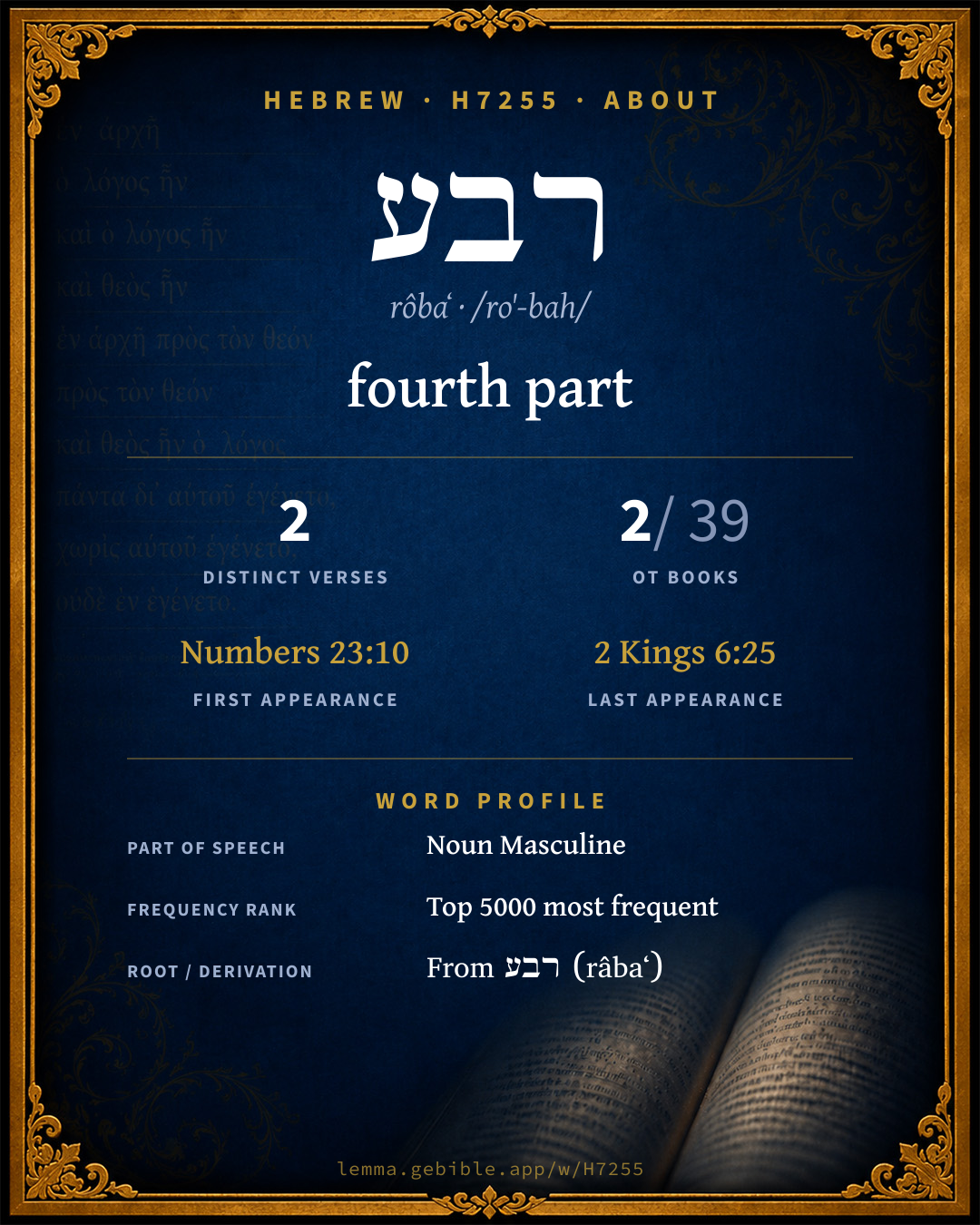
רֹ֫בַע
fourth part
Full lexicon entry — Brown-Driver-Briggs (BDB)
From Brown-Driver-Briggs (BDB)
Where this word appears
Grammar key — what these labels mean
Part of speech
- Noun
- A naming word — a person, place, thing, or idea.
Noun type
- Common
- A common noun — a general class of person, place, or thing (“king,” “city,” “water”), not a specific name.
State
- Construct
- A noun bound to a following noun in a possessive / “of” relationship (the construct chain).
Gender
- Masculine
- Grammatically masculine.
Number
- Singular
- One.
Every verse where H7255 appears — 2 distinct verses across 2 books. Click any verse to open its interlinear word-by-word view. Verse text shown in the World English Bible for context — . Each verse’s Hebrew form is shown with its reference; the English is not keyword-highlighted, since the data carries no word-level English alignment. Use “Compare translations” on any verse to read it across multiple English versions. This concordance covers the Hebrew Bible; Septuagint (Greek Old Testament) occurrences are not indexed here.
Numbers 1 verse
2 Kings 1 verse
About this entry
At a glance — auto-summarized from this page’s data, not written by a person. Every figure links to its source below. This summary describes the numbers; it doesn’t interpret them.
“fourth part” is the headline sense of the Hebrew noun רבע (rôbaʻ). It is rare — just 2 verses in the entire Hebrew Bible. More than half of its appearances fall in Numbers. Its earliest occurrence is Numbers 23:10. Related forms include רבע, ארבע and רביעי. The sections below give every sense, occurrence, and version rendering.
Gloss history
Strong's 1890 vs modern scholarship
About this word
Strong's H7255 catalogs a Hebrew word from the Hebrew Old Testament.
These counts are not copied from any lexicon or concordance. They are computed here, from the morphology-tagged Hebrew Old Testament. What Lemma adds →
- 2
- distinct verses
- The word appears in 2 distinct verses.
- 2 / 39
- OT books
- The word appears in 2 of 39 Old Testament books.
- #4,807
- by frequency
- Top 5000 most frequent Hebrew words (rank 4,807 of 8,640 Hebrew words by occurrence).
View all 2 occurrences in the concordance →
By traditional corpus
Conventional, traditional groupings — biblical authorship is debated, so this is a traditional corpus grouping, not an authorship claim. Each share is this word’s portion of its verses in that division of the Hebrew canon. Each figure is a share of the word’s 2 distinct verses.
- Torah (Pentateuch) 1 verse · 50%
- Prophets (Nevi'im) 1 verse · 50%
How translations render this word
Counts come from each version’s own published word-to-Strong’s tagging or interlinear alignment — an approximate guide to how each version renders this word, not a word-level alignment the data otherwise carries. Because each total is that version’s own tagged count, the per-version totals vary from one another and need not match the appearance or distinct-verse counts above. These counts may also differ from a printed concordance because Lemma counts each distinctly tagged rendering and does not collapse phrase taggings into a single head-word total. This is a fixed set of word-tagged versions (KJV, ASV, BSB, ULT) and does not change with the reading translation you choose elsewhere. Each version’s license is shown beside its name below (and on Sources).
- King James Version: Fourth 1×, Fourth part 1×
- American Standard Version: Fourth 1×, Fourth part 1×
- Berean Standard Bible: Fourth 1×, Quarter 1×
- unfoldingWord Literal Text: Fourth of 1×, Fourth part of 1×
King James Version Public Domain
Renders H7255 across 2 tagged occurrences — most commonly:
American Standard Version Public Domain
Renders H7255 across 2 tagged occurrences — most commonly:
Berean Standard Bible Public Domain
Renders H7255 across 2 tagged occurrences — most commonly:
unfoldingWord Literal Text CC BY-SA 4.0
Renders H7255 across 2 tagged occurrences — most commonly:
Senses in BDB
The 1 sense BDB distinguishes for this word, in lexicon order (not ranked by frequency or importance). The full entry — with sub-senses — is in the Lexicon Entry tab.
- fourth part
Word origin
n.[m.] fourth part;—ר׳ cstr.; of Israel Nu 23:10; of a ḳab 2 K 6:25.
— Brown-Driver-Briggs (Oxford 1906, public domain), digitized via Sefaria, supplemented by the OpenScriptures HebrewLexicon (CC BY 4.0). See Sources.
Derived from רבע (râbaʻ) (H7251) — to square.
Jastrow Dictionary
A second Hebrew/Aramaic lexicon for comparison, covering Aramaic and post-biblical (Talmudic, Targumic, Midrashic) usage that the biblical-Hebrew BDB does not. Matched by lemma rather than by Strong’s number, so a lemma may carry more than one Jastrow headword (shown separately below), and the entries cover usage well beyond the Bible.
רָבַע
- (b. h.) to lie with, copulate with, cover. Y. Ab. Zar. I, 40ᵃ top והלא מביא … והוא רוֹבְעָהּ וכ׳ but may he not bring (the crippled sire) to her, and he cover her, and she may give birth? Ib. והיא רוֹבַעַת ממנו וכ׳ and she (the crippled mare) may be fecundated by him.—Esp. a) (with ref. to Lev. XX, 16) to have connection with a beast. Snh. I, 4 הרוֹבֵעַ והנִרְבָּע the animal that covered (a woman), and the animal that was covered (by a man). B. Kam. 40ᵇ; a. e.—b) to commit pederasty. Snh. 9ᵇ פלוני רְבָעוֹ לאונסו וכ׳ (if a man says) such and such a man committed sodomy with him (euphem. for me) against his will, he himself in connection with another witness can testify &c.—Trnsf. to fructify the ground. Taan. 6ᵇ דבר שרובע, v. רְבִיעָה. e.g. Leviticus 20:16
- to be covered, esp. to be copulated in an unnatural way. Snh. I, 4, v. supra. Ab. Zar. 24ᵃ וולד הנִרְבַּעַת אסורה the issue of a beast that was used for buggery while pregnant is disqualified for the altar; היא וולדה נִירְבְּעוּ for mother and child have been abused; a. fr.
- 1. (v. (v. רְבִיעָה) to inundate for the sake of improving the soil. Y. Peah VII, 20ᵇ (ref. to המרבץ, ib. V, 19ᵃ top) מביון שהוא מְרַבְּעָהּ וכ׳ because he inundates it, it will yield so much more next year.
- 2. (denom. of אַרְבַּע) a) to do for the fourth time. Sifré Deut. 306 הוי מפטם … ומְרַבֵּע perfume (thyself) with the words of the Law, and do it a second, a third, and a fourth time; Yalk. ib. 942.—b) to quadrate, make quadrilateral. Part. pass. מְרוּבָּע; f. מְרוּבַּעַת; pl. מְרוּבָּעִים, מְרוּבָּעִין; מְרוּבָּעוֹת. Y. Maasr. V, end, 52ᵃ אין מר׳ מששת ימי בראשית there is no quadrangular form in natural objects; ib. והתנינן … הקילקי המ׳ but do we not read in the Mishnah (Neg. VI, 1) … ‘of the size of a Cilician bean which is quadrilateral’? כל גרמא … (ד)יְרַבְּעֶנָּהּ הוא this very passage proves that there is nothing quadrangular in nature; and why does the Mishnah say so? It means that he (the priest) should calculate the size of a bean by circumscribing a quadrilateral around it; Y. Ned. III, 37ᵈ bot.; Y. Shebu. III, 34ᵈ די ירבעונה הוא (read: יְרַבְּעֶינָּהּ). Tosef. Maasr. III, 14, v. גָּרִיס. Y. Erub. II, 20ᵃ מר׳ a quadrilateral stone, opp. עגולה; Bab. Erub. 19ᵇ; Tosef. ib. II (I), 1. Ib. VI (V), 10 ריבע את העיר וכ׳ if he squares a town (which is built in a curve) and makes the calculation as if it were a square table (plane); Erub. 56ᵇ המְרַבֵּעַ וכ׳. Ib. וחוזר ומרבע את התחומין and then again he draws a square for the Sabbath limits. Ib. כמה מר׳ יתר וכ׳ how much larger is the square than the inscribed circle?; a. fr.
רְבַע
- 1. to lie, couch. Targ. Num. XXII, 27 (h. text רבץ). Targ. Y. Gen. XLIX, 25; a. fr.—Part. רְבִיעַ; f. רְבִיעָא; pl. רְבִיעִין; רְבִיעָן. Ib. IV, 7. Targ. Deut. XXII, 6 (O. ed. Vien. רְבֵעָא). Targ. Ps. CIV, 22; a. fr.—Y. Ber. VIII, 12ᵇ top לא מיסתך דאת ר׳ וכ׳ is it not not enough that thou art lying (on the dining couch), and he stands and attends thee? Ib. גזירנא דהוא ר׳ וכ׳ (not גזירה) I decree that he lie down, and thou stand &c. Gen. R. s. 7 רביע ואנא וכ׳ lie down (to be lashed), and I will tell thee; Tanḥ. Ḥuck. 6; Pesik. R. s. 14. Koh. R. to I, 8 קם ור׳ ליה על רגלוי he arose and threw himself down at his feet. Shebu. 22ᵇ, a. fr. אריא הוא דר׳ וכ׳, v. אַרְיָא; a. fr.
- 2. to commit buggery. Ab. Zar. 24ᵃ דילמא רַבְעוּהָ לאימא דאימא perhaps they (gentiles) had connection with the grandmother (of the animal, while she was pregnant); a. e.
- 1. to cause to lie down, lay down. Targ. Y. Gen. XXIV, 11 (h. text ויברך). Targ. Y. Deut. XXV, 2 ויַרְבְּעִינֵיה (not ויִרְ׳).—Part. pass. מַרְבַּע. Targ. Y. I Gen. XLIX, 14.—Num. R. s. 19 אַרְבְּעוּנֵיה דילקי lay him down, that he may receive lashes; Tanḥ. l. c. ארבעתיה (corr. acc.); ib. ארבעונהי (corr. acc.). Pesik. R. l. c. אַרְבְּעִינֵיה lay thou him down. Y. Bicc. I, 64ᵃ אַרְבְּעֵיה על וכ׳ he ordered him to be laid on the benches (for punishment). B. Kam. 114ᵃ אַרְבְּעֵית לי אריא וכ׳ thou didst put a lion at my borders, i.e. you forced a violent neighbor upon me; a. e.—Y. Yeb. IV, 6ᵃ bot. ואנא בעי מַרְבַּעְתָּהּ וכ׳ and I want to assist at her lying down (for delivery), before she cools off, v. צְנַן.
- 2. to copulate animals, esp. to hybridize. Targ. Y. Gen. XXXVI, 24. Targ. Y. Lev. XIX, 19.
- 1. to divide into four parts. Targ. Y. Deut. XXXII, 4.
- 2. to make quadrangular. Part. pass. מְרַבַּע (מְרֻבַּע Hebraism); f. מְרַבְּעָא; pl. מְּרַבְּעִין; מְרַבְּעָן, מְרַבְּעָתָא quadrate. Targ. Ex. XXVII, 1. Targ. Ez. XLV, 2. Targ. I Kings VII, 5. Targ. Y. I Num. XXXIII, 7 (not מֵרַבְ׳); Targ. Y. I Ex. XIV, 2 (ed. Vien. מרביעתא, corr. acc.); a. e.—Y. Sot. V, 20ᵇ bot. מאן דמְרַבַּע ארבע וכ׳ he that wants to form four rows of four casks each requires sixteen casks. Erub. 57ᵃ אימור … כמאן דמְרַבְּעָא רַבּוּעֵי ודאי מי מְרַבַּעְנָא we said, we consider it in our calculations as if it were squared; do we, however, really make it a square (by filling the space with buildings)?; a. e.
רֶבַע
- preced.) one-fourth, quarter.—Pl. רְבָעִים. Erub. 56ᵃ בארבעה רִבְעֵי היום וכ׳ at one of the four quarters of the day, at the beginning of the day, or at the beginning of the night, or at noon, or at midnight.—Esp. one-fourth of a Ḳab. Pl. as ab. Ḥall. II, 6 חמשת ר׳ קמח five quarts of flour (v. Maim. a. l.). Ib. I, 4; a. fr.—Du. רִבְעָתַיִם, רִיבְ׳. Ker. I, 7 בר׳ at the price of two quarters (of a silver Denar); B. Bath. 166ᵇ (Rashb: at one quarter of a Denar for a pair of birds, v. Tosaf. a. l.); Ker. 10ᵇ
A Dictionary of the Targumim, the Talmud Babli and Yerushalmi, and the Midrashic Literature (Marcus Jastrow; London, Luzac, 1903) — Public Domain. Digitized via Sefaria. Digitized via Sefaria. Full attribution on Sources.
Forms in the corpus
The 2 distinct written forms H7255 takes in the Hebrew Bible, most frequent first — each parse links to that state’s occurrences in the concordance. Hebrew forms include their vowel points and cantillation, so a single lemma takes many written forms.
| Form | Parsing | Example | Uses |
|---|---|---|---|
| וְ/רֹ֛בַע | Noun, Common, Masculine, Singular, Construct | 2 Kings 6:25 | 1 |
| רֹ֣בַע | Noun, Common, Masculine, Singular, Construct | Numbers 23:10 | 1 |
Same root — word family
Other BDB entries built from the same root as H7255, grouped by Strong’s listed origin. These share a root / origin per the lexicon — not necessarily a shared meaning. Each links to that word’s own entry.
Derives from
Shares the same root
- ארבע ʼarbaʻ H702 four
- רביעי rᵉbîyʻîy H7243 fourth
- רבע rebaʻ H7253 fourth part
- רבע ribbêaʻ H7256 fourth
Compare all same-root words → Showing 4 of 6 — not the complete family. They share a root, not necessarily a meaning.
Septuagint verse parallels
This word appears in 2 verses that also exist in the Greek Old Testament (Septuagint), out of the 2 Hebrew verses it occurs in. You can read those verses in Greek by switching the Old Testament edition to the Septuagint.
Read these verses in the Septuagint
This is a verse-level parallel only — the same verses exist in both the Hebrew and Greek Old Testaments. No word-level Hebrew↔Greek correspondence is claimed: the data carries no such alignment, so no Greek word is shown as this Hebrew word’s translation. Coverage is not total — the Septuagint omits the deuterocanon and renumbers the Psalms, so some Hebrew verses have no direct Greek parallel.