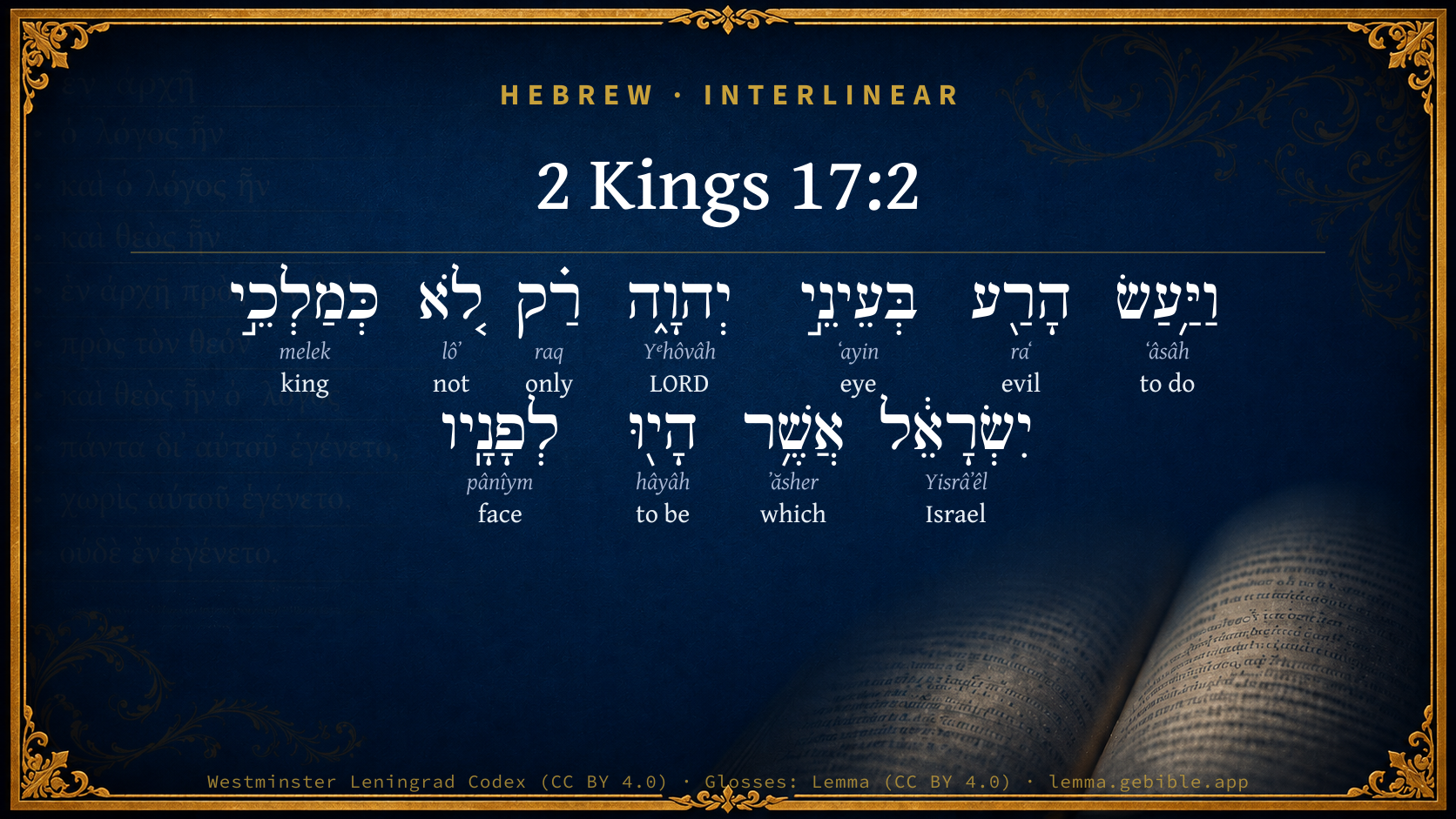
2 Kings 17:2

Hebrew (Westminster Leningrad Codex) 2 Kings 17:2 appears in the Hebrew Old Testament. The text above is from the Westminster Leningrad Codex. Each word links to its Strong’s number, a concise gloss, and parsing drawn from the Open Scriptures Hebrew Bible morphology. Click any word for its full Brown-Driver-Briggs (BDB) entry.
Download image
Cite this verse

2 Kings 17:2 (World English Bible). Public Domain. Lemma interlinear Bible study tool, https://lemma.gebible.app/v/2-kings/17/2.

Show BibTeX & RIS
BibTeX
RIS
English Translation
He did that which was evil in the sight of Yahweh, yet not as the kings of Israel who were before him.
World English Bible · Public Domain
Download a study sheet

One document with this verse’s original text, its word-by-word gloss line, the meaning frame, cross-references with their text, attributed commentary, and full source and license credits — printable, and it pastes into notes with its structure intact.

This verse Autodidact and up

Study sheet (.html) Plain text (.txt)

A passage Seminary Student

Up to 50 verses in one chapter. A passage sheet keeps up to 6 commentary sources and 12 cross-references per verse, in the order this page ranks them, and says so on the sheet whenever that leaves anything out. Ask for a single verse and you get the Autodidact verse sheet above.

Everything on this page stays free to read, with no account — the sheet is a download of what is already on screen, not access to it.

Want to remove ads? Support Godless Engineer
Compare translations 3

The same verse in 3 English versions, stacked beneath the original-language interlinear above. Click any original word for its lexicon entry.

Each is an independent rendering of the whole verse — the interlinear is not word-aligned to these translations.

Highlighted words mark where these versions differ — a whole-verse word diff, not a word-by-word alignment.

  • World English Bible Public Domain
    He did that which was evil in the sight of Yahweh, yet not as the kings of Israel who were before him.
  • King James Version Public Domain
    And he did that which was evil in the sight of the LORD, but not as the kings of Israel that were before him.
  • unfoldingWord Literal Text CC BY-SA 4.0
    And he did evil in the eyes of Yahweh, only not like the kings of Israel who were to his face.

unfoldingWord Literal Text — © unfoldingWord, licensed CC BY-SA 4.0. Word-aligned USFM3 via Door43 (git.door43.org/unfoldingWord/en_ult).

Versions to compare (up to 4)

3 of 4 selected

Show all 18 translations

Every available English version of this verse, each an independent rendering of the whole verse.

  • World English Bible Public Domain
    He did that which was evil in the sight of Yahweh, yet not as the kings of Israel who were before him.
  • Berean Standard Bible Public Domain
    And he did evil in the sight of the LORD, but not like the kings of Israel who preceded him.
  • Majority Standard Bible Public Domain
    And he did evil in the sight of the LORD, but not like the kings of Israel who preceded him.
  • King James Version Public Domain
    And he did that which was evil in the sight of the LORD, but not as the kings of Israel that were before him.
  • American Standard Version (1901) Public Domain
    And he did that which was evil in the sight of Jehovah, yet not as the kings of Israel that were before him.
  • Revised Version (1885) Public Domain
    And he did that which was evil in the sight of the LORD, yet not as the kings of Israel that were before him.
  • Geneva Bible (1599) Public Domain
    And he did euill in the sight of the Lord, but not as the Kinges of Israel, that were before him.
  • Douay-Rheims (1899) Public Domain
    And he did evil before the Lord: but not as the kings of Israel that had been before him.
  • Young's Literal Translation Public Domain
    and he doth the evil thing in the eyes of Jehovah, only, not as the kings of Israel who were before him;
  • Literal Standard Version CC BY-SA 4.0
    and he does evil in the eyes of YHWH, only, not as the kings of Israel who were before him;
  • Unlocked Literal Bible CC BY-SA 4.0
    He did what was evil in the sight of Yahweh, yet not as the kings of Israel who were before him.
  • unfoldingWord Literal Text CC BY-SA 4.0
    And he did evil in the eyes of Yahweh, only not like the kings of Israel who were to his face.
  • Darby Bible Public Domain
    And he did evil in the sight of Jehovah, but not as the kings of Israel that had been before him.
  • World Messianic Bible Public Domain
    He did that which was evil in the LORD’s sight, yet not as the kings of Israel who were before him.
  • Webster's Bible Public Domain
    And he did that which was evil in the sight of the LORD, but not as the kings of Israel that were before him.
  • Free Bible Version CC BY-SA 4.0
    He did what was evil in the Lord's sight, but not in the same way as the kings of Israel who were before him.
  • Bible in Basic English Public Domain
    He did evil in the eyes of the Lord, though not like the kings of Israel before him.
  • JPS Tanakh (1917) Public Domain
    And he did that which was evil in the sight of the LORD, yet not as the kings of Israel that were before him.

Literal Standard Version (2020), Covenant Press — licensed CC BY-SA 4.0. Text via the HelloAO Bible API (eBible.org). Unlocked Literal Bible (unfoldingWord) — licensed CC BY-SA 4.0. Text via the HelloAO Bible API (eBible.org). unfoldingWord Literal Text — © unfoldingWord, licensed CC BY-SA 4.0. Word-aligned USFM3 via Door43 (git.door43.org/unfoldingWord/en_ult). Free Bible Version, Dr. Jonathan Gallagher — licensed CC BY-SA 4.0. Text via the HelloAO Bible API (eBible.org).

Word by word

More ways to search: Search by grammar → Find every occurrence → Compare this word →

Practice this passage: Drill this verse → Learn its vocabulary →

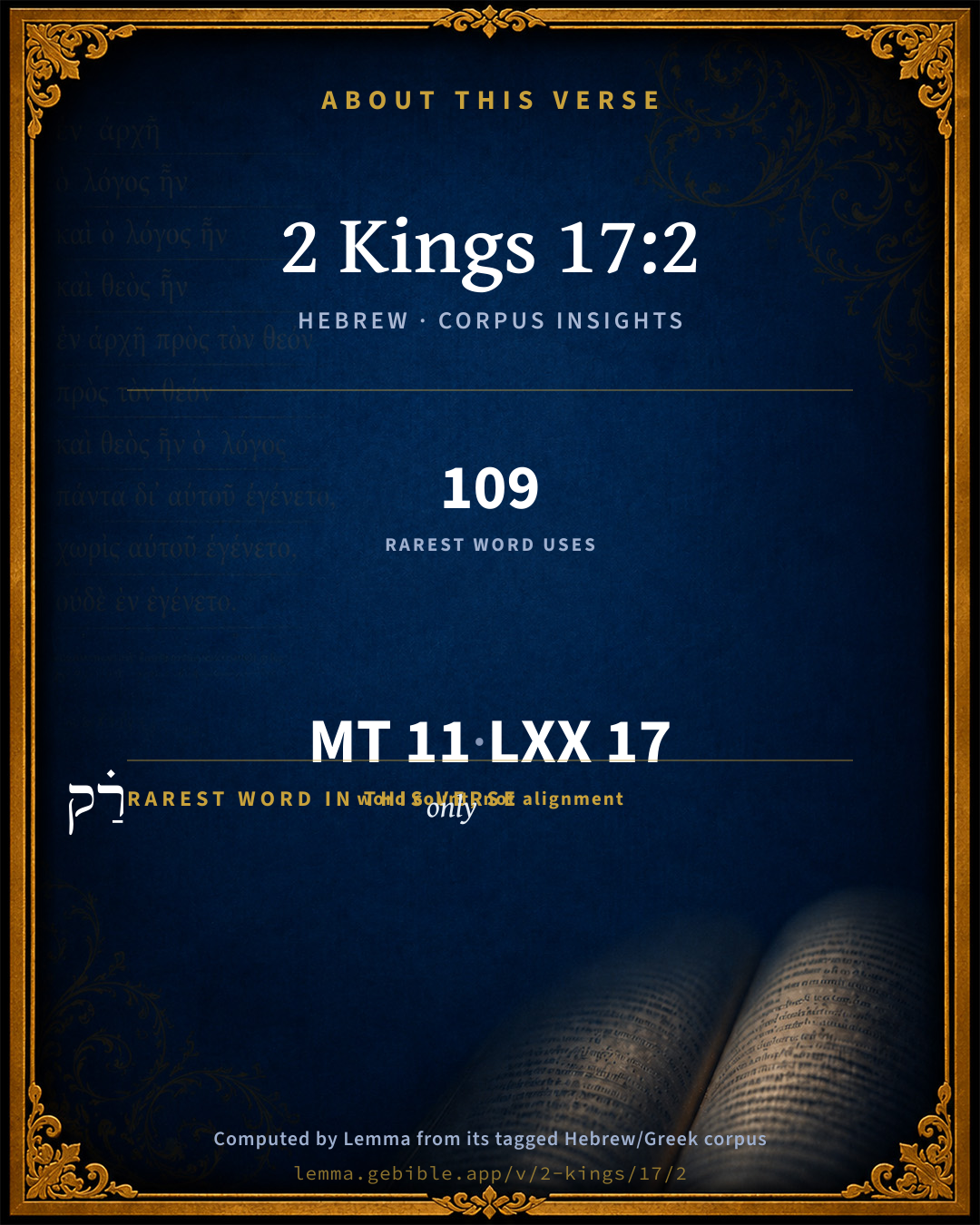
רַ֗ק
raq
H7535
“only”
Particle, Accusative
Part of Speech
Particle
Type
Accusative
Full BDB Definition

Origin: the same as H7534 as a noun

TWOT: 2218a

only, altogether, surely - only - only, nought but, altogether (in limitation) - save, except (after a negative) - only, altogether, surely (with an affirmative) - if only, provided only (prefixed for emphasis) - only, exclusively (for emphasis)
  1. וַיַּ֥עַשׂ ʻâsâh H6213 “and · to do” Conjunction + Verb, Qal, Sequential Imperfect, 3rd Person, Masculine, Singular
  2. הָרַ֖ע raʻ H7451 “the · evil” Particle, Definite Article + Adjective, Adjective, Masculine, Singular, Absolute
  3. בְּעֵינֵ֣י ʻayin H5869 “in/at · eyes of” Preposition + Noun, Common, Both, Dual, Construct
  4. יְהוָ֑ה Yᵉhôvâh H3068 “LORD” Noun, Proper
  5. לֹ֚א lôʼ H3808 “not” Particle, Negative
  6. כְּמַלְכֵ֣י melek H4428 “like/as · kings of” Preposition + Noun, Common, Masculine, Plural, Construct
  7. יִשְׂרָאֵ֔ל Yisrâʼêl H3478 “Israel” Noun, Proper
  8. אֲשֶׁ֥ר ʼăsher H834 “which” Particle, Relative
  9. הָי֖וּ hâyâh H1961 “to be” Verb, Qal, Perfect, 3rd Person, Common, Plural
  10. לְפָנָֽיו pânîym H6440 “to/for · face(s) · his” Preposition + Noun, Common, Both, Plural, Construct + Suffix, Personal, 3rd Person, Masculine, Singular

About this verse

These counts appear in no published source. They are computed here, from the morphology-tagged text and Lemma’s own curated glosses. What Lemma adds →

11
words
11
distinct lemmas
Historical
section

Grammatical profile

  • 2 verbs
  • 5 nouns
  • 1 adjective
  • 3 particles

Verb forms

  • וַיַּ֥עַשׂ Qal · Sequential Imperfect
  • הָי֖וּ Qal · Perfect

Hebrew & Septuagint length

In English translation the verse runs 22 words from the Hebrew and 21 from the Septuagint (LXX English) — closely comparable.

A rough comparison of the two English renderings, which tokenize alike — not a word-level alignment.

Word counts can differ between the Hebrew and the Greek without any difference in meaning — e.g. the Hebrew direct-object marker אֵת has no separate Greek word, and Greek often adds the article ὁ.

In the original languages it is 11 Hebrew tokens and 17 Greek tokens — but the two are counted differently (Hebrew bundles its prefixes and suffixes into one token; the Greek is in lemma form), so that isn’t a like-for-like length.

Cross-references

8

Topical passages linked to 2 Kings 17:2 in the Treasury of Scripture Knowledge — connected by theme and wording, ordered by reader-vote popularity; previews shown in the World English Bible.

  • 2 Kings 3:2 He did that which was evil in the sight of Yahweh, but not like his father, and like his mother; for he put away the pillar of Baal that his father had made.
  • 2 Kings 10:31 But Jehu took no heed to walk in the law of Yahweh, the God of Israel, with all his heart: he didn't depart from the sins of Jeroboam, with which he made Israel to sin.
  • 2 Kings 13:2 He did that which was evil in the sight of Yahweh, and followed the sins of Jeroboam the son of Nebat, with which he made Israel to sin; he didn't depart from it.
  • 2 Kings 13:11 He did that which was evil in the sight of Yahweh; he didn't depart from all the sins of Jeroboam the son of Nebat, with which he made Israel to sin; but he walked therein.
  • 2 Kings 15:9 He did that which was evil in the sight of Yahweh, as his fathers had done: he didn't depart from the sins of Jeroboam the son of Nebat, with which he made Israel to sin.
  • 2 Kings 15:18 He did that which was evil in the sight of Yahweh: he didn't depart all his days from the sins of Jeroboam the son of Nebat, with which he made Israel to sin.
  • 2 Kings 15:24 He did that which was evil in the sight of Yahweh: he didn't depart from the sins of Jeroboam the son of Nebat, with which he made Israel to sin.
  • 2 Chronicles 30:5–11 So they established a decree to make proclamation throughout all Israel, from Beersheba even to Dan, that they should come to keep the Passover to Yahweh, the God of Israel, at Jerusalem: for they had not kept it in great numbers in such sort as it is written.

Cross-references courtesy of OpenBible.info (CC BY 4.0).

Hebrew and Greek witnesses Masoretic Hebrew ↔ Greek Septuagint

The same verse in the two great witnesses to the Old Testament, shown verse-for-verse.

These are two independent witnesses, not word-aligned to each other, and the Septuagint is shown in lemma (dictionary) form.

Hebrew 2 Kings 17:2 Masoretic · Westminster Leningrad Codex

וַיַּ֥עַשׂ הָרַ֖ע בְּעֵינֵ֣י יְהוָ֑ה רַ֗ק לֹ֚א כְּמַלְכֵ֣י יִשְׂרָאֵ֔ל אֲשֶׁ֥ר הָי֖וּ לְפָנָֽיו

He did that which was evil in the sight of Yahweh, yet not as the kings of Israel who were before him.

World English Bible · Public Domain

Greek LXX 2 Kings 17:2 Septuagint · lemma form

καί ποιέω ὁ πονηρός ἐν ὀφθαλμός κύριος πλήν οὐ ὡς ὁ βασιλεύς ἰσραήλ ὅς εἰμί ἔμπροσθεν αὐτός

And he did evil in the eyes of the Lord, only not as the kings of Israel that were before him.

LXX2012 (modern English Septuagint) · Public Domain

Hebrew: Westminster Leningrad Codex (CC BY 4.0). Greek: Septuagint (public domain); English from LXX2012 (modern English Septuagint) (Public Domain). How the Septuagint differs from the Hebrew →

Targum (Aramaic paraphrase)

1

The Targum is the ancient Jewish Aramaic paraphrase of the Hebrew Scriptures — an interpretive translation, not the Hebrew text itself. Onkelos (literal) and Pseudo-Jonathan (expansive) render the Torah, and Jonathan the Prophets. Coverage is partial: where no permissively-licensed English translation exists for a verse, only the Aramaic is shown. This is verse-level text, not a word-by-word alignment to the Hebrew.

  1. Targum Jonathan Prophets (Joshua–Malachi)
    וַעֲבַד דְבִישׁ קֳדָם יְיָ לְחוֹד לָא כְמַלְכֵי יִשְׂרָאֵל דַהֲווֹ קֳדָמוֹהִי:

    (no public-domain English translation for this verse)

    Targum Jonathan — Aramaic: “Mikraot Gedolot” (public domain). English: “Sefaria Community Translation” (CC0 1.0 (public-domain dedication)); “London "Chaldee Paraphrase," 1871” (public domain). Text via Sefaria.

Commentary

Notes on 2 Kings 17:2 from classic Christian and Jewish commentators (each source and its license shown beneath its notes). The classic Christian expositions comment on the surrounding passage and are grouped to its opening verse, so a note may address several verses; the Jewish commentaries on the Tanakh (Rashi and others) are per-verse, so they appear only where the commentator wrote on this verse.

Lemma curates 59 commentaries, every one of them public domain or Creative Commons licensed, each selected and text-cleaned for this edition rather than reprinted as found. About our sources →

Trapp's Complete Commentary

John Trapp

2Ki 17:2 And he did [that which was] evil in the sight of the LORD, but not as the kings of Israel that were before him.

Ver. 2. But not as the kings of Israel that were before him.] For he suffered his subjects to go up to the passover celebrated by Hezekiah when he invited them, {2Ch 30:11} and to worship the Lord as they thought meet. Sulpitius Severus therefore is out when he saith of Hoshea, Hic ultra omnes superiores reges impius, &c.; this king being wicked above all that went before him, procured to himself punishment from God, and to his nation perpetual captivity. For he was better than his predecessors, as here appeareth; and the iniquity of the people was now full. It is not the last sand that exhausteth the hour glass, nor the last stroke of the axe that felleth the tree; so here.

John Trapp, A Commentary or Exposition upon All the Books of the Old and New Testament (1647–1656) — public domain. Text from a community e-Sword module.

Joseph Benson's Commentary

2Ki 17:2. But not as the kings of Israel that were before him — For he neither worshipped Baal, as many of his predecessors had done, nor compelled the people to worship the calves, one of which, that of Dan, being destroyed or carried away before this time, as the Hebrew writers affirm. And whereas the kings of Israel had hitherto maintained guards upon the frontiers, to hinder their subjects from going to Jerusalem to worship, Hoshea took away those guards, and gave free liberty to all, to go and pay their adoration where the law had directed; and, therefore, when Hezekiah had invited all Israel to come to his passover, this prince permitted all that would to go: and when, upon their return from that festival, they destroyed all the monuments of idolatry that were found in the kingdom of Samaria, instead of forbidding them, in all probability he gave his consent to it; because, without some tacit encouragement, at least, they durst not have ventured to do it. — Prideaux. And yet God, whose judgments are a great deep, brought destruction on the kingdom of Israel in the reign of this king. The fact was, that the Israelites had now completely filled up the measure of their iniquities, and God, by bringing ruin upon them at this time, when their king was less guilty than his predecessors, designed to show that he was punishing, not only the sins of that generation, but of the foregoing ages, and reckoning with them for the iniquities of their fathers. Add to this, that if Hoshea was not so bad as the generality of their former kings, yet the people were quite as wicked as those that went before them; and it was an aggravation of their wickedness, and brought ruin on them the sooner, that their king did not set them so bad an example as the former kings had done, nor hinder their reforming. He gave them leave to abandon their idols and their sins, and to return to the worship of the true God, and obedience to his laws: but they persisted in their idolatries and other vices, which laid the blame of their sin and ruin wholly upon themselves.

Joseph Benson's Commentary on the Old and New Testaments (1811–1818) — public domain. Text from a community e-Sword module.

Tyndale Open Study Notes

Tyndale Open Resources

17:2 Hoshea’s evil deeds were not to the same extent as his forebears, though what this means exactly is not explained.

Tyndale Open Study Notes — © Tyndale Open Resources, licensed CC BY-SA 4.0. Text via the HelloAO Bible API.

Geneva Bible (1599)

Geneva Bible translators

Though he invented no new idolatry, or impiety as others did, yet he sought for help at the Egyptians, which God had forbidden.

Geneva Bible (1599) marginal notes — public domain. Text via Bolls.life.

Jamieson, Fausset & Brown

Robert Jamieson, A. R. Fausset & David Brown

he did evil . . . but not as the kings of Israel--Unlike his predecessors from the time of Jeroboam, he neither established the rites of Baal, nor compelled the people to adhere to the symbolic worship of the calves. [See on Ch2 30:1.] In these respects, Hoshea acted as became a constitutional king of Israel. Yet, through the influence of the nineteen princes who had swayed the scepter before him (all of whom had been zealous patrons of idolatry, and many of whom had been also infamous for personal crimes), the whole nation had become so completely demoralized that the righteous judgment of an angry Providence impended over it.

Jamieson, Fausset & Brown — Commentary Critical and Explanatory on the Whole Bible (1871) — public domain (CC PDM 1.0). Text via the HelloAO Bible API.

Ellicott's Commentary for English Readers

(2) But not as the kings of Israel that were before him.—The preceding phrase is used of all the northern kings but Shallum, who only reigned a month, and had no time for the display of his religious policy. We can hardly assume that Hoshea abandoned the calf-worship of Bethel, but he may have discountenanced the cultus of the Baals and Asheras. The Seder Olam states that Hoshea did not replace the calf of Bethel, which, it assumes, had been carried off by the Assyrians in accordance with the prophecy of Hosea (Hos_10:5). We may remember that the last sovereigns of falling monarchies have not always been the worst of their line—e.g., Charles I. or Louis XVI.

A Bible Commentary for English Readers, edited by Charles John Ellicott (1878–1897) — public domain. Text from a community e-Sword module.

The Cambridge Bible for Schools and Colleges

gen. ed. J. J. S. Perowne

2. but not as the kings of Israel that were before him] We have no record of the doings of Hoshea, so as to specify in what points he was better than his predecessors. A long persistence in evil doing had however corrupted the whole nation, and the cutting short which had begun under the house of Jehu (2Ki_10:32) was now very nearly completed.

The Cambridge Bible for Schools and Colleges (gen. ed. J. J. S. Perowne; Cambridge University Press, 1878–1918) — public domain. Text from a community e-Sword module.

John Gill's Exposition

And he did that which was evil in the sight of the Lord, but not as the kings of Israel that were before him. He did not worship Baal, as some of them had done; and he could not worship the calves, as all of them had, for they were carried away by the Assyrians in the former captivities, as the Jews (s) say; and who also observe (t), that he removed the garrisons set on the borders of the land to watch the Israelites, that they might not go up to Jerusalem; and this being done on the fifteenth of Ab, that day was afterwards observed as a festival on that account; and they further remark (u), that the captivity of the ten tribes was in the reign of this king, who was better than the rest, to show that it was not barely the sins of the kings on whom the Israelites would cast the blame, that they were carried captives, but their own, according to Hos 5:3.

(s) Seder Olam Rabba, c. 22. (t) T. Bab. Gittin, fol. 88. Kimchi in loc. (u) Seder Olam Raba, ut supra. (c. 22.)

John Gill's Exposition of the Whole Bible (1746–1763) — public domain (CC PDM 1.0). Text via the HelloAO Bible API.

Albert Barnes' Notes on the Bible

Not as the kings of Israel that were before him - The repentance of a nation like that of an individual, may be “too late.” God is long-suffering; but after national sins have reached a certain height, after admonitions and warnings have been repeatedly rejected, after lesser punishments have failed - judgment begins to fall. Forces have been set in motion, which nothing but a miracle could stop; and God does not see fit to work a miracle in such a case. Compare Butler, ‘Analogy, ‘ Pt. I ch. 2 end.

Albert Barnes' Notes on the Bible (1834–1885) — public domain. Text from a community e-Sword/MySword module.

Haydock's Catholic Bible Commentary

Him. The Jews say, that he did not hinder his subjects from going to Jerusalem to adore. One of the golden calves had been sent away by Manahem, Osee x. 5. (Calmet) --- Yet under the less wicked king the nation is destroyed, as their crimes were come to the height; and Osee had not sufficient virtue to suspend the stroke of divine justice any longer. (Haydock)

George Leo Haydock (1774–1849), Haydock's Catholic Family Bible and Commentary, 1859 edition — public domain. Excludes Psalms (Douay-Rheims chapter numbering differs from Protestant) and Deuterocanonical books (Catholic canon only).

Matthew Poole's English Annotations

For he neither worshipped Baal, as many of his predecessors did; nor compelled the people to worship the calves; one of them, that of Dan, being destroyed, or carried away before, as the Hebrew writers affirm; nor, as some add, hindered those by force who were minded to go to Jerusalem to worship; and yet, the measure of the Israelites’ sins being now full, vengeance comes upon them without remedy: compare 2Ki 23:26.

Matthew Poole's English Annotations on the Holy Bible (1683–1685) — public domain. Text from a community e-Sword/MySword module.

Whedon's Commentary on the Bible

Daniel D. Whedon

2. Not as the kings of Israel that were before him — “It looks,” says Ewald, “like the bitter irony of fate that this Hoshea, who was to be the last king, was a better one than any of his predecessors. The words of the true prophets who had uttered so many and such important truths concerning this kingdom during the last fifty years, may, perhaps, have exercised a powerful influence over him, and instilled into him better principles. But they had always predicted its fall as certain; and now the irresistible force of history was to prove that no single man, whatever might be his position and superiority, could be strong enough to delay the ruin of the whole structure, if the right moment for its reformation had passed.”

Daniel D. Whedon (gen. ed.), Commentary on the Old and New Testaments (1874–1909) — public domain. Text from a community e-Sword module.

The Pulpit Commentary

And he did that which was evil in the sight of the Lord, but not as the kings of Israel that were before him. Hoshea"s general attitude towards Jehovah was much the same as that of former kings of Israel. De maintained the calf-worship, leant upon "arms of flesh," and turned a deaf ear to the teaching of the prophets e.g, Hoshea and Micah, who addressed their warnings to him. But he was not guilty of any special wickedness he set up no new idolatry; he seems to have allowed his subjects, if they pleased, to attend the festival worship at Jerusalem. (2Ch_30:11, 2Ch_30:18) The rabbis add that when the golden calf of Bethel had been carried off by the Assyrians in one of their incursions, he did not replace it ("Seder Olam," 2Ki 22); but it is not at all clear that the image was carried away until Hoshea"s reign was over. (see Dr. Pusey"s comment on Hos_10:6 in his "Minor Prophets," p. 64)

The Pulpit Commentary (1880–1919), ed. H.D.M. Spence-Jones & Joseph S. Exell — public domain. Text from a community e-Sword module.

John Wesley's Explanatory Notes

But not, &c. - For he neither worshipped Baal, as many of his predecessors did; nor compelled the people to worship the calves; (one of them, that of Daniel, being destroyed, or carried away before, as the Hebrew writers affirm;) nor, as some add, hindered those by force, who were minded to go to Jerusalem to worship. And yet, the measure of the Israelites sins, being now full, vengeance comes upon them without remedy.

John Wesley, Explanatory Notes Upon the Whole Bible (1754–1765) — public domain. Text via the GEBible commentary corpus.

Rashi

Rabbi Shlomo Yitzchaki (Rashi)

But not like the kings of Yisroel. For he abolished the sentries who were stationed on the roads from the days of Yorovom, to guard against the [Bnei] Yisroel from going up and performing the pilgrimage for the festivals, and this one abolished them, because the golden calves had already been exiled in the two [previous] exiles. In the first exile, [it states,] “he took Iyon and Dan,” [i.e.,] he exiled the calf that was in Dan. And in the second [exile], when Reuvein and Gad were exiled, he took the calf that was in Beis Eil, to fulfill what was stated, ”That too, will be transported to Ashur.” And because the sentries were abolished, and they [nonetheless] refrained from going up and performing the pilgrimage for the festivals, therefore, their verdict to be exiled in his days was sealed, for until now, they had blamed the corruption on their kings, but now they had no one to blame. This is what Hoshei'a the son of Be'eiri said, ”For now you have gone astray, Ephrayim, Yisroel has become defiled.” [i.e.,] now your evil has been revealed.

Rashi on the Tanakh — English translations: “The Judaica Press complete Tanach with Rashi, translated by A. J. Rosenberg” (CC BY 4.0); “Pentateuch with Rashi's commentary by M. Rosenbaum and A.M. Silbermann, 1929-1934” (public domain); “The Metsudah Tanach series, Lakewood, N.J” (CC BY 4.0); and “The Book of Joshua, Metsudah Publications, 1997” (CC BY 4.0). Text via Sefaria.

Lesson kit

Teaching starters — assembled from the data on this page, not authored interpretation. Every prompt links to the verse data it draws on. Edit before teaching.

2 Kings, in the Historical, opens this verse with 11 words (11 distinct Hebrew lemmas). Its most distinctive word is raq (“only”). A historical commentator’s framing appears above. Read the whole chapter for the surrounding context.

Discussion questions

  1. How does “only” (raq) shape what this verse is saying?
  2. 2 Kings 3:2 shares this passage’s theme. How do the two illuminate each other?
  3. These translations render this verse differently; the difference is in the English rendering, not the original. What questions does that raise?
  4. The verb «וַיַּ֥עַשׂ» is Qal Sequential Imperfect. How does its form color the action?
  5. Reading how Trapp's Complete Commentary and Joseph Benson's Commentary read this verse, where do the two commentators agree and where do they part?

Things to notice

Reading settings

Reading text

Shown beneath each verse's original-language words.

Old Testament
Old Testament edition

Read the OT as the Masoretic Hebrew (MT) or the Greek Septuagint (LXX).

English shown for the Greek Septuagint (in the Hebrew ↔ Greek comparison).

Comparing translations? Open the Compare panel on any verse page to stack up to four side by side.