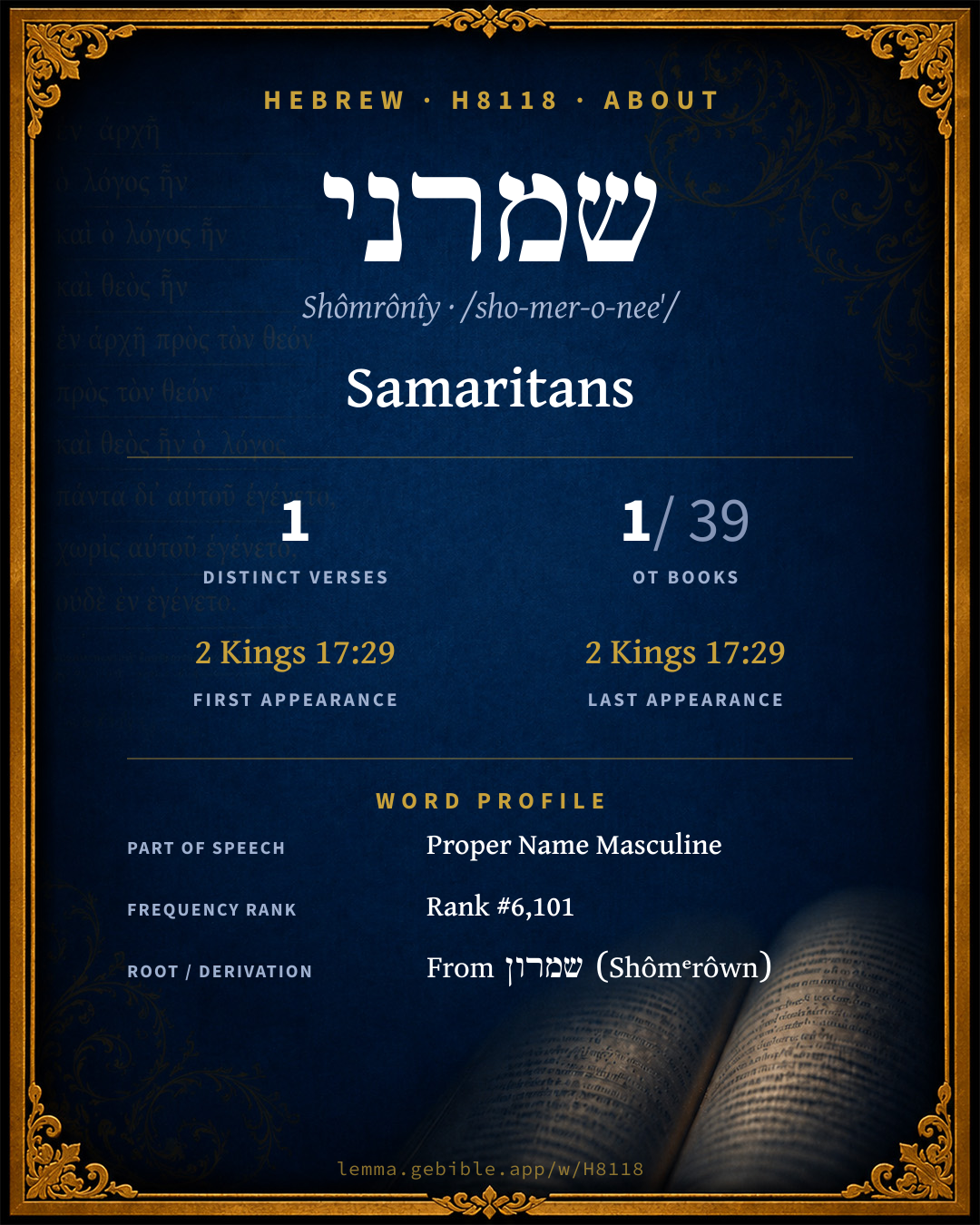
שֹׁמרֹנִי
Samaritans
BDB lists 2 entries for ‘Samaritans’ fuller range ↓
Full lexicon entry — Brown-Driver-Briggs (BDB)
From Brown-Driver-Briggs (BDB)
Where this word appears
Grammar key — what these labels mean
Noun type
- Gentilic
- A noun naming a member of a people, tribe, or region of origin (e.g. an Israelite, a Moabite).
State
- Absolute
- The independent form of a noun, not bound to a following word.
Gender
- Masculine
- Grammatically masculine.
Number
- Plural
- More than one (in Hebrew, generally three or more).
Every verse where H8118 appears — 1 distinct verse across 1 book. Click any verse to open its interlinear word-by-word view. Verse text shown in the World English Bible for context — . Each verse’s Hebrew form is shown with its reference; the English is not keyword-highlighted, since the data carries no word-level English alignment. Use “Compare translations” on any verse to read it across multiple English versions. This concordance covers the Hebrew Bible; Septuagint (Greek Old Testament) occurrences are not indexed here.
2 Kings 1 verse
About this entry
At a glance — auto-summarized from this page’s data, not written by a person. Every figure links to its source below. This summary describes the numbers; it doesn’t interpret them.
“Samaritans” is the headline sense of the Hebrew name שמרני (Shômrônîy). It is rare — just 1 verse in the entire Hebrew Bible. It clusters heavily in 2 Kings, which alone accounts for 100% of its uses. Its lone occurrence is 2 Kings 17:29. The sections below give every occurrence and version rendering.
Gloss history
Strong's 1890 vs modern scholarship
About this word
Strong's H8118 catalogs a Hebrew word from the Hebrew Old Testament.
These counts are not copied from any lexicon or concordance. They are computed here, from the morphology-tagged Hebrew Old Testament. What Lemma adds →
- 1
- distinct verses
- The word appears in 1 distinct verse.
- 1 / 39
- OT books
- The word appears in 1 of 39 Old Testament books.
- #6,101
- by frequency
- Rank #6,101 (rank 6,101 of 8,640 Hebrew words by occurrence).
View all 1 occurrence in the concordance →
Most concentrated in
- 2 Kings 1 verse 100%
By section of the Old Testament
By traditional corpus
Conventional, traditional groupings — biblical authorship is debated, so this is a traditional corpus grouping, not an authorship claim. Each share is this word’s portion of its verses in that division of the Hebrew canon. Each figure is a share of the word’s 1 distinct verse.
- Prophets (Nevi'im) 1 verse · 100%
How translations render this word
Counts come from each version’s own published word-to-Strong’s tagging or interlinear alignment — an approximate guide to how each version renders this word, not a word-level alignment the data otherwise carries. Because each total is that version’s own tagged count, the per-version totals vary from one another and need not match the appearance or distinct-verse counts above. These counts may also differ from a printed concordance because Lemma counts each distinctly tagged rendering and does not collapse phrase taggings into a single head-word total. This is a fixed set of word-tagged versions (KJV, ASV, BSB, ULT) and does not change with the reading translation you choose elsewhere. Each version’s license is shown beside its name below (and on Sources).
- King James Version: Samaritans 1×
- American Standard Version: Samaritans 1×
- Berean Standard Bible: Samaria 1×
- unfoldingWord Literal Text: Samaritans 1×
King James Version Public Domain
Renders H8118 across 1 tagged occurrence — most commonly:
American Standard Version Public Domain
Renders H8118 across 1 tagged occurrence — most commonly:
Berean Standard Bible Public Domain
Renders H8118 across 1 tagged occurrence — most commonly:
unfoldingWord Literal Text CC BY-SA 4.0
Renders H8118 across 1 tagged occurrence — most commonly:
Senses in BDB
The 2 senses BDB distinguishes for this word, in lexicon order (not ranked by frequency or importance). The full entry — with sub-senses — is in the Lexicon Entry tab.
- Samaritans = "of Samaria"
- inhabitants of Samaria
Word origin
[ שֹׁמרֹנִי ] adj.gent. Samaritan, only as n.pl. 2 K 17:29
— Brown-Driver-Briggs (Oxford 1906, public domain), digitized via Sefaria, supplemented by the OpenScriptures HebrewLexicon (CC BY 4.0). See Sources.
Derived from שמרון (Shômᵉrôwn) (H8111) — Samaria.
Same root — word family
Other BDB entries built from the same root as H8118, grouped by Strong’s listed origin. These share a root / origin per the lexicon — not necessarily a shared meaning. Each links to that word’s own entry.
Derives from
Proper names from this root
People and places named from this root — a name, not an additional meaning of the word.
Compare all same-root words → 3 of the same-root words are proper names (people or places). They share a root, not necessarily a meaning.
Bible dictionary
Public-domain dictionary articles matched to this entry by name (Samaritans). A biblical name can be shared by more than one person or place, so an article may treat several.
Easton's Bible Dictionary · M. G. Easton, 1897
The name given to the new and mixed inhabitants whom Esarhaddon (B.C. 677), the king of Assyria, brought from Babylon and other places and settled in the cities of Samaria, instead of the original inhabitants whom Sargon (B.C. 721) had removed into captivity (2 Kings 17:24; comp. Ezra 4:2, 9, 10). These strangers (comp. Luke 17:18) amalgamated with the Jews still remaining in the land, and gradually abandoned their old idolatry and adopted partly the Jewish religion.
After the return from the Captivity, the Jews in Jerusalem refused to allow them to take part with them in rebuilding the temple, and hence sprang up an open enmity between them. They erected a rival temple on Mount Gerizim, which was, however, destroyed by a Jewish king (B.C. 130). They then built another at Shechem. The bitter enmity between the Jews and Samaritans continued in the time of our Lord: the Jews had "no dealings with the Samaritans" (John 4:9; comp. Luke 9:52, 53). Our Lord was in contempt called "a Samaritan" (John 8:48). Many of the Samaritans early embraced the gospel (John 4:5-42; Acts 8:25; 9:31; 15:3). Of these Samaritans there still remains a small population of about one hundred and sixty, who all reside in Shechem, where they carefully observe the religious customs of their fathers. They are the "smallest and oldest sect in the world."
Smith's Bible Dictionary · William Smith, 1863
Strictly speaking, a Samaritan would be an inhabitant of the city of Samaria, but the term was applied to all the people of the kingdom of Israel. After the captivity of Israel, B.C. 721, and in our Lord's time, the name was applied to a peculiar people whose origin was in this wise. At the final captivity of Israel by Shalmaneser, we may conclude that the cities of Samaria were not merely partially but wholly depopulated of their inhabitants in B.C. 721, and that they remained in this desolated state until, in the words of (2 Kings 17:24) "the king of Assyria brought men from Babylon and front Cuthah, and from Av. (Ivah,) (2 Kings 18:34) and from Hamath, and front Sepharvaim, and placed them in the cities of Samaria instead of the children of Israel and they possessed Samaria, and dwelt in the cities thereof." Thus the new Samaritans were Assyrians by birth or subjugation. These strangers, whom we will now assume to hare been placed in "the cities of Samaria" by Esar-haddon, were of course idolaters, and worshipped a strange medley of divinities. God's displeasure was kindled, and they were annoyed by beasts of prey, which had probably increased to a great extent before their entrance upon the land. On their explaining their miserable condition to the king of Assyria, he despatched one of the captive priests to teach them "how they should fear the Lord." The priest came accordingly, and henceforth, in the language of the sacred historian, they "Feared the Lord, and served their graven images, both their children and their children's children: as did their fathers, so do the unto this day." (2 Kings 17:41) A gap occurs in their history until Judah has returned from captivity. They then desire to be allowed to participate in the rebuilding of the temple at Jerusalem; but on being refused, the Samaritans throw off the mask, and become open enemies, frustrate the operations of the Jews through the reigns of two Persian kings, and are only effectually silenced in the reign of Darius Hystaspes, B.C. 519. The feud thus unhappily begun grew year by year more inveterate. Matters at length came to a climax. About B.C. 409, a certain Manasseh, a man of priestly lineage, on being expelled from Jerusalem by nehemiah for an unlawful marriage, obtained permission from the Persian king of his day, Darius Nothus, to build a temple on Mount Gerizim for the Samaritans, with whom he had found refuge. The animosity of the Samaritans became more intense than ever. They are sid to have done everything in their power to annoy the Jews. Their own temple on Gerizim they considered to be much superior to that at Jerusalem. There they sacrificed a passover. Toward the mountain, even after the temple on it had fallen, wherever they were they directed their worship. To their copy of the law they arrogated an antiquity and authority greater than attached to any copy in the possession of the Jews. The law (i.e. the five books of Moses) was their sole code; for they rejected every other book in the Jewish canon. The Jews, on the other hand, were not more conciliatory in their treatment of the Samaritans. Certain other Jewish renegades had from time to time taken refuge with the Samaritans; hence by degrees the Samaritans claimed to partake of jewish blood, especially if doing so happened to suit their interest. Very far were the Jews from admitting this claim to consanguinity on the part of these people. The traditional hatred in which the jew held the Samaritan is expressed in Ecclus. 50:25,26. Such were the Samaritans of our Lord's day; a people distinct from the jews, though lying in the very midst of the Jews; a people preserving their identity, though seven centuries had rolled away since they had been brought from Assyria by Esar-haddon, and though they had abandoned their polytheism for a sort of ultra Mosaicism; a people who, though their limits had gradually contracted and the rallying-place of their religion on Mount Gerizim had been destroyed one hundred and sixty years before by John Hyrcanus (B.C. 130), and though Samaria (the city) had been again and again destroyed, still preserved their nationality still worshipped from Shechem and their impoverished settlements toward their sacred hill, still retained their peculiar religion, and could not coalesce with the Jews.
Classic public-domain reference works; full attribution on Sources.
Septuagint verse parallels
This word appears in 1 verse that also exists in the Greek Old Testament (Septuagint), out of the 1 Hebrew verse it occurs in. You can read those verses in Greek by switching the Old Testament edition to the Septuagint.
Read these verses in the Septuagint
This is a verse-level parallel only — the same verses exist in both the Hebrew and Greek Old Testaments. No word-level Hebrew↔Greek correspondence is claimed: the data carries no such alignment, so no Greek word is shown as this Hebrew word’s translation. Coverage is not total — the Septuagint omits the deuterocanon and renumbers the Psalms, so some Hebrew verses have no direct Greek parallel.