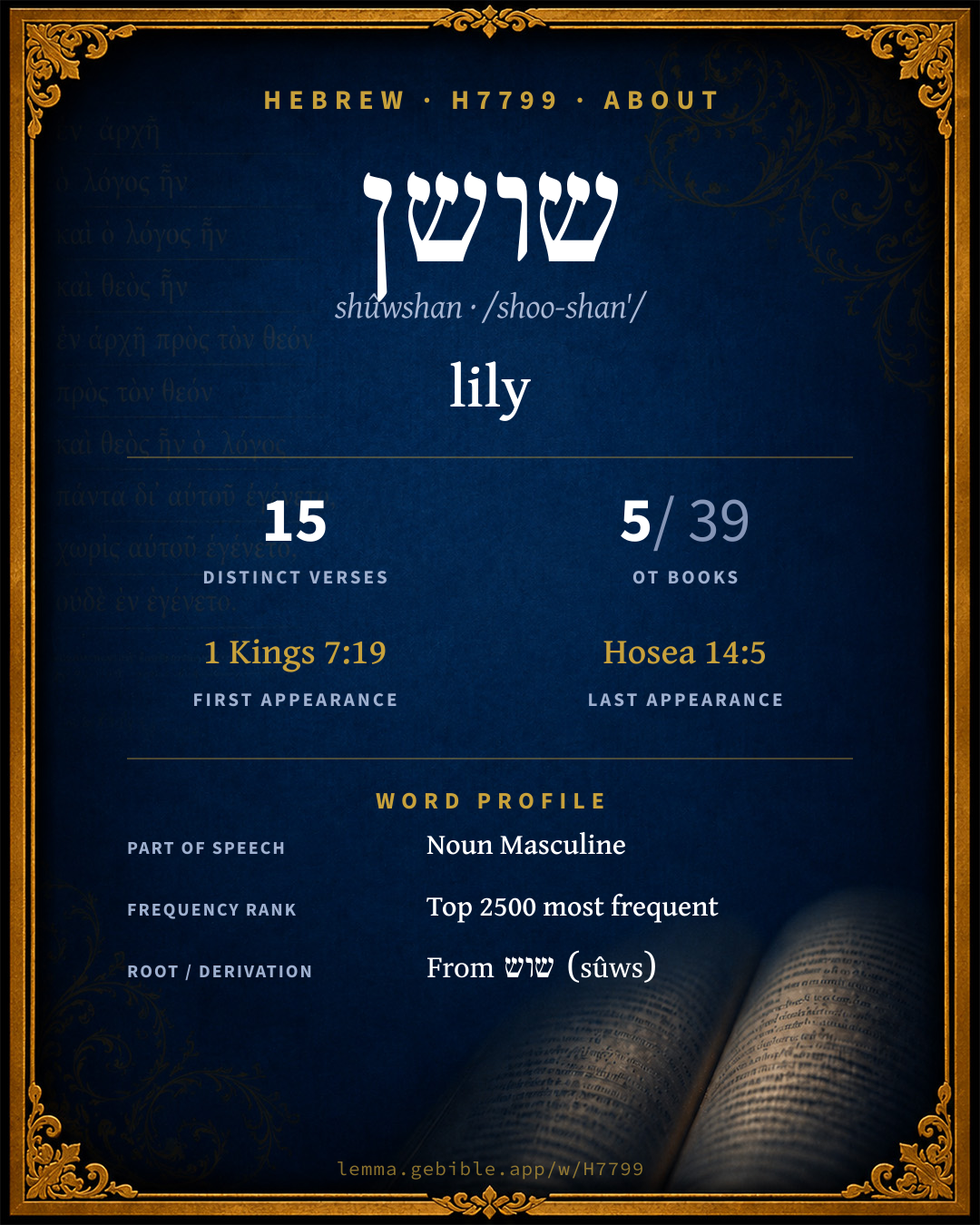
שׁוּשַׁן
lily
‘lily’ is one of 3 main senses fuller range ↓
Full lexicon entry — Brown-Driver-Briggs (BDB)
From Brown-Driver-Briggs (BDB)
Where this word appears
See every Absolute-state word in the Hebrew Bible →
Grammar key — what these labels mean
Part of speech
- Noun
- A naming word — a person, place, thing, or idea.
Noun type
- Common
- A common noun — a general class of person, place, or thing (“king,” “city,” “water”), not a specific name.
State
- Absolute
- The independent form of a noun, not bound to a following word.
- Construct
- A noun bound to a following noun in a possessive / “of” relationship (the construct chain).
Gender
- Both
- Attested as both masculine and feminine.
Number
- Plural
- More than one (in Hebrew, generally three or more).
- Singular
- One.
Grammatical forms
- Noun, Common, Both, Plural, Absolute 8 times (53%)
- Noun, Common, Both, Singular, Absolute 6 times (40%)
- Noun, Common, Both, Singular, Construct 1 time (7%)
Parsed forms decoded from the imported morphology (morphhb / Westminster Leningrad Codex — WLC text public domain, morphhb tagging CC BY 4.0), counted across 15 parsed occurrences — not distinct verses.
Every verse where H7799 appears — 15 distinct verses across 5 books. Click any verse to open its interlinear word-by-word view. Verse text shown in the World English Bible for context — . Each verse’s Hebrew form is shown with its reference; the English is not keyword-highlighted, since the data carries no word-level English alignment. Use “Compare translations” on any verse to read it across multiple English versions. This concordance covers the Hebrew Bible; Septuagint (Greek Old Testament) occurrences are not indexed here.
1 Kings 3 verses
- 1 Kings 7:19 שׁוּשַׁ֣ן n c bs The capitals that were on the top of the pillars in the porch were of lily-work, four cubits.
- 1 Kings 7:22 שׁוֹשָׁ֑ן n c bs On the top of the pillars was lily-work: so was the work of the pillars finished.
- 1 Kings 7:26 שׁוֹשָׁ֑ן n c bs It was a handbreadth thick: and the brim of it was worked like the brim of a cup, like the flower of a lily: it held two thousand baths.
2 Chronicles 1 verse
Psalms 2 verses
Song of Solomon 8 verses
- Song of Solomon 2:1 שֽׁוֹשַׁנַּ֖ת n c bs cs I am a rose of Sharon, A lily of the valleys.
- Song of Solomon 2:2 כְּ/שֽׁוֹשַׁנָּה֙ prep + n c bs As a lily among thorns, So is my love among the daughters. Beloved
- Song of Solomon 2:16 בַּ/שּׁוֹשַׁנִּֽים prep det + n c bp My beloved is mine, and I am his. He browses among the lilies.
- Song of Solomon 4:5 בַּ/שּׁוֹשַׁנִּֽים prep det + n c bp Your two breasts are like two fawns That are twins of a roe, Which feed among the lilies.
- Song of Solomon 5:13 שֽׁוֹשַׁנִּ֔ים n c bp His cheeks are like a bed of spices with towers of perfumes. His lips are like lilies, dropping liquid myrrh.
- Song of Solomon 6:2 שֽׁוֹשַׁנִּֽים n c bp My beloved has gone down to his garden, To the beds of spices, To feed in the gardens, and to gather lilies.
- Song of Solomon 6:3 בַּ/שׁוֹשַׁנִּֽים prep det + n c bp I am my beloved's, and my beloved is mine. He browses among the lilies,
- Song of Solomon 7:2 בַּ/שּׁוֹשַׁנִּֽים prep det + n c bp Your body is like a round goblet, No mixed wine is wanting. Your waist is like a heap of wheat, Set about with lilies.
Hosea 1 verse
About this entry
At a glance — auto-summarized from this page’s data, not written by a person. Every figure links to its source below. This summary describes the numbers; it doesn’t interpret them.
שושן (shûwshan) is a Hebrew noun most often rendered “lily.” It clusters heavily in Song of Solomon, which alone accounts for 53% of its uses. With 15 verses in 5 books, it is an uncommon word in the Hebrew Bible. Debuting at 1 Kings 7:19, it then recurs through the corpus. Its lexical range runs to 3 senses. The sections below give every sense, occurrence, and version rendering.
Gloss history
Strong's 1890 vs modern scholarship
About this word
Strong's H7799 catalogs a Hebrew word from the Hebrew Old Testament.
These counts are not copied from any lexicon or concordance. They are computed here, from the morphology-tagged Hebrew Old Testament. What Lemma adds →
- 15
- distinct verses
- The word appears in 15 distinct verses.
- 5 / 39
- OT books
- The word appears in 5 of 39 Old Testament books.
- #1,836
- by frequency
- Top 2500 most frequent Hebrew words (rank 1,836 of 8,640 Hebrew words by occurrence).
View all 15 occurrences in the concordance →
Most concentrated in
- Song of Solomon 8 verses 53%
- 1 Kings 3 verses 20%
- Psalms 2 verses 13%
By section of the Old Testament
By traditional corpus
Conventional, traditional groupings — biblical authorship is debated, so this is a traditional corpus grouping, not an authorship claim. Each share is this word’s portion of its verses in that division of the Hebrew canon. Each figure is a share of the word’s 15 distinct verses.
- Writings (Ketuvim) 11 verses · 73%
- Prophets (Nevi'im) 4 verses · 27%
How translations render this word
Counts come from each version’s own published word-to-Strong’s tagging or interlinear alignment — an approximate guide to how each version renders this word, not a word-level alignment the data otherwise carries. Because each total is that version’s own tagged count, the per-version totals vary from one another and need not match the appearance or distinct-verse counts above. These counts may also differ from a printed concordance because Lemma counts each distinctly tagged rendering and does not collapse phrase taggings into a single head-word total. This is a fixed set of word-tagged versions (KJV, ASV, BSB, ULT) and does not change with the reading translation you choose elsewhere. Each version’s license is shown beside its name below (and on Sources).
BDB lists this Strong’s number as 2 distinct words (homographs). Each count above pools all of them and is not split by sense — see the Senses section below. A low-frequency rendering may belong to a different one of those words, not the primary meaning.
- King James Version†: Lilies 4×, Among the lilies 3×, Lily 3×
- American Standard Version†: Lily 5×, Lilies 2×
- Berean Standard Bible†: Lilies 5×, Among the lilies 3×, Like a lily 3×
- unfoldingWord Literal Text†: Lily 4×, Among the lilies 3×, Lilies 3×
King James Version Public Domain
Renders H7799 across 15† tagged occurrences — most commonly:
Plus 3 renderings that appear only once — usually multi-word phrases or single function words the recovered tagging swept in, not distinct renderings.
American Standard Version Public Domain
Renders H7799 across 13† tagged occurrences — most commonly:
Plus 6 renderings that appear only once — usually multi-word phrases or single function words the recovered tagging swept in, not distinct renderings.
Berean Standard Bible Public Domain
Renders H7799 across 17† tagged occurrences — most commonly:
Plus 2 renderings that appear only once — usually multi-word phrases or single function words the recovered tagging swept in, not distinct renderings.
unfoldingWord Literal Text CC BY-SA 4.0
Renders H7799 across 13† tagged occurrences — most commonly:
Plus 3 renderings that appear only once — usually multi-word phrases or single function words the recovered tagging swept in, not distinct renderings.
Senses in the full BDB
What do BDB’s symbols mean?
BDB uses these scholarly abbreviations:
| Symbol | Meaning |
|---|---|
| 𝔊 | the Septuagint (the ancient Greek translation, LXX) |
| 𝔙 | the Vulgate (the Latin translation) |
| 𝔖 | the Syriac version (the Peshitta) |
| 𝔗 | the Targum (the Aramaic translation) |
| ψ | the Psalms |
| √ | root (the underlying root or stem) |
| ‖ | parallel passage (a synonymous or contrasted parallel) |
| † | the dagger: every passage where the word occurs is cited |
The 0 senses and sub-senses the full Brown-Driver-Briggs lexicon distinguishes for this word, in lexicon order (not ranked by frequency), with BDB’s own verbatim wording and sub-sense lettering. Shown in Hebrew script with BDB’s own scholarly abbreviations. The condensed entry is in the Lexicon Entry tab. See also the Forms in the corpus table below.
שושן I שׁוֹשַׁנָּה n.f. usually lily, prob. any lily-like flower (TristrNHB 462 ff. Post Hast. DB Lily Löw No. 323
שושן II loc. Susa, winter residence of Persian kings
Senses from the full Brown-Driver-Briggs lexicon (Brown, Driver, Briggs; Oxford 1906 — public domain), digitized via Sefaria, supplemented by the OpenScriptures HebrewLexicon (CC BY 4.0). Full attribution on Sources.
Word origin
I. n.m. שׁוֹשַׁנָּה n.f. usually lily, prob. any lily-like flower (TristrNHB 462 ff. Post Hast. DB Lily Löw No. 323; NH שׁוֹשַׁנָּה, Arabic سَوْسَنٌ (Vulg. سُوسَنٌ), especially iris, Aramaic שׁוּשַׁנְתָּא, ܫܽܘܫܰܢܬܳܐ (PS 4344), Gk. σοῦσον LewyFremdw. 48; orig. loan-word from Egyptian sššn, šôšĕn, Erman ZMG xlvi (1892), 117);—lily: in sim., יִפְרַח כַּשּׁוֹשַׁנָּה Ho 14:6 (of Isr.), כְּשׁוֹ׳ בֵּין הַחוֹחִים Ct 2:2 (sim. of bride), so cstr. שׁוֹשַׁנַּת הָעֲמָקִים v 1 (cf. חֲבַצֶּלֶת); pl. שׁוֹשַׁנִּים 2:16; 4:5; 6:2, 3; 7:3 and (fig. of lover’s lips) 5:13; of flower-shaped capitals of pillars, מַעֲשֵׂה שׁוּשַׁן 1 K 7:19, מ׳ שׁוֹשָׁ֑ן v 22; cf. פֶּרַח שׁוֹשָׁ֑ן of brim of molten sea v 26, ‖ פ׳ שׁוֹשַׁנָּה 2 Ch 4:5; elsewhere only ψ-titles: עַל־שֹׁשַׁנִּים ψ 45:1; 69:1, עַל־שׁוּשַׁן עֵדוּת 60:1, אֶל־שֹׁשַׁנִּים עֵדוּת 80:1; meaning not clear, v. Bae et Comm. al.; yet cf. עֵדוּת, sub עוד.
II. n.pr.loc. Susa, winter residence of Persian kings; Σουσαν, ἐν Σουσοις (cuneif. Šûšan DlPa 326 COT Ne 1:1 Billerbeck Susa Say Hast. DB Shushan);—שׁ׳ הַבִּירָה Ne 1:1 (9th month, כִּסְלֵו), Dn 8:2 (in Elam), Est 1:2, 5; 2:3, 5, 8; 3:15a; 8:14; 9:6, 11, 12 (12th month, אֲדָר, v 1); הַבּ׳ om., שׁוּשָׁ֑ן Est 4:8, 16 and (month אֲדָר) 9:13, 14, 15(×2), 18; הָעִיר שׁ׳ 3:15b; 8:15.
— Brown-Driver-Briggs (Oxford 1906, public domain), digitized via Sefaria, supplemented by the OpenScriptures HebrewLexicon (CC BY 4.0). See Sources.
Derived from שוש (sûws) (H7797) — to rejoice.
Jastrow Dictionary
A second Hebrew/Aramaic lexicon for comparison, covering Aramaic and post-biblical (Talmudic, Targumic, Midrashic) usage that the biblical-Hebrew BDB does not. Matched by lemma rather than by Strong’s number, so a lemma may carry more than one Jastrow headword (shown separately below), and the entries cover usage well beyond the Bible.
שׁוּשַׁן
- (b. h.) pr. n. pl. Shushan, Susa, the capital of the Persian empire; שׁ׳ הַבִּירָה the Castle of S. Midd. I, 3 שער המזרחי עליו ש׳ הב׳ צורה the eastern gate of the Temple mount on which the picture of the Castle of S. was sculptured. Kel. XVII, 9 שתי אמות בש׳ הב׳ two standard cubit measures were deposited in the gate called the Castle of S.; Men. 98ᵃ; Bekh. 39ᵇ sq.; Pes. 86ᵃ. Meg. 2ᵇ מה ש׳ מוקפת וכ׳ as S. was known to be a fortified city since the days of Ahasverus &c. Ib. לחלק בין ש׳ וכ׳ to make a distinction between S. and other towns; a. fr.
שׁוֹשַׁן
- = next w. Targ. Ex. XXV, 33 (h. text פרח). Targ. Hos. XIV, 6. Targ. I Kings VII, 19; a. fr.—Pl. שׁוֹשַׁנִּין, שׁוֹשׁנַּיָּא. Targ. Is. XXXV, 1 (h. text חבצלת). Targ. O. Ex. XXV, 31; 34 (Y. שׁוֹשַׁנְיָי׳). Targ. I Kings VI, 18 (h. text צצים). Targ. II Chr. III, 10 (h. text צעצעים); a. e.
A Dictionary of the Targumim, the Talmud Babli and Yerushalmi, and the Midrashic Literature (Marcus Jastrow; London, Luzac, 1903) — Public Domain. Digitized via Sefaria. Digitized via Sefaria. Full attribution on Sources.
Forms in the corpus
The 12 distinct written forms H7799 takes in the Hebrew Bible, most frequent first — each parse links to that state’s occurrences in the concordance. Hebrew forms include their vowel points and cantillation, so a single lemma takes many written forms.
| Form | Parsing | Example | Uses |
|---|---|---|---|
| בַּ/שּׁוֹשַׁנִּֽים | Noun, Common, Both, Plural, Absolute | Song of Solomon 2:16 | 3 |
| שׁוֹשָׁ֑ן | Noun, Common, Both, Singular, Absolute | 1 Kings 7:22 | 2 |
| בַּ/שׁוֹשַׁנִּֽים | Noun, Common, Both, Plural, Absolute | Song of Solomon 6:3 | 1 |
| כְּ/שֽׁוֹשַׁנָּה֙ | Noun, Common, Both, Singular, Absolute | Song of Solomon 2:2 | 1 |
| כַּ/שּֽׁוֹשַׁנָּ֑ה | Noun, Common, Both, Singular, Absolute | Hosea 14:5 | 1 |
| שֹׁ֭שַׁנִּים | Noun, Common, Both, Plural, Absolute | Psalms 45:1 | 1 |
| שֽׁוֹשַׁנִּ֔ים | Noun, Common, Both, Plural, Absolute | Song of Solomon 5:13 | 1 |
| שֽׁוֹשַׁנִּֽים | Noun, Common, Both, Plural, Absolute | Song of Solomon 6:2 | 1 |
| שֽׁוֹשַׁנַּ֖ת | Noun, Common, Both, Singular, Construct | Song of Solomon 2:1 | 1 |
| שֽׁוֹשַׁנָּ֑ה | Noun, Common, Both, Singular, Absolute | 2 Chronicles 4:5 | 1 |
| שׁוֹשַׁנִּ֬ים | Noun, Common, Both, Plural, Absolute | Psalms 69:1 | 1 |
| שׁוּשַׁ֣ן | Noun, Common, Both, Singular, Absolute | 1 Kings 7:19 | 1 |
Same root — word family
Other BDB entries built from the same root as H7799, grouped by Strong’s listed origin. These share a root / origin per the lexicon — not necessarily a shared meaning. Each links to that word’s own entry.
Derives from
Shares the same root
Proper names from this root
People and places named from this root — a name, not an additional meaning of the word.
- שושא Shavshâʼ H7798 Shavsha
- Σουσαννα Sousánna G4677 Susanna
- שושן Shûwshan H7800 Shushan
- שושן עדות Shûwshan ʻÊdûwth H7802 Shoshannim-eduth
- ששן Shêshân H8348 Sheshan
Compare all same-root words → Showing 4 of 9 — not the complete family. 5 of the same-root words are proper names (people or places). They share a root, not necessarily a meaning.
Septuagint verse parallels
This word appears in 15 verses that also exist in the Greek Old Testament (Septuagint), out of the 15 Hebrew verses it occurs in. You can read those verses in Greek by switching the Old Testament edition to the Septuagint.
Read these verses in the Septuagint
This is a verse-level parallel only — the same verses exist in both the Hebrew and Greek Old Testaments. No word-level Hebrew↔Greek correspondence is claimed: the data carries no such alignment, so no Greek word is shown as this Hebrew word’s translation. Coverage is not total — the Septuagint omits the deuterocanon and renumbers the Psalms, so some Hebrew verses have no direct Greek parallel.