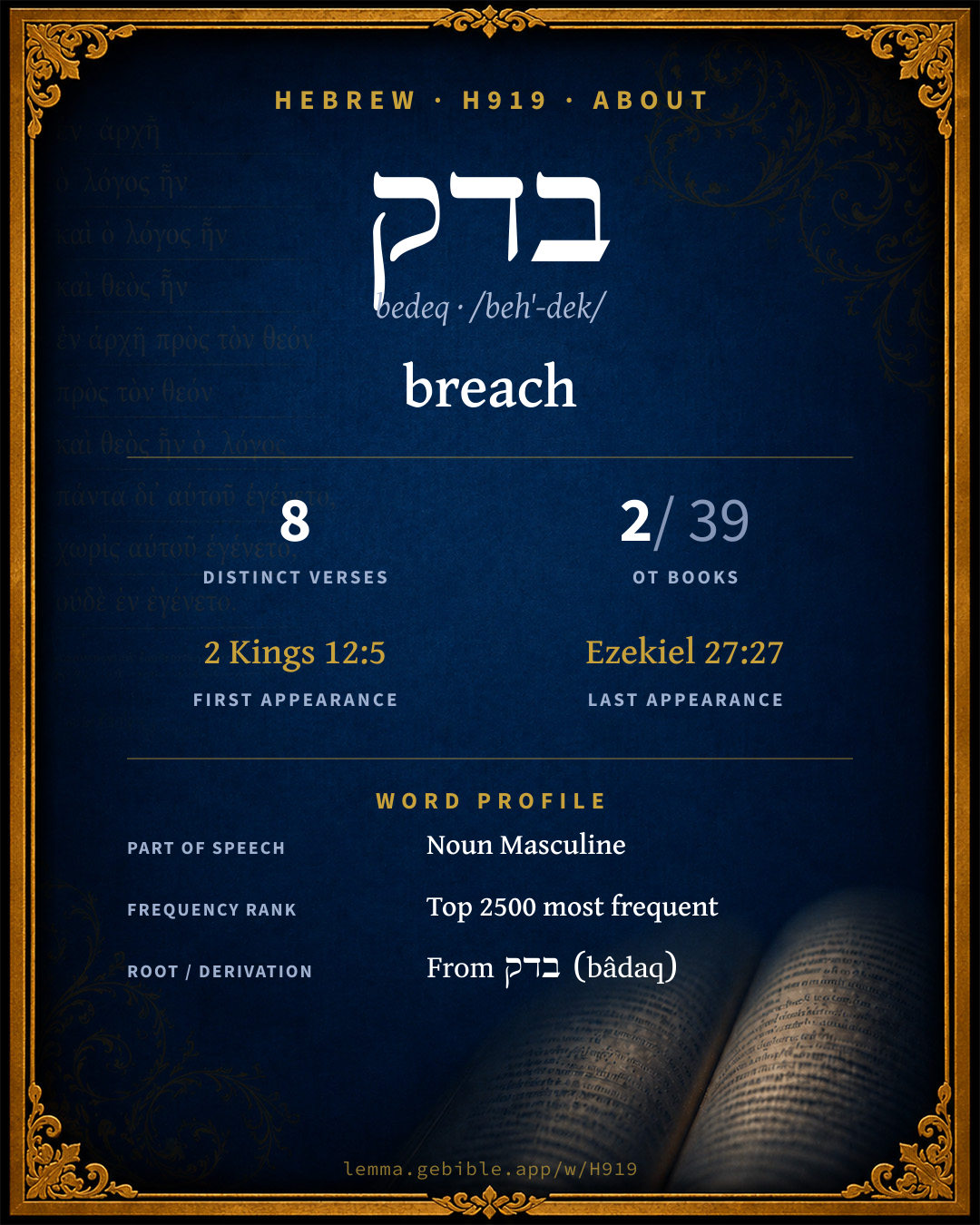
בֶּ֫דֶק
breach
Full lexicon entry — Brown-Driver-Briggs (BDB)
From Brown-Driver-Briggs (BDB)
Where this word appears
See every Construct-state word in the Hebrew Bible →
Grammar key — what these labels mean
Part of speech
- Noun
- A naming word — a person, place, thing, or idea.
Noun type
- Common
- A common noun — a general class of person, place, or thing (“king,” “city,” “water”), not a specific name.
State
- Construct
- A noun bound to a following noun in a possessive / “of” relationship (the construct chain).
- Absolute
- The independent form of a noun, not bound to a following word.
Gender
- Masculine
- Grammatically masculine.
Number
- Singular
- One.
8 distinct verses where H919 appears in the Construct state, across 2 books. Filtered view — show all forms. Click any verse to open its interlinear word-by-word view. Verse text shown in the World English Bible for context — . Each verse’s Hebrew form is shown with its reference; the English is not keyword-highlighted, since the data carries no word-level English alignment. Use “Compare translations” on any verse to read it across multiple English versions. This concordance covers the Hebrew Bible; Septuagint (Greek Old Testament) occurrences are not indexed here.
2 Kings 6 verses
- 2 Kings 12:5 בֶּ֣דֶק בָּֽדֶק n c ms cs n c ms let the priests take it to them, every man from his acquaintance; and they shall repair the breaches of the house, wherever any breach shall be found.
- 2 Kings 12:6 בֶּ֥דֶק n c ms cs But it was so, that in the three and twentieth year of king Jehoash the priests had not repaired the breaches of the house.
- 2 Kings 12:7 בֶּ֣דֶק לְ/בֶ֥דֶק n c ms cs prep + n c ms cs Then king Jehoash called for Jehoiada the priest, and for the [other] priests, and said to them, Why don't you repair the breaches of the house? now therefore take no [more] money from your acquaintance, but deliver it for the breaches of the house.
- 2 Kings 12:8 בֶּ֥דֶק n c ms cs The priests consented that they should take no [more] money from the people, neither repair the breaches of the house.
- 2 Kings 12:12 בֶּ֣דֶק n c ms cs and to the masons and the stone cutters, and for buying timber and hewn stone to repair the breaches of the house of Yahweh, and for all that was laid out for the house to repair it.
- 2 Kings 22:5 בֶּ֥דֶק n c ms cs and let them deliver it into the hand of the workmen who have the oversight of the house of Yahweh; and let them give it to the workmen who are in the house of Yahweh, to repair the breaches of the house,
Ezekiel 2 verses
- Ezekiel 27:9 בִּדְקֵ֑/ךְ n c ms cs + sfx pers 2fs The old men of Gebal and the wise men of it were in you your repairers of ship seams: all the ships of the sea with their mariners were in you to deal in your merchandise.
- Ezekiel 27:27 בִדְקֵ֣/ך n c ms cs + sfx pers 2fs Your riches, and your wares, your merchandise, your mariners, and your pilots, your repairers of ship seams, and the dealers in your merchandise, and all your men of war, who are in you, with all your company which is in the midst of you, shall fall into the heart of the seas in the day of your ruin.
About this entry
At a glance — auto-summarized from this page’s data, not written by a person. Every figure links to its source below. This summary describes the numbers; it doesn’t interpret them.
בדק — transliterated bedeq — is a Hebrew noun carrying the sense “breach.” Its uses cluster heavily in 2 Kings (75% of all occurrences). With 8 verses in 2 books, it is an uncommon word in the Hebrew Bible. Debuting at 2 Kings 12:5, it then recurs through the corpus. The King James Version usually renders it “breaches,” while modern versions prefer “damage of” (unfoldingWord Literal Text) — see the renderings breakdown. Each statement above links to its evidence; the full detail follows below.
Gloss history
Strong's 1890 vs modern scholarship
About this word
Strong's H919 catalogs a Hebrew word from the Hebrew Old Testament.
These counts are not copied from any lexicon or concordance. They are computed here, from the morphology-tagged Hebrew Old Testament. What Lemma adds →
- 8
- distinct verses
- The word appears in 8 distinct verses.
- 2 / 39
- OT books
- The word appears in 2 of 39 Old Testament books.
- #2,342
- by frequency
- Top 2500 most frequent Hebrew words (rank 2,342 of 8,640 Hebrew words by occurrence).
View all 8 occurrences in the concordance →
By traditional corpus
Conventional, traditional groupings — biblical authorship is debated, so this is a traditional corpus grouping, not an authorship claim. Each share is this word’s portion of its verses in that division of the Hebrew canon. Each figure is a share of the word’s 8 distinct verses.
- Prophets (Nevi'im) 8 verses · 100%
How translations render this word
Counts come from each version’s own published word-to-Strong’s tagging or interlinear alignment — an approximate guide to how each version renders this word, not a word-level alignment the data otherwise carries. Because each total is that version’s own tagged count, the per-version totals vary from one another and need not match the appearance or distinct-verse counts above. These counts may also differ from a printed concordance because Lemma counts each distinctly tagged rendering and does not collapse phrase taggings into a single head-word total. This is a fixed set of word-tagged versions (KJV, ASV, BSB, ULT) and does not change with the reading translation you choose elsewhere. Each version’s license is shown beside its name below (and on Sources).
- King James Version: Breaches 6×
- American Standard Version: Breaches 6×
- Berean Standard Bible: Damage 3×
- unfoldingWord Literal Text: Damage of 6×, Damage 2×
King James Version Public Domain
Renders H919 across 10 tagged occurrences — most commonly:
Plus 4 renderings that appear only once — usually multi-word phrases or single function words the recovered tagging swept in, not distinct renderings.
American Standard Version Public Domain
Renders H919 across 10 tagged occurrences — most commonly:
Plus 4 renderings that appear only once — usually multi-word phrases or single function words the recovered tagging swept in, not distinct renderings.
Berean Standard Bible Public Domain
Renders H919 across 7 tagged occurrences — most commonly:
Plus 4 renderings that appear only once — usually multi-word phrases or single function words the recovered tagging swept in, not distinct renderings. Not rendered by a distinct English word in 2 further occurrences.
unfoldingWord Literal Text CC BY-SA 4.0
Renders H919 across 10 tagged occurrences — most commonly:
Plus 2 renderings that appear only once — usually multi-word phrases or single function words the recovered tagging swept in, not distinct renderings.
Senses in BDB
The 1 sense BDB distinguishes for this word, in lexicon order (not ranked by frequency or importance). The full entry — with sub-senses — is in the Lexicon Entry tab.
- fissure, rent, breach, leak (in a building)
Word origin
n.m. 2 K 12:6 fissure, rent, breach (Aramaic בִּידְקָא, ܒܶܕܩܳܐ (Nasar.))—בּ׳ abs. 2 K 12:6; cstr. ib. + 6 times; sf. בִּדְקֵךְ Ez 27:9, 27;—in as building; temple ב׳ הַבַּיִת 2 K 12:6, 7, 8(×2), 9; 22:5, cf. 12:13 (ב׳ בֵּית י׳); v 6 abs.; law. c. חִזֵּק repair; cf. מַחֲזִיקֵי ב׳ repairers of thy fissures Ez 27:9, 27 (of Tyre).
— Brown-Driver-Briggs (Oxford 1906, public domain), digitized via Sefaria, supplemented by the OpenScriptures HebrewLexicon (CC BY 4.0). See Sources.
Derived from בדק (bâdaq) (H918) — to mend.
Jastrow Dictionary
A second Hebrew/Aramaic lexicon for comparison, covering Aramaic and post-biblical (Talmudic, Targumic, Midrashic) usage that the biblical-Hebrew BDB does not. Matched by lemma rather than by Strong’s number, so a lemma may carry more than one Jastrow headword (shown separately below), and the entries cover usage well beyond the Bible.
בָּדַק
- , v. בדד) to split, break into, penetrate. Keth. XIII, 9 הנוה היפה בּוֹדֵק the removal to a better residence (and style of living) penetrates (the body and creates disease); v. ib. 110ᵇ מאי ב׳ כדשמואל וכ׳ what does bodek mean? Answ. As it is expressed by Samuel …, a change of the mode of living (v. וֶסֶת) is the beginning of abdominal disease.—Esp.
- 1. to search, examine, investigate, try. Sot. V, 1 as well as the water בּוֹדְקִין אותה וכ׳ tries her (eventually makes her sick), so does it try him (the adulterer). Pes. I, 1 ב׳ את החמץ leavened bread is searched after (for the sake of removing it). Ib. 9ᵇ (בית) בָּדוּק a house which has been searched. Snh. III, 6 ב׳ את העדים the witnesses are cross-examined. Ib. IV, 5; v. דְּרִישָׁה. Sabb. 139ᵃ וכ׳ בְּדוֹק בדיינו investigate the doings of the Israelitish judges. Keth. VII, 8 הוא בּוֹדְקָהּ וכ׳ he has her examined (as to bodily soundness) by his female relatives. Ib. 75ᵇ חזקה אין … אא"כ בּוֹדְקוֹ the presumption is that nobody will drink out of a cup, unless he has examined it (will not marry a woman before ascertaining her physical condition). Kidd. IV, 4 צריך לבְדוֹק אחריה וכ׳ must investigate her family records up to four mothers &c. Ib. 5 אין בודקין מן וכ׳ no family records are searched beyond the altar, i.e. the ascertained fact of a person’s admission to priestly services is sufficient evidence of unblemished descent for marriage purposes. Nidd. 30ᵇ ובדקן ומצאן (read ובדקו ומצאו) they (the scholars) examined (made a post mortem examination); Tosef. ib. IV, 17; Bekh. 45ᵃ; a. fr.
- 2. to tend, cure (plants), esp. to cover with earth or manure. Tosef. Shebi. I, 12; Y. ib. IV, 35ᵇ bot.
- to be examined &c. Y. Gitt. I, 43ᵇ; IX, end, 50ᵈ נ׳ השם the report was traced. Nidd. V, 6 נדריה נִבְדָּקִין her vows are subject to examination (to find out whether she knows the import of a vow); a. fr.
בְּדַק
- 1. to split, burst, break into. Ḥull. 105ᵃ חזא צינורא דבדקא וכ׳ (Ar. דבידקא) he saw that a sewer had burst into his field (inundating it); v. בִּדְקָא.
- 2. to examine, espy; to test. Targ. Judg. XVIII, 2; a. fr.—Yeb. 65ᵃ אִיבְדוֹק נפשאי I will test myself (as to my virility). Y. Ned. II, 37ᵇ bot. בעי חיפה מִיבְדְּקוּנֵיה Ḥefa wanted to sound his knowledge. Taan. 21ᵇ; a. fr. e.g. Judges 18:2
- 3. to cure the body by means of a purgative. Ned. 50ᵇ הוה בָּדִיק נפשיה וכ׳ purged himself with &c.; a. e.—Part. pass. בְּדִיק tested, sure, known. Y. Sot. V, 20ᶜ bot. לא הוות בדיקה לי was unknown to me (I had not experienced). Taan. 23ᵇ לא בדיקתו לי (not בדקיתו) ye are unknown to me (as to your honesty).—בְּדִיקְנָא I am sure, I know. Pes. 111ᵇ בדיקנא ביה במר דלא וכ׳ I am sure you do not know (Ms. M. ב׳ ליה וכ׳, Ms. 2 Oxf. בקינא, v. Rabb. D. S. a. l. note). *Ḥull. 32ᵃ לא הוה בדיקנא ביה וכ׳ Ar. Var. (ed. בדיחנא) I was not so familiar with my uncle that I should have asked him.
- to discover (by sorcery), to find out secrets. Targ. O. Gen. XLIV, 5; 15. Cmp. בְּדִיקְנָאָה.
בֶּדֶק
- preced.)
- 1. breach, defect.
- 2. attendance, repair. ב׳ הבית (II Kings XII, 8) keeping the Temple in repair. Y. Pes. VIII, 36ᵃ top. Tem. I, 6 קדשי ב׳ הב׳ (Mish. קרבנות) offerings for the Temple repair, opp. to קדשי מזבח objects dedicated for sacrifices. Ibid. VII, 1; a. fr.—Pl. בְּדָקִים, constr. בִּדְקֵי. Sabb. 32ᵃ ב׳ מיתה breaches through which death enters, i.e. sins for which one is visited with death; v. דֶּבֶק. e.g. 2 Kings 12:8
*בֶּדֶק
- , defect, sin. Targ. Y. II, Num. V, 19 these waters searching לב׳ האילין the defect. [Probably a corrupt reading.]
A Dictionary of the Targumim, the Talmud Babli and Yerushalmi, and the Midrashic Literature (Marcus Jastrow; London, Luzac, 1903) — Public Domain. Digitized via Sefaria. Digitized via Sefaria. Full attribution on Sources.
Forms in the corpus
The 6 distinct written forms H919 takes in the Hebrew Bible, most frequent first — each parse links to that state’s occurrences in the concordance. Hebrew forms include their vowel points and cantillation, so a single lemma takes many written forms.
| Form | Parsing | Example | Uses |
|---|---|---|---|
| בֶּ֣דֶק | Noun, Common, Masculine, Singular, Construct | 2 Kings 12:5 | 3 |
| בֶּ֥דֶק | Noun, Common, Masculine, Singular, Construct | 2 Kings 12:6 | 3 |
| בִדְקֵ֣/ך | Noun, Common, Masculine, Singular, Construct | Ezekiel 27:27 | 1 |
| בִּדְקֵ֑/ךְ | Noun, Common, Masculine, Singular, Construct | Ezekiel 27:9 | 1 |
| בָּֽדֶק | Noun, Common, Masculine, Singular, Absolute | 2 Kings 12:5 | 1 |
| לְ/בֶ֥דֶק | Noun, Common, Masculine, Singular, Construct | 2 Kings 12:7 | 1 |
Septuagint verse parallels
This word appears in 8 verses that also exist in the Greek Old Testament (Septuagint), out of the 8 Hebrew verses it occurs in. You can read those verses in Greek by switching the Old Testament edition to the Septuagint.
Read these verses in the Septuagint
This is a verse-level parallel only — the same verses exist in both the Hebrew and Greek Old Testaments. No word-level Hebrew↔Greek correspondence is claimed: the data carries no such alignment, so no Greek word is shown as this Hebrew word’s translation. Coverage is not total — the Septuagint omits the deuterocanon and renumbers the Psalms, so some Hebrew verses have no direct Greek parallel.