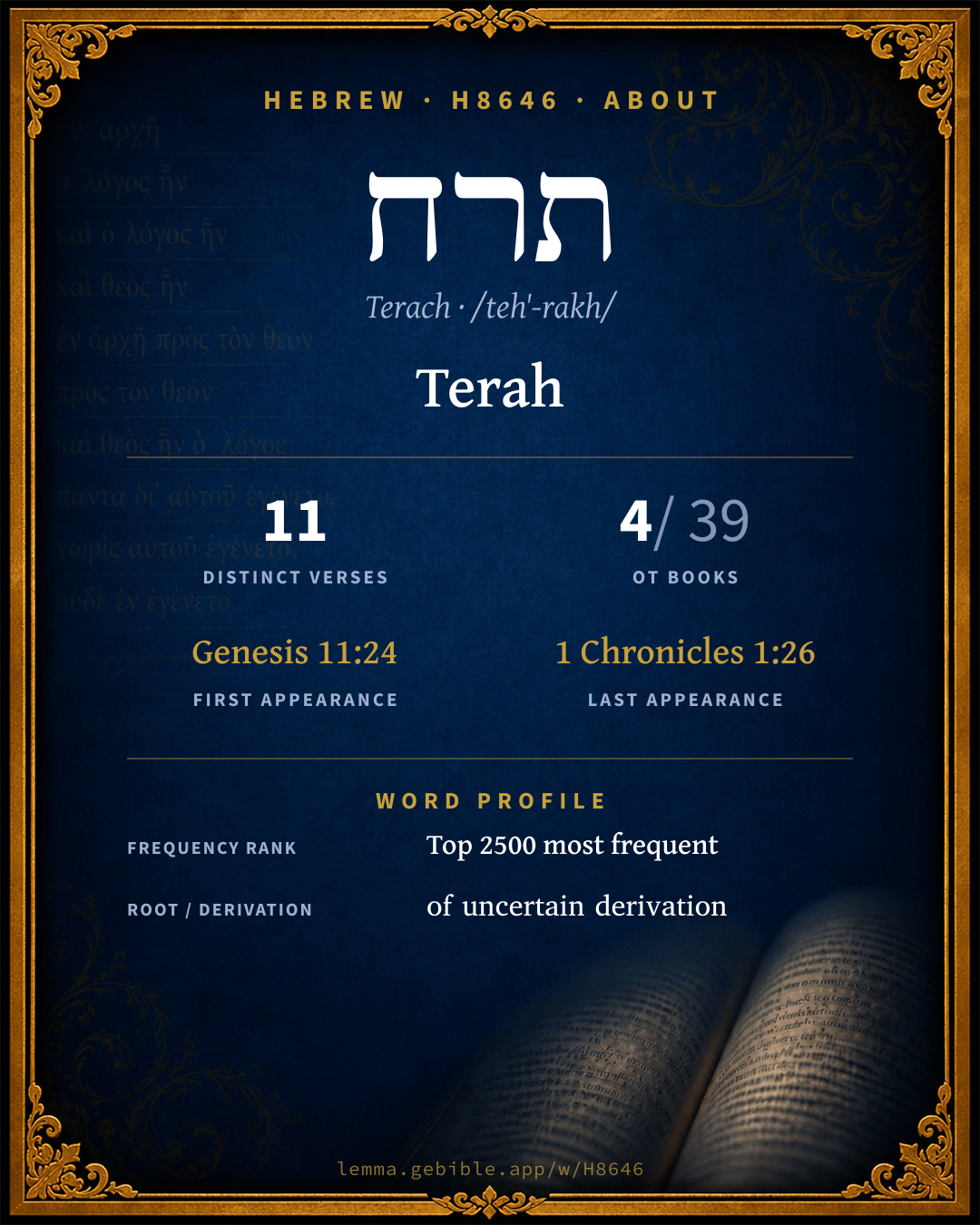
תֶּ֫רַח
Terah
BDB lists 3 entries for ‘Terah’ fuller range ↓
Full lexicon entry — Brown-Driver-Briggs (BDB)
From Brown-Driver-Briggs (BDB)
Where this word appears
Grammar key — what these labels mean
Part of speech
- Noun
- A naming word — a person, place, thing, or idea.
Noun type
- Proper
- A name of a specific person, place, or people (e.g. Abraham, Zion, Israel).
Every verse where H8646 appears in the Book of 1 Chronicles — 1 distinct verse. Click any verse to open its interlinear word-by-word view. Verse text shown in the World English Bible for context — . Each verse’s Hebrew form is shown with its reference; the English is not keyword-highlighted, since the data carries no word-level English alignment. Use “Compare translations” on any verse to read it across multiple English versions. This concordance covers the Hebrew Bible; Septuagint (Greek Old Testament) occurrences are not indexed here.
1 Chronicles
About this entry
At a glance — auto-summarized from this page’s data, not written by a person. Every figure links to its source below. This summary describes the numbers; it doesn’t interpret them.
At its core, תרח (Terach) means “Terah.” The word gravitates to Genesis (64%), then Numbers and Joshua. It turns up in 11 verses across 4 books, an uncommon footprint. Scripture first uses it in Genesis 11:24. Dig into 11-verse concordance and the renderings breakdown below.
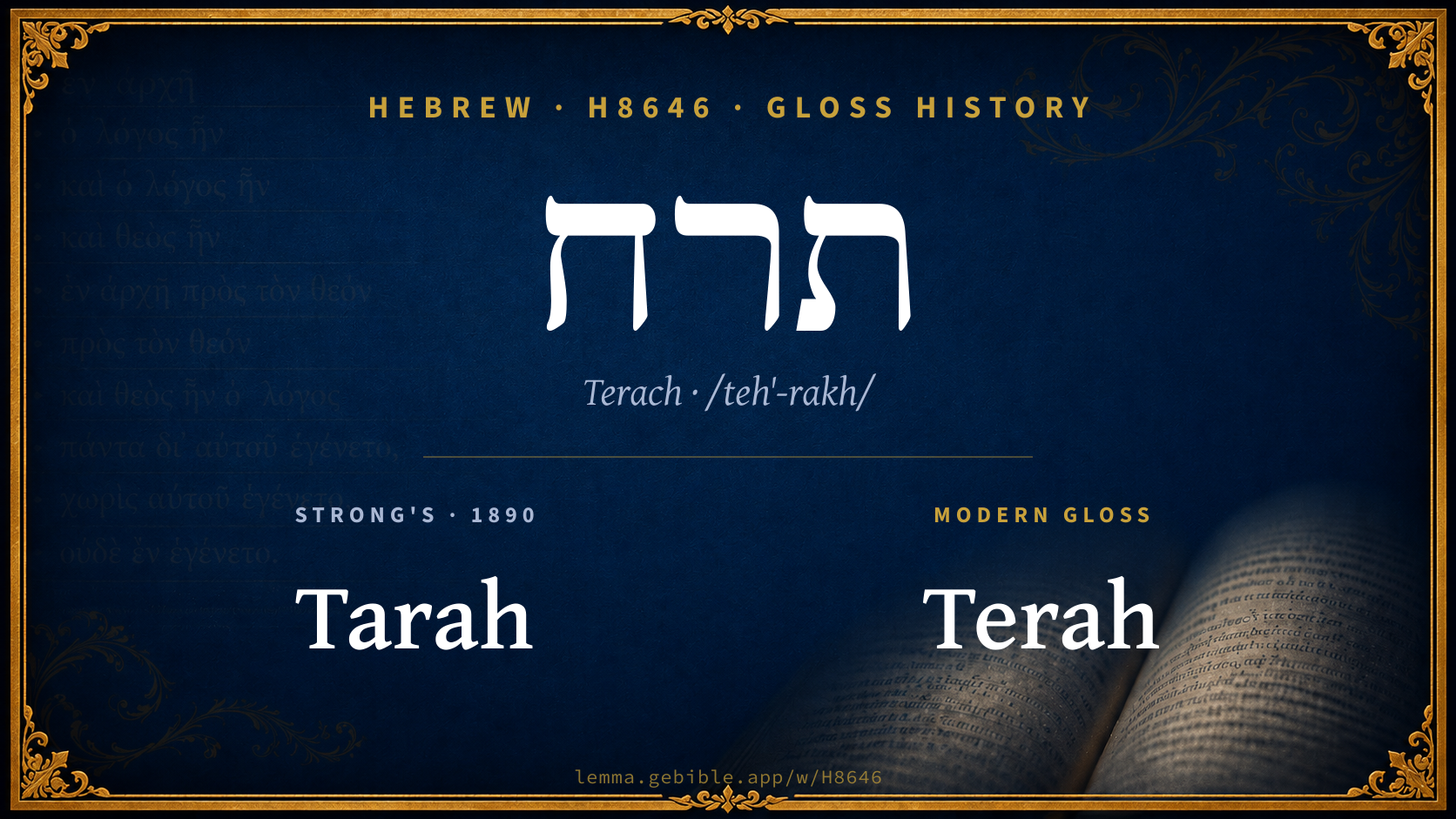
Gloss history
Strong's 1890 vs modern scholarship
About this word
Strong's H8646 catalogs a Hebrew word from the Hebrew Old Testament.
These counts are not copied from any lexicon or concordance. They are computed here, from the morphology-tagged Hebrew Old Testament. What Lemma adds →
- 11
- distinct verses
- The word appears in 11 distinct verses.
- 4 / 39
- OT books
- The word appears in 4 of 39 Old Testament books.
- #2,001
- by frequency
- Top 2500 most frequent Hebrew words (rank 2,001 of 8,640 Hebrew words by occurrence).
View all 11 occurrences in the concordance →
By section of the Old Testament
By traditional corpus
Conventional, traditional groupings — biblical authorship is debated, so this is a traditional corpus grouping, not an authorship claim. Each share is this word’s portion of its verses in that division of the Hebrew canon. Each figure is a share of the word’s 11 distinct verses.
- Torah (Pentateuch) 9 verses · 82%
- Prophets (Nevi'im) 1 verse · 9%
- Writings (Ketuvim) 1 verse · 9%
How translations render this word
Counts come from each version’s own published word-to-Strong’s tagging or interlinear alignment — an approximate guide to how each version renders this word, not a word-level alignment the data otherwise carries. Because each total is that version’s own tagged count, the per-version totals vary from one another and need not match the appearance or distinct-verse counts above. These counts may also differ from a printed concordance because Lemma counts each distinctly tagged rendering and does not collapse phrase taggings into a single head-word total. This is a fixed set of word-tagged versions (KJV, ASV, BSB, ULT) and does not change with the reading translation you choose elsewhere. Each version’s license is shown beside its name below (and on Sources).
- King James Version: Terah 11×, Tarah 2×
- American Standard Version: Terah 13×
- Berean Standard Bible: Terah 10×
- unfoldingWord Literal Text: Terah 13×
King James Version Public Domain
Renders H8646 across 13 tagged occurrences — most commonly:
American Standard Version Public Domain
Renders H8646 across 13 tagged occurrences — most commonly:
Berean Standard Bible Public Domain
Renders H8646 across 12 tagged occurrences — most commonly:
Plus 2 renderings that appear only once — usually multi-word phrases or single function words the recovered tagging swept in, not distinct renderings. Not rendered by a distinct English word in 1 further occurrence.
unfoldingWord Literal Text CC BY-SA 4.0
Renders H8646 across 13 tagged occurrences — most commonly:
Senses in the full BDB
What do BDB’s symbols mean?
BDB uses these scholarly abbreviations:
| Symbol | Meaning |
|---|---|
| 𝔊 | the Septuagint (the ancient Greek translation, LXX) |
| 𝔙 | the Vulgate (the Latin translation) |
| 𝔖 | the Syriac version (the Peshitta) |
| 𝔗 | the Targum (the Aramaic translation) |
| ψ | the Psalms |
| √ | root (the underlying root or stem) |
| ‖ | parallel passage (a synonymous or contrasted parallel) |
| † | the dagger: every passage where the word occurs is cited |
The 2 senses and sub-senses the full Brown-Driver-Briggs lexicon distinguishes for this word, in lexicon order (not ranked by frequency), with BDB’s own verbatim wording and sub-sense lettering. Shown in Hebrew script with BDB’s own scholarly abbreviations. The condensed entry is in the Lexicon Entry tab. See also the Forms in the corpus table below.
- 1. m. father of Abraham: (a king of ibex RSK (1st ed.) 220 (the deriv. was withdrawn afterwards by RS himself, v. RSK (2nd ed.) vii). (cf.Assyrian turâḫu, Arabic تَأْرُخٌ NöZMG xxxiii (1879), 331, Syriac ܬܰܪܽܘܚܳܐ capra caucasica), against which NöZMG xl 167;* n.pr. div. JenZA vi. 70);—ת׳ Gn 11:25, 26, 27(×2), 28, 31, 32(×2) Jos 24:2; תָּ֑רַח Gn 11:24; 1 Ch 1:26; Θαρρα, 𝔊L Θαρα.—Vid. SelbieHast. DB Terah. e.g. Genesis 11:25
- 2. loc. station on Exodus journey Nu 33:27, 28; Ταραθ. e.g. Numbers 33:27
Senses from the full Brown-Driver-Briggs lexicon (Brown, Driver, Briggs; Oxford 1906 — public domain), digitized via Sefaria, supplemented by the OpenScriptures HebrewLexicon (CC BY 4.0). Full attribution on Sources.
Word origin
Origin: of uncertain derivation
Jastrow Dictionary
A second Hebrew/Aramaic lexicon for comparison, covering Aramaic and post-biblical (Talmudic, Targumic, Midrashic) usage that the biblical-Hebrew BDB does not. Matched by lemma rather than by Strong’s number, so a lemma may carry more than one Jastrow headword (shown separately below), and the entries cover usage well beyond the Bible.
תְּרַח
- , Ithpe. אִיתְרַח (denom. of רוח) [to breathe,] to rest, wait. Targ. Y. Deut. I, 6 (v., however, אֲרַח).—Sabb. 134ᵃ לִיתְרְחוּ ליה וכ׳ (Ms. M. לישתהי; Ar. לִיתְרְהוּ) let them wait with his circumcision, until the blood withdraws from the surface. Ib. 136ᵃ אי אִיתְרְחִיתוּ ליה וכ׳ if you had waited until evening to kill it, we should have eaten of it. M. Kat. 28ᵃ אִיתְרַח לי וכ׳ (Ms. M. איתרך, v. Rabb. D. S. a. l. note) give me thirty days’ time. Arakh. 9ᵃ קא מִתְרְהָא סיהרא וכ׳ Ar. (Var. מתאחר) the new month would be delayed two (three) days; (ed. מייתרא the old month would gain &c.). Nidd. 30ᵇ אתרח ארבעין יומין וכ׳ Var. (read: אִתְרְחָא; ed. אייתרה) she may have waited forty days and then become pregnant; a. e.—B. Kam. 80ᵇ מאן נִתְרַח ניתרח וכ׳ (Rashi to Gitt. 68ᵇ מאן תרח ניתרח) who shall wait (in the antechamber)? shall Samuel wait, and Rab and R. Asi enter?; ונתרח רב או רב אסי but should Rab have waited or Rab Asi? [Ms. M. מאן טרח ניטרח וכ׳ who should be troubled? &c.]
- to cause to wait, keep back. Gitt. 68ᵇ תַּרֲחֵיה גביה וכ׳ (Ar. תַּרְהֲיֵיה Paeli) he kept him with him until &c.
- 1. to be liberal. Y. B. Mets. VI, beg. 10ᵈ לא דאנא … אלא אנא חייה מַתְרִיחַ לכון (ed. Krot. מתרית, corr. acc.) not that I am legally bound to give you your wages, but I, Ḥiya, am liberal towards you.
- 2. to allow time. Ab. Zar. 18ᵃ מַתְרַחְנָא מִתְרַח (not מרתח; Ms. M. מתרחנא only; v. Rabb. D. S. a. l. note) I will give you time (wait until you are well again); [prob. to be read: מַרְתַּחְנָא I am hot, v. רְתַה.]
A Dictionary of the Targumim, the Talmud Babli and Yerushalmi, and the Midrashic Literature (Marcus Jastrow; London, Luzac, 1903) — Public Domain. Digitized via Sefaria. Digitized via Sefaria. Full attribution on Sources.
Forms in the corpus
The 11 distinct written forms H8646 takes in the Hebrew Bible, most frequent first — each parse links to that state’s occurrences in the concordance. Hebrew forms include their vowel points and cantillation, so a single lemma takes many written forms.
| Form | Parsing | Example | Uses |
|---|---|---|---|
| תֶּ֔רַח | Noun, Proper | Genesis 11:25 | 2 |
| תָּֽרַח | Noun, Proper | Genesis 11:24 | 2 |
| בְּ/תָֽרַח | Noun, Proper | Numbers 33:27 | 1 |
| מִ/תָּ֑רַח | Noun, Proper | Numbers 33:28 | 1 |
| תֶ֔רַח | Noun, Proper | Genesis 11:32 | 1 |
| תֶ֖רַח | Noun, Proper | Genesis 11:26 | 1 |
| תֶּ֖רַח | Noun, Proper | Genesis 11:32 | 1 |
| תֶּ֚רַח | Noun, Proper | Genesis 11:27 | 1 |
| תֶּ֛רַח | Noun, Proper | Joshua 24:2 | 1 |
| תֶּ֜רַח | Noun, Proper | Genesis 11:31 | 1 |
| תֶּ֣רַח | Noun, Proper | Genesis 11:28 | 1 |
Same root — word family
Other BDB entries built from the same root as H8646, grouped by Strong’s listed origin. These share a root / origin per the lexicon — not necessarily a shared meaning. Each links to that word’s own entry.
Proper names from this root
People and places named from this root — a name, not an additional meaning of the word.
Compare all same-root words → 1 of the same-root words is a proper name (a person or place). They share a root, not necessarily a meaning.
Bible dictionary
Public-domain dictionary articles matched to this entry by name (Terah). A biblical name can be shared by more than one person or place, so an article may treat several.
Easton's Bible Dictionary · M. G. Easton, 1897
The wanderer; loiterer, for some unknown reason emigrated with his family from his native mountains in the north to the plains of Mesopotamia. He had three sons, Haran, Nahor, and Abraham, and one daughter, Sarah. He settled in "Ur of the Chaldees," where his son Haran died, leaving behind him his son Lot. Nahor settled at Haran, a place on the way to Ur. Terah afterwards migrated with Abraham (probably his youngest son) and Lot (his grandson), together with their families, from Ur, intending to go with them to Canaan; but he tarried at Haran, where he spent the remainder of his days, and died at the age of two hundred and five years (Gen. 11:24-32; Josh. 24:2). What a wonderful part the descendants of this Chaldean shepherd have played in the history of the world!
Smith's Bible Dictionary · William Smith, 1863
(station), the father of Abram, Nahor and Haran, and through them the ancestor of the great families of the Israelites, Ishmaelites, Midianites, Moabites and Ammonites. (Genesis 11:24-32) The account given of him in the Old Testament narrative is very brief. We learn from it simply that he was an idolater, (Joshua 24:2) that he dwelt beyond the Euphrates in Ur of the Chaldees, (Genesis 11:28) and that in the southwesterly migration, which from some unexplained cause he undertook in his old age, he went with his son Abram, his daughter-in-law Sarai, and his grandson Lot, "to go into the land of Canaan, and they came unto Haran, and dwelt there." (Genesis 11:31) And finally, "the days of Terah were two hundred and five years; and Terah died in Haran." (Genesis 11:32) (B.C. 1921.)
Hitchcock's Bible Names Dictionary · Roswell D. Hitchcock, 1869
to breathe; scent; blow
Classic public-domain reference works; full attribution on Sources.
Septuagint verse parallels
This word appears in 11 verses that also exist in the Greek Old Testament (Septuagint), out of the 11 Hebrew verses it occurs in. You can read those verses in Greek by switching the Old Testament edition to the Septuagint.
Read these verses in the Septuagint
This is a verse-level parallel only — the same verses exist in both the Hebrew and Greek Old Testaments. No word-level Hebrew↔Greek correspondence is claimed: the data carries no such alignment, so no Greek word is shown as this Hebrew word’s translation. Coverage is not total — the Septuagint omits the deuterocanon and renumbers the Psalms, so some Hebrew verses have no direct Greek parallel.