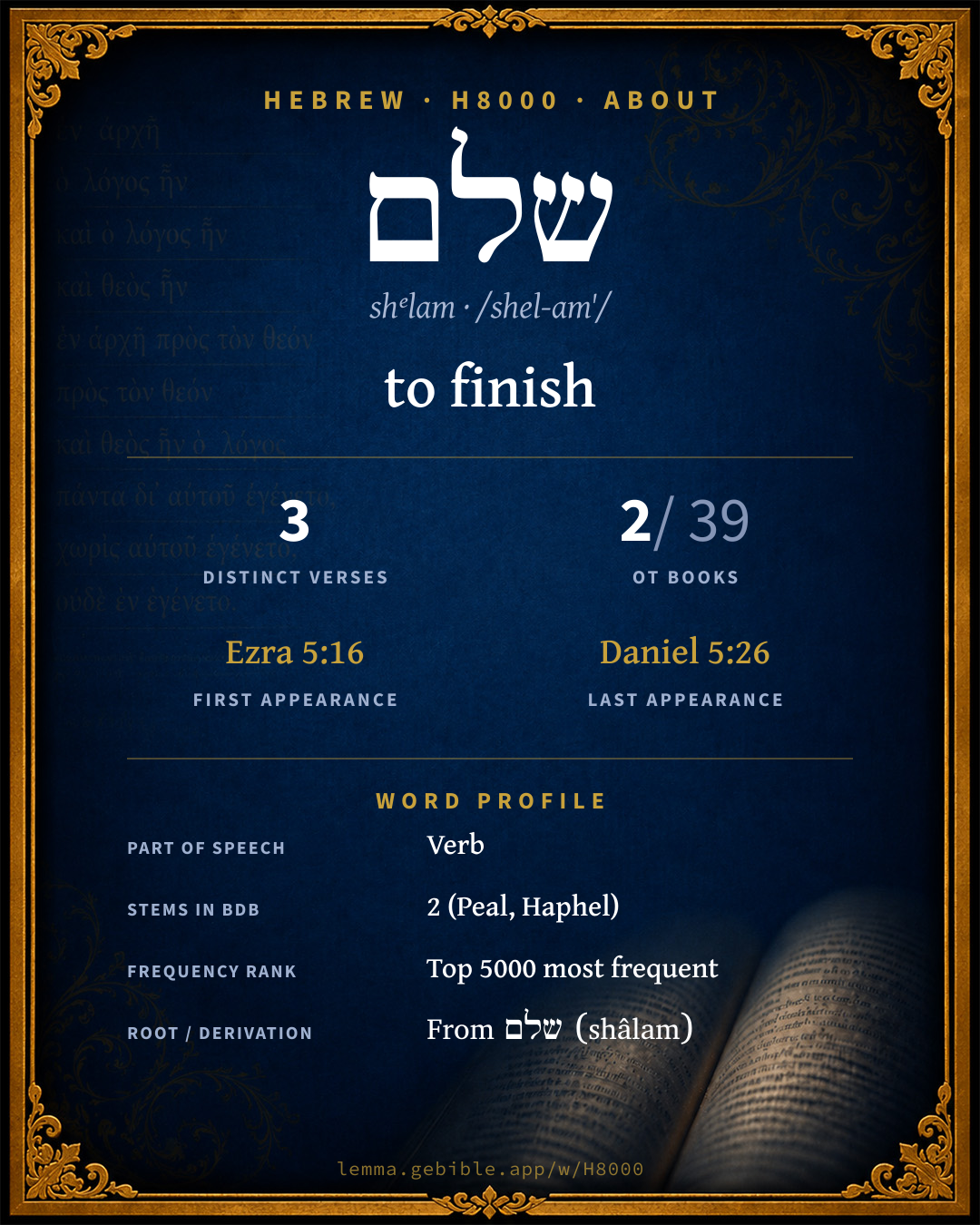
שְׁלֵם
to finish
‘to finish’ is one of 3 main senses fuller range ↓
Full lexicon entry — Brown-Driver-Briggs (BDB)
From Brown-Driver-Briggs (BDB)
Where this word appears
See every Hiphil verb in the Hebrew Bible →
Grammar key — what these labels mean
Part of speech
- Verb
- An action or state-of-being word.
Stem
- Hiphil
- The causative active stem (“he caused / brought about”).
- Qal Passive
- An archaic passive of the Qal, preserved in a few forms.
Form
- Perfect
- A completed action or state — Hebrew marks aspect (completeness) more than strict tense (“he wrote”).
- Participle Passive
- A verbal adjective expressing action received (“written”).
- Imperative
- A direct command (“write!”).
State
- Absolute
- The independent form of a noun, not bound to a following word.
Person
- 3rd Person
- The one spoken about (“he / she / it / they”).
- 2nd Person
- The one addressed (“you”).
Gender
- Masculine
- Grammatically masculine.
Number
- Singular
- One.
1 verse where H8000 appears in the Qal Passive stem in the Book of Ezra. Filtered view — show all forms. Click any verse to open its interlinear word-by-word view. Verse text shown in the World English Bible for context — . Each verse’s Hebrew form is shown with its reference; the English is not keyword-highlighted, since the data carries no word-level English alignment. Use “Compare translations” on any verse to read it across multiple English versions. This concordance covers the Hebrew Bible; Septuagint (Greek Old Testament) occurrences are not indexed here.
Ezra
About this entry
At a glance — auto-summarized from this page’s data, not written by a person. Every figure links to its source below. This summary describes the numbers; it doesn’t interpret them.
“to finish” is the headline sense of the Hebrew verb שלם (shᵉlam). A scarce word — 3 verses in all of the Hebrew Bible. More than two-thirds of its appearances fall in Ezra. Scripture first uses it in Ezra 5:16. As a verb its force shifts by stem, across 2 stems (Peal, Haphel, and more). The sections below give every sense, occurrence, and version rendering.
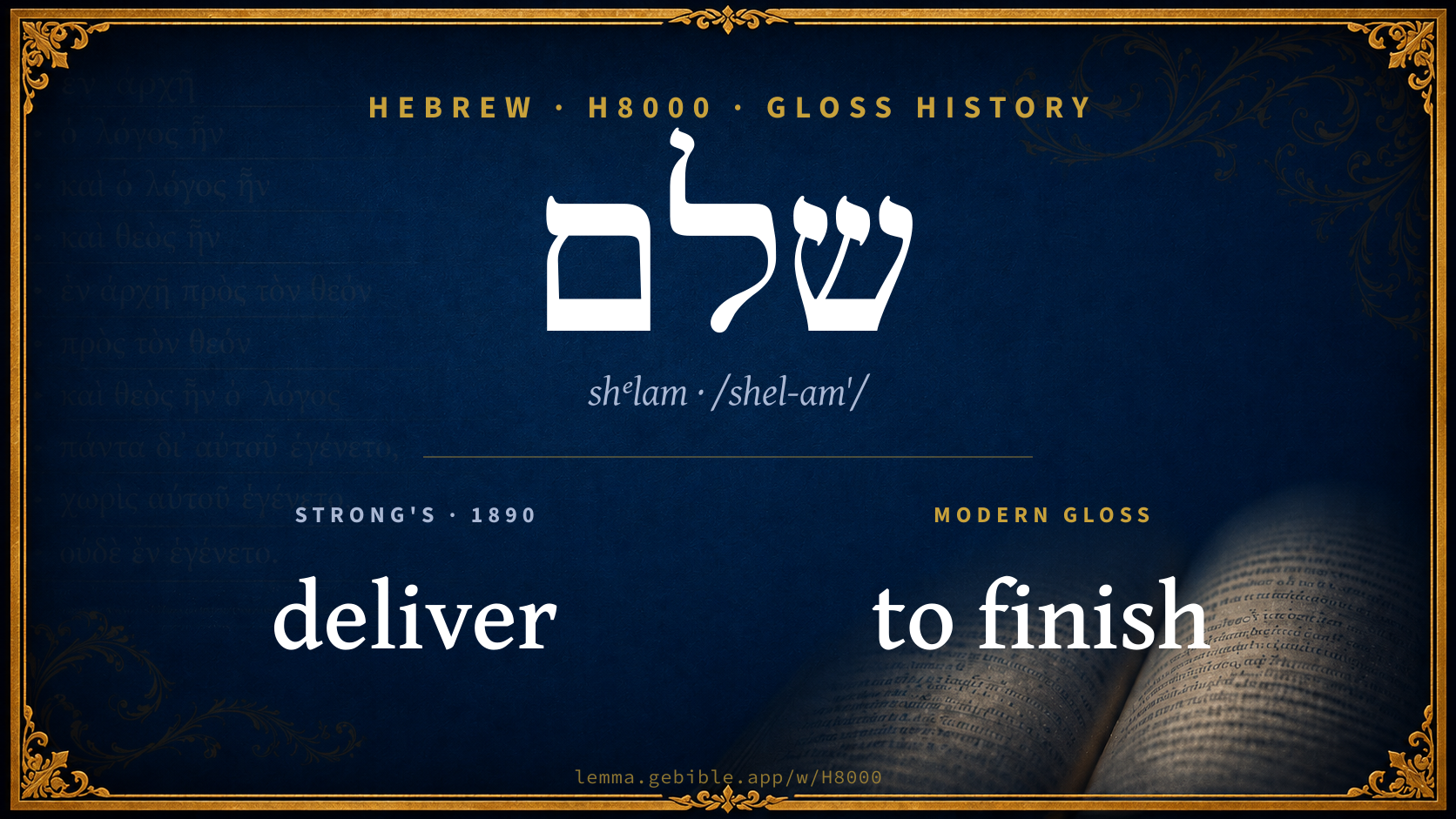
Gloss history
Strong's 1890 vs modern scholarship
About this word
Strong's H8000 catalogs a Hebrew word from the Hebrew Old Testament.
These counts are not copied from any lexicon or concordance. They are computed here, from the morphology-tagged Hebrew Old Testament. What Lemma adds →
- 3
- distinct verses
- The word appears in 3 distinct verses.
- 2 / 39
- OT books
- The word appears in 2 of 39 Old Testament books.
- #4,179
- by frequency
- Top 5000 most frequent Hebrew words (rank 4,179 of 8,640 Hebrew words by occurrence).
View all 3 occurrences in the concordance →
By traditional corpus
Conventional, traditional groupings — biblical authorship is debated, so this is a traditional corpus grouping, not an authorship claim. Each share is this word’s portion of its verses in that division of the Hebrew canon. Each figure is a share of the word’s 3 distinct verses.
- Writings (Ketuvim) 3 verses · 100%
How translations render this word
Counts come from each version’s own published word-to-Strong’s tagging or interlinear alignment — an approximate guide to how each version renders this word, not a word-level alignment the data otherwise carries. Because each total is that version’s own tagged count, the per-version totals vary from one another and need not match the appearance or distinct-verse counts above. These counts may also differ from a printed concordance because Lemma counts each distinctly tagged rendering and does not collapse phrase taggings into a single head-word total. This is a fixed set of word-tagged versions (KJV, ASV, BSB, ULT) and does not change with the reading translation you choose elsewhere. Each version’s license is shown beside its name below (and on Sources).
- King James Version: Finished 2×
- American Standard Version: Brought it to an end 1×, Completed 1×, Deliver 1×
- Berean Standard Bible: Been completed 1×, Brought it to an end 1×, You must deliver 1×
- unfoldingWord Literal Text: Brought it to an end 1×, Complete 1×, Deliver in full 1×
King James Version Public Domain
Renders H8000 across 3 tagged occurrences — most commonly:
Plus 1 rendering that appears only once — usually multi-word phrases or single function words the recovered tagging swept in, not distinct renderings.
American Standard Version Public Domain
Renders H8000 across 3 tagged occurrences — most commonly:
Berean Standard Bible Public Domain
Renders H8000 across 3 tagged occurrences — most commonly:
unfoldingWord Literal Text CC BY-SA 4.0
Renders H8000 across 4 tagged occurrences — most commonly:
Senses in the full BDB
Hebrew verbs can shift meaning by stem (binyan): Qal is the basic action, Niphal is often passive or reflexive, Piel often intensifies or makes it factitive, and Hiphil is typically causative. The senses below are grouped under the stem BDB assigns to each. This entry also uses Peal (the basic Aramaic stem, parallel to Qal) and Haphel (the causative Aramaic stem, parallel to Hiphil).
What do BDB’s symbols mean?
BDB uses these scholarly abbreviations:
| Symbol | Meaning |
|---|---|
| 𝔊 | the Septuagint (the ancient Greek translation, LXX) |
| 𝔙 | the Vulgate (the Latin translation) |
| 𝔖 | the Syriac version (the Peshitta) |
| 𝔗 | the Targum (the Aramaic translation) |
| ψ | the Psalms |
| √ | root (the underlying root or stem) |
| ‖ | parallel passage (a synonymous or contrasted parallel) |
| † | the dagger: every passage where the word occurs is cited |
The 2 senses and sub-senses the full Brown-Driver-Briggs lexicon distinguishes for this word, in lexicon order (not ranked by frequency), with BDB’s own verbatim wording and sub-sense lettering. Shown in Hebrew script with BDB’s own scholarly abbreviations. The condensed entry is in the Lexicon Entry tab. See also the Forms in the corpus table below.
Peal
- . finished, of temple
Haphel
- . God has finished it (the kingdom; brought it to an end)
Senses from the full Brown-Driver-Briggs lexicon (Brown, Driver, Briggs; Oxford 1906 — public domain), digitized via Sefaria, supplemented by the OpenScriptures HebrewLexicon (CC BY 4.0). Full attribution on Sources.
Word origin
[ שְׁלֵם ] vb. be complete
— Brown-Driver-Briggs (Oxford 1906, public domain), digitized via Sefaria, supplemented by the OpenScriptures HebrewLexicon (CC BY 4.0). See Sources.
Derived from שלם (shâlam) (H7999) — to be at peace.
Jastrow Dictionary
A second Hebrew/Aramaic lexicon for comparison, covering Aramaic and post-biblical (Talmudic, Targumic, Midrashic) usage that the biblical-Hebrew BDB does not. Matched by lemma rather than by Strong’s number, so a lemma may carry more than one Jastrow headword (shown separately below), and the entries cover usage well beyond the Bible.
שָׁלֵם
- (b. h.) to be whole, complete; to end, cease. Y. Sot. VIII, 22ᶜ bot. שלום שבימיו שָׁלְמָה וכ׳ Zedekiah was named Shallum, because in his days ended the reign of the house of Judah; Y. Shek. VI, 49ᵈ top; Y. Hor. III, 47ᶜ bot.; Bab. Hor. 11ᵇ; Ker. 5ᵇ ששלם (corr. acc.); Yalk. Kings 250; Yalk. Chr. 1085. Pesik. R. s. 6 (ref. to I Kings VII, 51) כיון שבא … עכשיו שלמה מלאכת וכ׳ when Solomon came and built the Temple, the Lord said, now the work of heaven and earth (creation) is complete; Yalk. Kings 186 שְׁלֵימָה. Pesik. R. l. c. כיון שהִשְׁלִימוּ … שלמה נפשם when the workmen had finished their work, their life was finished (they died); Yalk. l. c.; a. e. e.g. 1 Kings 7:51
- 1. to complete, finish. Pesik. R. l. c., v. supra. Y. R. Hash. I, 57ᵃ top; Y. Shebi. II, 34ᵃ top מכיון שהוא עומד … מַשְׁלִים שנתו since he stands in (has entered) the third year of the tree, he may count it a full year. Yoma 33ᵃ (ref. to Lev. VI, 5, play on עליה … השלמים) עליה הַשְׁלֵם כל וכ׳ with it (the evening sacrifice) cease all sacrifices (none can be offered after it). B. Kam. 10ᵃ החופר … והִשְׁלִימָהּ לעשרה if one digs a pit nine cubits deep, and another comes and completes it to the legal size of ten. Ber. 47ᵇ שחרר … והִשְׁלִימוֹ וכ׳ he freed his slave and used him to complete the quorum of ten persons. Ib. 8ᵇ המשלים פרשיותיו, v. פָּרָשָׁה I. Pesik. R. l. c. לכך נקרא שלמה שה׳ … לתוך מעשה ידיו he is called Sh’lomoh (perfect), because God caused the work of creation to be perfected through his handiwork (the Temple); Yalk. Kings l. c.; a. fr.—Esp. to finish the fast-day. Taan. VII, 9 יַשְׁלִימוּ they must fast the whole day. Yoma 82ᵃ מַשְׁלִימִין they must fast to the end of the day; a. fr.—Part. pass. מוּשְׁלָם perfect, virtuous. Hor. l. c. he was named Shallum שהיה מ׳ במעשיו Ag. Hatt. (ed. משולם) because he was perfect in his deeds; Yalk. Kings 250; Yalk. Chr. l. c. e.g. Leviticus 6:5
- 2. (denom. of שָׁלוֹם) to make friends, or to surrender. Succ. 52ᵃ (ref. to Prov. XXV, 22) א"ת יְשַׁלֵּם אלא יַשְׁלִימֶנּוּ לך read not y’shallem (he will pay) but, he will surrender him (the evil spirit) to thee; (comment.; he will make him be friends with thee).—Part. pass. as ab. Num. R. s. 74 אחד עשר יום היו מוּשְׁלָמִים לאלהים eleven days were they (the Israelites) at peace with God (adhered to him sincerely); כ"ט יום … מוּשְׁלָמִין twenty-nine days they were sincere servants of God, opp. עשו את העגל. Ib. אינם מושלמים לי וכ׳ (ed. Wil. משלמים, corr. acc.) they will be faithful to me only forty days. Gen. R. s. 16, beg. מ׳ לבוראו faithful to his Creator; a. e. e.g. Proverbs 25:22
- to be finished, to end. Tanḥ. Mishp. 19 המלאך אומר נ׳ פלוני the angel says, such and such has ended (must die).
- 1. to perfect.—Part. pass. מְשׁוּלָּם. Hor. l. c., v. supra. Yalk. Lev. 458 מְשׁוּלָּמִים, v. שָׁלוֹם.
- 2. to compensate, reward, pay. Pesik. R. l. c. (play on ותשלם, I Kings VII, 51) עלי לשַׁלֵּם להם מתן שכר it is for me to pay them their reward. Ib. עלי לשלם לו it is for me to compensate it (the month of Kislev) for its loss; ומה ש׳ לו וכ׳ and wherewith did he compensate it? With the dedication under the Hasmonean house. Y. Taan. II, 65ᵇ top (ref. to Mic. VII, 3) שַׁלֵּם לי וַאֲשַׁלֵּם לך (the judge says,) pay me, and I shall pay thee (decide in thy favor). B. Kam. I, 1 חב המזיק לשלם וכ׳ he that caused the damage is bound to pay &c. Ib. 4 משַׁלֵּם נזק שלם must pay the full indemnity. B. Mets. III, 1 ש׳ ולא רצה וכ׳ if he pays in preference to making oath. B. Bath. III, 4 מְשַׁלְּמִין לו את הכל they must pay him in full. Ab. II, 16 שׁיְשַׁלֵּם, v. שָׂכָר; a. v. fr. e.g. 1 Kings 7:51
שִׁלֵם
- 1. to be perfect, complete, finished, spent. Targ. Ex. XXXIX, 32. Targ. Gen. XLVII, 15 (Y. II חסיל). Targ. O. Ex. XXIII, 2 שְׁלַם (ed. Berl. שָׁלִים); a. v. fr.—M. Kat. 28ᵇ דשְׁלִימוּ וכ׳, v. זְוָדָא.
- 2. to be peaceful, sincere, friendly; v. שְׁלִים.
- 1. to complete, finish, fulfil. Targ. II Sam. XXII, 26; Targ. Ps. XVIII, 26. Targ. Job XXIII, 14 (ed. Wil. שַׁלְיֵם, corr. acc.). Targ. Y. II, Ex. XII, 42, v. שְׁלָה; a. fr.—Y. Snh. I, 19ᵃ top קם ר׳ נתן וא׳ R. N. stood up and completed the verse. Ber. 8ᵇ אַשְׁלִימוּ וכ׳ finish your readings, keeping pace with the congregation, v. פָּרָשָׁה I. Taan. 25ᵇ סבר לאַשְׁלוּמינְהוּ he wanted them to finish the fast; a. fr.
- 2. to fill, set. Targ. Ex. XXVIII, 17; XXXIX, 10 (h. text מלא). Ib. XXXI, 5.
- 3. to make peace, be at peace. Targ. Josh. X, 1; 4. Targ. II Sam. X, 9. Ib. XX, 18; a. e.
- 4. (with בתר) to follow exactly, faithfully. Targ. Num. XIV, 24 (h. text מלא). Targ. Deut. I, 36. Targ. I Kings XI, 6.
- 5. to surrender, hand over, entrust. Targ. Deut. XXXII, 30 (h. text הסגיר). Targ. Ex. XXXI, 3 אשל׳ עימיה וכ׳ I entrusted to him &c. (h. text ואמלא אותו); a. e.—B. Mets. 85ᵃ אַשְׁלְמֵיה לר׳ שמעון וכ׳ he gave him in charge of R. S. (to teach him). Yoma 83ᵇ אַשְׁלִימוּ ליה וכ׳ they gave him their money-bags in trust; a. e.
- 1. to complete; to supply. Targ. I Kings IX, 25.
- 2. (with בתר) to follow. Targ. O. Ex. XX, 5; Targ. Jer. XXXII, 18.
- 3. to recompense, pay. Ib. Targ. Ex. XXI, 34; 36. Targ. Job XX, 10; a. fr.—B. Kam. 13ᵇ בעית לשַׁלּוּמֵי את you would have to pay; בעינא לשלומי must I pay? Ib. 53ᵃ לִישַׁלֵּם האי פלגא וכ׳ let this one pay half, and the other one half; a. fr.
- 1. to be paid; to be rewarded, recompensed. Targ. Ps. LXV, 2. Targ. Prov. XIX, 17 Ms. (ed. מְשַׁלֵּם). Targ. Is. XLII, 19; a. e.—Pes. 28ᵃ מִשְׁתְּלִים, v. גִּירָאָה. B. Kam. l. c. כל היכא … לאִשְׁתַּלּוּמֵי מהאי מִשְׁתַּלֵּם מהאי where indemnity cannot be had from him (who dug the pit), it may be had from him (who owns the pit). Ib. מה דאית לי לאשתלומי מהאיך מִשְׁתַּלַּמְנָא … משתלמנא ממך whatever I can get from him I take; what I cannot get from him, I must get from you; a. fr.
- 2. to be perfect. Meg. 23ᵃ he was called Meshullam, דמִישְּׁלַם בעובדיה (Ms. M. דמוּשְׁלָם Hebraism) because he was perfect in his conduct, v. שָׁלַם; Yalk. Neh. 1070 דמִשְּׁלַם.
שָׁלֵם II
- preced.) whole, complete. Naz. 44 לאביו בזמן שהוא ש׳ וכ׳ ‘for his father’ (Lev. XXI, 2) as long as his body is intact (he may defile himself by contact), but not when it is defective. B. Kam. I, 4, a. fr. נזק ש׳ (abbrev. נ"ש), v. נֵזֶק. Gen. R. s. 79 (ref. to Gen. XXXIII, 18) ש׳ בגופו intact in his body; ש׳ בבניו intact in his children; ש׳ בממונו unimpaired in his possessions; ש׳ בתלמודו whole in his learning (having forgotten nothing of his paternal lessons). Sifra Vayikra, N’dabah, Par. 13, ch. XVI (play on שְׁלָמִים) מי שחוא ש׳ מביא שלמים היה אונן וכ׳ Ar. (ed. שָׁלוֹם) if he is whole (mourns over no loss), he may bring a peace-offering, if he is a mourner, he dare not. Ib. כל קרבן … היה ש׳ מביא וכ׳ whatever sacrifice he may offer, if he is whole, he may &c. Nidd. V, 3 כחתן ש׳, v. חָתָן; a. fr.—B. Kam. 116ᵇ נותן לו שכרו מִשָּׁ׳ he must pay him the full (promised) reward, opp. אין לו אלא שכרו he can claim only the ordinary wages for his labor.—Pl. שְׁלֵמִים, שְׁלֵמִין, שְׁלֵי׳. Sifra l. c. Ber. 39ᵇ פתיתין וש׳ broken pieces of bread and whole loaves. Sabb. 98ᵇ ש׳ solid boards, opp. דנִיסְרָא; a. fr.—Fem. שְׁלֵמָה, שְׁלֵי׳. Zeb. 5ᵃ משנה ש׳ a perfect (undisputed) Mishnah. Ber. l. c. פרוסה של חיטין וש׳ וכ׳ if there is before you a piece of wheat bread, and a whole loaf of barley bread. Ib. מניח … בתוך הש׳ he places the broken with the whole loaf. Ib. וש׳ משנתך (Ms. M. ושלום) and what thou teachest is perfect. Tosef. ib. IV, 15. Men. 65ᵇ ולא תהא תורה ש׳ שלנו וכ׳ should not our perfect Torah pass for as much as your idle talk?; a. fr.—[Y. Pes. II, 29ᵇ bot. מצה שלמה, v. שְׁלֹמֹה.]—Pl. שְׁלֵמוֹת, שְׁלֵי׳. Treat. S’maḥoth ch. VIII, end (ref. to Deut. XXVII, 6) ומה אבנים … יהיו ש׳ לפני בני תורה … יהיו שלימים לפני הקב"ה וכ׳ of stones (for the altar) which do not see …, because they make peace between Israel and their father in heaven, the Lord says, they must be whole before me, how much more must scholars, I who are an atonement for the world, be whole before the Lord!; a. e. e.g. Leviticus 21:2
שְׁלָם
- = h. שָׁלוֹם, perfection, soundness, health, peace. Targ. Ps. XXXVIII, 4. Targ. Gen. XLIII, 23. Ib. 27. Targ. Jud. XI, 13. Targ. Deut. XX, 10 (Y. ed. Vien. לְשׁלֵּם, corr. acc.). Ib. 11 (Y. I דִּשְׁלֵם, corr. acc.; a. fr.).—Taan. 24ᵇ they called to me in my dream, ש׳ טב לרב טב וכ׳ good health to the good teacher from the good Lord &c. Ib. 9ᵇ ליזלו רבנן בש׳ may our teachers (you) go in peace. Yoma 71ᵇ, v. עֲמַם II; a. v. fr.—שאל בש׳ to inquire after the health of; to salute. Targ. Gen. XLIII, 27; a. fr. (v. also סְעַר I).—Y. Ber. II, 4ᵇ, a. e. לא שאיל בשְׁלָמֵיה, v. זְעֵיר II; ib. דלא שאל בשְׁלָמִי he did not salute me. Ber. 9ᵇ כי … שאיל בשְׁלוֹמֵיה וכ׳ when you go up there (to Palestine), greet my brother &c.; a. fr.—יהב ש׳ to offer peace, salute. Taan. 23ᵃ sq. יהבו ליה ש׳ ולא וכ׳ they saluted him, but he did not look at them in a friendly way (give no sign of recognition). Ib.ᵇ מ"ט כי יהיבנא למר ש׳ וכ׳ when we saluted you, why did you make no recognition? Gitt. 62ᵃ מקדים ויהיב להו ש׳ saluted them (gentiles) first; a. fr.—V. בִּשְׁלָמָא.
שָׁלֵם ²
- ; pl. שַׁלְמִין; שַׁלְמַן, v. שְׁלִים.
A Dictionary of the Targumim, the Talmud Babli and Yerushalmi, and the Midrashic Literature (Marcus Jastrow; London, Luzac, 1903) — Public Domain. Digitized via Sefaria. Digitized via Sefaria. Full attribution on Sources.
Forms in the corpus
The 3 distinct written forms H8000 takes in the Hebrew Bible, most frequent first — each parse links to that stem’s occurrences in the concordance. Hebrew forms include their vowel points and cantillation, so a single lemma takes many written forms.
| Form | Parsing | Example | Uses |
|---|---|---|---|
| הַשְׁלֵ֕ם | Verb, Hiphil, Imperative, 2nd Person, Masculine, Singular | Ezra 7:19 | 1 |
| וְ/הַשְׁלְמַֽ/הּ | Verb, Hiphil, Perfect, 3rd Person, Masculine, Singular | Daniel 5:26 | 1 |
| שְׁלִֽם | Verb, Qal Passive, Participle Passive, Masculine, Singular, Absolute | Ezra 5:16 | 1 |
Same root — word family
Other BDB entries built from the same root as H8000, grouped by Strong’s listed origin. These share a root / origin per the lexicon — not necessarily a shared meaning. Each links to that word’s own entry.
Derives from
Shares the same root
- שלום shâlôwm H7965 peace
- שלום shillûwm H7966 reward
- שלם shelem H8002 peace offering
- שלם shâlêm H8003 complete
- שלם shillêm H8005 recompense
- שלמן shalmôn H8021 reward
Proper names from this root
People and places named from this root — a name, not an additional meaning of the word.
- משלם Mᵉshullâm H4918 Meshullam
- משלמות Mᵉshillêmôwth H4919 Meshillemoth
- משלמיה Mᵉshelemyâh H4920 Meshelemiah
- משלמית Mᵉshillêmîyth H4921 Meshillemith
- שולמית Shûwlammîyth H7759 Shulamite
Compare all same-root words → Showing 4 of 13 — not the complete family. 5 of the same-root words are proper names (people or places). They share a root, not necessarily a meaning.
Septuagint verse parallels
This word appears in 2 verses that also exist in the Greek Old Testament (Septuagint), out of the 3 Hebrew verses it occurs in. You can read those verses in Greek by switching the Old Testament edition to the Septuagint.
Read these verses in the Septuagint
This is a verse-level parallel only — the same verses exist in both the Hebrew and Greek Old Testaments. No word-level Hebrew↔Greek correspondence is claimed: the data carries no such alignment, so no Greek word is shown as this Hebrew word’s translation. Coverage is not total — the Septuagint omits the deuterocanon and renumbers the Psalms, so some Hebrew verses have no direct Greek parallel.