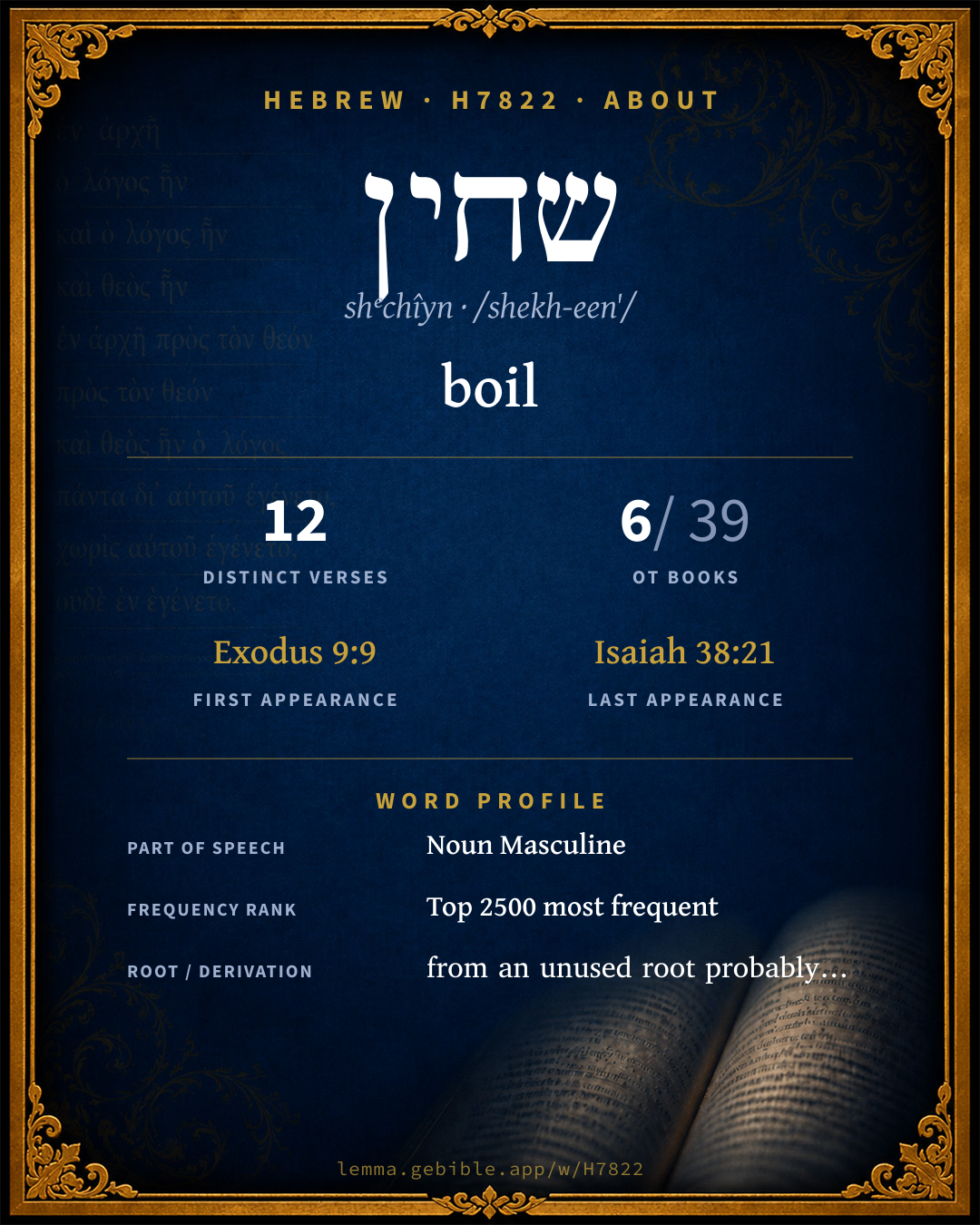
שְׁחִין
boil
also: inflamed spot, inflammation, eruption fuller range ↓
Full lexicon entry — Brown-Driver-Briggs (BDB)
From Brown-Driver-Briggs (BDB)
Where this word appears
See every Absolute-state word in the Hebrew Bible →
Grammar key — what these labels mean
Part of speech
- Noun
- A naming word — a person, place, thing, or idea.
Noun type
- Common
- A common noun — a general class of person, place, or thing (“king,” “city,” “water”), not a specific name.
State
- Absolute
- The independent form of a noun, not bound to a following word.
- Construct
- A noun bound to a following noun in a possessive / “of” relationship (the construct chain).
Gender
- Masculine
- Grammatically masculine.
Number
- Singular
- One.
11 distinct verses where H7822 appears in the Absolute state, across 6 books. Filtered view — show all forms. Click any verse to open its interlinear word-by-word view. Verse text shown in the World English Bible for context — . Each verse’s Hebrew form is shown with its reference; the English is not keyword-highlighted, since the data carries no word-level English alignment. Use “Compare translations” on any verse to read it across multiple English versions. This concordance covers the Hebrew Bible; Septuagint (Greek Old Testament) occurrences are not indexed here.
Exodus 3 verses
- Exodus 9:9 לִ/שְׁחִ֥ין prep + n c ms It shall become small dust over all the land of Egypt, and shall be a boil breaking forth with boils on man and on animal, throughout all the land of Egypt."
- Exodus 9:10 שְׁחִין֙ n c ms They took ashes of the furnace, and stood before Pharaoh; and Moses sprinkled it up toward the sky; and it became a boil breaking forth with boils on man and on animal.
- Exodus 9:11 הַ/שְּׁחִ֑ין הַ/שְּׁחִ֔ין ptcl def.art + n c ms ptcl def.art + n c ms The magicians couldn't stand before Moses because of the boils; for the boils were on the magicians, and on all the Egyptians.
Leviticus 4 verses
- Leviticus 13:18 שְׁחִ֑ין n c ms "When the body has a boil on its skin, and it has healed,
- Leviticus 13:19 הַ/שְּׁחִין֙ ptcl def.art + n c ms and in the place of the boil there is a white rising, or a bright spot, reddish-white, then it shall be shown to the priest;
- Leviticus 13:20 בַּ/שְּׁחִ֥ין prep det + n c ms and the priest shall examine it; and, behold, if the appearance of it is lower than the skin, and the hair of it has turned white, then the priest shall pronounce him unclean. It is the plague of leprosy. It has broken out in the boil.
- Leviticus 13:23 הַ/שְּׁחִ֖ין ptcl def.art + n c ms But if the bright spot stays in its place, and hasn't spread, it is the scar from the boil; and the priest shall pronounce him clean.
Deuteronomy 1 verse
2 Kings 1 verse
Job 1 verse
Isaiah 1 verse
About this entry
At a glance — auto-summarized from this page’s data, not written by a person. Every figure links to its source below. This summary describes the numbers; it doesn’t interpret them.
שחין (shᵉchîyn) is a Hebrew noun most often rendered “boil.” Scripture first uses it in Exodus 9:9. It turns up in 12 verses across 6 books, an uncommon footprint. It concentrates in Leviticus, which alone accounts for 33% of its uses. Ranging over 2 senses, its meaning includes “inflamed spot”, “inflammation”, and “eruption”. For the data behind this summary, explore the sense tree and the renderings breakdown below.
Gloss history
Strong's 1890 vs modern scholarship
About this word
Strong's H7822 catalogs a Hebrew word from the Hebrew Old Testament.
These counts are not copied from any lexicon or concordance. They are computed here, from the morphology-tagged Hebrew Old Testament. What Lemma adds →
- 12
- distinct verses
- The word appears in 12 distinct verses.
- 6 / 39
- OT books
- The word appears in 6 of 39 Old Testament books.
- #2,001
- by frequency
- Top 2500 most frequent Hebrew words (rank 2,001 of 8,640 Hebrew words by occurrence).
View all 12 occurrences in the concordance →
Most concentrated in
- Leviticus 4 verses 33%
- Exodus 3 verses 25%
- Deuteronomy 2 verses 17%
By section of the Old Testament
By traditional corpus
Conventional, traditional groupings — biblical authorship is debated, so this is a traditional corpus grouping, not an authorship claim. Each share is this word’s portion of its verses in that division of the Hebrew canon. Each figure is a share of the word’s 12 distinct verses.
- Torah (Pentateuch) 9 verses · 75%
- Prophets (Nevi'im) 2 verses · 17%
- Writings (Ketuvim) 1 verse · 8%
How translations render this word
Counts come from each version’s own published word-to-Strong’s tagging or interlinear alignment — an approximate guide to how each version renders this word, not a word-level alignment the data otherwise carries. Because each total is that version’s own tagged count, the per-version totals vary from one another and need not match the appearance or distinct-verse counts above. These counts may also differ from a printed concordance because Lemma counts each distinctly tagged rendering and does not collapse phrase taggings into a single head-word total. This is a fixed set of word-tagged versions (KJV, ASV, BSB, ULT) and does not change with the reading translation you choose elsewhere. Each version’s license is shown beside its name below (and on Sources).
- King James Version: Boil 6×, Boils 2×
- American Standard Version: Boil 6×, Boils 3×
- Berean Standard Bible: Boil 5×, Boils 5×
- unfoldingWord Literal Text: Boils 6×, Boil 5×, With 2×
King James Version Public Domain
Renders H7822 across 13 tagged occurrences — most commonly:
Plus 5 renderings that appear only once — usually multi-word phrases or single function words the recovered tagging swept in, not distinct renderings.
American Standard Version Public Domain
Renders H7822 across 13 tagged occurrences — most commonly:
Plus 4 renderings that appear only once — usually multi-word phrases or single function words the recovered tagging swept in, not distinct renderings.
Berean Standard Bible Public Domain
Renders H7822 across 12 tagged occurrences — most commonly:
Plus 2 renderings that appear only once — usually multi-word phrases or single function words the recovered tagging swept in, not distinct renderings. Not rendered by a distinct English word in 1 further occurrence.
unfoldingWord Literal Text CC BY-SA 4.0
Renders H7822 across 15 tagged occurrences — most commonly:
Plus 2 renderings that appear only once — usually multi-word phrases or single function words the recovered tagging swept in, not distinct renderings.
Senses in BDB
The 2 senses BDB distinguishes for this word, in lexicon order (not ranked by frequency or importance). The full entry — with sub-senses — is in the Lexicon Entry tab.
- boil, inflamed spot, inflammation, eruption
- of man, leprosy, of man and beast
Word origin
n.m. boil, coll. eruption;—on man 2 K 20:7 = Is 38:21, שׁ׳ רָ֑ע Dt 28:35; Jb 2:7; possibly leprous Lv 13:18, 19, 20, צָרֶ֫בֶת הַשּׁ׳ 13:23 (v. צ׳; all P), in Egypt, on man and beast Ex 9:9, 10, 11(×2) (all P), cstr. שְׁחִין מִצְרַיִם Dt 28:27.
— Brown-Driver-Briggs (Oxford 1906, public domain), digitized via Sefaria, supplemented by the OpenScriptures HebrewLexicon (CC BY 4.0). See Sources.
Origin: from an unused root probably meaning to burn
Jastrow Dictionary
A second Hebrew/Aramaic lexicon for comparison, covering Aramaic and post-biblical (Talmudic, Targumic, Midrashic) usage that the biblical-Hebrew BDB does not. Matched by lemma rather than by Strong’s number, so a lemma may carry more than one Jastrow headword (shown separately below), and the entries cover usage well beyond the Bible.
שְׁחֵין
- , v. שְׁחַן
שְׁחִין
- inflammation, boil, ulcer, skin-disease. Gen. R. s. 41 כ"ד מיני ש׳, v. רָאֲתָן. Ib. מוכה ש׳ afflicted with boils. Neg. I, 5, sq.; a. fr.
שְׁחִין ²
- 1. heat. Targ. Is. XVIII, 4.
- 2. sore, boil, v. שִׁחְנָא.
שְׁחַן
- (answering to h. חם, חמם)
- 1. to be warm. Targ. Is. XLIV, 15, sq. Targ. Koh. IV, 11. Targ. Job XXXVII, 17 Ms. (ed. מְשַׁחֲנִין, Pa.; ed. Wil. מִשְׁחֲנִין, corr. acc.).
- 2. to heat, light a fire. Arakh. 31ᵇ אנא קדים שָׁחֵין נורא וכ׳ I lighted a fire (moved into my house) before thee.
- 3. (with על) to hatch, v. infra.
- 1. to heat. Keth. 10ᵇ; Gitt. 70ᵃ מְשַׁחֲנַן, v. שְׂבַע. Y. Sabb. I, end, 4ᵇ מהו מיחזרתיה ומְשַׁחַנְתֵּיה is it permitted to put it back (into the oven) and keep it warm? Lev. R. s. 25 היא … ומְשַׁחֲנָא להון she (the mother hen) gathers them, and puts them under her wings, and keeps them warm.
- 2. to hatch, sit over. Targ. Jer. XVII, 11 (ed. Wil. מְשָׁחִין, read: מְשַׁחֵין). Targ. Is. LIX, 5. Targ. Job XXXIX, 16 שַׁחֲנָא על בניא (Ms. תעיין בנהא; h. text הקשיח).
- to be warmed, get warm. Ib. XXXI, 20. Targ. Y. Deut. XXII, 11.
A Dictionary of the Targumim, the Talmud Babli and Yerushalmi, and the Midrashic Literature (Marcus Jastrow; London, Luzac, 1903) — Public Domain. Digitized via Sefaria. Digitized via Sefaria. Full attribution on Sources.
Forms in the corpus
The 10 distinct written forms H7822 takes in the Hebrew Bible, most frequent first — each parse links to that state’s occurrences in the concordance. Hebrew forms include their vowel points and cantillation, so a single lemma takes many written forms.
| Form | Parsing | Example | Uses |
|---|---|---|---|
| הַ/שְּׁחִ֖ין | Noun, Common, Masculine, Singular, Absolute | 2 Kings 20:7 | 3 |
| בִּ/שְׁחִ֣ין | Noun, Common, Masculine, Singular, Absolute | Deuteronomy 28:35 | 2 |
| בִּ/שְׁחִ֤ין | Noun, Common, Masculine, Singular, Construct | Deuteronomy 28:27 | 1 |
| בַּ/שְּׁחִ֥ין | Noun, Common, Masculine, Singular, Absolute | Leviticus 13:20 | 1 |
| הַ/שְּׁחִ֑ין | Noun, Common, Masculine, Singular, Absolute | Exodus 9:11 | 1 |
| הַ/שְּׁחִ֔ין | Noun, Common, Masculine, Singular, Absolute | Exodus 9:11 | 1 |
| הַ/שְּׁחִין֙ | Noun, Common, Masculine, Singular, Absolute | Leviticus 13:19 | 1 |
| לִ/שְׁחִ֥ין | Noun, Common, Masculine, Singular, Absolute | Exodus 9:9 | 1 |
| שְׁחִ֑ין | Noun, Common, Masculine, Singular, Absolute | Leviticus 13:18 | 1 |
| שְׁחִין֙ | Noun, Common, Masculine, Singular, Absolute | Exodus 9:10 | 1 |
Septuagint verse parallels
This word appears in 12 verses that also exist in the Greek Old Testament (Septuagint), out of the 12 Hebrew verses it occurs in. You can read those verses in Greek by switching the Old Testament edition to the Septuagint.
Read these verses in the Septuagint
This is a verse-level parallel only — the same verses exist in both the Hebrew and Greek Old Testaments. No word-level Hebrew↔Greek correspondence is claimed: the data carries no such alignment, so no Greek word is shown as this Hebrew word’s translation. Coverage is not total — the Septuagint omits the deuterocanon and renumbers the Psalms, so some Hebrew verses have no direct Greek parallel.