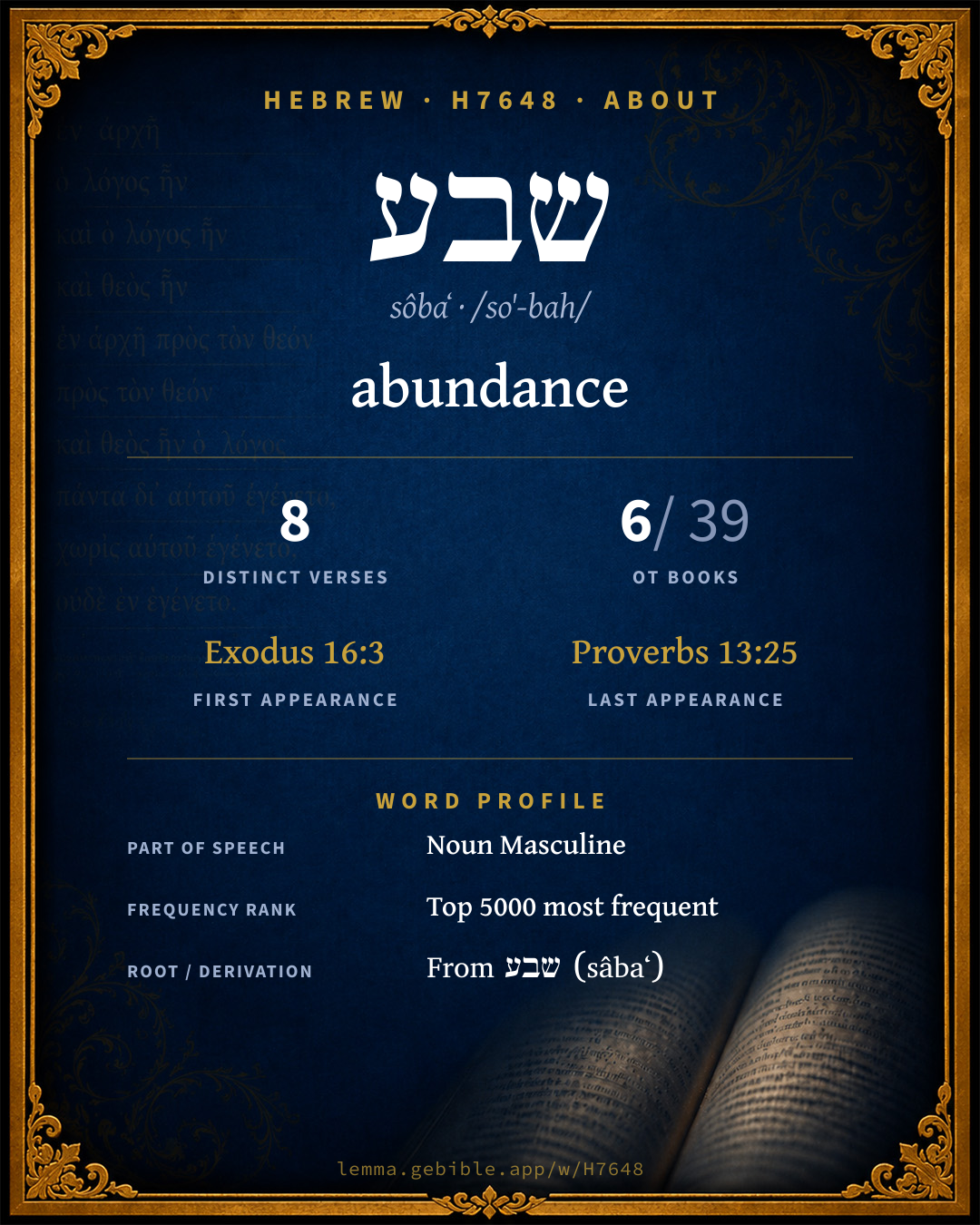
שֹׂ֫בַע
abundance
also: satiety, fulness fuller range ↓
Full lexicon entry — Brown-Driver-Briggs (BDB)
From Brown-Driver-Briggs (BDB)
Where this word appears
See every Absolute-state word in the Hebrew Bible →
Grammar key — what these labels mean
Part of speech
- Noun
- A naming word — a person, place, thing, or idea.
Noun type
- Common
- A common noun — a general class of person, place, or thing (“king,” “city,” “water”), not a specific name.
State
- Absolute
- The independent form of a noun, not bound to a following word.
- Construct
- A noun bound to a following noun in a possessive / “of” relationship (the construct chain).
Gender
- Masculine
- Grammatically masculine.
Number
- Singular
- One.
4 distinct verses where H7648 appears in the Construct state, across 4 books. Filtered view — show all forms. Click any verse to open its interlinear word-by-word view. Verse text shown in the World English Bible for context — . Each verse’s Hebrew form is shown with its reference; the English is not keyword-highlighted, since the data carries no word-level English alignment. Use “Compare translations” on any verse to read it across multiple English versions. This concordance covers the Hebrew Bible; Septuagint (Greek Old Testament) occurrences are not indexed here.
Deuteronomy 1 verse
Ruth 1 verse
Psalms 1 verse
Proverbs 1 verse
About this entry
At a glance — auto-summarized from this page’s data, not written by a person. Every figure links to its source below. This summary describes the numbers; it doesn’t interpret them.
The Hebrew noun שבע centers on the idea of “abundance.” Its earliest occurrence is Exodus 16:3. It appears 8 verses across 6 books of the Hebrew Bible, among its uncommon vocabulary. The word gravitates to Leviticus (25%), then Psalms and Exodus. Beyond “abundance” it also covers “satiety” and “fulness” — see its full sense range. Dig into 8-verse concordance and the renderings breakdown below.
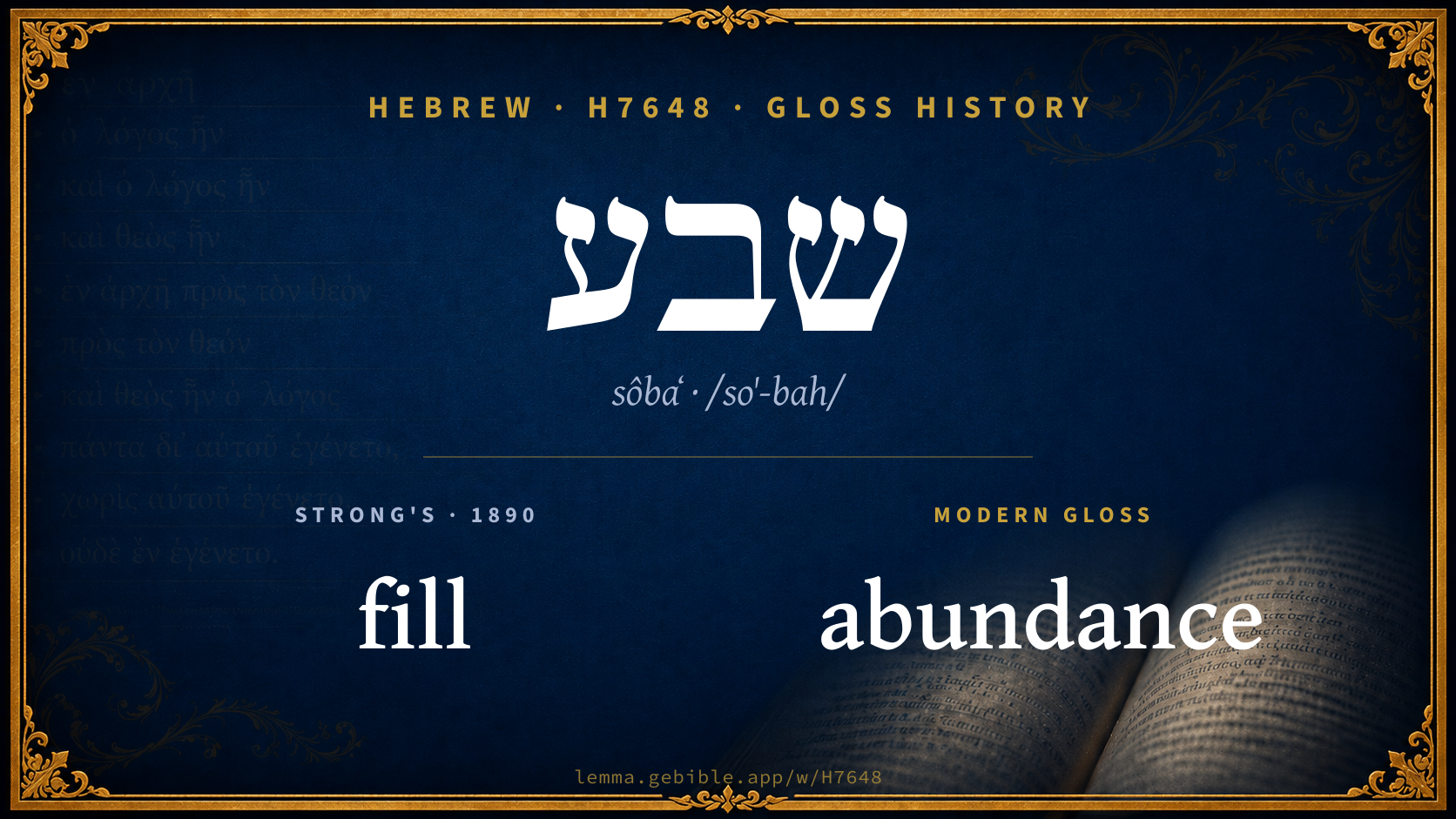
Gloss history
Strong's 1890 vs modern scholarship
About this word
Strong's H7648 catalogs a Hebrew word from the Hebrew Old Testament.
These counts are not copied from any lexicon or concordance. They are computed here, from the morphology-tagged Hebrew Old Testament. What Lemma adds →
- 8
- distinct verses
- The word appears in 8 distinct verses.
- 6 / 39
- OT books
- The word appears in 6 of 39 Old Testament books.
- #2,625
- by frequency
- Top 5000 most frequent Hebrew words (rank 2,625 of 8,640 Hebrew words by occurrence).
View all 8 occurrences in the concordance →
By section of the Old Testament
By traditional corpus
Conventional, traditional groupings — biblical authorship is debated, so this is a traditional corpus grouping, not an authorship claim. Each share is this word’s portion of its verses in that division of the Hebrew canon. Each figure is a share of the word’s 8 distinct verses.
- Torah (Pentateuch) 4 verses · 50%
- Writings (Ketuvim) 4 verses · 50%
How translations render this word
Counts come from each version’s own published word-to-Strong’s tagging or interlinear alignment — an approximate guide to how each version renders this word, not a word-level alignment the data otherwise carries. Because each total is that version’s own tagged count, the per-version totals vary from one another and need not match the appearance or distinct-verse counts above. These counts may also differ from a printed concordance because Lemma counts each distinctly tagged rendering and does not collapse phrase taggings into a single head-word total. This is a fixed set of word-tagged versions (KJV, ASV, BSB, ULT) and does not change with the reading translation you choose elsewhere. Each version’s license is shown beside its name below (and on Sources).
- King James Version: Full 3×, Fill 2×
- American Standard Version: Full 3×, Fill 2×
- Berean Standard Bible: Fill 2×
- unfoldingWord Literal Text: Satisfaction 3×
King James Version Public Domain
Renders H7648 across 8 tagged occurrences — most commonly:
Plus 3 renderings that appear only once — usually multi-word phrases or single function words the recovered tagging swept in, not distinct renderings.
American Standard Version Public Domain
Renders H7648 across 8 tagged occurrences — most commonly:
Plus 3 renderings that appear only once — usually multi-word phrases or single function words the recovered tagging swept in, not distinct renderings.
Berean Standard Bible Public Domain
Renders H7648 across 8 tagged occurrences — most commonly:
Plus 6 renderings that appear only once — usually multi-word phrases or single function words the recovered tagging swept in, not distinct renderings.
unfoldingWord Literal Text CC BY-SA 4.0
Renders H7648 across 9 tagged occurrences — most commonly:
Plus 6 renderings that appear only once — usually multi-word phrases or single function words the recovered tagging swept in, not distinct renderings.
Senses in the full BDB
What do BDB’s symbols mean?
BDB uses these scholarly abbreviations:
| Symbol | Meaning |
|---|---|
| 𝔊 | the Septuagint (the ancient Greek translation, LXX) |
| 𝔙 | the Vulgate (the Latin translation) |
| 𝔖 | the Syriac version (the Peshitta) |
| 𝔗 | the Targum (the Aramaic translation) |
| ψ | the Psalms |
| √ | root (the underlying root or stem) |
| ‖ | parallel passage (a synonymous or contrasted parallel) |
| † | the dagger: every passage where the word occurs is cited |
The 2 senses and sub-senses the full Brown-Driver-Briggs lexicon distinguishes for this word, in lexicon order (not ranked by frequency), with BDB’s own verbatim wording and sub-sense lettering. Shown in Hebrew script with BDB’s own scholarly abbreviations. The condensed entry is in the Lexicon Entry tab. See also the Forms in the corpus table below.
- 1. satiety, as to food Ru 2:18; לָשׂ׳ (לֶחֶם) אָכַל Ex 16:3 (P), Lv 25:19; 26:5 (both H), cf. לָשׂ׳ ψ 78:25; אָכַל … כְּנַפְשְׁךָ שׂ׳ Dt 23:25 eat grapes according to thine appetite, (namely) thy fill, cf. אָכַל לְשׂ׳ נַפְשׁוֹ Pr 13:25. e.g. Ruth 2:18
- 2. satisfying abundance, שׂ׳ שְׂמָחוֹת ψ 16:11. e.g. Psalms 16:11
Senses from the full Brown-Driver-Briggs lexicon (Brown, Driver, Briggs; Oxford 1906 — public domain), digitized via Sefaria, supplemented by the OpenScriptures HebrewLexicon (CC BY 4.0). Full attribution on Sources.
Word origin
n.[m.] satiety, abundance;—abs. לָשׂ׳ Ex 16:3 +, cstr. שׂבַע ψ 16:11, לְשׂ׳ Pr 13:25; sf. שָׂבְעֶ֑ךָ Dt 23:25, שָׂבְעָהּ Ru 2:18;—
— Brown-Driver-Briggs (Oxford 1906, public domain), digitized via Sefaria, supplemented by the OpenScriptures HebrewLexicon (CC BY 4.0). See Sources.
Derived from שבע (sâbaʻ) (H7646) — to be satisfied.
Jastrow Dictionary
A second Hebrew/Aramaic lexicon for comparison, covering Aramaic and post-biblical (Talmudic, Targumic, Midrashic) usage that the biblical-Hebrew BDB does not. Matched by lemma rather than by Strong’s number, so a lemma may carry more than one Jastrow headword (shown separately below), and the entries cover usage well beyond the Bible.
שֶׁבַע
- (b. h.) seven. Snh. V, 1, v. חֲקִירָה. Ib. 3 בש׳ (sub שעות) at seven hours of the day. Ab. V, 7. Lam. R. introd. (R. Josh. 2) ש׳ מש׳ seven times seven; a. v. fr.—בנות ש׳, ברת ש׳, v. בַּת I a. בְּרַת I.—Esp. שִׁבְעָה (sub. ימים) Shib ah, the seven days of mourning for a near relative. M. Kat. 20ᵃ, v. שְׁלֹשָׁה; a. fr.—Y. M. Kat. III, 82ᶜ; v. שָׁמַר.—Pl. שִׁבְעִים seventy. Snh. V, 5 עד ש׳ ואחד (add to the members of the court,) until they number seventy-one. Ab. Zar. 11ᵇ אחת לש׳ שנה once every seventy years; a. v. fr.
שְׁבַע
- Targ. Gen. V, 7. Ib. IV, 24 (O. ed. Vien. שִׁבְעָה). Ib. XXIX, 27. Targ. Y. II, Num. XI, 26 שׁוֹבְעָתֵי; a. fr.—Y. Kil. IV, beg. 29ᵃ חמש שורין מן שו׳ שו׳ five rows of seven trees each. Y. Sabb. I, 3ᶜ bot. אלו שגזרו … שובעה אינון those laws which they decreed by majority of votes, were seven; a. fr.—Pl. שַׁבְעִין, שִׁבְ׳, שׁוּבְ׳ seventy. Targ. Gen. V, 12; a. fr.
שָׁבַע
- , Nif. נִשְׁבַּע (b. h.) to be sworn, to swear. Shebu. III, 6 נ׳ לבטל וכ׳ if a person swears that he will omit to perform a commandment. Ib. VI, 4 אין נִשְׁבָּעִין על וכ׳ no oath is imposed in refutation of a claim of a deaf and mute, or of an insane person, or of a minor, nor do we administer an oath to a (claimant) minor, אבל נשבעין לקטן וכ׳ but you must make oath when suing a minor or the sacred treasury. Ib. 7 ומי נ׳ מי … שמא יִשָּׁבַע זה וכ׳ which of them is first admitted to an oath? He with whom the (lost) pledge was deposited, lest this one (the debtor) swear (to the value of the pledge), and the other produce the pledge (and prove him a perjurer). Ib. VII, 1 כל הנשבעין שבתורה נשבעין וכ׳ all those bound to swear according to Biblical law swear and are free from payment, but the following swear and receive (are awarded their claim). Ib. 32ᵇ ואינו יכול לִישָּׁבֵעַ, v. שְׁבוּעָה; a. fr.
- to adjure; to impose, administer an oath. Ib. IV, 3 אמרו אין אנו … מַשְׁבִּיעַ אני עליכם וכ׳ if they say, we know no testimony in thy case, (and he says,) I adjure you, and they say, Amen: they are guilty (if they could testify). Ib. ה׳ עליהן … חוץ וכ׳ if he adjured them five times out of court, and coming before court they confess (that they know testimony), they are acquitted. Ib. VIII, 2 מַשְׁבִּיעֲךָ אני וכ׳ I adjure thee, and he says, Amen. Ib. 29ᵃ; 39ᵃ, a. e. וכשמַשְׁבִּיעִין אותו … אנו משביעין אותך וכ׳ and when the court administers an oath to him, they say to him, know that we cause thee to swear not in thy sense, but in the sense of God and in the sense of the court; a. fr.—Part. pass. מוּשְׁבָּע; pl. מוּשְׁבָּעִין. Ib. 31ᵃ מ׳ מפי עצמו one who is sworn on his own demand (in his own case); מ׳ מפי אחרים one who is sworn on other people’s demands (as a supposed witness that claims ignorance). Ib. III, 6 הרשות שאינו מ׳ עליה מהר סיני a religiously indifferent act, on which he is not sworn from Mount Sinai; מצוה שהוא מ׳ וכ׳ a religious act on which he is sworn &c. Ib. 21ᵇ; 22ᵇ, v. סִינַי; a. fr.
שְׁבַע II
- Ithpa. אִשְׁתַּבַּע, Ithpe. אִשְׁתְּבַע, אִישְּׁבַע as preced. Nif. Targ. Lev. V, 22; 24. Targ. Jer. V, 2; a. fr.— Shebu. 29ᵃ ודילמא … וכי קא מִשְׁתַּבַּע אדעתא דיריה א׳ perhaps that man saw a huge bird and called it gamla (camel), and when he swore (that he saw a camel fly in the air), he swore in his sense. Ib. דכי קא משתבע … קא משתבע so that when he swears (that he has paid the money), he swears to the truth in his sense (having given him tokens, v. אִיסְקוּנְדְּרֵי). Ib. 32ᵇ אי … הוה מִשְׁתַּבַּעְנָא וכ if thou hadst come and testified for me, I should have been assigned an oath and received my claim; מי יימר דמִשְׁתַּבְּעַת who can say that thou wouldst have made oath? Ib. לִישְׁתַּבַּע shall he be admitted to an oath? Ib. 26ᵃ ואנא בשיקרא אִישְׁתַּבְּעִי and have I sworn falsely?; a. fr.
- as preced. Hif. Targ. Y. II, Ex. XIII, 19 [read:] מִשְׁבָּע אַשְׁבַּע. Targ. Cant. II, 7. Targ. Cant. II, 4; a. e.—Shebu. 36ᵃ אַשְׁבְּעִינְהוּ ולייטינהו he made them swear, and also pronounced a curse upon them. Ib. 41ᵃ לא מַשְׁבְּעִינָן ליה we do not put him to an oath; a. fr.
שָׂבֵעַ I
- next w.) sated, filled, satisfied. Gitt. 56ᵃ יוצא כשהוא ש׳, v. רָעֵב I. Lev. R. s. 34 לשְׂבֵעוֹ וכ׳, v. רָעֵב I; a. fr.—Pl. שְׂבֵעִים, שְׂבֵעִין, שְׂבֵי׳. Joma 74ᵇ סומין … ואינו ש׳ blind persons eat and are not satisfied. Taan. 10ᵇ אל תראו עצמיכם בפני בני עשו … כאילו אתם ש׳ Ms. M. (v. Rabb. D. S. a. l. note) make no show of your plenty before the sons of Esau or of Ishmael, lest they envy you; Yalk. Gen. 148; a. e.—Fem. שְׂבֵעָה, שְׂבֵי׳. Y. Ab. Zar. III, 42ᶜ top the Lord allows the righteous in this world to see their (future) reward, ונפשם ש׳ וכ׳ and they feel satisfied and go to sleep; a. e.—Pl. שְׂבֵעוֹת, שְׂבֵי׳. Midr. Sam. ch. XIII (ref. to I Sam. IX, 12, sq.) וכל האורך הזה … ולא היו ש׳ ממנו why this lengthy speech? It intimates that they looked at the beauty of Saul and could not see enough of it; a. e. e.g. 1 Samuel 9:12
שָׂבֵעַ II
- to be filled, to have plenty, be satisfied. Sabb. 113ᵇ (ref. to Ruth II, 14) ותאכל בעולם הזה ותִשְׂבַּע וכ׳ she (Israel) will eat in this world, will have plenty in the Messianic days, and leave over for the hereafter. Succ. 52ᵇ, v. רָעֵב II; a. e. e.g. Ruth 2:14
- to satisfy. Gen. R. s. 76, end כדי להַשְׂבִּיעַ עיניו וכ׳ in order to satisfy the eyes of the wicked man. Y. Keth. V, 30ᵇ הִשְׂבִּיעָתוֹ; Succ. l. c. מַשְׂבִּיעוֹ, v. רָעֵב II. Snh. 100ᵃ; a. fr.—Ib. 29ᵇ אדם עשוי שלא להשביע את עצמו man is wont not to declare himself wealthy (to disclaim wealth, by saying that he is in debt, even if he is not); כשם שאדם … שלא להשביע את בניו as man is wont to disclaim wealth for himself, so is he likely to disclaim it for his heirs (therefore an ante-mortem confession of indebtedness does not establish a claim against heirs).
- same.—Part. pass. מְשׂוּבָּע. Lev. R. s. 29 (play on השביעי, Lev. XXIII, 24) שהוא מש׳ בכל וכ׳ a month which is plentiful in every thing &c. e.g. Leviticus 23:24
- to be satiated, sick. Num. R. s. 14 עתיד להִשְׂתַּבּעַ, v. סִיג I.
שְׂבַע
- , to be satisfied, saturated. Targ. O. Ex. XVI, 8 למִיסְבַּע ed. Berl. (ed. Amst. למִישְׂ׳); Y. למִשְׂבּוֹעַ. Targ. Ps. CIV, 16 (Ms. ס׳); a. fr.—Part. שְׂבִיעַ, שְׂבַע, סְ׳; f. שָׂבְעָא, סָ׳. Targ. Prov. XXX, 22 דשביע ed. Lag. (Ms. דסביע; ed. Wil. דיִשְׂבַּע). Targ. Job XLII, 17. Targ. Gen. XXV, 8. Targ. Prov. XXVII, 7; a. fr.—Pesik. R. s. 16; Pesik. Eth Korb., p. 57ᵇ, a. e., v. רְוֵי; a. e.
- ; Af. אַשְׂבַּע, אַסְ׳ to satisfy. Targ. Ps. XC, 14. Ib. CVII, 9; a. fr.—Taan. 24ᵃ רחמנא לִישַׂבְּעָךְ … דאַשְׂבְּעָן ברך the Lord satisfy thee, as thy son has satisfied us. Yoma 79ᵇ שַׂבּוּעֵי מְשַׂבְּעא is enough to satisfy the appetite. Gitt. 70ᵃ תמרי מְשַׂבְּעַן וכ׳ dates satisfy, heat &c.; Keth. 10ᵇ; a. e.
- (cmp. צָבָה) to be swollen. Esth. R. to III, 14 א׳ קרסוליה (omitted in Yalk. ib. 1056) his ankle was swollen.
שָׂבָע
- , v. שׂוֹבַע, שׂוֹבְעָא, a. סִבְעָא.
שׂוֹבַע
- plenty, satiation. Ber. 55ᵃ שלשה דברים … רעב וש׳ וכ׳ three things does the Lord himself announce: famine, plenty, and a good leader. Tosef. Pes. V, 3 חגיגה … פסח נאכל בש׳ (Var. על הש׳) the pilgrim’s sacrifice … must be eaten first, so that the Passover offering be eaten after the appetite is satisfied; Y. ib. VI, 33ᶜ לָשׂבַע; Bab. ib. 70ᵃ על השבע. Gen. R. s. 91 שני השָ׳ the years of plenty. Snh. 97ᵃ ש׳ ואינו ש׳ plenty and no plenty (partial plenty); ש׳ גדול general plenty; a. fr.
A Dictionary of the Targumim, the Talmud Babli and Yerushalmi, and the Midrashic Literature (Marcus Jastrow; London, Luzac, 1903) — Public Domain. Digitized via Sefaria. Digitized via Sefaria. Full attribution on Sources.
Forms in the corpus
The 7 distinct written forms H7648 takes in the Hebrew Bible, most frequent first — each parse links to that state’s occurrences in the concordance. Hebrew forms include their vowel points and cantillation, so a single lemma takes many written forms.
| Form | Parsing | Example | Uses |
|---|---|---|---|
| לָ/שֹׂ֑בַע | Noun, Common, Masculine, Singular, Absolute | Exodus 16:3 | 2 |
| לְ/שֹׂ֣בַע | Noun, Common, Masculine, Singular, Construct | Proverbs 13:25 | 1 |
| לָ/שֹׂ֔בַע | Noun, Common, Masculine, Singular, Absolute | Leviticus 26:5 | 1 |
| לָ/שֹֽׂבַע | Noun, Common, Masculine, Singular, Absolute | Psalms 78:25 | 1 |
| מִ/שָּׂבְעָֽ/הּ | Noun, Common, Masculine, Singular, Construct | Ruth 2:18 | 1 |
| שָׂבְעֶ֑/ךָ | Noun, Common, Masculine, Singular, Construct | Deuteronomy 23:24 | 1 |
| שֹׂ֣בַע | Noun, Common, Masculine, Singular, Construct | Psalms 16:11 | 1 |
Same root — word family
Other BDB entries built from the same root as H7648, grouped by Strong’s listed origin. These share a root / origin per the lexicon — not necessarily a shared meaning. Each links to that word’s own entry.
Derives from
Shares the same root
Derived from this word
Compare all same-root words → Showing 4 of 5 — not the complete family. They share a root, not necessarily a meaning.
Septuagint verse parallels
This word appears in 7 verses that also exist in the Greek Old Testament (Septuagint), out of the 8 Hebrew verses it occurs in. You can read those verses in Greek by switching the Old Testament edition to the Septuagint.
Read these verses in the Septuagint
This is a verse-level parallel only — the same verses exist in both the Hebrew and Greek Old Testaments. No word-level Hebrew↔Greek correspondence is claimed: the data carries no such alignment, so no Greek word is shown as this Hebrew word’s translation. Coverage is not total — the Septuagint omits the deuterocanon and renumbers the Psalms, so some Hebrew verses have no direct Greek parallel.