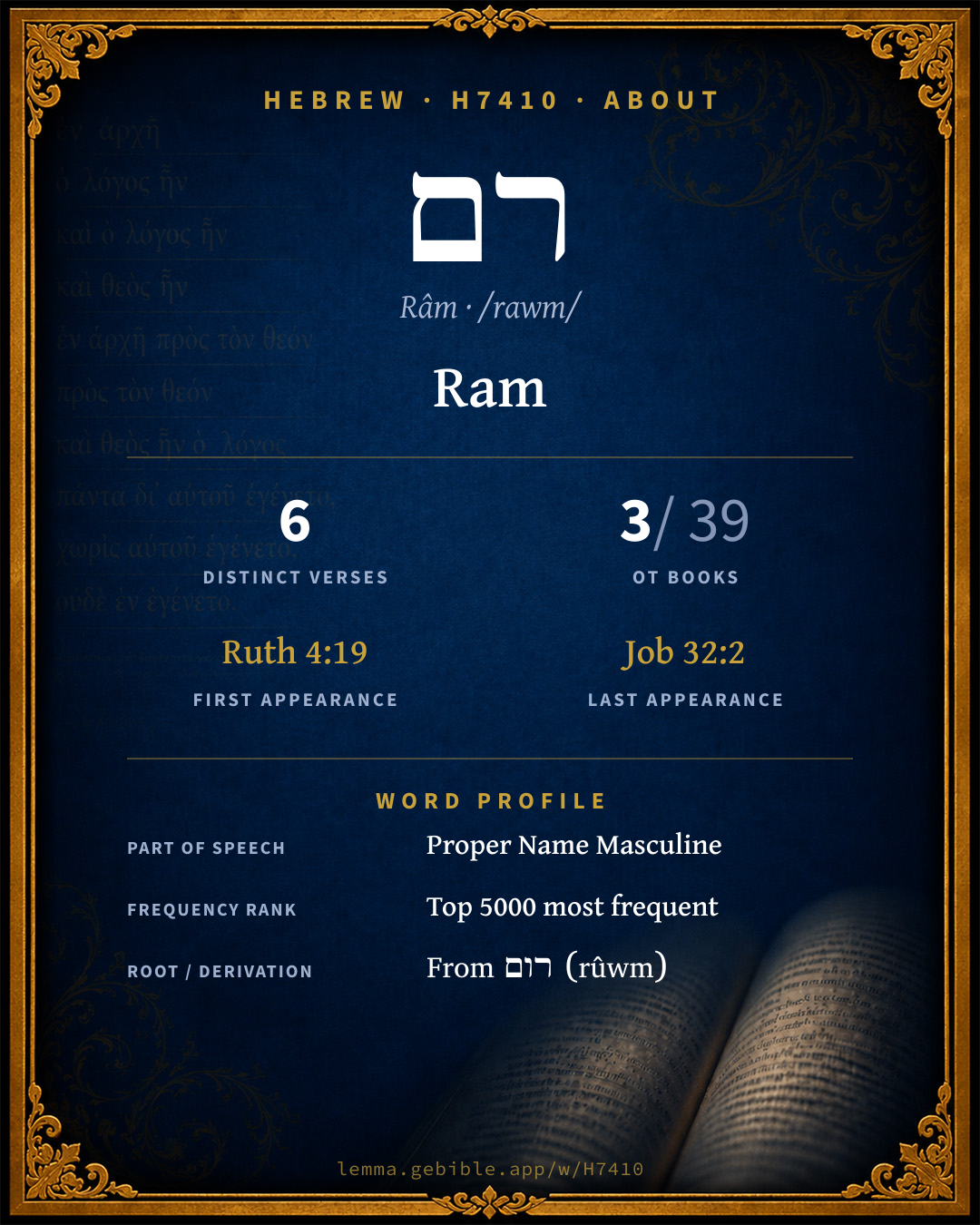
רָם
Ram
BDB lists 4 entries for ‘Ram’ fuller range ↓
Full lexicon entry — Brown-Driver-Briggs (BDB)
From Brown-Driver-Briggs (BDB)
Where this word appears
Grammar key — what these labels mean
Part of speech
- Noun
- A naming word — a person, place, thing, or idea.
Noun type
- Proper
- A name of a specific person, place, or people (e.g. Abraham, Zion, Israel).
Every verse where H7410 appears in the Book of 1 Chronicles — 4 distinct verses. Click any verse to open its interlinear word-by-word view. Verse text shown in the World English Bible for context — . Each verse’s Hebrew form is shown with its reference; the English is not keyword-highlighted, since the data carries no word-level English alignment. Use “Compare translations” on any verse to read it across multiple English versions. This concordance covers the Hebrew Bible; Septuagint (Greek Old Testament) occurrences are not indexed here.
1 Chronicles
- 1 Chronicles 2:9 רָ֖ם n Proper The sons also of Hezron, who were born to him: Jerahmeel, and Ram, and Chelubai.
- 1 Chronicles 2:10 וְ/רָ֖ם conj + n Proper Ram became the father of Amminadab, and Amminadab became the father of Nahshon, prince of the children of Judah;
- 1 Chronicles 2:25 רָ֑ם n Proper The sons of Jerahmeel the firstborn of Hezron were Ram the firstborn, and Bunah, and Oren, and Ozem, Ahijah.
- 1 Chronicles 2:27 רָ֖ם n Proper The sons of Ram the firstborn of Jerahmeel were Maaz, and Jamin, and Eker.
About this entry
At a glance — auto-summarized from this page’s data, not written by a person. Every figure links to its source below. This summary describes the numbers; it doesn’t interpret them.
The Hebrew name רם centers on the idea of “Ram.” The word gravitates to 1 Chronicles (67%), then Ruth and Job. It turns up in 6 verses across 3 books, an uncommon footprint. First canonically at Ruth 4:19, it enters the text early. Dig into 6-verse concordance and the renderings breakdown below.
Gloss history
Strong's 1890 vs modern scholarship
About this word
Strong's H7410 catalogs a Hebrew word from the Hebrew Old Testament.
These counts are not copied from any lexicon or concordance. They are computed here, from the morphology-tagged Hebrew Old Testament. What Lemma adds →
- 6
- distinct verses
- The word appears in 6 distinct verses.
- 3 / 39
- OT books
- The word appears in 3 of 39 Old Testament books.
- #2,835
- by frequency
- Top 5000 most frequent Hebrew words (rank 2,835 of 8,640 Hebrew words by occurrence).
View all 6 occurrences in the concordance →
Most concentrated in
- 1 Chronicles 4 verses 67%
- Ruth 1 verse 17%
- Job 1 verse 17%
By section of the Old Testament
By traditional corpus
Conventional, traditional groupings — biblical authorship is debated, so this is a traditional corpus grouping, not an authorship claim. Each share is this word’s portion of its verses in that division of the Hebrew canon. Each figure is a share of the word’s 6 distinct verses.
- Writings (Ketuvim) 6 verses · 100%
How translations render this word
Counts come from each version’s own published word-to-Strong’s tagging or interlinear alignment — an approximate guide to how each version renders this word, not a word-level alignment the data otherwise carries. Because each total is that version’s own tagged count, the per-version totals vary from one another and need not match the appearance or distinct-verse counts above. These counts may also differ from a printed concordance because Lemma counts each distinctly tagged rendering and does not collapse phrase taggings into a single head-word total. This is a fixed set of word-tagged versions (KJV, ASV, BSB, ULT) and does not change with the reading translation you choose elsewhere. Each version’s license is shown beside its name below (and on Sources).
- King James Version: Ram 6×
- American Standard Version: Ram 5×
- Berean Standard Bible: Ram 7×
- unfoldingWord Literal Text: Ram 7×
King James Version Public Domain
Renders H7410 across 7 tagged occurrences — most commonly:
Plus 1 rendering that appears only once — usually multi-word phrases or single function words the recovered tagging swept in, not distinct renderings.
American Standard Version Public Domain
Renders H7410 across 7 tagged occurrences — most commonly:
Plus 2 renderings that appear only once — usually multi-word phrases or single function words the recovered tagging swept in, not distinct renderings.
Berean Standard Bible Public Domain
Renders H7410 across 7 tagged occurrences — most commonly:
unfoldingWord Literal Text CC BY-SA 4.0
Renders H7410 across 7 tagged occurrences — most commonly:
Senses in the full BDB
What do BDB’s symbols mean?
BDB uses these scholarly abbreviations:
| Symbol | Meaning |
|---|---|
| 𝔊 | the Septuagint (the ancient Greek translation, LXX) |
| 𝔙 | the Vulgate (the Latin translation) |
| 𝔖 | the Syriac version (the Peshitta) |
| 𝔗 | the Targum (the Aramaic translation) |
| ψ | the Psalms |
| √ | root (the underlying root or stem) |
| ‖ | parallel passage (a synonymous or contrasted parallel) |
| † | the dagger: every passage where the word occurs is cited |
The 3 senses and sub-senses the full Brown-Driver-Briggs lexicon distinguishes for this word, in lexicon order (not ranked by frequency), with BDB’s own verbatim wording and sub-sense lettering. Shown in Hebrew script with BDB’s own scholarly abbreviations. The condensed entry is in the Lexicon Entry tab. See also the Forms in the corpus table below.
- 1.
- a. an ancestor of David, Ru 4:19(×2), brother of Jerachmeel 1 Ch 2:9, 10. e.g. Ruth 4:19
- b. son of J. 1 Ch 2:25, 27.—Αρραν, Ραμ, etc. e.g. 1 Chronicles 2:25
- 2. name of Elihu’s family, Jb 32:2 (Ραμ[α], Αραμ), dub., cf. Bu. e.g. Job 32:2
Senses from the full Brown-Driver-Briggs lexicon (Brown, Driver, Briggs; Oxford 1906 — public domain), digitized via Sefaria, supplemented by the OpenScriptures HebrewLexicon (CC BY 4.0). Full attribution on Sources.
Word origin
Derived from רום (rûwm) (H7311) — to rise.
Jastrow Dictionary
A second Hebrew/Aramaic lexicon for comparison, covering Aramaic and post-biblical (Talmudic, Targumic, Midrashic) usage that the biblical-Hebrew BDB does not. Matched by lemma rather than by Strong’s number, so a lemma may carry more than one Jastrow headword (shown separately below), and the entries cover usage well beyond the Bible.
רָם
- high, exalted. B. Bath. 78ᵇ (play on ונירם, Num. XXI, 30) אמר רשע אין רם the wicked says, there is no Most High. Num. R. s. 2019 (play on ארם, Num. XXIII, 7) עם רם שלמעלן הייתי וכ׳ with the Most High I was in communion, and Balak brought me down; ib. רם הייתי וכ׳ I was high, but Balak &c. Sot. 32ᵇ בקול רם in a high (loud) voice. Y. ib. VII, 21ᶜ top (ref. to Deut. XXVII, 14) כקולו של רם like the voice of the Most High; a. fr.—Fem. רָמָה. Mekh. B’shall., s. 1 (ref. to Ex. XIV, 8) שהיתה ידן … ר׳ על וכ׳ Israel’s power was high above the Egyptians’; a. e.—Pl. רָמִים; רָמוֹת. Num. R. l. c. מן הר׳ הייתי וכ׳ I was one of the elevated. Keth. 103ᵇ נהוג נשיאותך בר׳ conduct thy office with the exalted (surround thyself with the best people; Var. בדָמִים, q. v.). Midr. Till. to Ps. XVIII, 28 עיניך על ר׳ להשפילם thy eyes are on the haughty to lower them; a. e. e.g. Numbers 21:30
רָם ²
- , v. בָּרִין
רָם ³
- , v. כַּירִי II
רָם ⁴
- , high, exalted. Targ. Ps. XLVI, 11 (ed. Wil. רְמָא). Targ. I Sam. IX, 2. Targ. Is. II, 15. Targ. II Esth. I, 2 ר׳ ומנטלא high and exalted; a. fr.—Pl. רָמִין, רָמַיָּא; f. רָמָתָא. Targ. Prov. XXV, 3. Targ. Deut. XXVIII, 52. Targ. Is. II, 12; 14. Targ. Prov. VI, 17; a. fr.—Gen. R. s. 32 אין מן טורייא ר׳ הוא וכ׳ if it (Mount Gerizim) belongs to the highest mountains &c.; Cant. R. to IV, 4 רָמְמַיָּיא.
A Dictionary of the Targumim, the Talmud Babli and Yerushalmi, and the Midrashic Literature (Marcus Jastrow; London, Luzac, 1903) — Public Domain. Digitized via Sefaria. Digitized via Sefaria. Full attribution on Sources.
Forms in the corpus
The 5 distinct written forms H7410 takes in the Hebrew Bible, most frequent first — each parse links to that state’s occurrences in the concordance. Hebrew forms include their vowel points and cantillation, so a single lemma takes many written forms.
| Form | Parsing | Example | Uses |
|---|---|---|---|
| וְ/רָ֖ם | Noun, Proper | 1 Chronicles 2:10 | 2 |
| רָ֖ם | Noun, Proper | 1 Chronicles 2:9 | 2 |
| רָ֑ם | Noun, Proper | 1 Chronicles 2:25 | 1 |
| רָ֔ם | Noun, Proper | Ruth 4:19 | 1 |
| רָ֥ם | Noun, Proper | Job 32:2 | 1 |
Same root — word family
Other BDB entries built from the same root as H7410, grouped by Strong’s listed origin. These share a root / origin per the lexicon — not necessarily a shared meaning. Each links to that word’s own entry.
Derives from
Shares the same root
- מרום mârôwm H4791 height
- רום rûwm H7312 haughtiness
- רום rûwm H7313 to rise
- רום rôwm H7315 on high
- רמה râmâh H7413 high place
- רמות râmûwth H7419 height
- תרומה tᵉrûwmâh H8641 offering
Proper names from this root
People and places named from this root — a name, not an additional meaning of the word.
- ירימות Yᵉrîymôwth H3406 Jerimoth
- ירמות Yarmûwth H3412 Jarmuth
- ירמי Yᵉrêmay H3413 Jeremai
- ירמיה Yirmᵉyâh H3414 Jeremiah
- מרמות Mᵉrêmôwth H4822 Meremoth
- רומה Rûwmâh H7316 height
- רוממתי עזר Rôwmamtîy ʻEzer H7320 Romamti-ezer
- רמיה Ramyâh H7422 Ramiah
- Αραμ Arám G689 Arphaxad
Compare all same-root words → Showing 4 of 18 — not the complete family. 9 of the same-root words are proper names (people or places). They share a root, not necessarily a meaning.
Bible dictionary
Public-domain dictionary articles matched to this entry by name (Ram). A biblical name can be shared by more than one person or place, so an article may treat several.
Easton's Bible Dictionary · M. G. Easton, 1897
Exalted. (1.) The son of Hezron, and one of the ancestors of the royal line (Ruth 4:19). The margin of 1 Chr. 2:9, also Matt. 1:3, 4 and Luke 3:33, have "Aram."
(2.) One of the sons of Jerahmeel (1 Chr. 2:25, 27).
(3.) A person mentioned in Job 32:2 as founder of a clan to which Elihu belonged. The same as Aram of Gen. 22:21.
Smith's Bible Dictionary · William Smith, 1863
(high, exalted).
+ A son of Hezron and the father of Ammin-adab, born in Egypt after Jacob's migration there. (Ruth 4:19) (B.C. 1706.) In (Matthew 1:3,4) and Luke 3:33 He is called Aram in the Authorized Version, but RAM in the Revised Version of (Matthew 1:3,4) and Arni in the Revised Version of (Luke 3:33) + The first-born of Jerahmeel, and therefore nephew of the preceding. (1 Chronicles 3:25,27) (B.C. after 1706.) + One of the kindred of Elihu. (Job 32:2) Ewald identified this Ram with Aram in (Genesis 22:21)
[See BATTERING-RAM]
Hitchcock's Bible Names Dictionary · Roswell D. Hitchcock, 1869
elevated; sublime
Classic public-domain reference works; full attribution on Sources.
Septuagint verse parallels
This word appears in 6 verses that also exist in the Greek Old Testament (Septuagint), out of the 6 Hebrew verses it occurs in. You can read those verses in Greek by switching the Old Testament edition to the Septuagint.
Read these verses in the Septuagint
This is a verse-level parallel only — the same verses exist in both the Hebrew and Greek Old Testaments. No word-level Hebrew↔Greek correspondence is claimed: the data carries no such alignment, so no Greek word is shown as this Hebrew word’s translation. Coverage is not total — the Septuagint omits the deuterocanon and renumbers the Psalms, so some Hebrew verses have no direct Greek parallel.