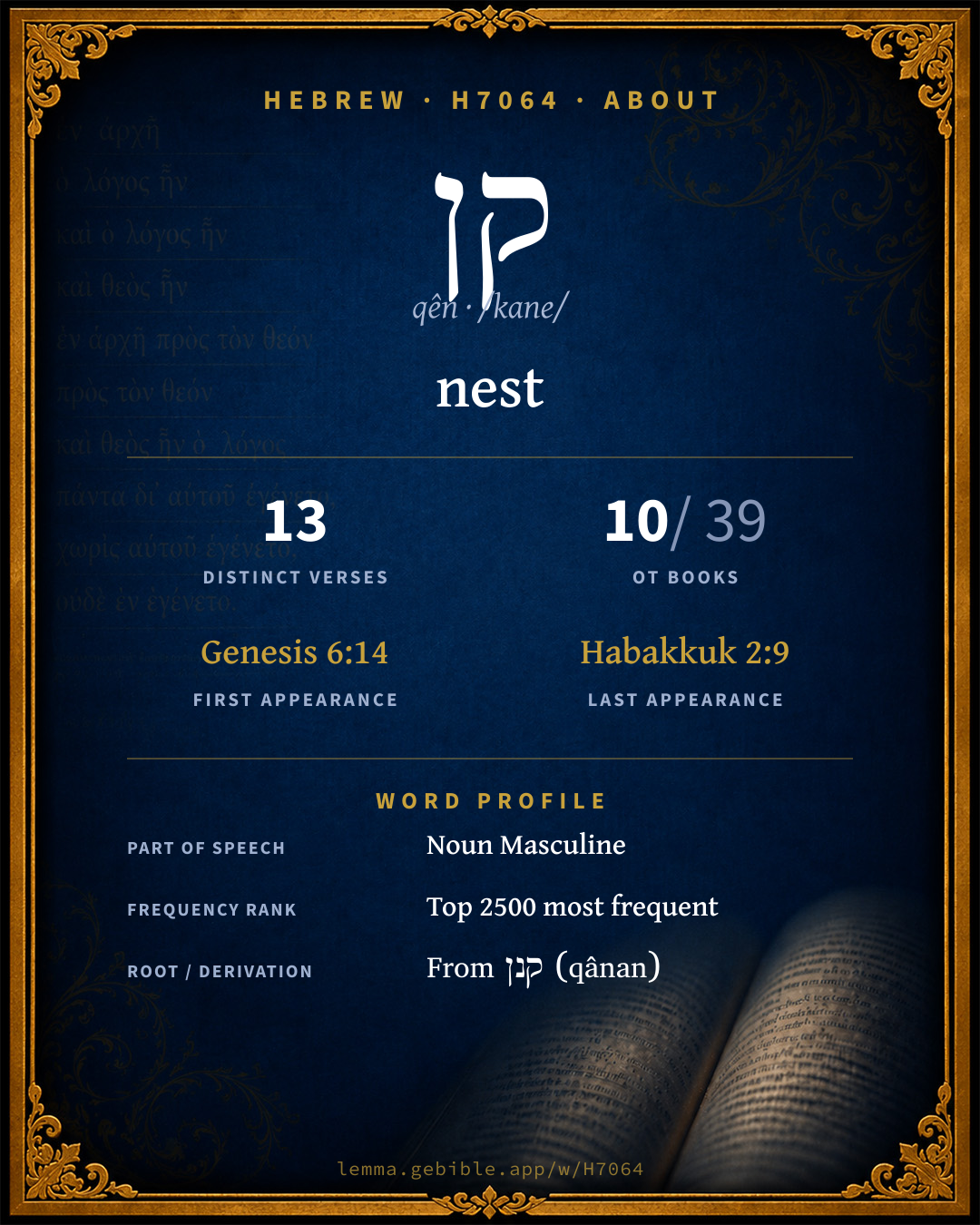
קֵן
nest
‘nest’ is one of 3 main senses fuller range ↓
Full lexicon entry — Brown-Driver-Briggs (BDB)
From Brown-Driver-Briggs (BDB)
Where this word appears
Grammar key — what these labels mean
Part of speech
- Noun
- A naming word — a person, place, thing, or idea.
Noun type
- Common
- A common noun — a general class of person, place, or thing (“king,” “city,” “water”), not a specific name.
State
- Construct
- A noun bound to a following noun in a possessive / “of” relationship (the construct chain).
- Absolute
- The independent form of a noun, not bound to a following word.
Gender
- Masculine
- Grammatically masculine.
Number
- Singular
- One.
- Plural
- More than one (in Hebrew, generally three or more).
Every verse where H7064 appears in the Book of Proverbs — 1 distinct verse. Click any verse to open its interlinear word-by-word view. Verse text shown in the World English Bible for context — . Each verse’s Hebrew form is shown with its reference; the English is not keyword-highlighted, since the data carries no word-level English alignment. Use “Compare translations” on any verse to read it across multiple English versions. This concordance covers the Hebrew Bible; Septuagint (Greek Old Testament) occurrences are not indexed here.
Proverbs
About this entry
At a glance — auto-summarized from this page’s data, not written by a person. Every figure links to its source below. This summary describes the numbers; it doesn’t interpret them.
קן — transliterated qên — is a Hebrew noun carrying the sense “nest.” It first appears in Genesis 6:14. The Hebrew Bible uses it across 13 verses — uncommon. It is not a single-sense word — see its full sense range. Related forms include קנן and קינן. See the sense tree, 13-verse concordance, and the renderings breakdown below.
Gloss history
Strong's 1890 vs modern scholarship
About this word
Strong's H7064 catalogs a Hebrew word from the Hebrew Old Testament.
These counts are not copied from any lexicon or concordance. They are computed here, from the morphology-tagged Hebrew Old Testament. What Lemma adds →
- 13
- distinct verses
- The word appears in 13 distinct verses.
- 10 / 39
- OT books
- The word appears in 10 of 39 Old Testament books.
- #2,001
- by frequency
- Top 2500 most frequent Hebrew words (rank 2,001 of 8,640 Hebrew words by occurrence).
View all 13 occurrences in the concordance →
Most concentrated in
- Deuteronomy 2 verses 15%
- Job 2 verses 15%
- Isaiah 2 verses 15%
By section of the Old Testament
By traditional corpus
Conventional, traditional groupings — biblical authorship is debated, so this is a traditional corpus grouping, not an authorship claim. Each share is this word’s portion of its verses in that division of the Hebrew canon. Each figure is a share of the word’s 13 distinct verses.
- Prophets (Nevi'im) 5 verses · 38%
- Torah (Pentateuch) 4 verses · 31%
- Writings (Ketuvim) 4 verses · 31%
How translations render this word
Counts come from each version’s own published word-to-Strong’s tagging or interlinear alignment — an approximate guide to how each version renders this word, not a word-level alignment the data otherwise carries. Because each total is that version’s own tagged count, the per-version totals vary from one another and need not match the appearance or distinct-verse counts above. These counts may also differ from a printed concordance because Lemma counts each distinctly tagged rendering and does not collapse phrase taggings into a single head-word total. This is a fixed set of word-tagged versions (KJV, ASV, BSB, ULT) and does not change with the reading translation you choose elsewhere. Each version’s license is shown beside its name below (and on Sources).
- King James Version: Nest 11×
- American Standard Version: Nest 10×
- Berean Standard Bible: Nest 11×
- unfoldingWord Literal Text: Nest 10×
King James Version Public Domain
Renders H7064 across 13 tagged occurrences — most commonly:
Plus 2 renderings that appear only once — usually multi-word phrases or single function words the recovered tagging swept in, not distinct renderings.
American Standard Version Public Domain
Renders H7064 across 13 tagged occurrences — most commonly:
Plus 3 renderings that appear only once — usually multi-word phrases or single function words the recovered tagging swept in, not distinct renderings.
Berean Standard Bible Public Domain
Renders H7064 across 13 tagged occurrences — most commonly:
Plus 2 renderings that appear only once — usually multi-word phrases or single function words the recovered tagging swept in, not distinct renderings.
unfoldingWord Literal Text CC BY-SA 4.0
Renders H7064 across 13 tagged occurrences — most commonly:
Plus 3 renderings that appear only once — usually multi-word phrases or single function words the recovered tagging swept in, not distinct renderings.
Senses in the full BDB
What do BDB’s symbols mean?
BDB uses these scholarly abbreviations:
| Symbol | Meaning |
|---|---|
| 𝔊 | the Septuagint (the ancient Greek translation, LXX) |
| 𝔙 | the Vulgate (the Latin translation) |
| 𝔖 | the Syriac version (the Peshitta) |
| 𝔗 | the Targum (the Aramaic translation) |
| ψ | the Psalms |
| √ | root (the underlying root or stem) |
| ‖ | parallel passage (a synonymous or contrasted parallel) |
| † | the dagger: every passage where the word occurs is cited |
The 2 senses and sub-senses the full Brown-Driver-Briggs lexicon distinguishes for this word, in lexicon order (not ranked by frequency), with BDB’s own verbatim wording and sub-sense lettering. Shown in Hebrew script with BDB’s own scholarly abbreviations. The condensed entry is in the Lexicon Entry tab. See also the Forms in the corpus table below.
- 1. nest, of bird Dt 22:6 Jb 39:27; in sim. Is 10:14 Pr 27:8, of nestlings Dt 32:11 Is 16:2 (קֵן מְשֻׁלָּח֑), perhaps also עִם־נִּי Jb 29:18, but difficult, CheJQ July, 1897, 578 proposes זָקֵן or בִּזִקֻנַי (cf. 𝔊); nest on high, of rock-dwellings Nu 24:21 (JE) Je 49:16; Ob 4; fig. of Chaldeans’ secure abode Hb 2:9; temple as secure home for Isr. ψ 84:4 (fig. of swallow). e.g. Deuteronomy 22:6
- 2. cells, like nests, in Noah’s ark Gn 6:14 (P; read prob. קִנִּים קִנִּים, so Lag Ol BuUrg. 255 Di Holz Gunk). e.g. Genesis 6:14
Senses from the full Brown-Driver-Briggs lexicon (Brown, Driver, Briggs; Oxford 1906 — public domain), digitized via Sefaria, supplemented by the OpenScriptures HebrewLexicon (CC BY 4.0). Full attribution on Sources.
Word origin
n.m. Dt 22:6 nest;—abs. ק׳ Is 10:14; +; cstr. קַן־ Dt 22:6; sf. קִנּוֹ 32:11; +, etc.; pl. קִנִּים Gn 6:14;—
— Brown-Driver-Briggs (Oxford 1906, public domain), digitized via Sefaria, supplemented by the OpenScriptures HebrewLexicon (CC BY 4.0). See Sources.
Derived from קנן (qânan) (H7077) — to nest.
Jastrow Dictionary
A second Hebrew/Aramaic lexicon for comparison, covering Aramaic and post-biblical (Talmudic, Targumic, Midrashic) usage that the biblical-Hebrew BDB does not. Matched by lemma rather than by Strong’s number, so a lemma may carry more than one Jastrow headword (shown separately below), and the entries cover usage well beyond the Bible.
*קַן
- (v. קוּן) preparation, arrangement. Gitt. 6ᵃ top קן קולמוסא וקן מגילתא (שמע) אפי׳ even if the husband ordering a letter of divorce to be written heard only the sound produced by the cutting of the pen and the unfolding of the parchment; [Rashi: קן onomatopoetic: crackling, crepitation; Var. קַל sound].
קֵן
- c. (b. h.;
- 1. nest; birds in a nest. Ḥull. XII, 1, a. fr. שילוח הקן the duty of letting the mother bird go when a nest is taken out (Deut. XXII, 6 sq.). Gen. R. s. 19 אש יוצאה מקִינֹּו fire goes forth from its nest and burns it (the phœnix, v. חוֹל II); Midr. Sam. ch. XII; Yalk. Job 917 מקִנֹּו. Ex. R. s. 20 מצאו להם קן they (the Israelites) found a nest for themselves (with ref. to Ps. LXXXIV, 4); a. fr. e.g. Deuteronomy 22:6
- 2. (fem.) the couple of sacrificial birds (Lev. XII, 8; XIV, 30; a. e.). Ḳinnim II, 1 קן סתומה a couple of birds concerning which it has not yet been decided which is to be the burnt offering, and which the sin offering; ib. 4 קן מפורשת which has been decided upon; a. fr.—Pl. קִנִּים, קִנִּין, קִי׳. Ker. 28ᵃ אין הק׳ מתפרשות וכ׳ the special designation of the couples is made either by the owner or by the priest’s action. Ned. IV, 3 קִינֵּי זבין the bird sacrifices of those cured from gonorrhœa; ק׳ יולדות those of women after confinement; a. fr.—Ḳinnim, Ḳinnin, name of a treatise of the Mishnah, of the Order of Ḳodashim. e.g. Leviticus 12:8
- 3. cavity, chamber. — Pl. as ab. Lev. R. s. 14, v. כִּינָּה, a. כֹּונָנִית. Koh. R. to I, 9 שלא נבראו בי ק׳ וכ׳ because no chambers (for the reception of prophecy) were created within me until now &c.; (Ex. R. s. 28 לא נתנה לו רשות להתנבאות no permission to prophesy had been given him).
קֵן ²
- 1. nest, swarm. Targ. O. Deut. XXII, 6 (ed. Berl. קִינָא). Targ. Is. X, 14 (ed. Wil. קִנָה, corr. acc.). Targ. Jud. XIV, 8. Targ. I Sam. XIV, 27 (h. text יערת); a. fr.—Ḥull. 141ᵇ זיל טרוף אקן וכ׳ go and knock at the nest, that the birds be moved, and thus take possession of them. Gitt. 68ᵇ ק׳ דתרנגולא ברא the nest of a woodcock; חפיוה לקִינֵּיה וכ׳ they covered his nest with white glass; a. fr.—Snh. 102ᵇ (prov.) דפרע קִנְאֵיה מחריב קִינֵּיה Ar. he that wreaks his vengeance destroys his own nest (ed. דפרע קיניה מחריב ביתיה, read with Ms. F. קנאיה).—Pl. קִנֵּי, קִי׳. Erub. 3ᵃ (expl. אמלתרא) ק׳ nest-shaped cornices.—קַן נִשְׁרַיָּיא pr. n. pl. Eagles’ Nest, Ḳan-Nishraya (v. P. Sm. 3673), Kennesrin on the Euphrates. R. Hash. 26ᵃ (Ms. M. קנשרייא, v. Rabb. D. S. a. l. note).
- 2. close place. B. Kam. 58ᵇ תלתא … בק׳ וכ׳ three date-trees stood in one place (close together). Ib. 92ᵇ, v. שְׂרָכָא. Succ. 32ᵇ תלתא תלתא טרפי בק׳ three leaves close together (Rashi: on one stem, = קַן, קָנֶה).
A Dictionary of the Targumim, the Talmud Babli and Yerushalmi, and the Midrashic Literature (Marcus Jastrow; London, Luzac, 1903) — Public Domain. Digitized via Sefaria. Digitized via Sefaria. Full attribution on Sources.
Forms in the corpus
The 12 distinct written forms H7064 takes in the Hebrew Bible, most frequent first — each parse links to that state’s occurrences in the concordance. Hebrew forms include their vowel points and cantillation, so a single lemma takes many written forms.
| Form | Parsing | Example | Uses |
|---|---|---|---|
| קִנּ֔/וֹ | Noun, Common, Masculine, Singular, Construct | Deuteronomy 32:11 | 2 |
| כַ/קֵּ֤ן | Noun, Common, Masculine, Singular, Absolute | Isaiah 10:14 | 1 |
| קִנִּ֖ים | Noun, Common, Masculine, Plural, Absolute | Genesis 6:14 | 1 |
| קִנִּ֣/י | Noun, Common, Masculine, Singular, Construct | Job 29:18 | 1 |
| קִנֶּ֑/ךָ | Noun, Common, Masculine, Singular, Construct | Obadiah 1:4 | 1 |
| קִנֶּ֔/ךָ | Noun, Common, Masculine, Singular, Construct | Jeremiah 49:16 | 1 |
| קִנֶּֽ/ךָ | Noun, Common, Masculine, Singular, Construct | Numbers 24:21 | 1 |
| קִנָּ֑/הּ | Noun, Common, Masculine, Singular, Construct | Proverbs 27:8 | 1 |
| קִנּֽ/וֹ | Noun, Common, Masculine, Singular, Construct | Job 39:27 | 1 |
| קֵ֣ן | Noun, Common, Masculine, Singular, Absolute | Isaiah 16:2 | 1 |
| קֵ֥ן | Noun, Common, Masculine, Singular, Absolute | Psalms 84:3 | 1 |
| קַן | Noun, Common, Masculine, Singular, Construct | Deuteronomy 22:6 | 1 |
Same root — word family
Other BDB entries built from the same root as H7064, grouped by Strong’s listed origin. These share a root / origin per the lexicon — not necessarily a shared meaning. Each links to that word’s own entry.
Derives from
Proper names from this root
People and places named from this root — a name, not an additional meaning of the word.
Compare all same-root words → 1 of the same-root words is a proper name (a person or place). They share a root, not necessarily a meaning.
Septuagint verse parallels
This word appears in 13 verses that also exist in the Greek Old Testament (Septuagint), out of the 13 Hebrew verses it occurs in. You can read those verses in Greek by switching the Old Testament edition to the Septuagint.
Read these verses in the Septuagint
- Genesis 6:14
- Numbers 24:21
- Deuteronomy 22:6
- Job 29:18
- Psalms 84:3
- Proverbs 27:8
- Isaiah 10:14
- Jeremiah 49:16
- Obadiah 1:4
- Habakkuk 2:9
This is a verse-level parallel only — the same verses exist in both the Hebrew and Greek Old Testaments. No word-level Hebrew↔Greek correspondence is claimed: the data carries no such alignment, so no Greek word is shown as this Hebrew word’s translation. Coverage is not total — the Septuagint omits the deuterocanon and renumbers the Psalms, so some Hebrew verses have no direct Greek parallel.