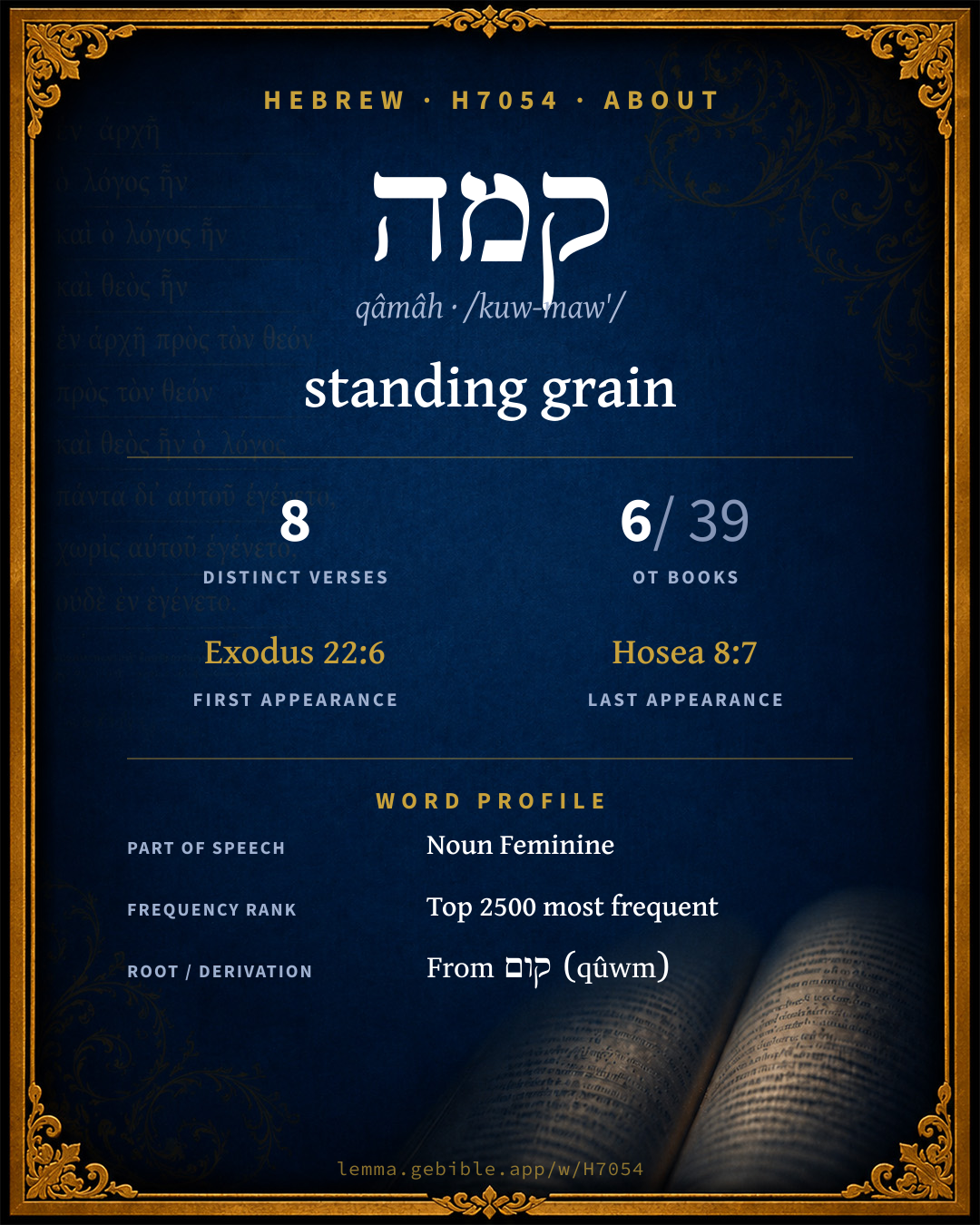
קָמָה
standing grain
Full lexicon entry — Brown-Driver-Briggs (BDB)
From Brown-Driver-Briggs (BDB)
Where this word appears
See every Absolute-state word in the Hebrew Bible →
Grammar key — what these labels mean
Part of speech
- Noun
- A naming word — a person, place, thing, or idea.
Noun type
- Common
- A common noun — a general class of person, place, or thing (“king,” “city,” “water”), not a specific name.
State
- Absolute
- The independent form of a noun, not bound to a following word.
- Construct
- A noun bound to a following noun in a possessive / “of” relationship (the construct chain).
Gender
- Feminine
- Grammatically feminine.
Number
- Singular
- One.
- Plural
- More than one (in Hebrew, generally three or more).
Every verse where H7054 appears in the Book of Deuteronomy — 2 distinct verses. Click any verse to open its interlinear word-by-word view. Verse text shown in the World English Bible for context — . Each verse’s Hebrew form is shown with its reference; the English is not keyword-highlighted, since the data carries no word-level English alignment. Use “Compare translations” on any verse to read it across multiple English versions. This concordance covers the Hebrew Bible; Septuagint (Greek Old Testament) occurrences are not indexed here.
Deuteronomy
- Deuteronomy 16:9 בַּ/קָּמָ֔ה prep det + n c fs Seven weeks shall you number to you: from the time you begin to put the sickle to the standing grain shall you begin to number seven weeks.
- Deuteronomy 23:25 בְּ/קָמַ֣ת קָמַ֥ת prep + n c fs cs n c fs cs When you come into your neighbor's standing grain, then you may pluck the ears with your hand; but you shall not move a sickle to your neighbor's standing grain.
About this entry
At a glance — auto-summarized from this page’s data, not written by a person. Every figure links to its source below. This summary describes the numbers; it doesn’t interpret them.
קמה (qâmâh) is a Hebrew noun most often rendered “standing grain.” It first appears in Exodus 22:6. The Hebrew Bible uses it across 8 verses — uncommon. Deuteronomy dominates its distribution — 2 of 8 verses. Sharing its root, it stands alongside קום, יקום and מקום. The sections below give every sense, occurrence, and version rendering.
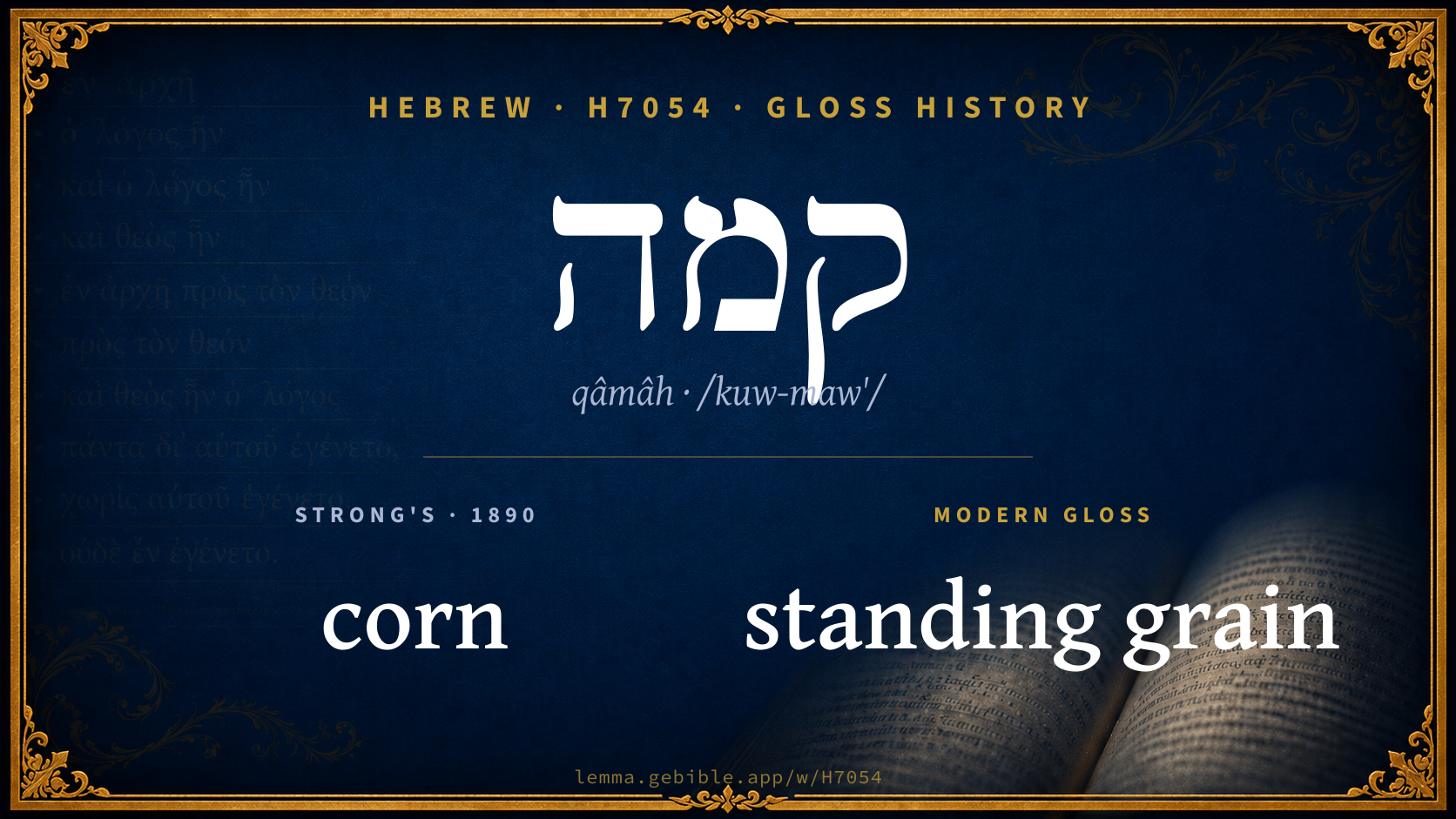
Gloss history
Strong's 1890 vs modern scholarship
About this word
Strong's H7054 catalogs a Hebrew word from the Hebrew Old Testament.
These counts are not copied from any lexicon or concordance. They are computed here, from the morphology-tagged Hebrew Old Testament. What Lemma adds →
- 8
- distinct verses
- The word appears in 8 distinct verses.
- 6 / 39
- OT books
- The word appears in 6 of 39 Old Testament books.
- #2,342
- by frequency
- Top 2500 most frequent Hebrew words (rank 2,342 of 8,640 Hebrew words by occurrence).
View all 8 occurrences in the concordance →
Most concentrated in
- Deuteronomy 2 verses 25%
- Isaiah 2 verses 25%
- Exodus 1 verse 13%
By section of the Old Testament
By traditional corpus
Conventional, traditional groupings — biblical authorship is debated, so this is a traditional corpus grouping, not an authorship claim. Each share is this word’s portion of its verses in that division of the Hebrew canon. Each figure is a share of the word’s 8 distinct verses.
- Prophets (Nevi'im) 5 verses · 63%
- Torah (Pentateuch) 3 verses · 38%
How translations render this word
Counts come from each version’s own published word-to-Strong’s tagging or interlinear alignment — an approximate guide to how each version renders this word, not a word-level alignment the data otherwise carries. Because each total is that version’s own tagged count, the per-version totals vary from one another and need not match the appearance or distinct-verse counts above. These counts may also differ from a printed concordance because Lemma counts each distinctly tagged rendering and does not collapse phrase taggings into a single head-word total. This is a fixed set of word-tagged versions (KJV, ASV, BSB, ULT) and does not change with the reading translation you choose elsewhere. Each version’s license is shown beside its name below (and on Sources).
- King James Version: Standing corn 4×, Be grown up 2×, Corn 2×
- American Standard Version: Standing grain 4×, 's standing grain 2×, Is grown up 2×
- Berean Standard Bible: Standing grain 6×, Is grown 2×
- unfoldingWord Literal Text: Standing grain 4×, Growing up 2×, Stalks of 2×
King James Version Public Domain
Renders H7054 across 10 tagged occurrences — most commonly:
Plus 2 renderings that appear only once — usually multi-word phrases or single function words the recovered tagging swept in, not distinct renderings.
American Standard Version Public Domain
Renders H7054 across 9 tagged occurrences — most commonly:
Plus 1 rendering that appears only once — usually multi-word phrases or single function words the recovered tagging swept in, not distinct renderings.
Berean Standard Bible Public Domain
Renders H7054 across 10 tagged occurrences — most commonly:
Plus 2 renderings that appear only once — usually multi-word phrases or single function words the recovered tagging swept in, not distinct renderings.
unfoldingWord Literal Text CC BY-SA 4.0
Renders H7054 across 11 tagged occurrences — most commonly:
Plus 3 renderings that appear only once — usually multi-word phrases or single function words the recovered tagging swept in, not distinct renderings.
Senses in BDB
The 1 sense BDB distinguishes for this word, in lexicon order (not ranked by frequency or importance). The full entry — with sub-senses — is in the Lexicon Entry tab.
- standing grain
Word origin
n.f. standing grain;—abs. ק׳ Ex 22:5 +; cstr. קָמַת Dt 23:26(×2); pl. cstr. קָמוֹת Ju 15:5;—standing grain (mature) Ex 22:5 (E), Dt 16:9; 23:26(×2) Ju 15:5(×2) Is 17:5; לִפְנֵי ק׳ 2 K 19:26 = Is 37:27 dub., לְפָנַי קֻמְךָ … and join to v 28: before me is thy rising up and thy sitting down We Bur Du CheHpt. al.; cf. sub שְׁדֵפָה. (i.e. before maturity);* in fig. Ho 8:7.—cf. VogelstLandwirthsch.51.
— Brown-Driver-Briggs (Oxford 1906, public domain), digitized via Sefaria, supplemented by the OpenScriptures HebrewLexicon (CC BY 4.0). See Sources.
Derived from קום (qûwm) (H6965) — to rise.
Jastrow Dictionary
A second Hebrew/Aramaic lexicon for comparison, covering Aramaic and post-biblical (Talmudic, Targumic, Midrashic) usage that the biblical-Hebrew BDB does not. Matched by lemma rather than by Strong’s number, so a lemma may carry more than one Jastrow headword (shown separately below), and the entries cover usage well beyond the Bible.
קָמָה
- standing corn. Peah VI, 8 הק׳ מצלת וכ׳ standing corn saves the sheaf (in the field from being considered a forgotten sheaf belonging to the poor); איזוהי ק׳ שהיא וכ׳ how much standing corn must there be to save the sheaf? Y. ib. VI, 19ᵈ top עומר שסביבותיו ק׳ a sheaf surrounded by standing corn. B. Kam. 60ᵃ (ref. to Ex. XXII, 5) ק׳ למה לי כל בעלי קימה what is ḳamah to intimate? It is to include all things of erect stature (as trees, living beings &c., Rashi). Y. ib. VI, beg. 5ᵇ; a. fr.—Pesik. R. s. 43 (play on מלל, Gen. XXI, 7) קָמָתוֹ … ונעשה מלילות the standing crop of Abraham was dried up, but it became again full of ears (his virile strength was restored); Gen. R. s. 53 קומתו (corr. acc.).—Pl. constr. קָמֵי halms, stalks; ק׳ שפה the stiff cords in the border (around the neck) of a garment. M. Kat. 22ᵇ מבדיל ק׳ ש׳ (in rending a garment in mourning) one must (may) sever the stiff border around the neck; (Y. ib. III, 83ᵈ top קנה שפה). Hor. 12ᵇ למטה מק׳ ש׳ beneath the border (leaving the border uncut); למעלה מק׳ ש׳ he rends from over the border (all through); (Y. M. Kat. l. c. קנה ש׳). e.g. Exodus 22:5
קָמָה ²
- ch., v. קָמָא II
A Dictionary of the Targumim, the Talmud Babli and Yerushalmi, and the Midrashic Literature (Marcus Jastrow; London, Luzac, 1903) — Public Domain. Digitized via Sefaria. Digitized via Sefaria. Full attribution on Sources.
Forms in the corpus
The 9 distinct written forms H7054 takes in the Hebrew Bible, most frequent first — each parse links to that state’s occurrences in the concordance. Hebrew forms include their vowel points and cantillation, so a single lemma takes many written forms.
| Form | Parsing | Example | Uses |
|---|---|---|---|
| קָמָֽה | Noun, Common, Feminine, Singular, Absolute | 2 Kings 19:26 | 2 |
| בְּ/קָמ֣וֹת | Noun, Common, Feminine, Plural, Construct | Judges 15:5 | 1 |
| בְּ/קָמַ֣ת | Noun, Common, Feminine, Singular, Construct | Deuteronomy 23:25 | 1 |
| בַּ/קָּמָ֔ה | Noun, Common, Feminine, Singular, Absolute | Deuteronomy 16:9 | 1 |
| הַ/קָּמָ֖ה | Noun, Common, Feminine, Singular, Absolute | Exodus 22:6 | 1 |
| קָמַ֥ת | Noun, Common, Feminine, Singular, Construct | Deuteronomy 23:25 | 1 |
| קָמָ֔ה | Noun, Common, Feminine, Singular, Absolute | Isaiah 17:5 | 1 |
| קָמָ֖ה | Noun, Common, Feminine, Singular, Absolute | Judges 15:5 | 1 |
| קָמָ֣ה | Noun, Common, Feminine, Singular, Absolute | Hosea 8:7 | 1 |
Same root — word family
Other BDB entries built from the same root as H7054, grouped by Strong’s listed origin. These share a root / origin per the lexicon — not necessarily a shared meaning. Each links to that word’s own entry.
Derives from
Shares the same root
- יקום yᵉqûwm H3351 substance
- מקום mâqôwm H4725 place
- קום qûwm H6966 to arise
- קומה qôwmâh H6967 height
- קוממיות qôwmᵉmîyûwth H6968 uprightness
- קים qîym H7009 adversary
- קימה qîymâh H7012 rising up
- תקומה tᵉqûwmâh H8617 standing
- תקומם tᵉqôwmêm H8618 rising against
Proper names from this root
People and places named from this root — a name, not an additional meaning of the word.
- יקים Yâqîym H3356 Jakim
- יקמיה Yᵉqamyâh H3359 Jecamiah
- יקמעם Yᵉqamʻâm H3360 Jekameam
- יקמעם Yoqmᵉʻâm H3361 Jokmeam
- קמואל Qᵉmûwʼêl H7055 Kemuel
- קמון Qâmôwn H7056 Camon
Compare all same-root words → Showing 4 of 17 — not the complete family. 6 of the same-root words are proper names (people or places). They share a root, not necessarily a meaning.
Septuagint verse parallels
This word appears in 8 verses that also exist in the Greek Old Testament (Septuagint), out of the 8 Hebrew verses it occurs in. You can read those verses in Greek by switching the Old Testament edition to the Septuagint.
Read these verses in the Septuagint
This is a verse-level parallel only — the same verses exist in both the Hebrew and Greek Old Testaments. No word-level Hebrew↔Greek correspondence is claimed: the data carries no such alignment, so no Greek word is shown as this Hebrew word’s translation. Coverage is not total — the Septuagint omits the deuterocanon and renumbers the Psalms, so some Hebrew verses have no direct Greek parallel.