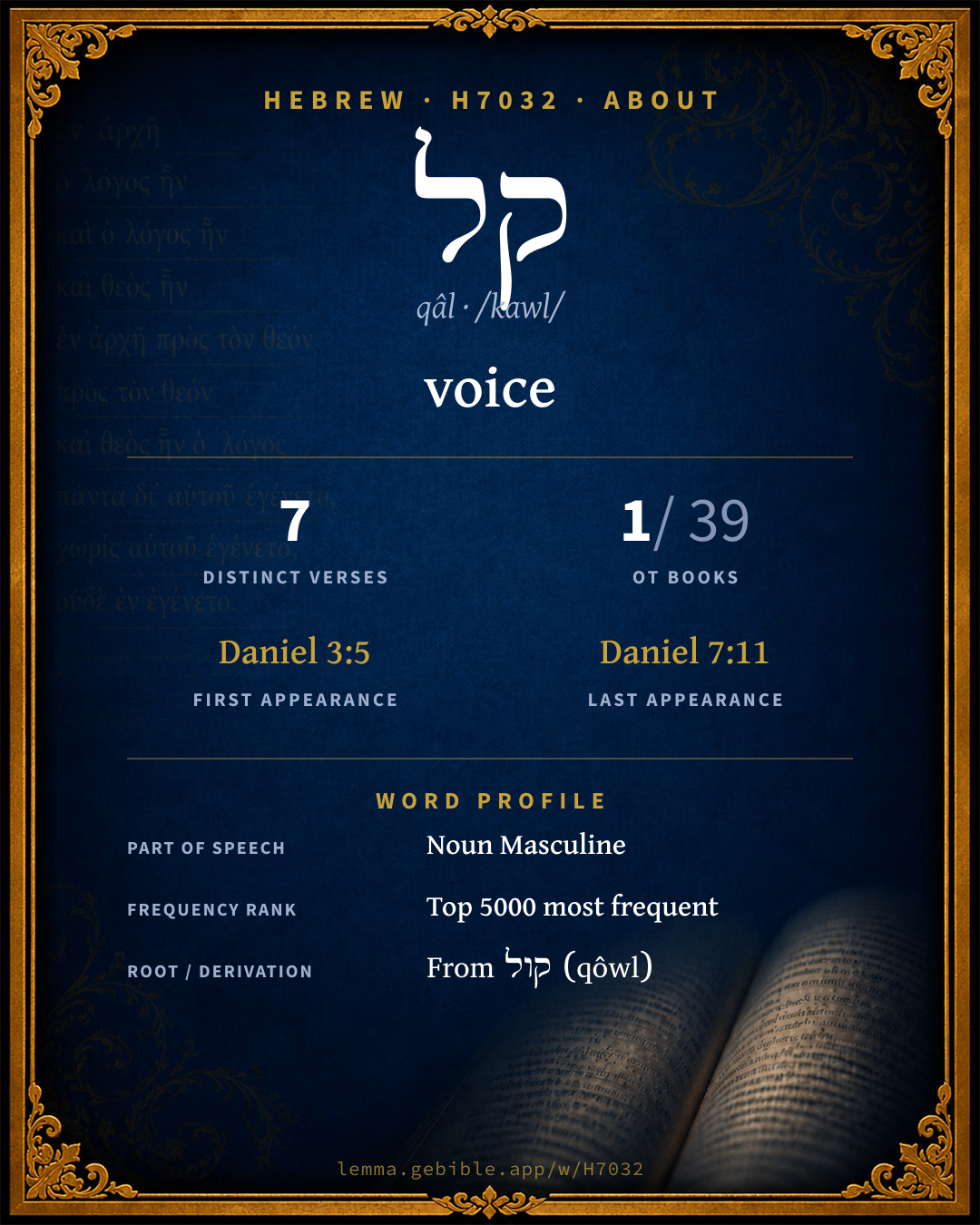
קָל
voice
Full lexicon entry — Brown-Driver-Briggs (BDB)
From Brown-Driver-Briggs (BDB)
Where this word appears
See every Construct-state word in the Hebrew Bible →
Grammar key — what these labels mean
Part of speech
- Noun
- A naming word — a person, place, thing, or idea.
Noun type
- Common
- A common noun — a general class of person, place, or thing (“king,” “city,” “water”), not a specific name.
State
- Construct
- A noun bound to a following noun in a possessive / “of” relationship (the construct chain).
- Absolute
- The independent form of a noun, not bound to a following word.
Gender
- Masculine
- Grammatically masculine.
Number
- Singular
- One.
Grammatical forms
- Noun, Common, Masculine, Singular, Construct 5 times (71%)
- Noun, Common, Masculine, Singular, Absolute 2 times (29%)
Parsed forms decoded from the imported morphology (morphhb / Westminster Leningrad Codex — WLC text public domain, morphhb tagging CC BY 4.0), counted across 7 parsed occurrences — not distinct verses.
Every verse where H7032 appears — 7 distinct verses across 1 book. Click any verse to open its interlinear word-by-word view. Verse text shown in the World English Bible for context — . Each verse’s Hebrew form is shown with its reference; the English is not keyword-highlighted, since the data carries no word-level English alignment. Use “Compare translations” on any verse to read it across multiple English versions. This concordance covers the Hebrew Bible; Septuagint (Greek Old Testament) occurrences are not indexed here.
Daniel 7 verses
- Daniel 3:5 קָ֣ל n c ms cs that whenever you hear the sound of the horn, flute, zither, lyre, harp, pipe, and all kinds of music, you fall down and worship the golden image that Nebuchadnezzar the king has set up;
- Daniel 3:7 קָ֣ל n c ms cs Therefore at that time, when all the peoples heard the sound of the horn, flute, zither, lyre, harp, pipe, and all kinds of music, all the peoples, the nations, and the languages, fell down and worshiped the golden image that Nebuchadnezzar the king had set up.
- Daniel 3:10 קָ֣ל n c ms cs You, O king, have made a decree, that every man that shall hear the sound of the horn, flute, zither, lyre, harp, pipe, and all kinds of music, shall fall down and worship the golden image;
- Daniel 3:15 קָ֣ל n c ms cs Now if you are ready whenever you hear the sound of the horn, flute, zither, lyre, harp, pipe, and all kinds of music to you fall down and worship the image which I have made, [well]: but if you don't worship, you shall be cast the same hour into the midst of a burning fiery furnace; and who is that god that shall deliver you out of my hands?
- Daniel 4:31 קָ֖ל n c ms While the word was in the king's mouth, there fell a voice from the sky, [saying], O king Nebuchadnezzar, to you it is spoken: The kingdom is departed from you:
- Daniel 6:20 בְּ/קָ֥ל prep + n c ms When he came near to the den to Daniel, he cried with a lamentable voice; the king spoke and said to Daniel, Daniel, servant of the living God, is your God, whom you serve continually, able to deliver you from the lions?
- Daniel 7:11 קָל֙ n c ms cs I saw at that time because of the voice of the great words which the horn spoke; I saw even until the animal was slain, and its body destroyed, and it was given to be burned with fire.
About this entry
At a glance — auto-summarized from this page’s data, not written by a person. Every figure links to its source below. This summary describes the numbers; it doesn’t interpret them.
At its core, קל (qâl) means “voice.” Its uses cluster heavily in Daniel (100% of all occurrences). Spanning 7 verses in 1 book, it ranks among the uncommon words of the Hebrew Bible. Scripture first uses it in Daniel 3:5. From the same root come קול and קוליה. Dig into 7-verse concordance and the renderings breakdown below.
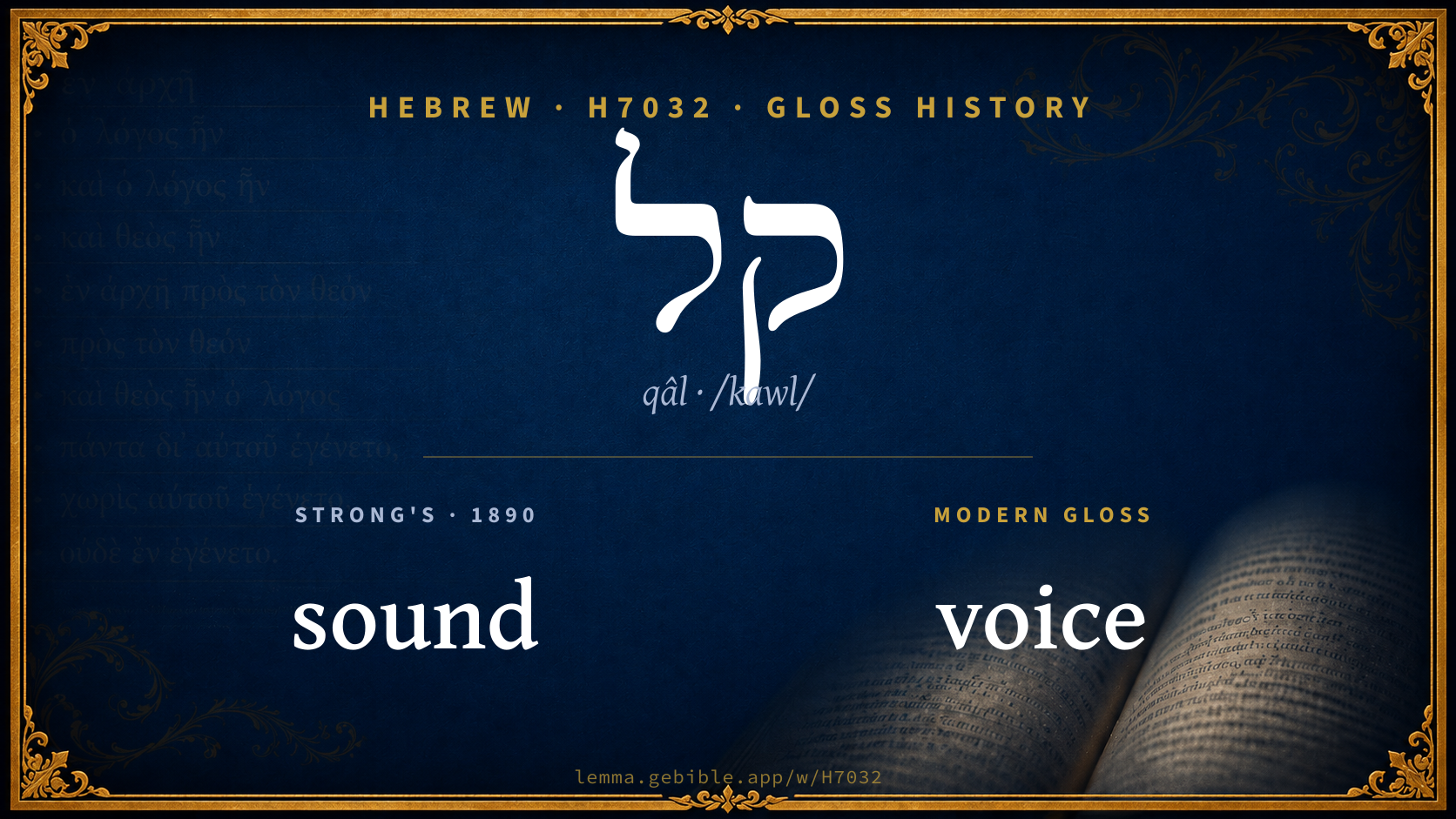
Gloss history
Strong's 1890 vs modern scholarship
About this word
Strong's H7032 catalogs a Hebrew word from the Hebrew Old Testament.
These counts are not copied from any lexicon or concordance. They are computed here, from the morphology-tagged Hebrew Old Testament. What Lemma adds →
- 7
- distinct verses
- The word appears in 7 distinct verses.
- 1 / 39
- OT books
- The word appears in 1 of 39 Old Testament books.
- #2,835
- by frequency
- Top 5000 most frequent Hebrew words (rank 2,835 of 8,640 Hebrew words by occurrence).
View all 7 occurrences in the concordance →
Most concentrated in
- Daniel 7 verses 100%
By section of the Old Testament
By traditional corpus
Conventional, traditional groupings — biblical authorship is debated, so this is a traditional corpus grouping, not an authorship claim. Each share is this word’s portion of its verses in that division of the Hebrew canon. Each figure is a share of the word’s 7 distinct verses.
- Writings (Ketuvim) 7 verses · 100%
How translations render this word
Counts come from each version’s own published word-to-Strong’s tagging or interlinear alignment — an approximate guide to how each version renders this word, not a word-level alignment the data otherwise carries. Because each total is that version’s own tagged count, the per-version totals vary from one another and need not match the appearance or distinct-verse counts above. These counts may also differ from a printed concordance because Lemma counts each distinctly tagged rendering and does not collapse phrase taggings into a single head-word total. This is a fixed set of word-tagged versions (KJV, ASV, BSB, ULT) and does not change with the reading translation you choose elsewhere. Each version’s license is shown beside its name below (and on Sources).
- King James Version: Sound 4×, Voice 3×
- American Standard Version: Sound 4×, Voice 3×
- Berean Standard Bible: Sound 4×, Voice 2×
- unfoldingWord Literal Text: Sound of 5×, Voice 2×
King James Version Public Domain
Renders H7032 across 7 tagged occurrences — most commonly:
American Standard Version Public Domain
Renders H7032 across 7 tagged occurrences — most commonly:
Berean Standard Bible Public Domain
Renders H7032 across 6 tagged occurrences — most commonly:
Not rendered by a distinct English word in 1 further occurrence.
unfoldingWord Literal Text CC BY-SA 4.0
Renders H7032 across 8 tagged occurrences — most commonly:
Plus 1 rendering that appears only once — usually multi-word phrases or single function words the recovered tagging swept in, not distinct renderings.
Senses in BDB
The 1 sense BDB distinguishes for this word, in lexicon order (not ranked by frequency or importance). The full entry — with sub-senses — is in the Lexicon Entry tab.
- voice, sound
Word origin
Derived from קול (qôwl) (H6963) — voice.
Jastrow Dictionary
A second Hebrew/Aramaic lexicon for comparison, covering Aramaic and post-biblical (Talmudic, Targumic, Midrashic) usage that the biblical-Hebrew BDB does not. Matched by lemma rather than by Strong’s number, so a lemma may carry more than one Jastrow headword (shown separately below), and the entries cover usage well beyond the Bible.
קַל I
- to be light, v. קָלַל.
קַל II
- preced.) light;
- 1. unimportant, of minor value; easy to achieve.—קל וחומר, v. חוֹמֶר I. Ḥull. XII, 5 מצוה ק׳ שהיא כאיסר a slight religious act which is performed at a sacrifice of one Isar. Y. Kidd. I, 61ᵇ bot. השוה הכתוב מצוה ק׳ שבקַלּוֹת וכ׳ the Bible put the lightest of the light acts (Deut. XXII, 7) on the same level with the most serious (Ex. XX, 12). Tosef. Yoma V (IV), 4 מאכילין אותו הקל הקל you must give him to eat (of forbidden things on hand) that which is of comparatively minor import; a. fr.—Pl. קַלִּים, קַלִּין; קַלּוֹת.—קלים וחמורים, v. חוֹמֶר I.—Dem. I, 1 הק׳ שבדמאי those fruits with which, in cases of doubt as to tithes (v. דְּמַאי), the law deals most leniently. Yoma VIII, 8 על עבירות ק׳ for minor transgressions (to which the lowest penalty is attached); ib. 85ᵇ אלו הן ק׳ וכ׳ these are the minor transgressions: omission of a positive command &c. (v. עָשָׂה); Tosef. ib. V (IV), 5. R. Hash. 25ᵇ, a. e. שלשה קַלֵּי עולם the three worthless (chiefs) in Israel’s history, opp. חמורי עולם. Ib. אפי׳ קל שבק׳ וכ׳ (not קלין) even the most worthless of worthless men, if once appointed a leader, should be respected like the strongest &c.; a. fr. e.g. Deuteronomy 22:7
- 2. lowly, poor.—Pl. as ab. Arakh. 24ᵃ שלא ישהא מרגלית לק׳ one must not delay the valuation of a jewel dedicated for its value by poor men (for the sake of taking it to a large town where a higher price can be obtained, but it must go by its local value); ib. 18ᵃ מרגלית לק׳ as to local valuation.
- 3. quick. Ab. III, 12, v. נוֹחַ II. Ib. V, 20 הוי … קל כנשר וכ׳ be … swift as an eagle, and run like a deer to do the will of thy Father in heaven. Sabb. VIII, 5 ביצה ק׳ שבבצים the lightest of eggs; expl. ib. 80ᵇ ק׳ לבשל quick to boil; Y. ib. VIII, 11ᵇ top. Gen. R. s. 16, v. חַד I. Keth. 112ᵃ (ref. to Jer. III, 19 נחלת צבי) מה צבי זה קל … ק׳ לבשל וכ׳ as the deer is the swiftest of beasts, so the land of Israel is the swiftest of all lands to ripen its fruits. Ex. R. s. 19, a. fr. לשעה קלה after a short time; a. fr.—Pl. as ab. Gen. R. l. c.; a. e. e.g. Jeremiah 3:19
קַל III
- c. = h. קוֹל, voice, sound; rumor. Targ. Ez. XI, 13. Targ. Gen. XXVII, 22. Targ. Ps. XCII, 12; a. fr.—M. Kat. 18ᵇ ק׳ דלא פסיק, v. פְּסַק. B. Bath. 5ᵃ רמא ביה ק׳ raised his voice against him (rebuked him). Y. Kil. IX, 32ᵇ top [read:] ואזל ק׳ דקרעין לגופפתה and the sound of (the lamentations at) the rending of garments went as far as Gof’fatha; Y. Keth. XII, 35ᵃ ואזיל קָלָה לקרעין וכ׳ (corr. acc.); a. fr.—בת ק׳, ברת ק׳ = h. בת קול (v. בַּת I) divine voice. Targ. Y. Gen. XXXVIII, 26; a. e.—Snh. 96ᵇ נפקת בת ק׳ (not נפקא ק׳) a divine voice came forth; a. fr.—Pl. קָלַיָּא, קָלִין, קָלֵי. Targ. Ex. IX, 23. Ib. 29; a. fr.—Targ. Ps. XCIII, 4 קָלָן.—B. Mets. 85ᵃ מעבר ליה קָלֵיה לקָלַיְהוּ the sound of his cry (in pain) drowned their (the beasts’) voices. R. Hash. 27ᵃ תרי ק׳ two simultaneous (or immediately consecutive) sounds; a. e.
קָל II
- (preced.) Ḳal (Voice), name of the genius of Nebuchadnezzar. Ex. R. s. 21 (ref. to Dan. IV, 28). e.g. Daniel 4:28
A Dictionary of the Targumim, the Talmud Babli and Yerushalmi, and the Midrashic Literature (Marcus Jastrow; London, Luzac, 1903) — Public Domain. Digitized via Sefaria. Digitized via Sefaria. Full attribution on Sources.
Forms in the corpus
The 4 distinct written forms H7032 takes in the Hebrew Bible, most frequent first — each parse links to that state’s occurrences in the concordance. Hebrew forms include their vowel points and cantillation, so a single lemma takes many written forms.
| Form | Parsing | Example | Uses |
|---|---|---|---|
| קָ֣ל | Noun, Common, Masculine, Singular, Construct | Daniel 3:5 | 4 |
| בְּ/קָ֥ל | Noun, Common, Masculine, Singular, Absolute | Daniel 6:20 | 1 |
| קָ֖ל | Noun, Common, Masculine, Singular, Absolute | Daniel 4:31 | 1 |
| קָל֙ | Noun, Common, Masculine, Singular, Construct | Daniel 7:11 | 1 |
Same root — word family
Other BDB entries built from the same root as H7032, grouped by Strong’s listed origin. These share a root / origin per the lexicon — not necessarily a shared meaning. Each links to that word’s own entry.
Derives from
Proper names from this root
People and places named from this root — a name, not an additional meaning of the word.
Compare all same-root words → 1 of the same-root words is a proper name (a person or place). They share a root, not necessarily a meaning.
Septuagint verse parallels
This word appears in 6 verses that also exist in the Greek Old Testament (Septuagint), out of the 7 Hebrew verses it occurs in. You can read those verses in Greek by switching the Old Testament edition to the Septuagint.
Read these verses in the Septuagint
This is a verse-level parallel only — the same verses exist in both the Hebrew and Greek Old Testaments. No word-level Hebrew↔Greek correspondence is claimed: the data carries no such alignment, so no Greek word is shown as this Hebrew word’s translation. Coverage is not total — the Septuagint omits the deuterocanon and renumbers the Psalms, so some Hebrew verses have no direct Greek parallel.