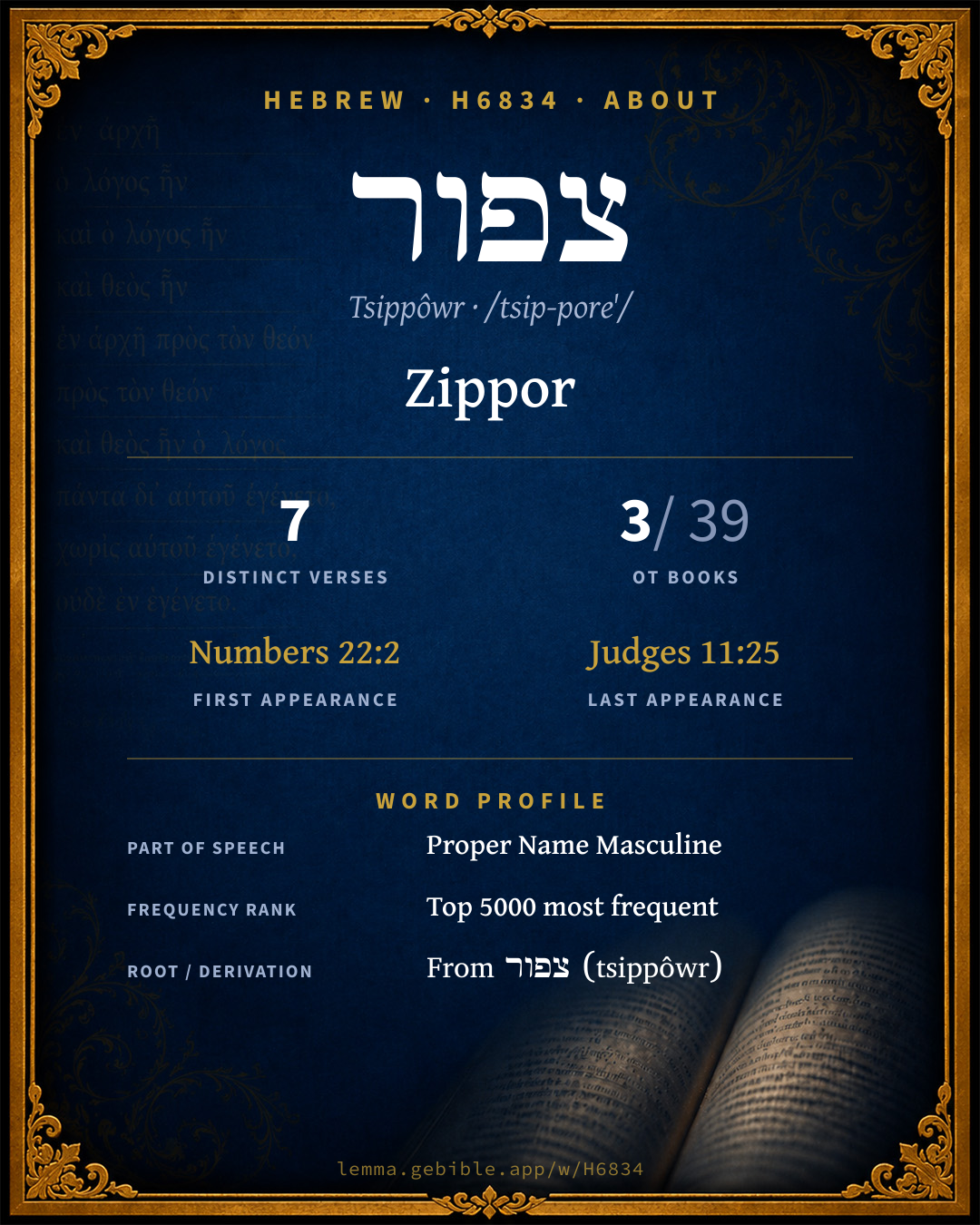
צִפּוֹר
Zippor
BDB lists 2 entries for ‘Zippor’ fuller range ↓
Full lexicon entry — Brown-Driver-Briggs (BDB)
From Brown-Driver-Briggs (BDB)
Where this word appears
Grammar key — what these labels mean
Part of speech
- Noun
- A naming word — a person, place, thing, or idea.
Noun type
- Proper
- A name of a specific person, place, or people (e.g. Abraham, Zion, Israel).
Every verse where H6834 appears in the Book of Joshua — 1 distinct verse. Click any verse to open its interlinear word-by-word view. Verse text shown in the World English Bible for context — . Each verse’s Hebrew form is shown with its reference; the English is not keyword-highlighted, since the data carries no word-level English alignment. Use “Compare translations” on any verse to read it across multiple English versions. This concordance covers the Hebrew Bible; Septuagint (Greek Old Testament) occurrences are not indexed here.
Joshua
About this entry
At a glance — auto-summarized from this page’s data, not written by a person. Every figure links to its source below. This summary describes the numbers; it doesn’t interpret them.
“Zippor” is the headline sense of the Hebrew name צפור (Tsippôwr). It clusters heavily in Numbers, which alone accounts for 71% of its uses. It turns up in 7 verses across 3 books, an uncommon footprint. First canonically at Numbers 22:2, it enters the text early. See 7-verse concordance and the renderings breakdown below.
Gloss history
Strong's 1890 vs modern scholarship
About this word
Strong's H6834 catalogs a Hebrew word from the Hebrew Old Testament.
These counts are not copied from any lexicon or concordance. They are computed here, from the morphology-tagged Hebrew Old Testament. What Lemma adds →
- 7
- distinct verses
- The word appears in 7 distinct verses.
- 3 / 39
- OT books
- The word appears in 3 of 39 Old Testament books.
- #2,835
- by frequency
- Top 5000 most frequent Hebrew words (rank 2,835 of 8,640 Hebrew words by occurrence).
View all 7 occurrences in the concordance →
By section of the Old Testament
By traditional corpus
Conventional, traditional groupings — biblical authorship is debated, so this is a traditional corpus grouping, not an authorship claim. Each share is this word’s portion of its verses in that division of the Hebrew canon. Each figure is a share of the word’s 7 distinct verses.
- Torah (Pentateuch) 5 verses · 71%
- Prophets (Nevi'im) 2 verses · 29%
How translations render this word
Counts come from each version’s own published word-to-Strong’s tagging or interlinear alignment — an approximate guide to how each version renders this word, not a word-level alignment the data otherwise carries. Because each total is that version’s own tagged count, the per-version totals vary from one another and need not match the appearance or distinct-verse counts above. These counts may also differ from a printed concordance because Lemma counts each distinctly tagged rendering and does not collapse phrase taggings into a single head-word total. This is a fixed set of word-tagged versions (KJV, ASV, BSB, ULT) and does not change with the reading translation you choose elsewhere. Each version’s license is shown beside its name below (and on Sources).
BDB lists this Strong’s number as 2 distinct words (homographs). Each count above pools all of them and is not split by sense — see the Senses section below. A low-frequency rendering may belong to a different one of those words, not the primary meaning.
- King James Version†: Zippor 7×
- American Standard Version†: Zippor 6×
- Berean Standard Bible†: Zippor 7×
- unfoldingWord Literal Text†: Zippor 7×
King James Version Public Domain
Renders H6834 across 7† tagged occurrences — most commonly:
American Standard Version Public Domain
Renders H6834 across 7† tagged occurrences — most commonly:
Plus 1 rendering that appears only once — usually multi-word phrases or single function words the recovered tagging swept in, not distinct renderings.
Berean Standard Bible Public Domain
Renders H6834 across 7† tagged occurrences — most commonly:
unfoldingWord Literal Text CC BY-SA 4.0
Renders H6834 across 7† tagged occurrences — most commonly:
Senses in the full BDB
What do BDB’s symbols mean?
BDB uses these scholarly abbreviations:
| Symbol | Meaning |
|---|---|
| 𝔊 | the Septuagint (the ancient Greek translation, LXX) |
| 𝔙 | the Vulgate (the Latin translation) |
| 𝔖 | the Syriac version (the Peshitta) |
| 𝔗 | the Targum (the Aramaic translation) |
| ψ | the Psalms |
| √ | root (the underlying root or stem) |
| ‖ | parallel passage (a synonymous or contrasted parallel) |
| † | the dagger: every passage where the word occurs is cited |
The 2 senses and sub-senses the full Brown-Driver-Briggs lexicon distinguishes for this word, in lexicon order (not ranked by frequency), with BDB’s own verbatim wording and sub-sense lettering. Shown in Hebrew script with BDB’s own scholarly abbreviations. The condensed entry is in the Lexicon Entry tab. See also the Forms in the corpus table below.
צפור I
- 1. single bird, Am 3:5; Ho 11:11 (sim.; ‖ יוֹנָה), La 3:52; Jb 40:29 ψ 102:8; 124:7 Pr 6:5; 7:23; 26:2; 27:8 (all sim.), Lv 14:5 + 10 times Ps. 84:4; כָּל־צ׳ כָּנָף Dt 4:17, כָּל־צ׳ טְהוֹרָה 14:11 (כל distrib.); קַן־צ׳ 22:6 bird’s nest, קוֹל הַצּ׳ Ec 12:4; pl. Is 31:5 (sim.), Ne 5:18; Lv 14:4 (שְׁתֵּי צִפֳּרִים, in purif.; cf. WeHeid. 2. 171 RSSem. i. 402, 2nd ed. 422), v 49 (id.), ψ 104:17 Ec 9:12. e.g. Amos 3:5
- 2. less often coll., either def. Gn 15:10 (two), or indef. ψ 11:1 (fig.), צִפֹּר שָׁמַיִם 8:9, especially צ׳ (כָּל־)כָּנָף Ez 39:17 ψ 148:10, כֹּל צ׳ כָּל־כָּנָף Gn 7:14; Ez 17:23, also redund. c. עַיִט, עֵיט צ׳ כָּל־כָּנָף Ez 39:4 birds of prey of all kinds. e.g. Genesis 15:10
צפור II m. father of Balak, king of Moab (bird
Senses from the full Brown-Driver-Briggs lexicon (Brown, Driver, Briggs; Oxford 1906 — public domain), digitized via Sefaria, supplemented by the OpenScriptures HebrewLexicon (CC BY 4.0). Full attribution on Sources.
Word origin
I. n.f. Am 3:5 (m. ψ 102:8, cf. KöSynt.§ 252 a, so 104:17, yet cf. AlbrZAW xvi (1896), 71), bird;—abs. צִפּוֹר Ho 11:11 + 15 times, צִפֹּר Gn 15:10 + 11 times, cstr. צִפּוֹר Dt 4:17 + 5 times, צִפֹּר ψ 8:9; pl. צִפֳּרִים Lv 14:4 + 5 times;—
II. n.pr.m. father of Balak, king of Moab (bird; perhaps specif. sparrow, cf. GrayProp. N. 94; Palm. n.pr.m. צפרא);—צ׳ Nu 22:2, 4, 16; Jos 24:9; Ju 11:25, צִפֹּר Nu 22:10; 23:18; Σεπφωρ.
— Brown-Driver-Briggs (Oxford 1906, public domain), digitized via Sefaria, supplemented by the OpenScriptures HebrewLexicon (CC BY 4.0). See Sources.
Derived from צפור (tsippôwr) (H6833) — bird.
Jastrow Dictionary
A second Hebrew/Aramaic lexicon for comparison, covering Aramaic and post-biblical (Talmudic, Targumic, Midrashic) usage that the biblical-Hebrew BDB does not. Matched by lemma rather than by Strong’s number, so a lemma may carry more than one Jastrow headword (shown separately below), and the entries cover usage well beyond the Bible.
צִפּוֹר
- c. (b. h.; v. צְפַר I)
- 1. bird. Ab. Zar. III, 1 כל שיש בידו … או צ׳ וכ׳ a statue which holds in its hand a staff or a bird &c. Ib. 41ᵃ צ׳ שתופש … כצ׳ the emblem of the bird is a symbol that he causes himself to be caught like a bird in behalf of the entire world (v. כַּדּוּר); Y. ib. III, 42ᶜ bot. צ׳ ותמצא וכ׳ the bird alludes to (Is. X, 14), ‘My hand reacheth forth, as for a nest, to the riches of all peoples’ (universal conquest); Num. R. s. 13. Sabb. XIII, 5, v. צוּד h. Ib. 106ᵇ, a. fr. צ׳ דרור, v. דְּרוֹר; a. v. fr.—Y. Snh. X, 28ᵈ bot. אמר לו אין צִפּוֹרְךָ מדינית (some ed. צִפּוֹרָה) he said to Moses, is not thy bird (Zipporah) a Midianite?—Makhsh. V, 2 העושה צ׳ במים (Var. צִנּוֹר) if one makes ‘a bird’ in water (producing bubbles by blowing through a tube); Tosef. ib. II, 13.—Pl. צִפּוֹרִים, צִפֳּרִים, רִין …, צִי׳. Naz. I, 1 הרי עלי צ׳ וכ׳ (Y. ed. צפר׳) if a person says, I vow birds …, he is bound to be a Nazarite; Y. ib. 51ᵃ bot., sq. ציפורין. Ib. וכי צ׳ הוא מביא וכ׳ does the Nazarite offer ‘birds’, does he not offer doves &c.? Ib. כל עוף … קרוי צ׳ all birds, whether clean or unclean, are called tsipporin. Bab. ib. 3ᵃ ציפרין סמוכין לשיער וכ׳ in saying, ‘I vow birds’, he presumably had in his mind the birds mentioned in connection with the growth of hair (Dan. IV, 30). Neg. XIV, 1 צִפֳּרֵי דרור (Mish. ed. צפרים), v. דְּרוֹר. Ab. Zar. 29ᵃ; Ber. 57ᵇ בשר צ׳ birds’ flesh (bad for convalescents); a. fr. e.g. Isaiah 10:14
- 2. צ׳ נפש (צִפָּר נ׳, צִי׳) [‘the bird of life’,] the cartilage at the end of the sternum (cartilago ensiformis). B. Kam. 90ᵇ במה הכהו … ציפור נפשו Ms. R. (ed. כמה … ציפר נ׳; Ms. F. צפר; v. Rabb. D. S. a. l. note 40) wherewith he struck him, and whether he struck him on his leg or on his stomach; Yalk. Ex. 331; Tosef. Snh. XII, 3. Tosef. Macc. V (IV), 15 כדי שלא תגיע לציפר וכ׳ ed. Zuck. (Var. לצפור; לצורפי, cler. error for לציפור) lest the whip reach his stomach, and he die.—צ׳ כרמים, v. צִפּוֹרֶת.—[צפור, Tosef. Kel. B. Bath. IV, 14 ed. Zuck., v. צְפִירָא II.]
צִפּוֹר ²
- ch., v. צִפַּר
A Dictionary of the Targumim, the Talmud Babli and Yerushalmi, and the Midrashic Literature (Marcus Jastrow; London, Luzac, 1903) — Public Domain. Digitized via Sefaria. Digitized via Sefaria. Full attribution on Sources.
Forms in the corpus
The 7 distinct written forms H6834 takes in the Hebrew Bible, most frequent first — each parse links to that state’s occurrences in the concordance. Hebrew forms include their vowel points and cantillation, so a single lemma takes many written forms.
| Form | Parsing | Example | Uses |
|---|---|---|---|
| צִפּ֑וֹר | Noun, Proper | Numbers 22:2 | 1 |
| צִפּ֔וֹר | Noun, Proper | Numbers 22:16 | 1 |
| צִפּ֖וֹר | Noun, Proper | Judges 11:25 | 1 |
| צִפּ֛וֹר | Noun, Proper | Numbers 22:4 | 1 |
| צִפֹּ֛ר | Noun, Proper | Numbers 22:10 | 1 |
| צִפֹּֽר | Noun, Proper | Numbers 23:18 | 1 |
| צִפּוֹר֙ | Noun, Proper | Joshua 24:9 | 1 |
Same root — word family
Other BDB entries built from the same root as H6834, grouped by Strong’s listed origin. These share a root / origin per the lexicon — not necessarily a shared meaning. Each links to that word’s own entry.
Derives from
Shares the same root
Proper names from this root
People and places named from this root — a name, not an additional meaning of the word.
Compare all same-root words → 1 of the same-root words is a proper name (a person or place). They share a root, not necessarily a meaning.
Bible dictionary
Public-domain dictionary articles matched to this entry by name (Zippor). A biblical name can be shared by more than one person or place, so an article may treat several.
Easton's Bible Dictionary · M. G. Easton, 1897
A little bird, the father of Balak, king of Moab (Num. 22:2, 4).
Smith's Bible Dictionary · William Smith, 1863
(sparrow), father of Balak king of Moab. (Numbers 22:2,4,10,16; 23:18; Joshua 24:9; Judges 11:25) Whether he was the "former king of Moab" alluded to in (Numbers 21:26) we are not told. (B.C. 1451.)
Hitchcock's Bible Names Dictionary · Roswell D. Hitchcock, 1869
bird; sparrow; crown; desert
Classic public-domain reference works; full attribution on Sources.
Septuagint verse parallels
This word appears in 7 verses that also exist in the Greek Old Testament (Septuagint), out of the 7 Hebrew verses it occurs in. You can read those verses in Greek by switching the Old Testament edition to the Septuagint.
Read these verses in the Septuagint
This is a verse-level parallel only — the same verses exist in both the Hebrew and Greek Old Testaments. No word-level Hebrew↔Greek correspondence is claimed: the data carries no such alignment, so no Greek word is shown as this Hebrew word’s translation. Coverage is not total — the Septuagint omits the deuterocanon and renumbers the Psalms, so some Hebrew verses have no direct Greek parallel.