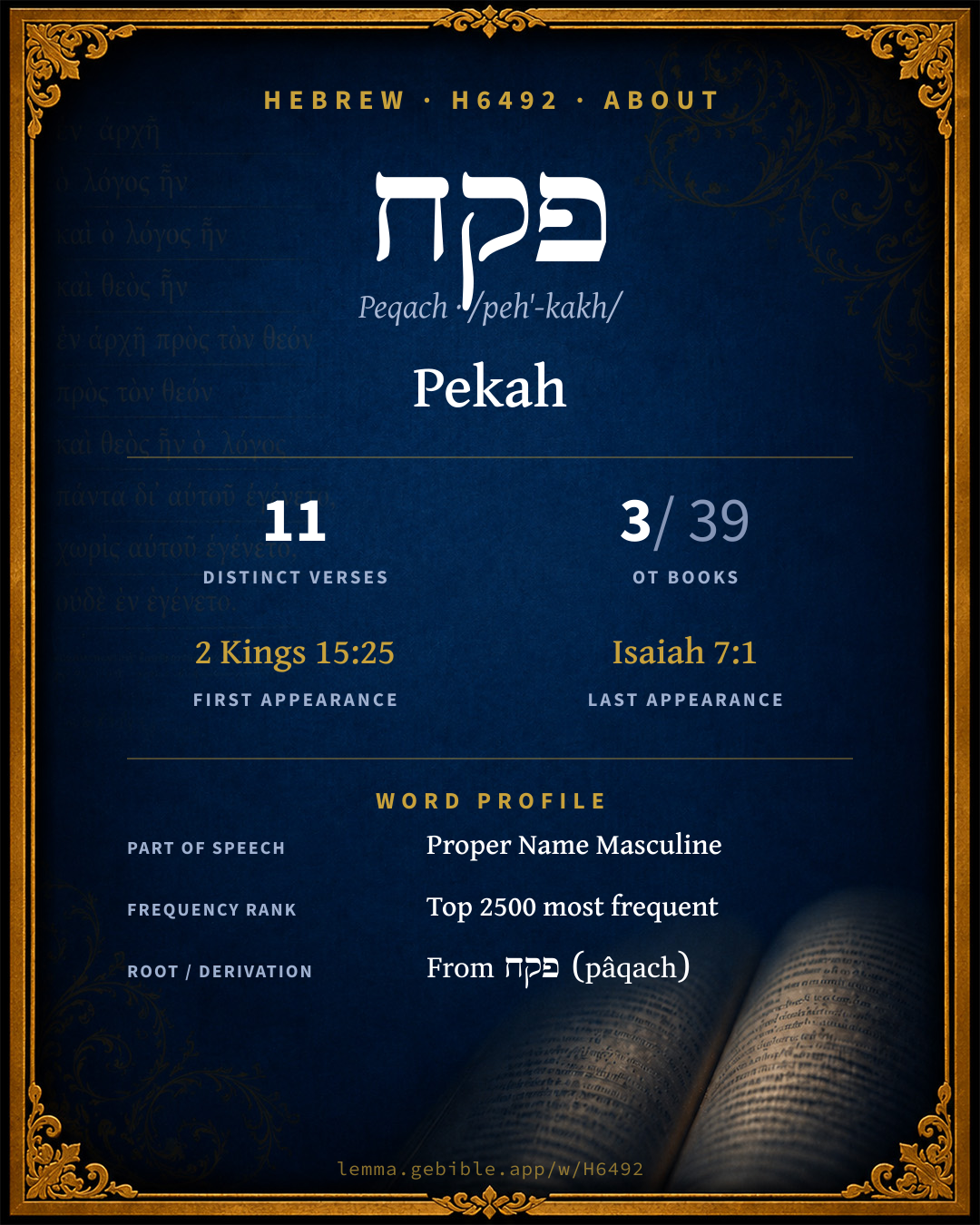
פֶּ֫קַח
Pekah
BDB lists 2 entries for ‘Pekah’ fuller range ↓
Full lexicon entry — Brown-Driver-Briggs (BDB)
From Brown-Driver-Briggs (BDB)
Where this word appears
Grammar key — what these labels mean
Part of speech
- Noun
- A naming word — a person, place, thing, or idea.
Noun type
- Proper
- A name of a specific person, place, or people (e.g. Abraham, Zion, Israel).
Every verse where H6492 appears in the Book of 2 Kings — 9 distinct verses. Click any verse to open its interlinear word-by-word view. Verse text shown in the World English Bible for context — . Each verse’s Hebrew form is shown with its reference; the English is not keyword-highlighted, since the data carries no word-level English alignment. Use “Compare translations” on any verse to read it across multiple English versions. This concordance covers the Hebrew Bible; Septuagint (Greek Old Testament) occurrences are not indexed here.
2 Kings
- 2 Kings 15:25 פֶּ֨קַח n Proper Pekah the son of Remaliah, his captain, conspired against him, and struck him in Samaria, in the castle of the king's house, with Argob and Arieh; and with him were fifty men of the Gileadites: and he killed him, and reigned in his place.
- 2 Kings 15:27 פֶּ֣קַח n Proper In the two and fiftieth year of Azariah king of Judah Pekah the son of Remaliah began to reign over Israel in Samaria, [and reigned] twenty years.
- 2 Kings 15:29 פֶּ֣קַח n Proper In the days of Pekah king of Israel came Tiglath Pileser king of Assyria, and took Ijon, and Abel Beth Maacah, and Janoah, and Kedesh, and Hazor, and Gilead, and Galilee, all the land of Naphtali; and he carried them captive to Assyria.
- 2 Kings 15:30 פֶּ֨קַח֙ n Proper Hoshea the son of Elah made a conspiracy against Pekah the son of Remaliah, and struck him, and killed him, and reigned in his place, in the twentieth year of Jotham the son of Uzziah.
- 2 Kings 15:31 פֶ֖קַח n Proper Now the rest of the acts of Pekah, and all that he did, behold, they are written in the book of the chronicles of the kings of Israel.
- 2 Kings 15:32 לְ/פֶ֥קַח prep + n Proper In the second year of Pekah the son of Remaliah king of Israel began Jotham the son of Uzziah king of Judah to reign.
- 2 Kings 15:37 פֶּ֥קַח n Proper In those days Yahweh began to send against Judah Rezin the king of Syria, and Pekah the son of Remaliah.
- 2 Kings 16:1 לְ/פֶ֖קַח prep + n Proper In the seventeenth year of Pekah the son of Remaliah Ahaz the son of Jotham king of Judah began to reign.
- 2 Kings 16:5 וּ/פֶ֨קַח conj + n Proper Then Rezin king of Syria and Pekah son of Remaliah king of Israel came up to Jerusalem to war: and they besieged Ahaz, but could not overcome him.
About this entry
At a glance — auto-summarized from this page’s data, not written by a person. Every figure links to its source below. This summary describes the numbers; it doesn’t interpret them.
פקח — transliterated Peqach — is a Hebrew name carrying the sense “Pekah.” More than three-quarters of its appearances fall in 2 Kings. The Hebrew Bible uses it across 11 verses — uncommon. It first appears in 2 Kings 15:25. See 11-verse concordance and the renderings breakdown below.
Gloss history
Strong's 1890 vs modern scholarship
About this word
Strong's H6492 catalogs a Hebrew word from the Hebrew Old Testament.
These counts are not copied from any lexicon or concordance. They are computed here, from the morphology-tagged Hebrew Old Testament. What Lemma adds →
- 11
- distinct verses
- The word appears in 11 distinct verses.
- 3 / 39
- OT books
- The word appears in 3 of 39 Old Testament books.
- #2,210
- by frequency
- Top 2500 most frequent Hebrew words (rank 2,210 of 8,640 Hebrew words by occurrence).
View all 11 occurrences in the concordance →
Most concentrated in
- 2 Kings 9 verses 82%
- 2 Chronicles 1 verse 9%
- Isaiah 1 verse 9%
By section of the Old Testament
By traditional corpus
Conventional, traditional groupings — biblical authorship is debated, so this is a traditional corpus grouping, not an authorship claim. Each share is this word’s portion of its verses in that division of the Hebrew canon. Each figure is a share of the word’s 11 distinct verses.
- Prophets (Nevi'im) 10 verses · 91%
- Writings (Ketuvim) 1 verse · 9%
How translations render this word
Counts come from each version’s own published word-to-Strong’s tagging or interlinear alignment — an approximate guide to how each version renders this word, not a word-level alignment the data otherwise carries. Because each total is that version’s own tagged count, the per-version totals vary from one another and need not match the appearance or distinct-verse counts above. These counts may also differ from a printed concordance because Lemma counts each distinctly tagged rendering and does not collapse phrase taggings into a single head-word total. This is a fixed set of word-tagged versions (KJV, ASV, BSB, ULT) and does not change with the reading translation you choose elsewhere. Each version’s license is shown beside its name below (and on Sources).
- King James Version: Pekah 10×
- American Standard Version: Pekah 10×
- Berean Standard Bible: Pekah 10×
- unfoldingWord Literal Text: Pekah 11×
King James Version Public Domain
Renders H6492 across 11 tagged occurrences — most commonly:
Plus 1 rendering that appears only once — usually multi-word phrases or single function words the recovered tagging swept in, not distinct renderings.
American Standard Version Public Domain
Renders H6492 across 11 tagged occurrences — most commonly:
Plus 1 rendering that appears only once — usually multi-word phrases or single function words the recovered tagging swept in, not distinct renderings.
Berean Standard Bible Public Domain
Renders H6492 across 11 tagged occurrences — most commonly:
Plus 1 rendering that appears only once — usually multi-word phrases or single function words the recovered tagging swept in, not distinct renderings.
unfoldingWord Literal Text CC BY-SA 4.0
Renders H6492 across 11 tagged occurrences — most commonly:
Senses in BDB
The 2 senses BDB distinguishes for this word, in lexicon order (not ranked by frequency or importance). The full entry — with sub-senses — is in the Lexicon Entry tab.
- Pekah = "opened"
- son of Remaliah…
Word origin
n.pr.m. usurping king of Israel, Φακεε (opening (? of eyes), or cf. Syriac ܦܶܩܚܳܐ flower; cf. n.pr.m. פקח, פקחי, on old Isr. seals; in Assyrian Paḳaḫa (acc.) SchrCOT 2 K 15:30);—2 K 15:25, 27, 29, 30, 31, 32, 37; 16:1, 5; Is 7:1; 2 Ch 28:6.
— Brown-Driver-Briggs (Oxford 1906, public domain), digitized via Sefaria, supplemented by the OpenScriptures HebrewLexicon (CC BY 4.0). See Sources.
Derived from פקח (pâqach) (H6491) — to open.
Jastrow Dictionary
A second Hebrew/Aramaic lexicon for comparison, covering Aramaic and post-biblical (Talmudic, Targumic, Midrashic) usage that the biblical-Hebrew BDB does not. Matched by lemma rather than by Strong’s number, so a lemma may carry more than one Jastrow headword (shown separately below), and the entries cover usage well beyond the Bible.
פָּקַח
- (b. h.) to break through, open.
- 1. to open. B. Bath. 12ᵇ אפילו … יין מְפַקְּחוֹ even if his heart be closed like a virgin (his mind be dull), wine will open it (make it bright).—Esp. (with גַּל) to open a heap of debris; to attempt to rescue a person supposed to be buried in debris. Ohol. XVI, 4 המְפקּחַ בגל he who digs among debris (not knowing certainly that a corpse is buried there). Pes. VIII, 6. Keth. 15ᵇ לְפַקֵּחַ עליו את הגל as regards digging for his sake (on the Sabbath). Ib. 5ᵃ מִפַקְּחִין פיקוח נפש, v. פִּיקּוּחַ; a. fr.
- 2. [to have the eyes open,] to guard, watch, care. Ib. הולכין … לפקח על עסקי רבים וכ׳ we may assemble in synagogues and school houses (in theatres and circuses) in order to watch over public affairs, on the Sabbath. Sabb. 150ᵇ לפקח על עסקי כלה וכ׳ to make arrangements for the reception of a bride &c.; Y. Ber. III, beg. 5ᵈ; a. fr.
- , Nithpa. נִתְפַּקֵּחַ (v. פִּקֵּחַ)
- 1. to recover the faculty of hearing (and speech). Gitt. II, 6. Yeb. 113ᵃ. Gen. R. s. 53; a. e.
- 2. to recover the faculty of speech. Pesik. R. s. 42 וכל אלם נפקח and every mute was made speaking.
- to cause to escape. B. Bath. 10ᵃ שינה מַפְקַחְתּוֹ, v. פָּכַח.
פְּקַח I
- , to open (the eye); (with על) to guard, care. Targ. Job XIV, 3. Ib. XXVII, 19. Targ. Ps. (XLVI, 8; a. fr.
- 1. to remove debris. Targ. Koh. III, 5.
- 2. to make open-minded, bright. Hor. 13ᵇ; Snh. 70ᵃ; Yoma 76ᵇ פַּקְחִין (= פקחני) made me open-minded, v. רֵיחָנָא.
- to awaken, become sober. Targ. Ps. LXXVIII, 65 (h. text מתרונן).
פְּקַח II
- (preced.) brighteness, prudence. Targ. Prov. XXVI, 12 פ׳ סכלא וכ׳ Ms. (ed. only סכלא, v. Pesh.) the cunning of a fool is better than his (h. text תקוה).
פִּקֵּחַ
- , פִּקַּחַת, פִּיקַּ׳ f. (b. h.; preced. wds.) [open,]
- 1. (opp. to חֵרֵשׁ) hearing. Yeb. XIV, 1 חרש שנשא פ׳ ופ׳ וכ׳ if a deaf mute married one hearing, or a hearing person married &c.; פ׳ שנשא פ׳ ונתחרשה if one hearing married one hearing, and she became deaf (and dumb); a. fr.
- 2. (opp. to סוּמָא or עִוֵּר) seeing. Ex. R. s. 36 משל לפ׳ וסומא וכ׳ like a seeing and a blind man walking together &c. Ex. R. s. 3 (ref. to Ex. IV, 11) פ׳ לראייה פ׳ לשמיעה piḳḳeaḥ refers both to sight and to hearing; a. e. e.g. Exodus 4:11
- 3. (opp. to טִפֵּשׁ) bright, smart, prudent. Keth. 88ᵃ (in Chald. dict.) אי פ׳ הוא וכ׳ if he (the husband) be prudent, he may cause her to have an oath administered to her according to Biblical law. Y. Meg. II, end, 73ᶜ הוי פ׳ ושתוק be prudent and keep silence; Yoma 7ᵃ. Y. Sabb. II, end, 5ᶜ אשה פ׳ a wise woman; a. fr.—Pl. פִּקְחִים, פִּקְחִין, פִּי׳; פִּקְחוֹת, פִּי׳. Yeb. XIV, 3, sq. Sabb. 153ᵃ. Y. Kidd. IV, 66ᶜ; Treat. Sof’rim XV, 10 רובן … פ׳ most bastards are bright; a. fr.
A Dictionary of the Targumim, the Talmud Babli and Yerushalmi, and the Midrashic Literature (Marcus Jastrow; London, Luzac, 1903) — Public Domain. Digitized via Sefaria. Digitized via Sefaria. Full attribution on Sources.
Forms in the corpus
The 8 distinct written forms H6492 takes in the Hebrew Bible, most frequent first — each parse links to that state’s occurrences in the concordance. Hebrew forms include their vowel points and cantillation, so a single lemma takes many written forms.
| Form | Parsing | Example | Uses |
|---|---|---|---|
| וּ/פֶ֨קַח | Noun, Proper | 2 Kings 16:5 | 2 |
| פֶּ֣קַח | Noun, Proper | 2 Kings 15:27 | 2 |
| פֶּ֨קַח | Noun, Proper | 2 Chronicles 28:6 | 2 |
| לְ/פֶ֖קַח | Noun, Proper | 2 Kings 16:1 | 1 |
| לְ/פֶ֥קַח | Noun, Proper | 2 Kings 15:32 | 1 |
| פֶ֖קַח | Noun, Proper | 2 Kings 15:31 | 1 |
| פֶּ֥קַח | Noun, Proper | 2 Kings 15:37 | 1 |
| פֶּ֨קַח֙ | Noun, Proper | 2 Kings 15:30 | 1 |
Same root — word family
Other BDB entries built from the same root as H6492, grouped by Strong’s listed origin. These share a root / origin per the lexicon — not necessarily a shared meaning. Each links to that word’s own entry.
Derives from
Shares the same root
Proper names from this root
People and places named from this root — a name, not an additional meaning of the word.
Compare all same-root words → Showing 4 of 5 — not the complete family. 1 of the same-root words is a proper name (a person or place). They share a root, not necessarily a meaning.
Bible dictionary
Public-domain dictionary articles matched to this entry by name (Pekah). A biblical name can be shared by more than one person or place, so an article may treat several.
Easton's Bible Dictionary · M. G. Easton, 1897
Open-eyed, the son of Remaliah a captain in the army of Pekahiah, king of Israel, whom he slew, with the aid of a band of Gileadites, and succeeded (B.C. 758) on the throne (2 Kings 15:25). Seventeen years after this he entered into an alliance with Rezin, king of Syria, and took part with him in besieging Jerusalem (2 Kings 15:37; 16:5). But Tiglath-pilser, who was in alliance with Ahaz, king of Judah, came up against Pekah, and carried away captive many of the inhabitants of his kingdom (2 Kings 15:29). This was the beginning of the "Captivity." Soon after this Pekah was put to death by Hoshea, the son of Elah, who usurped the throne (2 Kings 15:30; 16:1-9. Comp. Isa. 7:16; 8:4; 9:12). He is supposed by some to have been the "shephard" mentioned in Zech. 11:16.
Smith's Bible Dictionary · William Smith, 1863
(open-eyed), son of Remaliah, originally a captain of Pekaiah king of Israel, murdered his master seized the throne, and became the 18th sovereign of the northern kingdom, B.C. 757-740. Under his predecessors Israel had been much weakened through the payment of enormous tribute to the Assyrians (see especially) (2 Kings 15:20) and by internal wars and conspiracies. Pekah seems to have steadily applied himself to the restoration of power. For this purpose he contracted a foreign alliance, and fixed his mind on the plunder of the sister kingdom of Judah. He must have made the treaty by which he proposed to share its spoil with Rezin king of Damascus, when Jotham was still on the throne of Jerusalem (2 Kings 10:37) but its execution was long delayed, probably in consequence of that prince's righteous and vigorous administration. (2 Chronicles 27:1) ... When however his weak son Ahaz succeeded to the crown of David, the allies no longer hesitated, but entered upon the siege of Jerusalem, B.C. 742. The history of the war is found in 2Kin 13 and 2Chr 28. It is famous as the occasion of the great prophecies in Isai 7-9. Its chief result was the Jewish port of Elath on the Red Sea; but the unnatural alliance of Damascus and Samaria was punished through the complete overthrow of the ferocious confederates by Tiglath-pileser. The kingdom of Damascus. was finally suppressed and Rezin put to death while Pekah was deprived of at least half his kingdom, including all the northern portion and the whole district to the east of Jordan. Pekah himself, now fallen into the position of an Assyrian vassal was of course compelled to abstain from further attacks on Judah. Whether his continued tyranny exhausted the patience of his subjects, or whether his weakness emboldened them to attack him, is not known; but, from one or the other cause, Hoshea the son of Elah conspired against him and put him to death.
Hitchcock's Bible Names Dictionary · Roswell D. Hitchcock, 1869
he that opens; that is at liberty
Classic public-domain reference works; full attribution on Sources.
Septuagint verse parallels
This word appears in 11 verses that also exist in the Greek Old Testament (Septuagint), out of the 11 Hebrew verses it occurs in. You can read those verses in Greek by switching the Old Testament edition to the Septuagint.
Read these verses in the Septuagint
This is a verse-level parallel only — the same verses exist in both the Hebrew and Greek Old Testaments. No word-level Hebrew↔Greek correspondence is claimed: the data carries no such alignment, so no Greek word is shown as this Hebrew word’s translation. Coverage is not total — the Septuagint omits the deuterocanon and renumbers the Psalms, so some Hebrew verses have no direct Greek parallel.