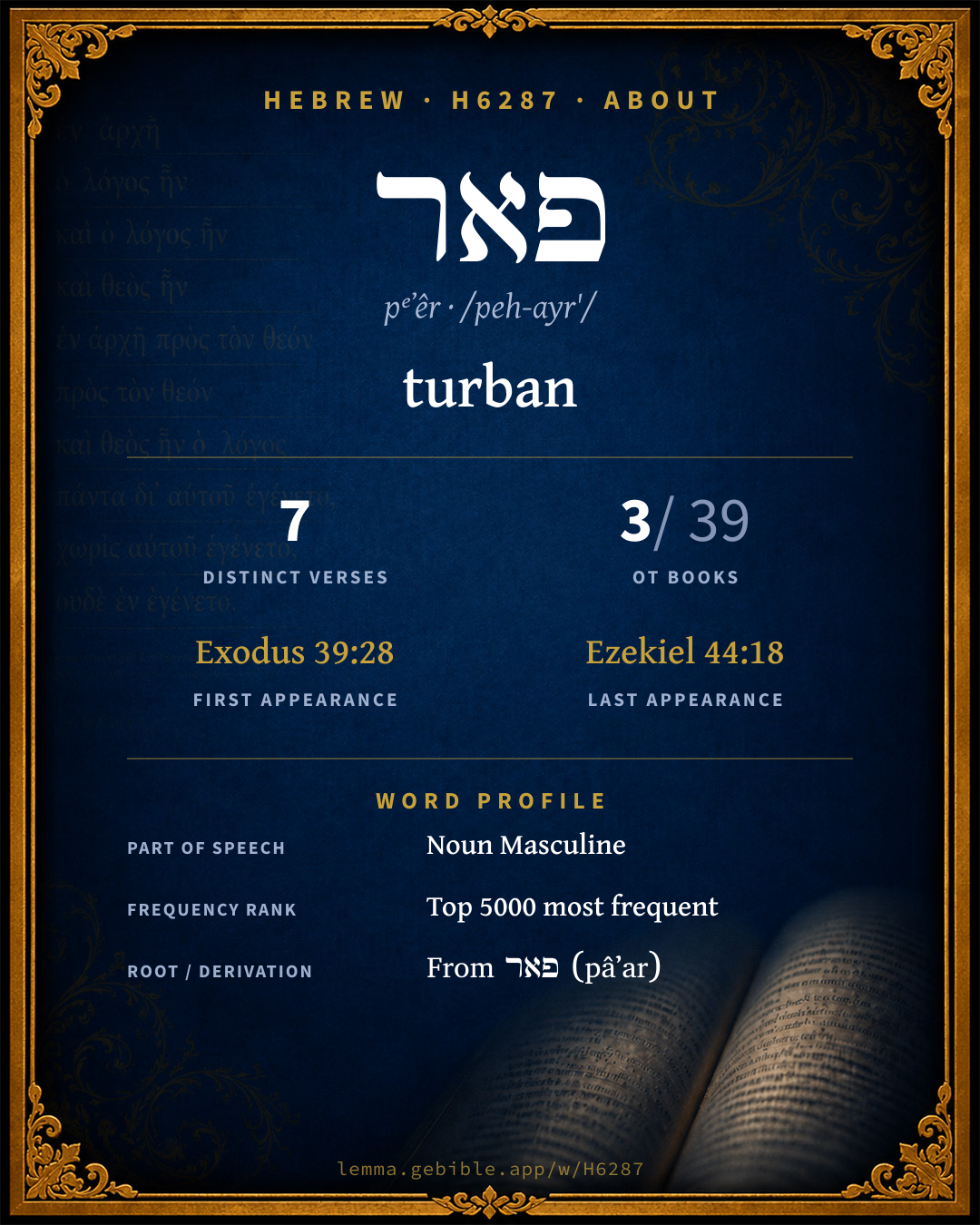
פְּאֵר
turban
Full lexicon entry — Brown-Driver-Briggs (BDB)
From Brown-Driver-Briggs (BDB)
Where this word appears
Grammar key — what these labels mean
Part of speech
- Noun
- A naming word — a person, place, thing, or idea.
Noun type
- Common
- A common noun — a general class of person, place, or thing (“king,” “city,” “water”), not a specific name.
State
- Construct
- A noun bound to a following noun in a possessive / “of” relationship (the construct chain).
- Absolute
- The independent form of a noun, not bound to a following word.
Gender
- Masculine
- Grammatically masculine.
Number
- Plural
- More than one (in Hebrew, generally three or more).
- Singular
- One.
Every verse where H6287 appears in the Book of Isaiah — 3 distinct verses. Click any verse to open its interlinear word-by-word view. Verse text shown in the World English Bible for context — . Each verse’s Hebrew form is shown with its reference; the English is not keyword-highlighted, since the data carries no word-level English alignment. Use “Compare translations” on any verse to read it across multiple English versions. This concordance covers the Hebrew Bible; Septuagint (Greek Old Testament) occurrences are not indexed here.
Isaiah
- Isaiah 3:20 הַ/פְּאֵרִ֤ים ptcl def.art + n c mp the headdresses, the ankle chains, the sashes, the perfume bottles, the charms,
- Isaiah 61:3 פְּאֵ֜ר n c ms to appoint to those who mourn in Zion, to give to them a garland for ashes, the oil of joy for mourning, the garment of praise for the spirit of heaviness; that they may be called trees of righteousness, the planting of Yahweh, that he may be glorified.
- Isaiah 61:10 פְּאֵ֔ר n c ms I will greatly rejoice in Yahweh, my soul shall be joyful in my God; for he has clothed me with the garments of salvation, he has covered me with the robe of righteousness, as a bridegroom decks himself with a garland, and as a bride adorns herself with her jewels.
About this entry
At a glance — auto-summarized from this page’s data, not written by a person. Every figure links to its source below. This summary describes the numbers; it doesn’t interpret them.
פאר — transliterated pᵉʼêr — is a Hebrew noun carrying the sense “turban.” It first appears in Exodus 39:28. The Hebrew Bible uses it across 7 verses — uncommon. More than a third of its appearances fall in Isaiah. Related forms include פאר, פארה and פארור. See the sense tree, 7-verse concordance, and the renderings breakdown below.
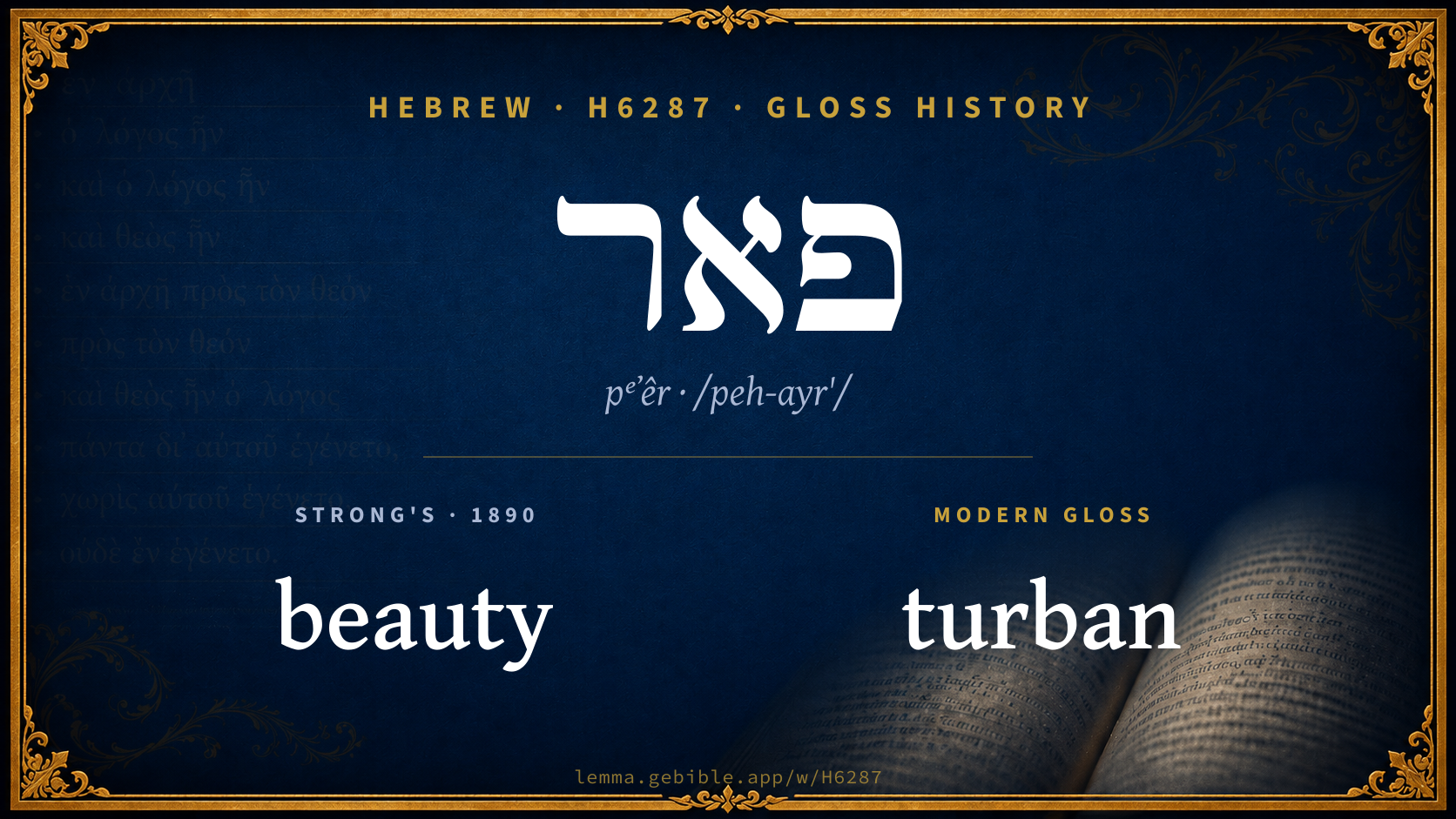
Gloss history
Strong's 1890 vs modern scholarship
About this word
Strong's H6287 catalogs a Hebrew word from the Hebrew Old Testament.
These counts are not copied from any lexicon or concordance. They are computed here, from the morphology-tagged Hebrew Old Testament. What Lemma adds →
- 7
- distinct verses
- The word appears in 7 distinct verses.
- 3 / 39
- OT books
- The word appears in 3 of 39 Old Testament books.
- #2,835
- by frequency
- Top 5000 most frequent Hebrew words (rank 2,835 of 8,640 Hebrew words by occurrence).
View all 7 occurrences in the concordance →
By section of the Old Testament
By traditional corpus
Conventional, traditional groupings — biblical authorship is debated, so this is a traditional corpus grouping, not an authorship claim. Each share is this word’s portion of its verses in that division of the Hebrew canon. Each figure is a share of the word’s 7 distinct verses.
- Prophets (Nevi'im) 6 verses · 86%
- Torah (Pentateuch) 1 verse · 14%
How translations render this word
Counts come from each version’s own published word-to-Strong’s tagging or interlinear alignment — an approximate guide to how each version renders this word, not a word-level alignment the data otherwise carries. Because each total is that version’s own tagged count, the per-version totals vary from one another and need not match the appearance or distinct-verse counts above. These counts may also differ from a printed concordance because Lemma counts each distinctly tagged rendering and does not collapse phrase taggings into a single head-word total. This is a fixed set of word-tagged versions (KJV, ASV, BSB, ULT) and does not change with the reading translation you choose elsewhere. Each version’s license is shown beside its name below (and on Sources).
- King James Version: Bonnets 2×
- American Standard Version: Tires 2×
- Berean Standard Bible: Turbans 2×
- unfoldingWord Literal Text: Headdress 2×
King James Version Public Domain
Renders H6287 across 7 tagged occurrences — most commonly:
Plus 5 renderings that appear only once — usually multi-word phrases or single function words the recovered tagging swept in, not distinct renderings.
American Standard Version Public Domain
Renders H6287 across 7 tagged occurrences — most commonly:
Plus 5 renderings that appear only once — usually multi-word phrases or single function words the recovered tagging swept in, not distinct renderings.
Berean Standard Bible Public Domain
Renders H6287 across 7 tagged occurrences — most commonly:
Plus 5 renderings that appear only once — usually multi-word phrases or single function words the recovered tagging swept in, not distinct renderings.
unfoldingWord Literal Text CC BY-SA 4.0
Renders H6287 across 8 tagged occurrences — most commonly:
Plus 6 renderings that appear only once — usually multi-word phrases or single function words the recovered tagging swept in, not distinct renderings.
Senses in BDB
The 1 sense BDB distinguishes for this word, in lexicon order (not ranked by frequency or importance). The full entry — with sub-senses — is in the Lexicon Entry tab.
- head-dress, ornament, turban
Word origin
n.m. Ez 44:18 head-dress, turban (? orig. ornament);—abs. פ׳ of bridegroom Is 61:10, sign of joy v 3 (opp. mourning, and so) פְּאֵרְךָ Ez 24:17, pl. sf. פְּאֵרֵכֶם v 23 (worn by men of position); of priests פַּאֲרֵי פִשְׁתִּים Ez 44:18, פּ׳ הַמִּגְבָּעֹת שֵׁשׁ Ex 39:28 (P); pl. abs. פְּאֵרִים Is 3:20 (of luxurious women).
— Brown-Driver-Briggs (Oxford 1906, public domain), digitized via Sefaria, supplemented by the OpenScriptures HebrewLexicon (CC BY 4.0). See Sources.
Derived from פאר (pâʼar) (H6286) — to glorify.
Jastrow Dictionary
A second Hebrew/Aramaic lexicon for comparison, covering Aramaic and post-biblical (Talmudic, Targumic, Midrashic) usage that the biblical-Hebrew BDB does not. Matched by lemma rather than by Strong’s number, so a lemma may carry more than one Jastrow headword (shown separately below), and the entries cover usage well beyond the Bible.
פְּאֵר
- פאר to cut off; to distinguish) ornament, crown, bonnet of distinction. Y. M. Kat. III, 82ᵈ top (ref. to פארך, Ez. XXIV, 17) אית דבעי מימר אילו התפלין some say, this refers to the T’fillin (which ordinarily a mourner must not put on); אית דבעי מימר זה הגיהוץ some say, this refers to glossy linen (festive dress, v. גִּיהוּץ); Ber. 11ᵃ אבל חייב … שהרי נאמר בהם פ׳ a mourner is bound to observe all ceremonial laws …, except that of T’fillin, which are called an ornament; ib. 16ᵇ; a. e.—*Pl. פְּאֵרוֹת head-ornaments, pearls, trinkets (strung on chains or cords). Ab. Zar. 47ᵃ בני מעיה מהו לפ׳ may its small intestines be used for pearl-strings? [Ms. M. לכנורות, v. כִּנּוֹר; ed. Pes. a. oth. פְּאוֹרוֹת; cmp. b. h. פֻּארָה, פֹּארֹת]. e.g. Ezekiel 24:17
פָּאַר
- (b. h.), Pi. פֵּאֵר (denom. of preced.)
- 1. to cut the crown off. Ḥull. 131ᵃ, sq. (ref. to תְפָאֵר, Deut. XXIV, 20) שלא תטול תפארתו ממנו thou must not cut the crown off it (the last berries). e.g. Deuteronomy 24:20
- 2. to crown, glorify. Lev. R. s. 2 כל מה … לגדלן ולפָאֲרָן פָּאֵר … להִתְפָּאֵר בהם as much as thou canst praise Israel, praise, as much as thou canst raise and glorify them, glorify, for I am to be glorified through them; Tanḥ. Ki Thissa 8; Pesik. Shek., p. 17ᵇ לפָאֲרוֹ פָּאֲרוֹ; a. e.—Part. pass. מְפוֹאָר; f. מְפוֹאָרָה, מְפוֹאֶרֶת. Taan. 7ᵃ (to R. Joshua) אי חכמה מפ׳ בכלי מכוער O for that glorious wisdom in an ugly vessel! Ab. Zar. 24ᵇ, v. עֲדִי II.
- 1. to lord it, rule. Sifré Deut. 284 (ref. to תפאר, v. supra) לא תִתְפָּאֵר לעני do not make thyself the master of the poor man (i.e. do not decide who shall and who shall not get the gleanings &c.); Yalk. ib. 937.
- 2. to be adorned, glorified. Lev. R. l. c., a. e., v. supra. Esth. R. to III, 6, v. פּוּרְפּוּרָא; a. e.
A Dictionary of the Targumim, the Talmud Babli and Yerushalmi, and the Midrashic Literature (Marcus Jastrow; London, Luzac, 1903) — Public Domain. Digitized via Sefaria. Digitized via Sefaria. Full attribution on Sources.
Forms in the corpus
The 7 distinct written forms H6287 takes in the Hebrew Bible, most frequent first — each parse links to that state’s occurrences in the concordance. Hebrew forms include their vowel points and cantillation, so a single lemma takes many written forms.
| Form | Parsing | Example | Uses |
|---|---|---|---|
| הַ/פְּאֵרִ֤ים | Noun, Common, Masculine, Plural, Absolute | Isaiah 3:20 | 1 |
| וּ/פְאֵרֵ/כֶ֣ם | Noun, Common, Masculine, Plural, Construct | Ezekiel 24:23 | 1 |
| פְאֵֽרְ/ךָ֙ | Noun, Common, Masculine, Singular, Construct | Ezekiel 24:17 | 1 |
| פְּאֵ֔ר | Noun, Common, Masculine, Singular, Absolute | Isaiah 61:10 | 1 |
| פְּאֵ֜ר | Noun, Common, Masculine, Singular, Absolute | Isaiah 61:3 | 1 |
| פַּאֲרֵ֤י | Noun, Common, Masculine, Plural, Construct | Ezekiel 44:18 | 1 |
| פַּאֲרֵ֥י | Noun, Common, Masculine, Plural, Construct | Exodus 39:28 | 1 |
Same root — word family
Other BDB entries built from the same root as H6287, grouped by Strong’s listed origin. These share a root / origin per the lexicon — not necessarily a shared meaning. Each links to that word’s own entry.
Derives from
Shares the same root
Proper names from this root
People and places named from this root — a name, not an additional meaning of the word.
Compare all same-root words → Showing 4 of 6 — not the complete family. 1 of the same-root words is a proper name (a person or place). They share a root, not necessarily a meaning.
Septuagint verse parallels
This word appears in 6 verses that also exist in the Greek Old Testament (Septuagint), out of the 7 Hebrew verses it occurs in. You can read those verses in Greek by switching the Old Testament edition to the Septuagint.
Read these verses in the Septuagint
This is a verse-level parallel only — the same verses exist in both the Hebrew and Greek Old Testaments. No word-level Hebrew↔Greek correspondence is claimed: the data carries no such alignment, so no Greek word is shown as this Hebrew word’s translation. Coverage is not total — the Septuagint omits the deuterocanon and renumbers the Psalms, so some Hebrew verses have no direct Greek parallel.