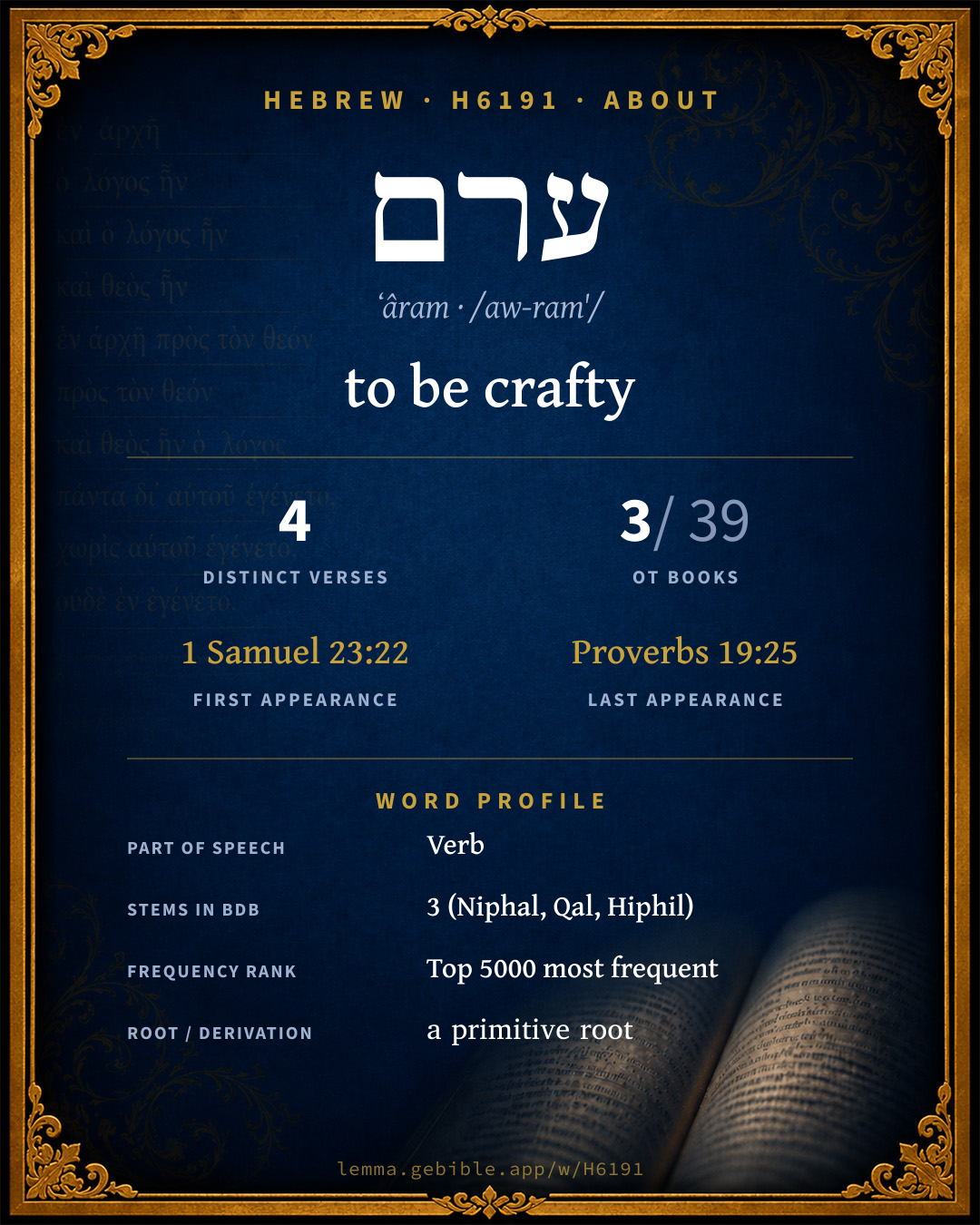
עָרֹם
to be crafty
‘to be crafty’ is one of 3 main senses fuller range ↓
Full lexicon entry — Brown-Driver-Briggs (BDB)
From Brown-Driver-Briggs (BDB)
Where this word appears
See every Qal verb in the Hebrew Bible →
Grammar key — what these labels mean
Part of speech
- Verb
- An action or state-of-being word.
Stem
- Qal
- The basic, simple active stem — the plain form of the verb (“he wrote”).
- Hiphil
- The causative active stem (“he caused / brought about”).
Form
- Imperfect
- An incomplete, ongoing, or future action (“he will / would write”).
- Infinitive Absolute
- An unbound verbal noun, often intensifying or standing in for a finite verb.
Person
- 3rd Person
- The one spoken about (“he / she / it / they”).
Gender
- Masculine
- Grammatically masculine.
Number
- Singular
- One.
- Plural
- More than one (in Hebrew, generally three or more).
1 distinct verse where H6191 appears in the Hiphil stem, across 1 book. Filtered view — show all forms. Click any verse to open its interlinear word-by-word view. Verse text shown in the World English Bible for context — . Each verse’s Hebrew form is shown with its reference; the English is not keyword-highlighted, since the data carries no word-level English alignment. Use “Compare translations” on any verse to read it across multiple English versions. This concordance covers the Hebrew Bible; Septuagint (Greek Old Testament) occurrences are not indexed here.
Psalms 1 verse
About this entry
At a glance — auto-summarized from this page’s data, not written by a person. Every figure links to its source below. This summary describes the numbers; it doesn’t interpret them.
“to be crafty” is the headline sense of the Hebrew verb ערם (ʻâram). The Hebrew Bible uses it only 4 verses. More than half of its appearances fall in Proverbs. Its earliest occurrence is 1 Samuel 23:22. As a verb its force shifts by stem, across 3 stems (Niphal, Qal, and more). The sections below give every sense, occurrence, and version rendering.
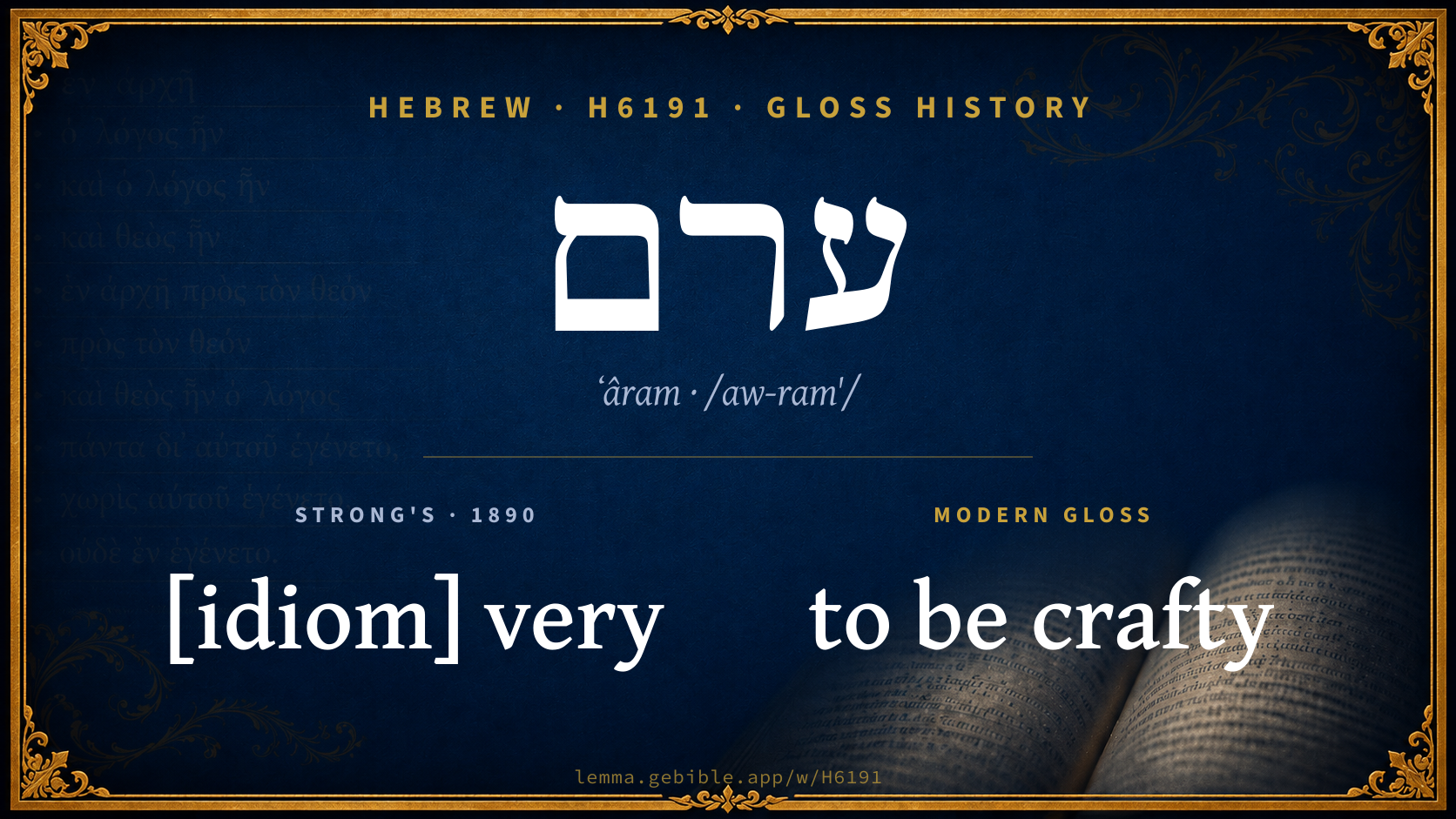
Gloss history
Strong's 1890 vs modern scholarship
About this word
Strong's H6191 catalogs a Hebrew word from the Hebrew Old Testament.
These counts are not copied from any lexicon or concordance. They are computed here, from the morphology-tagged Hebrew Old Testament. What Lemma adds →
- 4
- distinct verses
- The word appears in 4 distinct verses.
- 3 / 39
- OT books
- The word appears in 3 of 39 Old Testament books.
- #3,337
- by frequency
- Top 5000 most frequent Hebrew words (rank 3,337 of 8,640 Hebrew words by occurrence).
View all 4 occurrences in the concordance →
By section of the Old Testament
By traditional corpus
Conventional, traditional groupings — biblical authorship is debated, so this is a traditional corpus grouping, not an authorship claim. Each share is this word’s portion of its verses in that division of the Hebrew canon. Each figure is a share of the word’s 4 distinct verses.
- Writings (Ketuvim) 3 verses · 75%
- Prophets (Nevi'im) 1 verse · 25%
How translations render this word
Counts come from each version’s own published word-to-Strong’s tagging or interlinear alignment — an approximate guide to how each version renders this word, not a word-level alignment the data otherwise carries. Because each total is that version’s own tagged count, the per-version totals vary from one another and need not match the appearance or distinct-verse counts above. These counts may also differ from a printed concordance because Lemma counts each distinctly tagged rendering and does not collapse phrase taggings into a single head-word total. This is a fixed set of word-tagged versions (KJV, ASV, BSB, ULT) and does not change with the reading translation you choose elsewhere. Each version’s license is shown beside its name below (and on Sources).
BDB lists this Strong’s number as 4 distinct words (homographs). Each count above pools all of them and is not split by sense — see the Senses section below. A low-frequency rendering may belong to a different one of those words, not the primary meaning.
- King James Version†: He dealeth very 1×, Is prudent 1×, Subtilly 1×
- American Standard Version†: Getteth prudence 1×, Is told me that he dealeth very 1×, Subtly 1×
- Berean Standard Bible†: Craftiness 1×, Cunning 1×, Is extremely cunning 1×
- unfoldingWord Literal Text†: Being craftly 1×, Is crafty 1×, Is prudent 1×
King James Version Public Domain
Renders H6191 across 5† tagged occurrences — most commonly:
American Standard Version Public Domain
Renders H6191 across 5† tagged occurrences — most commonly:
Berean Standard Bible Public Domain
Renders H6191 across 5† tagged occurrences — most commonly:
Not rendered by a distinct English word in 1 further occurrence.
unfoldingWord Literal Text CC BY-SA 4.0
Renders H6191 across 5† tagged occurrences — most commonly:
Senses in the full BDB
Hebrew verbs can shift meaning by stem (binyan): Qal is the basic action, Niphal is often passive or reflexive, Piel often intensifies or makes it factitive, and Hiphil is typically causative. The senses below are grouped under the stem BDB assigns to each.
What do BDB’s symbols mean?
BDB uses these scholarly abbreviations:
| Symbol | Meaning |
|---|---|
| 𝔊 | the Septuagint (the ancient Greek translation, LXX) |
| 𝔙 | the Vulgate (the Latin translation) |
| 𝔖 | the Syriac version (the Peshitta) |
| 𝔗 | the Targum (the Aramaic translation) |
| ψ | the Psalms |
| √ | root (the underlying root or stem) |
| ‖ | parallel passage (a synonymous or contrasted parallel) |
| † | the dagger: every passage where the word occurs is cited |
The 3 senses and sub-senses the full Brown-Driver-Briggs lexicon distinguishes for this word, in lexicon order (not ranked by frequency), with BDB’s own verbatim wording and sub-sense lettering. Shown in Hebrew script with BDB’s own scholarly abbreviations. The condensed entry is in the Lexicon Entry tab. See also the Forms in the corpus table below.
ערם I aked (perhaps secondary form from עֵירֹם Ew§ 163 c Sta§ 327 a
ערם II
Niphal
- be heaped up (cf. Sab. אערמהו, pl. of [ערם] dam, so Arabic عَرِمٌ, cf. DHMZMG xxx (1876), 676; VOJ i. 25 who cp. BH עֲרֵמָה, Arabic عَرَمَةٌ (which Frä 135 thinks Aramaic loan-word), cf. ܥܪܰܡ Pa. heap up; > WetzstZeltschr. für Ethnol. 1873, 279 (Syriac Dreschtafel) who cp. عَرَمَ strip [whence עַרְמוֹן infr.], and thinks עֲרֵמָה = bare heap);—Pf. 3 pl. נֶעֶרְמוּ מַיִם Ex 15:8. e.g. Exodus 15:8
ערם III be shrewd, crafty (NH id., Hiph.
Qal
- Inf. abs. in עָרֹם יַעְרִם 1 S 23:22 he is exceedingly crafty. e.g. 1 Samuel 23:22
Hiphil
- Impf. be crafty, 3 ms. יַעְרִם 1 S 23:22; be or become shrewd יַעְרִם Pr 15:5; 19:25; all these Qal Impf.in—ִ according to BaZMG xlili (1889), 180 so Ges§ 63 n BuhlLex, but perhaps read יֶעְרַם as Qal; true Hiph. in 3 mpl. יַעֲרִימוּ סוֹד ψ 834 they make crafty (their) counsel against thy people. e.g. 1 Samuel 23:22
Senses from the full Brown-Driver-Briggs lexicon (Brown, Driver, Briggs; Oxford 1906 — public domain), digitized via Sefaria, supplemented by the OpenScriptures HebrewLexicon (CC BY 4.0). Full attribution on Sources.
Word origin
I. adj. naked (perhaps secondary form from עֵירֹם Ew§ 163 c Sta§ 327 a; or from √ עָרָה, q.v.);—abs. עָרוֹם Am 2:16 + 8 times, עָרֹם 1 S 19:24 + 3 times; f. עֲרֻמָּה Ho 2:5; pl. עֲרוּמִּים Gn 2:25 Jb 22:6;—naked Gn 2:25 (J) 1 S 19:24 Ho 2:5; adverb. (Ges§ 118 n) c. הָלַךְ Is 20:2, 3, 4 Mi 1:8, cf. Am 2:16 Jb 24:7, 10; = subst. concr. Is 58:7 Jb 22:6; = without possessions Jb 1:21(×2) = Ec 5:14; of Sheʾôl. open before י׳ Jb 26:6.
I. vb. be shrewd, crafty (NH id., Hiph.; Arabic عَرَمَ, عَرِمَ, عَرُمَ, be ill-natured, cross; 𝔗 adj. עָרִים shrewd, Syriac ܥܪܝܡ id., and vb. in der. spec. (Pe. in Lexx.));—
— Brown-Driver-Briggs (Oxford 1906, public domain), digitized via Sefaria, supplemented by the OpenScriptures HebrewLexicon (CC BY 4.0). See Sources.
Origin: a primitive root
Jastrow Dictionary
A second Hebrew/Aramaic lexicon for comparison, covering Aramaic and post-biblical (Talmudic, Targumic, Midrashic) usage that the biblical-Hebrew BDB does not. Matched by lemma rather than by Strong’s number, so a lemma may carry more than one Jastrow headword (shown separately below), and the entries cover usage well beyond the Bible.
עָרַם I
- v. Ex. XV, to heap up, pile. Gen. R. s. 83, end (play on עירם, Gen. XXXVI, 43) שהוא עתיד לַעֲרוֹם וכ׳ he is destined to heap up treasures for the king Messiah; (‘Rashi’: לַעֲרוֹת, v. עָרָה I).—Denom. עֲרֵימָה. e.g. Genesis 36:43
עָרַם II
- to peel off, strip; to make white, bright; v. עָרוּם, עָרוֹם.
- 1. to enlighten, inform. Y. Snh. V, beg. 22ᶜ, sq. (ref. to בערמה, Ex. XXI, 14) שיַעֲרִימוּהוּ באיזו מיתה מת they (the forewarning witnesses) must keep him informed as to what kind of death penalty is expecting him; (Bab. ib. 80ᵇ שיודיעוהו). e.g. Exodus 21:14
- 2. to plan, act deliberately. Mekh. Mishp. s. 4 (ref. to בערמה, v. supra) להוציא … שאינן מַעֲרִימִין this is to exclude the deaf and dumb, the insane and the minor (who do not act with premeditation; להוציא מרפא … אינן מערימין to exclude the surgeon …, for although they acted with wilfulness (criminal negligence), they did not plan; Yalk. Ex. 325.
- 3. to act with subtlety, to get around a law by an artifice. Sabb. 65ᵇ מערימין בדליקה in case of a conflagration on the Sabbath (when the rabbinical law allows the rescue of a certain number of clothes by putting them on) we may use an artifice (by laying off the clothes saved and going in again to save others); (oth. opin.) אין מערימין בדליקה you dare not &c. Ib. מהו שתַּעֲרִים וכ׳ dare a woman use an artifice &c., v. פָּרַף. Tosef. Bets. III, 2. Gen. R. s. 49 מה אתה מַעֲרִים על השבועה מבול וכ׳ why wilt thou cunningly evade thy own oath? destruction by water thou wilt not bring, but destruction by fire thou wilt? Yalk. ib. 83; a. fr.
A Dictionary of the Targumim, the Talmud Babli and Yerushalmi, and the Midrashic Literature (Marcus Jastrow; London, Luzac, 1903) — Public Domain. Digitized via Sefaria. Digitized via Sefaria. Full attribution on Sources.
Forms in the corpus
The 5 distinct written forms H6191 takes in the Hebrew Bible, most frequent first — each parse links to that stem’s occurrences in the concordance. Hebrew forms include their vowel points and cantillation, so a single lemma takes many written forms.
| Form | Parsing | Example | Uses |
|---|---|---|---|
| יַעְרִ֑ם | Verb, Qal, Imperfect, 3rd Person, Masculine, Singular | Proverbs 19:25 | 1 |
| יַעְרִ֖ם | Verb, Qal, Imperfect, 3rd Person, Masculine, Singular | 1 Samuel 23:22 | 1 |
| יַעְרִֽם | Verb, Qal, Imperfect, 3rd Person, Masculine, Singular | Proverbs 15:5 | 1 |
| יַעֲרִ֣ימוּ | Verb, Hiphil, Imperfect, 3rd Person, Masculine, Plural | Psalms 83:3 | 1 |
| עָר֥וֹם | Verb, Qal, Infinitive Absolute | 1 Samuel 23:22 | 1 |
Same root — word family
Other BDB entries built from the same root as H6191, grouped by Strong’s listed origin. These share a root / origin per the lexicon — not necessarily a shared meaning. Each links to that word’s own entry.
Derived from this word
- מערם maʻărôm H4636 nakedness
- עירם ʻêyrôm H5903 naked
- ערום ʻârôwm H6174 naked
- ערום ʻârûwm H6175 crafty
- ערם ʻôrem H6193 craftiness
- ערמון ʻarmôwn H6196 plane tree
Compare all same-root words → Showing 4 of 7 — not the complete family. They share a root, not necessarily a meaning.
Septuagint verse parallels
This word appears in 4 verses that also exist in the Greek Old Testament (Septuagint), out of the 4 Hebrew verses it occurs in. You can read those verses in Greek by switching the Old Testament edition to the Septuagint.
Read these verses in the Septuagint
This is a verse-level parallel only — the same verses exist in both the Hebrew and Greek Old Testaments. No word-level Hebrew↔Greek correspondence is claimed: the data carries no such alignment, so no Greek word is shown as this Hebrew word’s translation. Coverage is not total — the Septuagint omits the deuterocanon and renumbers the Psalms, so some Hebrew verses have no direct Greek parallel.