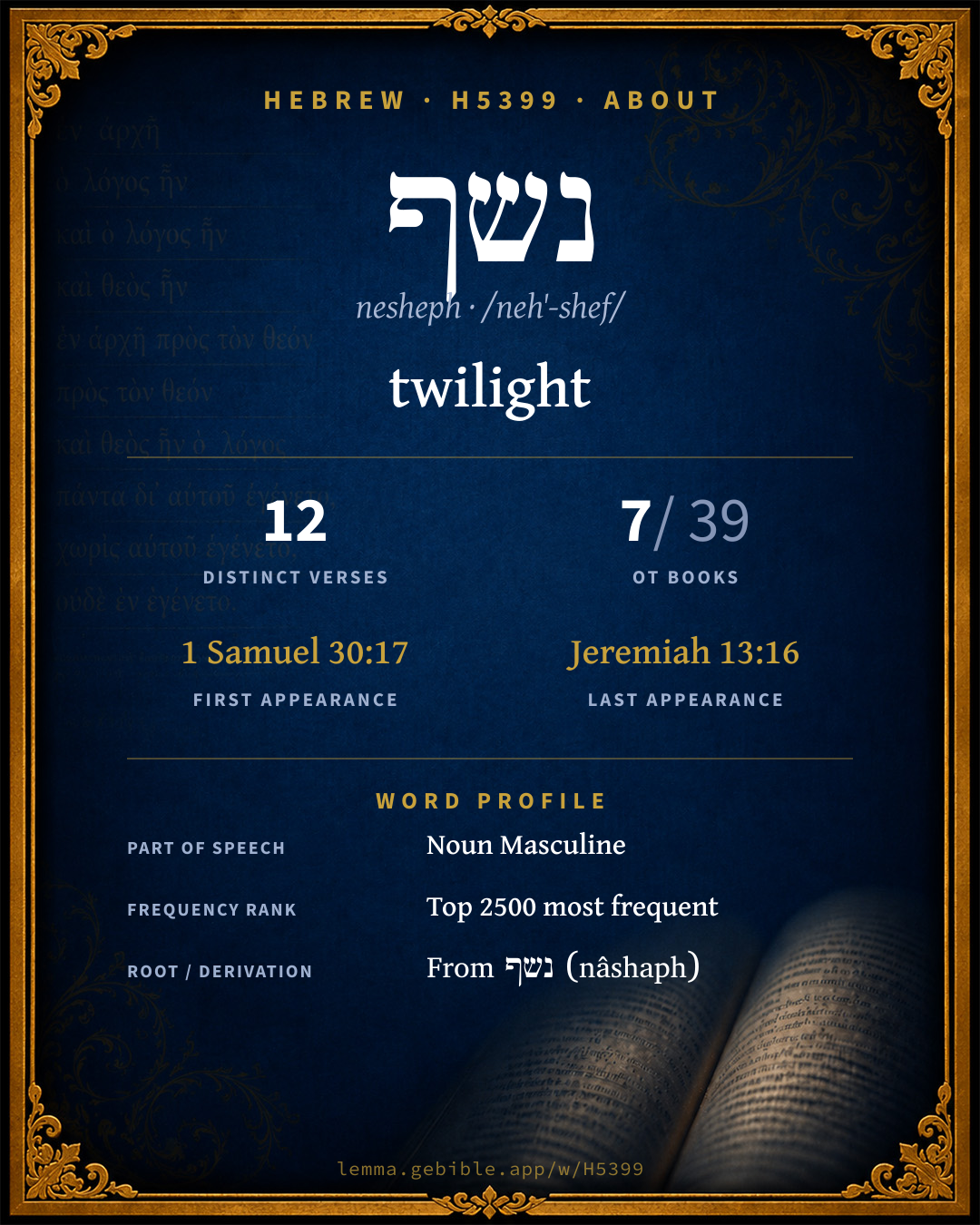
נֶ֫שֶׁף
twilight
‘twilight’ is one of 3 main senses fuller range ↓
Full lexicon entry — Brown-Driver-Briggs (BDB)
From Brown-Driver-Briggs (BDB)
Where this word appears
See every Absolute-state word in the Hebrew Bible →
Grammar key — what these labels mean
Part of speech
- Noun
- A naming word — a person, place, thing, or idea.
Noun type
- Common
- A common noun — a general class of person, place, or thing (“king,” “city,” “water”), not a specific name.
State
- Absolute
- The independent form of a noun, not bound to a following word.
- Construct
- A noun bound to a following noun in a possessive / “of” relationship (the construct chain).
Gender
- Masculine
- Grammatically masculine.
Number
- Singular
- One.
1 verse where H5399 appears in the Construct state in the Book of Job. Filtered view — show all forms. Click any verse to open its interlinear word-by-word view. Verse text shown in the World English Bible for context — . Each verse’s Hebrew form is shown with its reference; the English is not keyword-highlighted, since the data carries no word-level English alignment. Use “Compare translations” on any verse to read it across multiple English versions. This concordance covers the Hebrew Bible; Septuagint (Greek Old Testament) occurrences are not indexed here.
Job
About this entry
At a glance — auto-summarized from this page’s data, not written by a person. Every figure links to its source below. This summary describes the numbers; it doesn’t interpret them.
The Hebrew noun נשף centers on the idea of “twilight.” Its earliest occurrence is 1 Samuel 30:17. It turns up in 12 verses across 7 books, an uncommon footprint. The word gravitates to Job (25%), then Isaiah and 2 Kings. The lexicon spreads it across several senses; see its full sense range. For the data behind this summary, explore the sense tree and the renderings breakdown below.
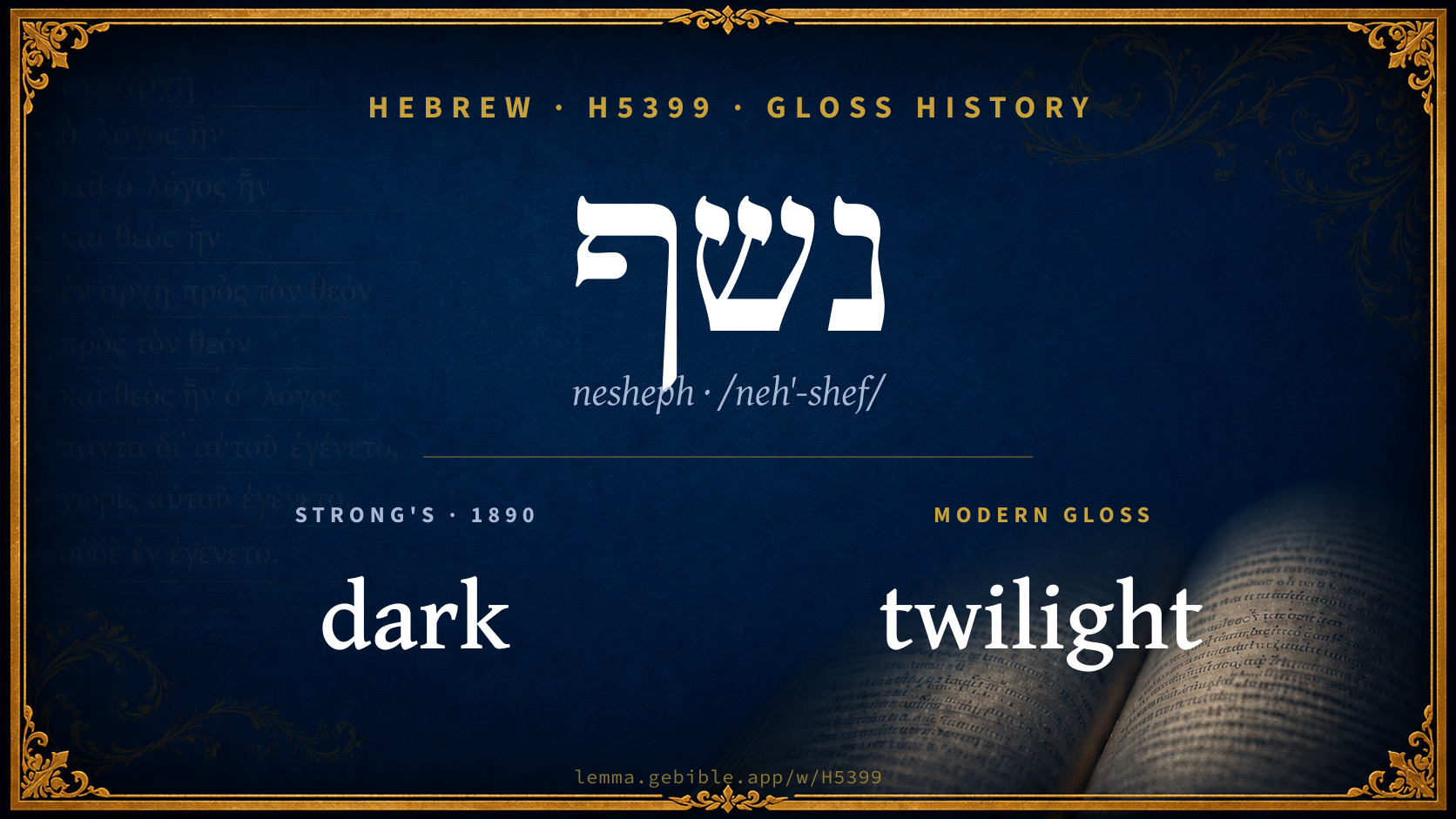
Gloss history
Strong's 1890 vs modern scholarship
About this word
Strong's H5399 catalogs a Hebrew word from the Hebrew Old Testament.
These counts are not copied from any lexicon or concordance. They are computed here, from the morphology-tagged Hebrew Old Testament. What Lemma adds →
- 12
- distinct verses
- The word appears in 12 distinct verses.
- 7 / 39
- OT books
- The word appears in 7 of 39 Old Testament books.
- #2,101
- by frequency
- Top 2500 most frequent Hebrew words (rank 2,101 of 8,640 Hebrew words by occurrence).
View all 12 occurrences in the concordance →
By section of the Old Testament
By traditional corpus
Conventional, traditional groupings — biblical authorship is debated, so this is a traditional corpus grouping, not an authorship claim. Each share is this word’s portion of its verses in that division of the Hebrew canon. Each figure is a share of the word’s 12 distinct verses.
- Prophets (Nevi'im) 7 verses · 58%
- Writings (Ketuvim) 5 verses · 42%
How translations render this word
Counts come from each version’s own published word-to-Strong’s tagging or interlinear alignment — an approximate guide to how each version renders this word, not a word-level alignment the data otherwise carries. Because each total is that version’s own tagged count, the per-version totals vary from one another and need not match the appearance or distinct-verse counts above. These counts may also differ from a printed concordance because Lemma counts each distinctly tagged rendering and does not collapse phrase taggings into a single head-word total. This is a fixed set of word-tagged versions (KJV, ASV, BSB, ULT) and does not change with the reading translation you choose elsewhere. Each version’s license is shown beside its name below (and on Sources).
- King James Version: Twilight 6×, Night 2×
- American Standard Version: Twilight 7×
- Berean Standard Bible: Twilight 7×
- unfoldingWord Literal Text: Twilight 8×, Dawn 2×
King James Version Public Domain
Renders H5399 across 12 tagged occurrences — most commonly:
Plus 4 renderings that appear only once — usually multi-word phrases or single function words the recovered tagging swept in, not distinct renderings.
American Standard Version Public Domain
Renders H5399 across 12 tagged occurrences — most commonly:
Plus 5 renderings that appear only once — usually multi-word phrases or single function words the recovered tagging swept in, not distinct renderings.
Berean Standard Bible Public Domain
Renders H5399 across 12 tagged occurrences — most commonly:
Plus 5 renderings that appear only once — usually multi-word phrases or single function words the recovered tagging swept in, not distinct renderings.
unfoldingWord Literal Text CC BY-SA 4.0
Renders H5399 across 13 tagged occurrences — most commonly:
Plus 3 renderings that appear only once — usually multi-word phrases or single function words the recovered tagging swept in, not distinct renderings.
Senses in the full BDB
What do BDB’s symbols mean?
BDB uses these scholarly abbreviations:
| Symbol | Meaning |
|---|---|
| 𝔊 | the Septuagint (the ancient Greek translation, LXX) |
| 𝔙 | the Vulgate (the Latin translation) |
| 𝔖 | the Syriac version (the Peshitta) |
| 𝔗 | the Targum (the Aramaic translation) |
| ψ | the Psalms |
| √ | root (the underlying root or stem) |
| ‖ | parallel passage (a synonymous or contrasted parallel) |
| † | the dagger: every passage where the word occurs is cited |
The 2 senses and sub-senses the full Brown-Driver-Briggs lexicon distinguishes for this word, in lexicon order (not ranked by frequency), with BDB’s own verbatim wording and sub-sense lettering. Shown in Hebrew script with BDB’s own scholarly abbreviations. The condensed entry is in the Lexicon Entry tab. See also the Forms in the corpus table below.
- 1. evening twilight 2 K 7:5, 7 (cf. לַיְלָה v 12); opp. בֹּקֶר Is 5:11; time of concealment Jb 24:15 Pr 7:9 (+ עֶרֶב יוֹם, אִישׁוֹן לַיְלָה וַאֲפֵלָה, to emphasize sin that shuns the day); of refreshing Is 21:4 (נ׳ חִשְׁקִי); of stumbling, in dim light Is 59:10 (opp. צָהֳרַיִם), so הָרֵי נָ֑שֶׁף Je 13:16 (both fig.); כּוֹכְבֵי נִשְׁפּוֹ Jb 3:9 the stars of its twilight (i.e. of night of Job’s birth).—so מֵהַנּ׳ וְעַד־הָעֶרֶב לְמָחֳרָתָם 1 S 30:17 Klo Kit HPS (read לְהַחֲרִמָם for לְמָח׳, We Kit Bu); Th, after Luth, sub 2, so Buhl Lex SS; Löhr allows either. e.g. 2 Kings 7:5
- 2. morning twilight Jb 7:4 (opp. עֶרֶב), appar. also ψ 119:147. e.g. Job 7:4
Senses from the full Brown-Driver-Briggs lexicon (Brown, Driver, Briggs; Oxford 1906 — public domain), digitized via Sefaria, supplemented by the OpenScriptures HebrewLexicon (CC BY 4.0). Full attribution on Sources.
Word origin
n.m. twilight (proposes twilight-breeze, cf. לְרוּחַ הַיּוֹם Gn 3:8; NH id.; 𝔗 נְשַׁף, נִשְׁפָּא);—נ׳ abs. 1 S 30:17 +, נָ֑שֶׁף Je 13:16; cstr. Is 21:4; sf. נִשְׁפּוֹ Jb 3:9;—
— Brown-Driver-Briggs (Oxford 1906, public domain), digitized via Sefaria, supplemented by the OpenScriptures HebrewLexicon (CC BY 4.0). See Sources.
Derived from נשף (nâshaph) (H5398) — to blow.
Jastrow Dictionary
A second Hebrew/Aramaic lexicon for comparison, covering Aramaic and post-biblical (Talmudic, Targumic, Midrashic) usage that the biblical-Hebrew BDB does not. Matched by lemma rather than by Strong’s number, so a lemma may carry more than one Jastrow headword (shown separately below), and the entries cover usage well beyond the Bible.
נָשַׁף
- to blow, breathe. Num. R. s. 20 וכי לא … לִנְשׁוֹף וכ׳ could not the angel have blown at him, and he (Balaam) would have given up his spirit?; Tanḥ. Bal. 8. Yalk. Cant. 986 והיה … נוֹשֵׁף בה and a serpent blew (hissed) at it (the dove); a. e.—נ׳ עֵמָּה (or עִיסָה) to make the leaven swell, to stir up passion, hatred. Esth. R. introd. (ref. to Am. V, 19) the serpent, that is Haman שהיה נוֹשֵׁף עֵמָּא כנחש who stirred up passion like the serpent (Gen. III, 13); Lev. R. s. 13 שנשף עיסה כנחש (not שמשך); ib. s. 15 end ששף כנחש (insert עמה); Gen. R. s. 16 שהיה המן שף עמה וכ׳ (fr. שׁוּף); Yalk. ib. 22 שף כנחשׁ (corr. acc.).—[Nif. נִשּׁוֹף, נִישּׁוֹף, v. שׁוּף II.] e.g. Amos 5:19
נְשַׁף I
- Ber. 3ᵇ (expl. נֶשֶׁף) נ׳ ליליא וכ׳ the night blows (expires), and the day comes in; the day blows, and night sets in (Rashi: retires), v. נֶשֶׁף, נִשְׁפָּא.
- to be covered with breath, to become dim. Men. 50ᵇ אִינַּשְּׁפָה לה (Ar. איג׳, Var. אינ׳; some ed. Ar. אינשבא) the bread loses its glistening surface (when it gets stale).
נְשַׁף II
- (cmp. שׁוּף I ch.) to slip, glide, move. Meg. 3ᵃ לִינְשׁוֹף מדוכתיה וכ׳ let him move (Rashi: skip) from his place four cubits.
- to be made to slip. B. Mets. 23ᵃ מִינַּשְׁתְּפָא it slips from its place (by people’s stepping against it).
נֶשֶׁף
- [zephyr,] early morning; sunset. Keth. 111ᵇ קדמתי בנ׳ (fr. Ps. CXIX, 147) I got up early in the morning. Ber. 3ᵇ (ref. to Ps. l. c.) ממאי דהאי נ׳ אורתא וכ׳ how do we know that neshef means evening? (Answ. ref. to Prov. VII, 9). Ib. ונ׳ אורתא הוא הא נ׳ וכ׳ does neshef mean evening? does it not mean morning?—Lam. R. introd. (R. Joḥ. 2) הרי נ׳ the mountains of darkness. Lev. R. s. 23 אימתי נ׳ בא וכ׳ when will the dusk come, when the evening?; a. e. e.g. Psalms 119:147
שָׁפַף
- (v. שׁוּף II, a. שָׁפָה I) to crush, rub. —Part. pass. שָׁפוּף; f. שְׁפוּפָה; pl. שְׁפוּפִים, שְׁפוּפִין; שְׁפוּפוֹת a) rubbed, rubbing. Gen. R. s. 65 היו רגליהם ש׳ בארץ their feet (which were hanging down) rubbed against the ground; (Y. Peah VII, 20ᵇ top נוגעות).—b) crushed, weak, nimble. Gen. R. s. 22 the evil inclination דומה ללסטיס ש׳ וכ׳ is like an enfeebled robber sitting on the cross-road &c.; Yalk. ib. 36; Yalk. Ps. 840. Gen. R. s. 25, end בני אדם ש׳ weak people, opp. גבורים; Ruth R. to I, 1. Gen. R. s. 53 עכשיו … לא ש׳ וכ׳ now what is his gift (the child born to him)? is it not puny? I put my finger &c. (v. פְּחַשׁ); Yalk. Deut. 810 מתנתיה … שְׁפִיפָה (Chald.). Gen. R. s. 60 דווין וש׳ ed., v. שָׁפָה I; a. fr.
- to rub, polish, brush off. Y. Sabb. IV, end, 7ᵃ עד שיְשַׁפְשֵׁף until he rubs (the stones, to wipe off the dirt); Bab. Sabb. 125ᵇ צאו ושׁפְשְׁפוּם go out and rub them. Y. Ter. I, beg. 40ᵃ במְשַׁפְשֵׁף בהן במים when he scours them with water. Yoma 30ᵃ לשַׁפְשִׁף to wipe off (squirtings). Mikv. IX, 2 אלא אם כן ש׳ unless he has rubbed the soot off. Tosef. Dem. I, 18 משפשף he may rub him (with oil). Y. Ber. IX, 14ᶜ top עד ששִׁיפְשֵׁף before rubbing (the rectum), v. מִשְׁמֵשׁ; a. fr.
- to be crushed. B. Kam. 28ᵇ ונשוף באבן (Ms. F. ונושף read: ונישף), v. שׁוּף II.
A Dictionary of the Targumim, the Talmud Babli and Yerushalmi, and the Midrashic Literature (Marcus Jastrow; London, Luzac, 1903) — Public Domain. Digitized via Sefaria. Digitized via Sefaria. Full attribution on Sources.
Forms in the corpus
The 10 distinct written forms H5399 takes in the Hebrew Bible, most frequent first — each parse links to that state’s occurrences in the concordance. Hebrew forms include their vowel points and cantillation, so a single lemma takes many written forms.
| Form | Parsing | Example | Uses |
|---|---|---|---|
| נֶ֣שֶׁף | Noun, Common, Masculine, Singular, Absolute | Job 24:15 | 2 |
| בַ/נֶּ֔שֶׁף | Noun, Common, Masculine, Singular, Absolute | 2 Kings 7:5 | 2 |
| בַ/נֶּשֶׁף֒ | Noun, Common, Masculine, Singular, Absolute | 2 Kings 7:7 | 1 |
| בַ֭/נֶּשֶׁף | Noun, Common, Masculine, Singular, Absolute | Psalms 119:147 | 1 |
| בְּ/נֶֽשֶׁף | Noun, Common, Masculine, Singular, Absolute | Proverbs 7:9 | 1 |
| כַּ/נֶּ֔שֶׁף | Noun, Common, Masculine, Singular, Absolute | Isaiah 59:10 | 1 |
| מֵ/הַ/נֶּ֥שֶׁף | Noun, Common, Masculine, Singular, Absolute | 1 Samuel 30:17 | 1 |
| נִ֫שְׁפּ֥/וֹ | Noun, Common, Masculine, Singular, Construct | Job 3:9 | 1 |
| נָ֑שֶׁף | Noun, Common, Masculine, Singular, Absolute | Jeremiah 13:16 | 1 |
| נָֽשֶׁף | Noun, Common, Masculine, Singular, Absolute | Job 7:4 | 1 |
Same root — word family
Other BDB entries built from the same root as H5399, grouped by Strong’s listed origin. These share a root / origin per the lexicon — not necessarily a shared meaning. Each links to that word’s own entry.
Derives from
Shares the same root
Compare all same-root words → They share a root, not necessarily a meaning.
Septuagint verse parallels
This word appears in 11 verses that also exist in the Greek Old Testament (Septuagint), out of the 12 Hebrew verses it occurs in. You can read those verses in Greek by switching the Old Testament edition to the Septuagint.
Read these verses in the Septuagint
This is a verse-level parallel only — the same verses exist in both the Hebrew and Greek Old Testaments. No word-level Hebrew↔Greek correspondence is claimed: the data carries no such alignment, so no Greek word is shown as this Hebrew word’s translation. Coverage is not total — the Septuagint omits the deuterocanon and renumbers the Psalms, so some Hebrew verses have no direct Greek parallel.