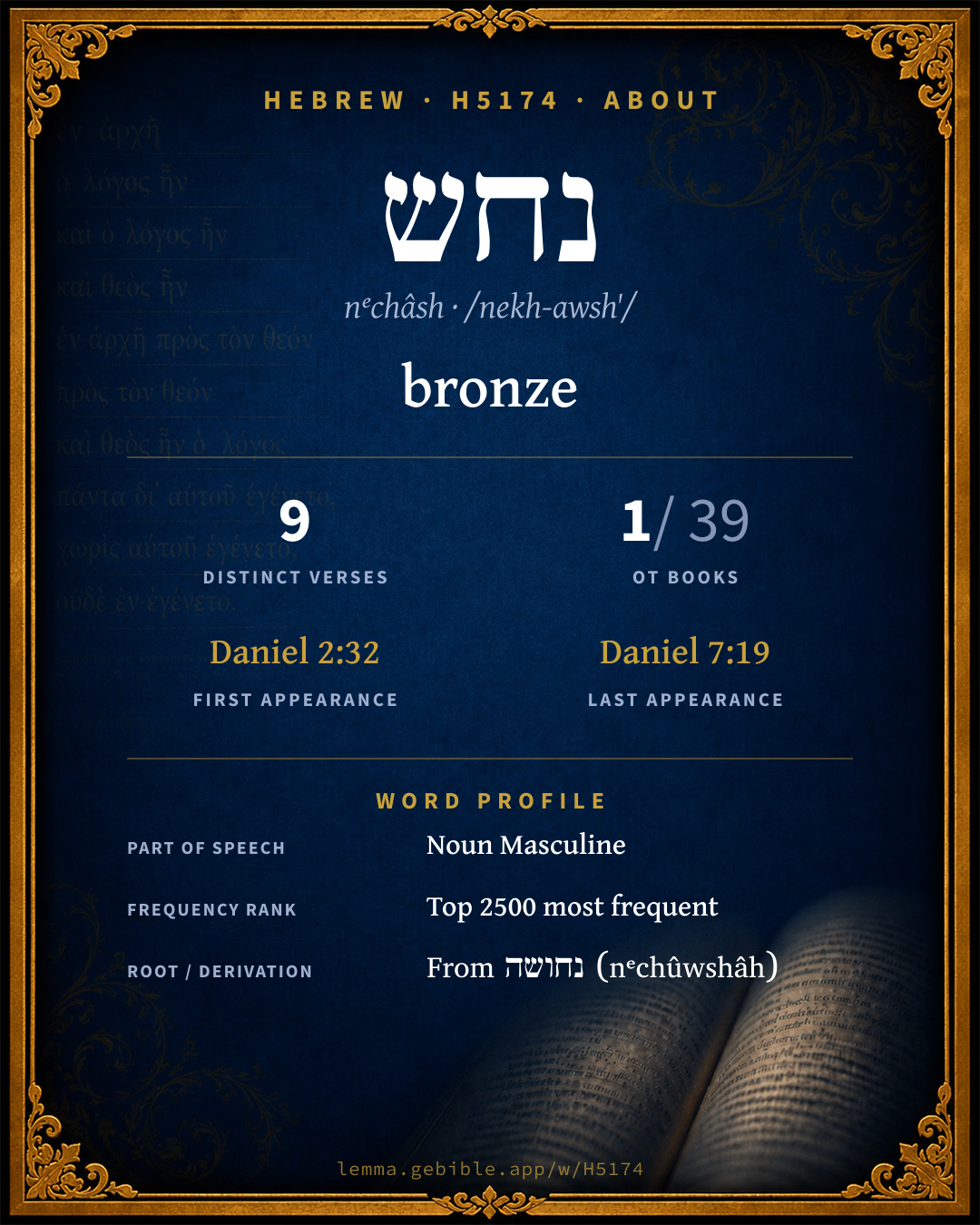
נְחָשׁ
bronze
Full lexicon entry — Brown-Driver-Briggs (BDB)
From Brown-Driver-Briggs (BDB)
Where this word appears
Grammar key — what these labels mean
Part of speech
- Noun
- A naming word — a person, place, thing, or idea.
Noun type
- Common
- A common noun — a general class of person, place, or thing (“king,” “city,” “water”), not a specific name.
State
- Absolute
- The independent form of a noun, not bound to a following word.
Gender
- Masculine
- Grammatically masculine.
Number
- Singular
- One.
Grammatical forms
- Particle, Definite Article 5 times (56%)
- Noun, Common, Masculine, Singular, Absolute 4 times (44%)
Parsed forms decoded from the imported morphology (morphhb / Westminster Leningrad Codex — WLC text public domain, morphhb tagging CC BY 4.0), counted across 9 parsed occurrences — not distinct verses.
Every verse where H5174 appears — 9 distinct verses across 1 book. Click any verse to open its interlinear word-by-word view. Verse text shown in the World English Bible for context — . Each verse’s Hebrew form is shown with its reference; the English is not keyword-highlighted, since the data carries no word-level English alignment. Use “Compare translations” on any verse to read it across multiple English versions. This concordance covers the Hebrew Bible; Septuagint (Greek Old Testament) occurrences are not indexed here.
Daniel 9 verses
- Daniel 2:32 נְחָֽשׁ n c ms As for this image, its head was of fine gold, its breast and its arms of silver, its belly and its thighs of brass,
- Daniel 2:35 נְחָשָׁ֜/א n c ms det + ptcl def.art Then was the iron, the clay, the brass, the silver, and the gold, broken in pieces together, and became like the chaff of the summer threshing floors; and the wind carried them away, so that no place was found for them: and the stone that struck the image became a great mountain, and filled the whole earth.
- Daniel 2:39 נְחָשָׁ֔/א n c ms det + ptcl def.art After you shall arise another kingdom inferior to you; and another third kingdom of brass, which shall bear rule over all the earth.
- Daniel 2:45 נְחָשָׁ֤/א n c ms det + ptcl def.art Because you saw that a stone was cut out of the mountain without hands, and that it broke in pieces the iron, the brass, the clay, the silver, and the gold; the great God has made known to the king what shall happen hereafter: and the dream is certain, and the interpretation of it sure.
- Daniel 4:15 וּ/נְחָ֔שׁ conj + n c ms Nevertheless leave the stump of its roots in the earth, even with a band of iron and brass, in the tender grass of the field; and let it be wet with the dew of the sky: and let his portion be with the animals in the grass of the earth:
- Daniel 4:23 וּ/נְחָ֔שׁ conj + n c ms Whereas the king saw a watcher and a holy one coming down from the sky, and saying, Hew down the tree, and destroy it; nevertheless leave the stump of the roots of it in the earth, even with a band of iron and brass, in the tender grass of the field, and let it be wet with the dew of the sky: and let his portion be with the animals of the field, until seven times pass over him;
- Daniel 5:4 נְחָשָׁ֥/א n c ms det + ptcl def.art They drank wine, and praised the gods of gold, and of silver, of brass, of iron, of wood, and of stone.
- Daniel 5:23 נְחָשָׁ֨/א n c ms det + ptcl def.art but have lifted up yourself against the Lord of heaven; and they have brought the vessels of his house before you, and you and your lords, your wives and your concubines, have drunk wine from them; and you have praised the gods of silver and gold, of brass, iron, wood, and stone, which don't see, nor hear, nor know; and the God in whose hand your breath is, and whose are all your ways, you have not glorified.
- Daniel 7:19 נְחָ֔שׁ n c ms Then I desired to know the truth concerning the fourth animal, which was diverse from all of them, exceedingly terrible, whose teeth were of iron, and its nails of brass; which devoured, broke in pieces, and stamped the residue with its feet;
About this entry
At a glance — auto-summarized from this page’s data, not written by a person. Every figure links to its source below. This summary describes the numbers; it doesn’t interpret them.
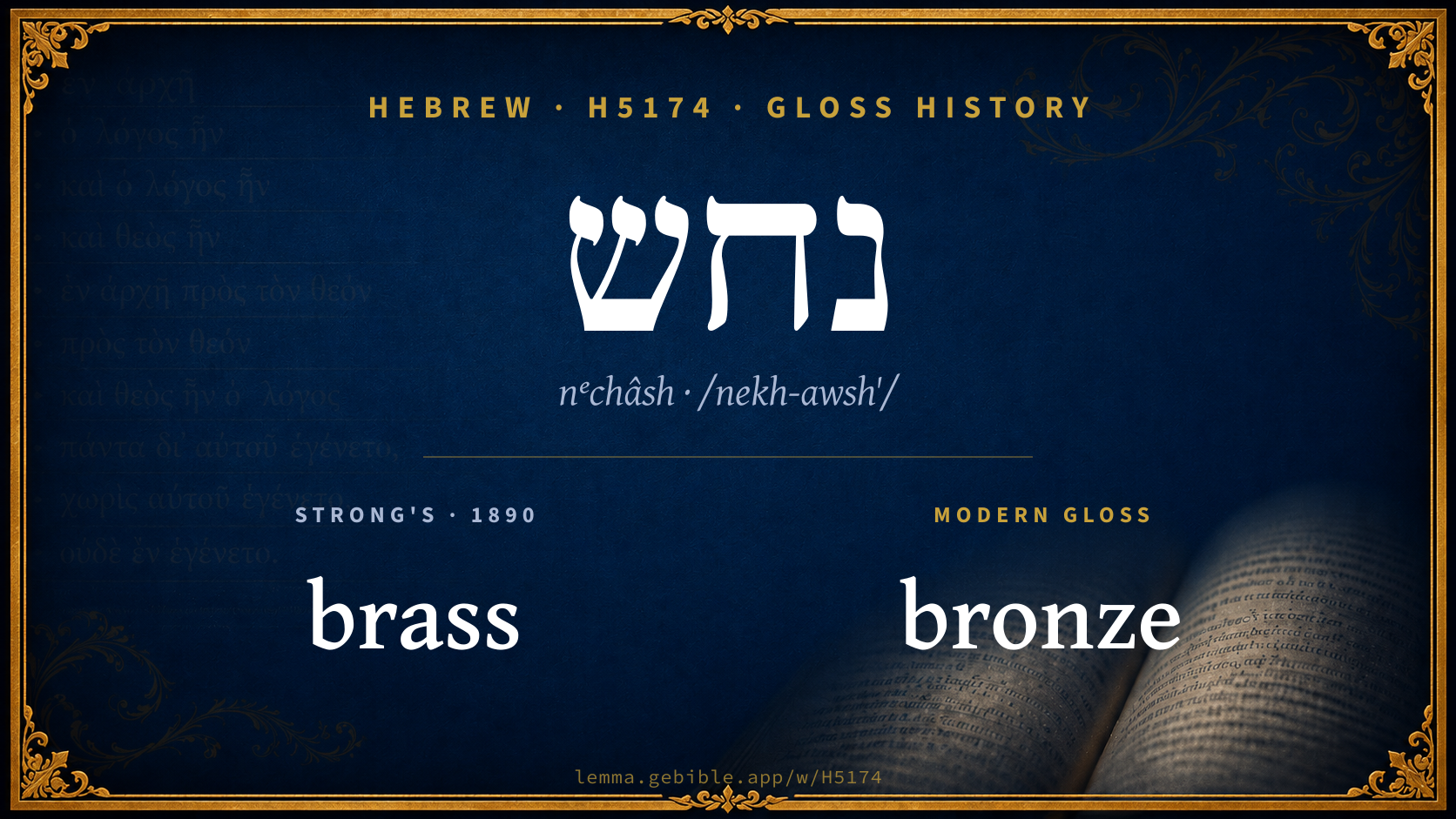
נחש (nᵉchâsh) is a Hebrew noun most often rendered “bronze.” Daniel dominates its distribution — 9 of 9 verses. Spanning 9 verses in 1 book, it ranks among the uncommon words of the Hebrew Bible. It first appears in Daniel 2:32. Its English rendering has broadened — “brass” classically, “bronze” (Berean Standard Bible) in modern versions; see the renderings breakdown. The sections below give every sense, occurrence, and version rendering.
Gloss history
Strong's 1890 vs modern scholarship
About this word
Strong's H5174 catalogs a Hebrew word from the Hebrew Old Testament.
These counts are not copied from any lexicon or concordance. They are computed here, from the morphology-tagged Hebrew Old Testament. What Lemma adds →
- 9
- distinct verses
- The word appears in 9 distinct verses.
- 1 / 39
- OT books
- The word appears in 1 of 39 Old Testament books.
- #2,481
- by frequency
- Top 2500 most frequent Hebrew words (rank 2,481 of 8,640 Hebrew words by occurrence).
View all 9 occurrences in the concordance →
Most concentrated in
- Daniel 9 verses 100%
By section of the Old Testament
By traditional corpus
Conventional, traditional groupings — biblical authorship is debated, so this is a traditional corpus grouping, not an authorship claim. Each share is this word’s portion of its verses in that division of the Hebrew canon. Each figure is a share of the word’s 9 distinct verses.
- Writings (Ketuvim) 9 verses · 100%
How translations render this word
Counts come from each version’s own published word-to-Strong’s tagging or interlinear alignment — an approximate guide to how each version renders this word, not a word-level alignment the data otherwise carries. Because each total is that version’s own tagged count, the per-version totals vary from one another and need not match the appearance or distinct-verse counts above. These counts may also differ from a printed concordance because Lemma counts each distinctly tagged rendering and does not collapse phrase taggings into a single head-word total. This is a fixed set of word-tagged versions (KJV, ASV, BSB, ULT) and does not change with the reading translation you choose elsewhere. Each version’s license is shown beside its name below (and on Sources).
- King James Version: Brass 9×
- American Standard Version: Brass 9×
- Berean Standard Bible: Bronze 7×
- unfoldingWord Literal Text: Bronze 9×
King James Version Public Domain
Renders H5174 across 9 tagged occurrences — most commonly:
American Standard Version Public Domain
Renders H5174 across 9 tagged occurrences — most commonly:
Berean Standard Bible Public Domain
Renders H5174 across 9 tagged occurrences — most commonly:
Plus 2 renderings that appear only once — usually multi-word phrases or single function words the recovered tagging swept in, not distinct renderings.
unfoldingWord Literal Text CC BY-SA 4.0
Renders H5174 across 9 tagged occurrences — most commonly:
Senses in BDB
The 1 sense BDB distinguishes for this word, in lexicon order (not ranked by frequency or importance). The full entry — with sub-senses — is in the Lexicon Entry tab.
- copper, bronze
Word origin
נְחָשׁ n.m. copper, bronze
— Brown-Driver-Briggs (Oxford 1906, public domain), digitized via Sefaria, supplemented by the OpenScriptures HebrewLexicon (CC BY 4.0). See Sources.
Derived from נחושה (nᵉchûwshâh) (H5154) — bronze.
Jastrow Dictionary
A second Hebrew/Aramaic lexicon for comparison, covering Aramaic and post-biblical (Talmudic, Targumic, Midrashic) usage that the biblical-Hebrew BDB does not. Matched by lemma rather than by Strong’s number, so a lemma may carry more than one Jastrow headword (shown separately below), and the entries cover usage well beyond the Bible.
נָחַשׁ
- to whisper.
- to divine, to make action dependent on an omen, to augur. Tosef. Sabb. VII (VIII), 13 איזהו מְנַחֵשׁ וכ׳ a diviner (under the law, Lev. XIX, 26) is he who says, ‘my staff fell out of my hand’ (it portends evil) &c.; Snh. 65ᵇ. Ib. 66ᵃ כגון אלו המְנַחֲשִׁים בחולדה וכ׳ like those who divine (evil or luck) from a weasel, birds &c. Y. Sabb. VI, end, 8ᵈ כל המנחש סופו לבוא עליו if one believes in omens, what he fears will finally befall him (with ref. to לא נחש Num. XXIII, 23, changed into לו נחש); Ned. 32ᵃ כל המנחש לו נחש for him who believes in omens, the omen exists (will be realized). Ib. כל אדם שאינו מנ׳ he who rejects divination. Mekh. B’shall. s. 2 שמא יְנַחֲשׁוּ ויחזרו וכ׳ lest they consider it a bad omen and go back. Ib. וזקני מדין נִחֲשׁוּ וכ׳ and the Midianite elders considered (Balaam’s death) a bad omen and went home; a. fr.—Sifra Vayikra, Par. 9, ch. XIII (ref. to Lev. XVIII, 3) [read:] שלא תְנַחֵשׁ thou must not augur (v. however, נָקַר II). e.g. Leviticus 19:26
נְחַשׁ I
- , Pa. נַחֵישׁ, נָ׳ same. Targ. II Kings XXI, 6. Ib. XVII, 17 (ed. Wil. ונְחִישׁוּ Pe.); a. fr.—Ḥull. 95ᵇ דנָחֵישׁ because he had made his movements dependent on an omen. Yeb. 120ᵇ כיס … מְנַחֲשֵׁי אינשי וכ׳ as to purse and bag people are superstitious and do not lend them; a. e.
נְחַשׁ II
- , Af. אַנְחֵשׁ, הַנְחֵשׁ (denom. of נְחָשׁ) to use copper and plate it with silver, to plate. Pesik. Ekhah, p. 122ᵇ הַנְחֵשׁ ליה make it plated for him (in place of solid silver); Yalk. Is. 258 אכחיש, read: אַנְ׳.
נַחַשׁ
- divination from omen, superstition. Num. R. s. 20 בעל נ׳ a believer in omens. Ned. 32ᵃ, v. נָחַשׁ. Y. Sabb. VI, 8ᶜ bot. אע"פ שאין נ׳ יש סימן although you must not make them an omen, they are a sign (presage); Ḥull. 95ᵇ. Ib. כל נ׳ שאינו … אינו נ׳ an omen which is not proposed in the manner of Eliezer … (Gen. XXIV, 13, sq.) or of Jonathan (I Sam. XIV, 9, sq.) is not considered a divination (in the sense of Lev. XIX, 26); a. fr.—Pl. נְחָשִׁים. Tanḥ. Balak 4 בעל נ׳, v. supra. e.g. Genesis 24:13
נָחָשׁ
- 1. [the hissing,] serpent. Gen. R. s. 22 נ׳ הקדמוני the original serpent (the seducer of Eve). Gen. R. s. 20 נ׳ זה רשע בעל תשובות that serpent is wicked and skilled in arguments. Bekh. 8ᵃ נ׳ לשבע שנים וכ׳ a serpent’s pregnancy lasts seven years, and for that wicked animal I find no parallel (in the vegetable kingdom). Gen. R. s. 54 הנ׳ של בית the domestic serpent (harmless); a. fr.—Pl. נְחָשִׁים. Gen. R. s. 84 נ׳ ועקרבים snakes and scorpions; a. fr.
- 2. a pungent (poisonous) fluid in the leaves or in the stems of onions kept for a long time in the ground. Erub. 29ᵇ
- 3. a disease of the eye, v. חִלָּזוֹן. Bekh. VI, 2 חלזון נ׳ וכ׳, expl. ib. 38ᵇ as identical with חלזון; Tosef. ib. IV, 2; Sifra Emor ch. II, Par. 3.
נַחַשׁ ²
- Targ. Y. II, Num. XXIII, 23.— Snh. 19ᵃ נ׳ קא רמי להו (by saying to his comforters, ‘be comforted’) does he not cast an evil omen on them (that they would suffer bereavement)? Gen. R. s. 87, v. הָן; a. e.—Pl. נַחְשִׁין, נַחְשַׁיָּא, נְחָ׳. Targ. Num. l. c. (O. ed. Berl. נַחַשַׁ׳). Targ. O. ib. XXIV, 1. Targ. Y. Lev. XIX, 26; a. fr.
נְחָשׁ
- m. ch. = h. נְחוֹשֶׁת. Targ. Jer. XV, 20. Targ. Num. XXI, 9; a. fr.—Y. Kidd. I, 58ᵈ נ׳ יקיר נ׳ זליל copper rises and falls (silver being the standard), v. יֵקִּירָא. Esth. R. to I, 22 (ר׳ עזריה) מה דהדין קיתונא דנ׳ וכ׳ what purpose this copper vessels serves, an earthen vessel may serve as well; Lev. R. s. 12 (not נחשת); a. e.
A Dictionary of the Targumim, the Talmud Babli and Yerushalmi, and the Midrashic Literature (Marcus Jastrow; London, Luzac, 1903) — Public Domain. Digitized via Sefaria. Digitized via Sefaria. Full attribution on Sources.
Forms in the corpus
The 8 distinct written forms H5174 takes in the Hebrew Bible, most frequent first — each parse links to that state’s occurrences in the concordance. Hebrew forms include their vowel points and cantillation, so a single lemma takes many written forms.
| Form | Parsing | Example | Uses |
|---|---|---|---|
| וּ/נְחָ֔שׁ | Noun, Common, Masculine, Singular, Absolute | Daniel 4:15 | 2 |
| נְחָ֔שׁ | Noun, Common, Masculine, Singular, Absolute | Daniel 7:19 | 1 |
| נְחָֽשׁ | Noun, Common, Masculine, Singular, Absolute | Daniel 2:32 | 1 |
| נְחָשָׁ֔/א | Particle, Definite Article | Daniel 2:39 | 1 |
| נְחָשָׁ֜/א | Particle, Definite Article | Daniel 2:35 | 1 |
| נְחָשָׁ֤/א | Particle, Definite Article | Daniel 2:45 | 1 |
| נְחָשָׁ֥/א | Particle, Definite Article | Daniel 5:4 | 1 |
| נְחָשָׁ֨/א | Particle, Definite Article | Daniel 5:23 | 1 |
Same root — word family
Other BDB entries built from the same root as H5174, grouped by Strong’s listed origin. These share a root / origin per the lexicon — not necessarily a shared meaning. Each links to that word’s own entry.
Derives from
Shares the same root
Compare all same-root words → They share a root, not necessarily a meaning.
Septuagint verse parallels
This word appears in 8 verses that also exist in the Greek Old Testament (Septuagint), out of the 9 Hebrew verses it occurs in. You can read those verses in Greek by switching the Old Testament edition to the Septuagint.
Read these verses in the Septuagint
This is a verse-level parallel only — the same verses exist in both the Hebrew and Greek Old Testaments. No word-level Hebrew↔Greek correspondence is claimed: the data carries no such alignment, so no Greek word is shown as this Hebrew word’s translation. Coverage is not total — the Septuagint omits the deuterocanon and renumbers the Psalms, so some Hebrew verses have no direct Greek parallel.