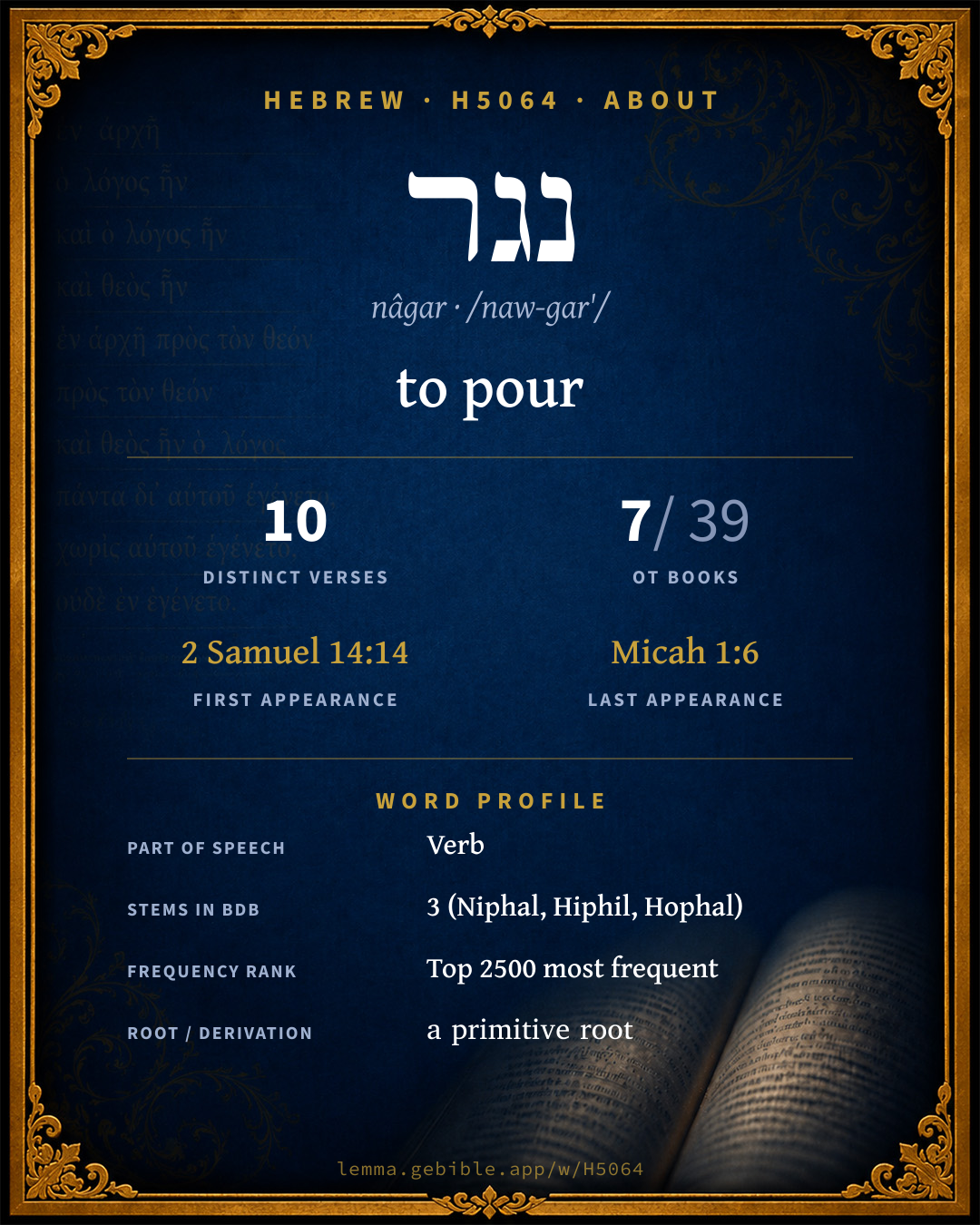
נָגַר
to pour
also: run, flow, pour down fuller range ↓
Full lexicon entry — Brown-Driver-Briggs (BDB)
From Brown-Driver-Briggs (BDB)
Where this word appears
See every Hiphil verb in the Hebrew Bible →
Grammar key — what these labels mean
Part of speech
- Verb
- An action or state-of-being word.
Stem
- Niphal
- Usually the simple passive or reflexive of the Qal (“he was written”). Here: ‘be poured’
- Hiphil
- The causative active stem (“he caused / brought about”).
- Hophal
- The passive counterpart of the Hiphil (“he was caused to…”).
Form
- Perfect
- A completed action or state — Hebrew marks aspect (completeness) more than strict tense (“he wrote”).
- Sequential Perfect
- A perfect with prefixed waw continuing a preceding imperfect or command (waw-consecutive perfect).
- Imperative
- A direct command (“write!”).
- Sequential Imperfect
- An imperfect with prefixed waw — the standard past-narrative form (waw-consecutive imperfect).
- Participle Active
- A verbal adjective expressing ongoing or characteristic action (“writing / one who writes”).
- Participle Passive
- A verbal adjective expressing action received (“written”).
- Imperfect
- An incomplete, ongoing, or future action (“he will / would write”).
State
- Absolute
- The independent form of a noun, not bound to a following word.
Person
- 3rd Person
- The one spoken about (“he / she / it / they”).
- 1st Person
- The speaker (“I / we”).
- 2nd Person
- The one addressed (“you”).
Gender
- Feminine
- Grammatically feminine.
- Common
- Either gender — not distinguished for this form.
- Masculine
- Grammatically masculine.
Number
- Singular
- One.
- Plural
- More than one (in Hebrew, generally three or more).
Every verse where H5064 appears in the Book of Psalms — 3 distinct verses. Click any verse to open its interlinear word-by-word view. Verse text shown in the World English Bible for context — . Each verse’s Hebrew form is shown with its reference; the English is not keyword-highlighted, since the data carries no word-level English alignment. Use “Compare translations” on any verse to read it across multiple English versions. This concordance covers the Hebrew Bible; Septuagint (Greek Old Testament) occurrences are not indexed here.
Psalms
- Psalms 63:10 יַגִּירֻ֥/הוּ Hiphil impf 3mp + sfx pers 3ms They shall be given over to the power of the sword. They shall be jackal food.
- Psalms 75:8 וַ/יַּגֵּ֪ר conj + Hiphil wimpf 3ms For in the hand of Yahweh there is a cup, Full of foaming wine mixed with spices. He pours it out. Indeed the wicked of the earth drink and drink it to its very dregs.
- Psalms 77:2 נִ֭גְּרָה Niphal pf 3fs In the day of my trouble I sought the Lord. My hand was stretched out in the night, and didn't get tired. My soul refused to be comforted.
About this entry
At a glance — auto-summarized from this page’s data, not written by a person. Every figure links to its source below. This summary describes the numbers; it doesn’t interpret them.
“to pour” is the headline sense of the Hebrew verb נגר (nâgar). First canonically at 2 Samuel 14:14, it enters the text early. The Hebrew Bible uses it across 10 verses — uncommon. More than a quarter of its appearances fall in Psalms. The verb spans 3 stems, from Niphal to Hiphil. See the sense tree, 10-verse concordance, and the renderings breakdown below.
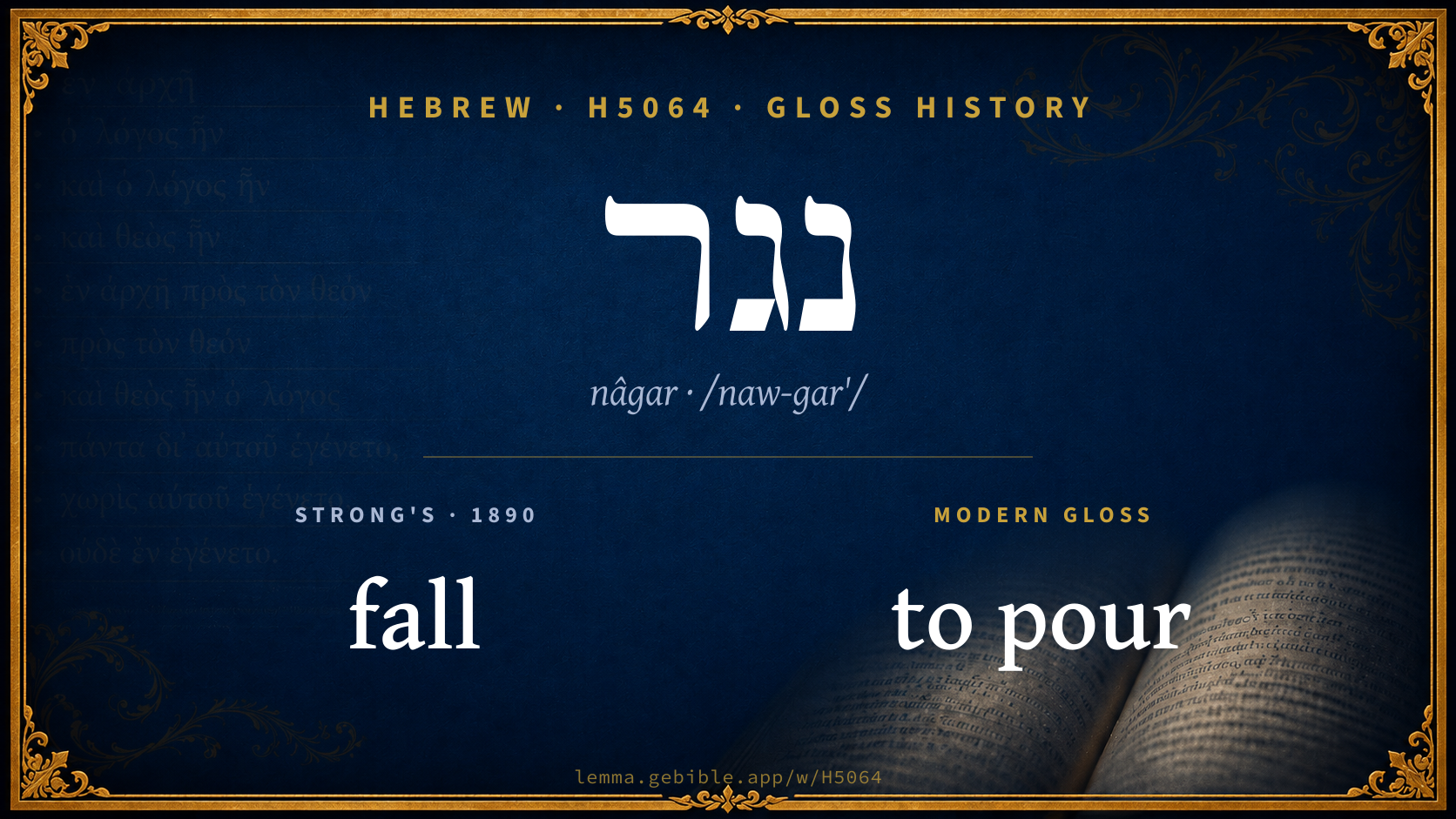
Gloss history
Strong's 1890 vs modern scholarship
About this word
Strong's H5064 catalogs a Hebrew word from the Hebrew Old Testament.
These counts are not copied from any lexicon or concordance. They are computed here, from the morphology-tagged Hebrew Old Testament. What Lemma adds →
- 10
- distinct verses
- The word appears in 10 distinct verses.
- 7 / 39
- OT books
- The word appears in 7 of 39 Old Testament books.
- #2,342
- by frequency
- Top 2500 most frequent Hebrew words (rank 2,342 of 8,640 Hebrew words by occurrence).
View all 10 occurrences in the concordance →
By section of the Old Testament
By traditional corpus
Conventional, traditional groupings — biblical authorship is debated, so this is a traditional corpus grouping, not an authorship claim. Each share is this word’s portion of its verses in that division of the Hebrew canon. Each figure is a share of the word’s 10 distinct verses.
- Prophets (Nevi'im) 5 verses · 50%
- Writings (Ketuvim) 5 verses · 50%
How translations render this word
Counts come from each version’s own published word-to-Strong’s tagging or interlinear alignment — an approximate guide to how each version renders this word, not a word-level alignment the data otherwise carries. Because each total is that version’s own tagged count, the per-version totals vary from one another and need not match the appearance or distinct-verse counts above. These counts may also differ from a printed concordance because Lemma counts each distinctly tagged rendering and does not collapse phrase taggings into a single head-word total. This is a fixed set of word-tagged versions (KJV, ASV, BSB, ULT) and does not change with the reading translation you choose elsewhere. Each version’s license is shown beside its name below (and on Sources).
- King James Version: Are poured 1×, Goods shall flow away 1×, Hast shed 1×
- American Standard Version: Are poured 1×, Give them 1×, Goods shall flow away 1×
- Berean Standard Bible: Delivered 1×, Flowing away 1×, He pours 1×
- unfoldingWord Literal Text: Deliver them over 1×, Flowing away 1×, He pours out 1×
King James Version Public Domain
Renders H5064 across 10 tagged occurrences — most commonly:
American Standard Version Public Domain
Renders H5064 across 10 tagged occurrences — most commonly:
Berean Standard Bible Public Domain
Renders H5064 across 9 tagged occurrences — most commonly:
Not rendered by a distinct English word in 1 further occurrence.
unfoldingWord Literal Text CC BY-SA 4.0
Renders H5064 across 10 tagged occurrences — most commonly:
Senses in the full BDB
Hebrew verbs can shift meaning by stem (binyan): Qal is the basic action, Niphal is often passive or reflexive, Piel often intensifies or makes it factitive, and Hiphil is typically causative. The senses below are grouped under the stem BDB assigns to each. This entry also uses Hophal (the passive of Hiphil).
What do BDB’s symbols mean?
BDB uses these scholarly abbreviations:
| Symbol | Meaning |
|---|---|
| 𝔊 | the Septuagint (the ancient Greek translation, LXX) |
| 𝔙 | the Vulgate (the Latin translation) |
| 𝔖 | the Syriac version (the Peshitta) |
| 𝔗 | the Targum (the Aramaic translation) |
| ψ | the Psalms |
| √ | root (the underlying root or stem) |
| ‖ | parallel passage (a synonymous or contrasted parallel) |
| † | the dagger: every passage where the word occurs is cited |
The 6 senses and sub-senses the full Brown-Driver-Briggs lexicon distinguishes for this word, in lexicon order (not ranked by frequency), with BDB’s own verbatim wording and sub-sense lettering. Shown in Hebrew script with BDB’s own scholarly abbreviations. The condensed entry is in the Lexicon Entry tab. See also the Forms in the corpus table below.
Niphal
- 1. be poured, split
- 2. pour oneself, flow, trickle, of eye (in tears)
- 3. fig. vanish
- 4. be stretched out (?)
Hiphil
- . pour down, hurl down
Hophal
- . of mountains melting at theophany.
Senses from the full Brown-Driver-Briggs lexicon (Brown, Driver, Briggs; Oxford 1906 — public domain), digitized via Sefaria, supplemented by the OpenScriptures HebrewLexicon (CC BY 4.0). Full attribution on Sources.
Word origin
[ נָגַר ] vb. pour, flow, run
— Brown-Driver-Briggs (Oxford 1906, public domain), digitized via Sefaria, supplemented by the OpenScriptures HebrewLexicon (CC BY 4.0). See Sources.
Origin: a primitive root
Jastrow Dictionary
A second Hebrew/Aramaic lexicon for comparison, covering Aramaic and post-biblical (Talmudic, Targumic, Midrashic) usage that the biblical-Hebrew BDB does not. Matched by lemma rather than by Strong’s number, so a lemma may carry more than one Jastrow headword (shown separately below), and the entries cover usage well beyond the Bible.
נָגַר
- to carry along, roll, v. Nif.
- to scrape, to saw; v. נַגָּר.
- (denom. of נַגָּר) to do carpenter’s work. Yalk. Josh. 7 (ref. to חרש, Josh. II, 1) בלי נגרות היו בידם מְנַגְּרִין they had with them carpenter’s tools, pretending to be carpenters; Ruth R. to I, 1 (Par. 2) מרגלים וכ׳ (corr. acc.). e.g. Joshua 2:1
- (cmp. אָגַר I, a. משך) (of water) to be conducted in gutters; to be stored up. Tosef. Par. IX (VIII), 8 המים הנמשכין והנגררין Var. (read: והנִגָּרִין; ed. Zuck. והנמרצין, v. מָרַץ) waters running in channels or stored up.—נִגָּרִים, נִגָּרִין animals in pens, fish in caufs &c. Tosef. Bets. III, 1; Bab. ib. 24ᵇ; Y. ib. III, 62ᵃ top; Y. Sabb. XIII, 14ᵃ bot. מן הנ׳, opp. to מן המצודות those found in traps, nets &c.
נְגַר
- 1. to scrape, plane, saw. Targ. Is. X, 16 (ed. Lag. נגד׳; corr. acc.).
- 2. interch. with נגד) to be prolonged, continue. Targ. Prov. XXVIII, 16 נִיגְּרוּן יומוי (ed. Wil. נגד׳); ib. 2 ניגרון (ed. Wil. נגדון; h. text יאריך).
- 3. to run along, flow. Targ. Job XL, 23 (ed. Lag. a. oth. נגיד). Targ. Y. Ex. XVI, 21. Targ. Is. VIII, 6 Ar. (ed. נגד׳); a. e.; v. נְגַד.
- 1. to saw. Targ. Is. X, 15 נַגָּרִית ed. Wil. (v. supra).
- 2. (denom. of נַגְרָא) to bolt. Targ. Jon. II, 7 נַגְּרַת (Bxt. נַגֶּרֶת; ed. Lag. a. oth. נגדת corr. acc.; h. text בְּרִחֶהָ).
נְגַר II
- N’gar, legendary name of one of the ancestors of Haman. Targ. Esth. V, 1; Targ. II Esth. III, 1 (נִגַּר)—[Targ. Y. Ex. XXXV, 35, v. נַגָּרָא.]
נַגָּר
- (נָגַר) carpenter, turner; in gen. artisan. B. Kam. 32ᵇ; Tosef. ib. VI, 25 חנותו של נ׳ a carpenter’s workshop. Tosef. Kel. B. Mets. IV, 5, v. חוֹלֵיץ; a. fr. Pl. נַגָּרִים, נַגָּרִין. Lev. R. s. 5 מה נ׳ הם וכ׳ how skillful are the Israelites that know how &c.; Yalk. Ps. 677 נגידים (corr. acc.); Midr. Till. to Ps. XIX גבורים.
נַגָּר ²
- 1. same. Targ. Ex. XXXV, 35 (Y. נְגַר; h. text חָרָשׁ). Targ. Is. XL, 19; a. fr.—Y. Sabb. VI, 8ᶜ top מבהתה מימור לנ׳ וכ׳ she is ashamed to tell the turner (of ivory), make me another tooth. B. Bath. 73ᵇ בר נ׳ a young carpenter; a. fr.—נַגַּר טורא [the carpenter of the mountain,] wood-cock. Targ. Lev. XI, 19; Targ. Deut. XIV, 18 (h. text דוכיפת).—Gitt. 68ᵇ והיינו דמתרגמינן נ׳ ט׳ that is the reason why we translate (תרנגולא ברא) naggar ṭura.—Trnsf. (cmp. חָרָשׁ) artist, master. Ab. Zar. 50ᵇ ולית נ׳ ולא בר נ׳ וכ׳ and there is no master nor son of master that can solve that; Y. Yeb. VIII, 9ᵇ bot.; Y. Kidd. IV, 66ᵃ bot. מילה דנ׳ בר נגרין וכ׳ something which no master, son of masters, can solve.—Pl. נַגָּרִין, נַגָּרַיָּא, נִגָּרֵי. Targ. II Sam. V, 11. Targ. Esth. V, 14; a. e.—Pes. 108ᵃ בשוליא דנ׳ we mean artisans’ apprentices.—Snh. 106ᵃ bot., v. זְנֵי. Y. Yeb. l. c.; Y. Kidd. l. c., v. supra. Sabb. 123ᵇ, v. הֲצִינָא.
- 2. carpenter’s axe.—Pl. נַגָּרֵי. Bets. 33ᵇ קתתא דנ׳ וחציני Ms. M. a. Ar. (ed. נרגי) helves of axes and adzes; Yoma 37ᵇ (v. Rabb. D. S. a. l. note 8), v. נַרְגָּא.
נָגָר
- (preced. wds.) [trimmed chip,] door-bolt, pin fitting into sockets top and bottom. Erub. X, 10, v. גְּלוֹסְטְרָא. Ib. 11, v. גָּרַר. B. Bath. 101ᵃ (in Chald. dict.) דעביד להו כמין נ׳ he made the sepulchral chambers like an upright bolt, i.e. placed the bodies in an upright position. Men. 33ᵃ עשאה כמין נ׳ if he fastened the door-post inscription (מזוזה) so as to look like a bolt shoved into a case, i.e. horizontally. Y. Meg. IV, end, 75ᶜ בית מזוזתו … כמין נ׳ the case for the inscription in Rabbi’s house was made like an upright bolt (reaching the top of the door). Num. R. s. 15; Yalk. Josh. 32 יריחי היתה נְגָרָהּ וכ׳ (not נגרא) Jericho was the bolt of Palestine; a. fr.
A Dictionary of the Targumim, the Talmud Babli and Yerushalmi, and the Midrashic Literature (Marcus Jastrow; London, Luzac, 1903) — Public Domain. Digitized via Sefaria. Digitized via Sefaria. Full attribution on Sources.
Forms in the corpus
The 10 distinct written forms H5064 takes in the Hebrew Bible, most frequent first — each parse links to that stem’s occurrences in the concordance. Hebrew forms include their vowel points and cantillation, so a single lemma takes many written forms.
| Form | Parsing | Example | Uses |
|---|---|---|---|
| הַ/נִּגָּרִ֣ים | Verb, Niphal, Participle Active, Masculine, Plural, Absolute | 2 Samuel 14:14 | 1 |
| וְ/הִגַּרְתִּ֤י | Verb, Hiphil, Sequential Perfect, 1st Person, Common, Singular | Micah 1:6 | 1 |
| וְ/הַגִּרֵ/ם֮ | Verb, Hiphil, Imperative, 2nd Person, Masculine, Singular | Jeremiah 18:21 | 1 |
| וַ/יַּגֵּ֪ר | Verb, Hiphil, Sequential Imperfect, 3rd Person, Masculine, Singular | Psalms 75:8 | 1 |
| וַ/תַּגֵּ֥ר | Verb, Hiphil, Sequential Imperfect, 2nd Person, Masculine, Singular | Ezekiel 35:5 | 1 |
| יַגִּירֻ֥/הוּ | Verb, Hiphil, Imperfect, 3rd Person, Masculine, Plural | Psalms 63:10 | 1 |
| מֻגָּרִ֥ים | Verb, Hophal, Participle Passive, Masculine, Plural, Absolute | Micah 1:4 | 1 |
| נִ֝גָּר֗וֹת | Verb, Niphal, Participle Active, Feminine, Plural, Absolute | Job 20:28 | 1 |
| נִ֭גְּרָה | Verb, Niphal, Perfect, 3rd Person, Feminine, Singular | Psalms 77:2 | 1 |
| נִגְּרָ֛ה | Verb, Niphal, Perfect, 3rd Person, Feminine, Singular | Lamentations 3:49 | 1 |
Septuagint verse parallels
This word appears in 10 verses that also exist in the Greek Old Testament (Septuagint), out of the 10 Hebrew verses it occurs in. You can read those verses in Greek by switching the Old Testament edition to the Septuagint.
Read these verses in the Septuagint
This is a verse-level parallel only — the same verses exist in both the Hebrew and Greek Old Testaments. No word-level Hebrew↔Greek correspondence is claimed: the data carries no such alignment, so no Greek word is shown as this Hebrew word’s translation. Coverage is not total — the Septuagint omits the deuterocanon and renumbers the Psalms, so some Hebrew verses have no direct Greek parallel.