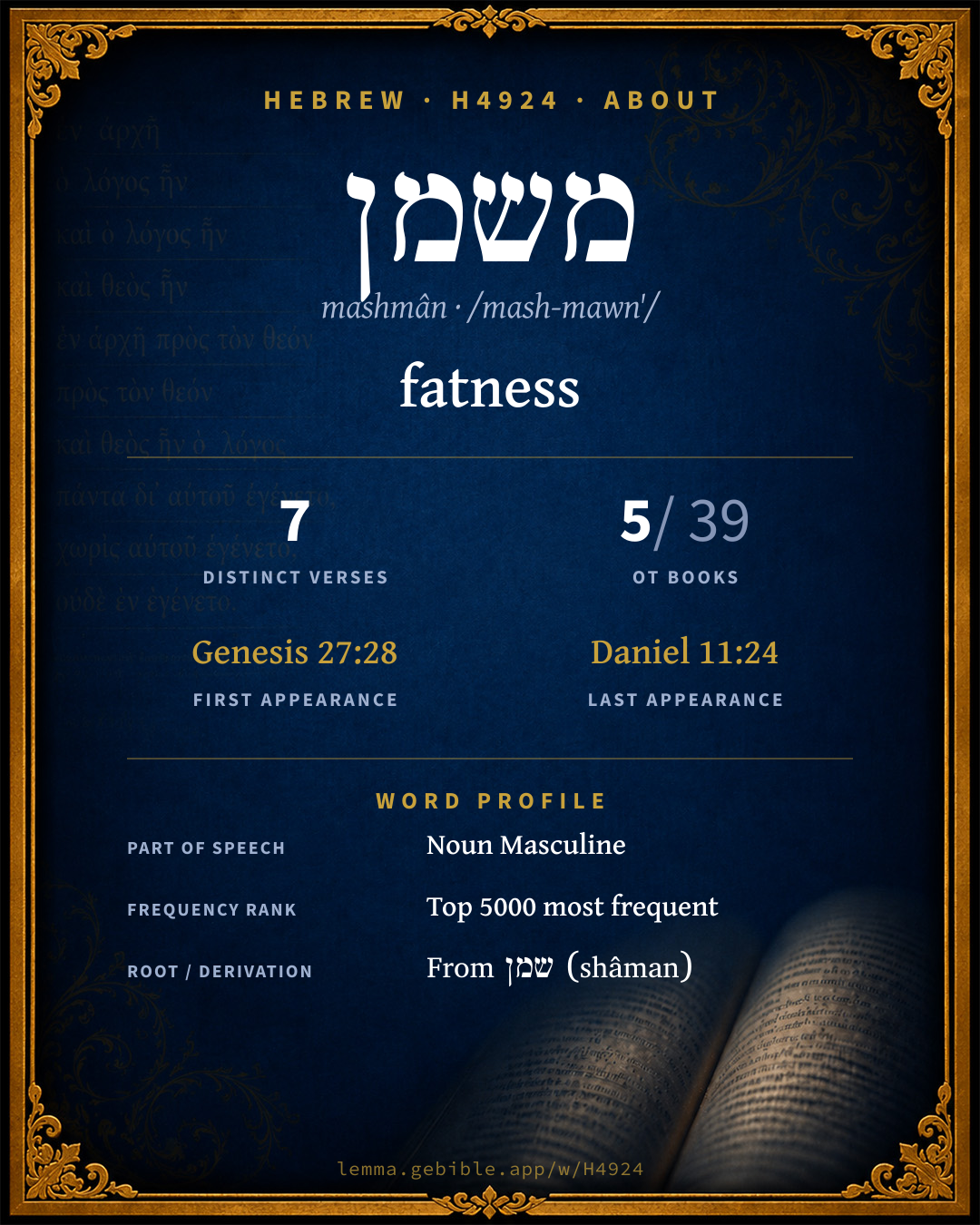
משמן
fatness
also: fat piece, fertile place, richly prepared food fuller range ↓
Full lexicon entry — Brown-Driver-Briggs (BDB)
From Brown-Driver-Briggs (BDB)
Where this word appears
Grammar key — what these labels mean
Part of speech
- Noun
- A naming word — a person, place, thing, or idea.
Noun type
- Common
- A common noun — a general class of person, place, or thing (“king,” “city,” “water”), not a specific name.
State
- Construct
- A noun bound to a following noun in a possessive / “of” relationship (the construct chain).
- Absolute
- The independent form of a noun, not bound to a following word.
Gender
- Masculine
- Grammatically masculine.
Number
- Plural
- More than one (in Hebrew, generally three or more).
- Singular
- One.
Every verse where H4924 appears in the Book of Daniel — 1 distinct verse. Click any verse to open its interlinear word-by-word view. Verse text shown in the World English Bible for context — . Each verse’s Hebrew form is shown with its reference; the English is not keyword-highlighted, since the data carries no word-level English alignment. Use “Compare translations” on any verse to read it across multiple English versions. This concordance covers the Hebrew Bible; Septuagint (Greek Old Testament) occurrences are not indexed here.
Daniel
About this entry
At a glance — auto-summarized from this page’s data, not written by a person. Every figure links to its source below. This summary describes the numbers; it doesn’t interpret them.
At its core, משמן (mashmân) means “fatness.” Scripture first uses it in Genesis 27:28. With 7 verses in 5 books, it is an uncommon word in the Hebrew Bible. Its uses concentrate in Genesis (29% of all occurrences). Ranging over 2 senses, its meaning includes “fat piece”, “fertile place”, and “richly prepared food”. For the data behind this summary, explore the sense tree and the renderings breakdown below.
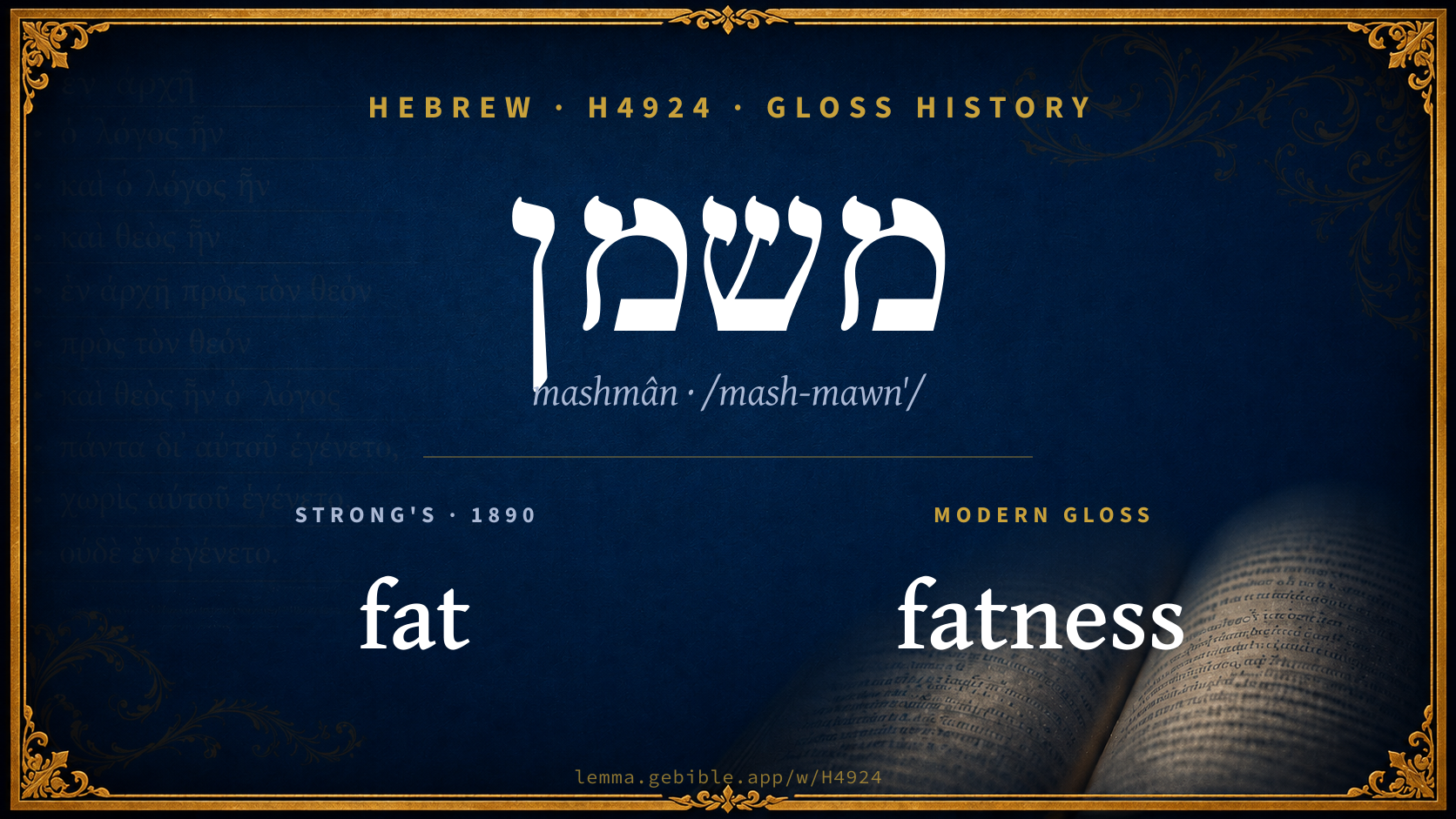
Gloss history
Strong's 1890 vs modern scholarship
About this word
Strong's H4924 catalogs a Hebrew word from the Hebrew Old Testament.
These counts are not copied from any lexicon or concordance. They are computed here, from the morphology-tagged Hebrew Old Testament. What Lemma adds →
- 7
- distinct verses
- The word appears in 7 distinct verses.
- 5 / 39
- OT books
- The word appears in 5 of 39 Old Testament books.
- #2,835
- by frequency
- Top 5000 most frequent Hebrew words (rank 2,835 of 8,640 Hebrew words by occurrence).
View all 7 occurrences in the concordance →
By section of the Old Testament
By traditional corpus
Conventional, traditional groupings — biblical authorship is debated, so this is a traditional corpus grouping, not an authorship claim. Each share is this word’s portion of its verses in that division of the Hebrew canon. Each figure is a share of the word’s 7 distinct verses.
- Writings (Ketuvim) 3 verses · 43%
- Torah (Pentateuch) 2 verses · 29%
- Prophets (Nevi'im) 2 verses · 29%
How translations render this word
Counts come from each version’s own published word-to-Strong’s tagging or interlinear alignment — an approximate guide to how each version renders this word, not a word-level alignment the data otherwise carries. Because each total is that version’s own tagged count, the per-version totals vary from one another and need not match the appearance or distinct-verse counts above. These counts may also differ from a printed concordance because Lemma counts each distinctly tagged rendering and does not collapse phrase taggings into a single head-word total. This is a fixed set of word-tagged versions (KJV, ASV, BSB, ULT) and does not change with the reading translation you choose elsewhere. Each version’s license is shown beside its name below (and on Sources).
- King James Version: Fatness 2×
- American Standard Version: Fatness 2×
- Berean Standard Bible: Among stout warriors 1×, Away from the richness 1×, Fat 1×
- unfoldingWord Literal Text: Fatness of 2×
King James Version Public Domain
Renders H4924 across 7 tagged occurrences — most commonly:
Plus 5 renderings that appear only once — usually multi-word phrases or single function words the recovered tagging swept in, not distinct renderings.
American Standard Version Public Domain
Renders H4924 across 7 tagged occurrences — most commonly:
Plus 5 renderings that appear only once — usually multi-word phrases or single function words the recovered tagging swept in, not distinct renderings.
Berean Standard Bible Public Domain
Renders H4924 across 7 tagged occurrences — most commonly:
unfoldingWord Literal Text CC BY-SA 4.0
Renders H4924 across 7 tagged occurrences — most commonly:
Plus 5 renderings that appear only once — usually multi-word phrases or single function words the recovered tagging swept in, not distinct renderings.
Senses in BDB
The 2 senses BDB distinguishes for this word, in lexicon order (not ranked by frequency or importance). The full entry — with sub-senses — is in the Lexicon Entry tab.
- fatness, fat piece, fertile place, richly prepared food
- fatness
Word origin
Derived from שמן (shâman) (H8080) — to be fat.
Jastrow Dictionary
A second Hebrew/Aramaic lexicon for comparison, covering Aramaic and post-biblical (Talmudic, Targumic, Midrashic) usage that the biblical-Hebrew BDB does not. Matched by lemma rather than by Strong’s number, so a lemma may carry more than one Jastrow headword (shown separately below), and the entries cover usage well beyond the Bible.
שָׁמֵן I
- (b. h.) [to be smooth,] to be fat.
- to grow fat, improve. Y. B. Kam. IX, beg. 6ᵈ גזל כחושה והִשְׁמִינָה if he took forcibly a lean animal, and it grew fat (in his possession); Tosef. B. Kam. VII, 17; Bab. B. Kam. 65ᵃ; a. e.
- to become smooth, bright; to glisten. Gen. R. s. 34 כל שהוא … היא מִשְׁתַּמֶּנֶת the more he beats it (the flax), the more it will glisten; Yalk. ib. 95; Yalk. Ps. 654.
- 1. (denom. of (denom. of שֶׁמֶן) to oil. Men. 23ᵃ קומץ … שׁשִׁמְּנוֹ וכ׳ the handful of the sinner’s meal-offering on which he (the priest) put oil, … has become unfit for the altar; Yalk. Lev. 474.
- 2. to smooth, level; ש׳ בין to compromise to average. B. Mets. 87ᵃ השוכר … מְשַׁמְּנִין ביניהם if one hires a laborer, saying, I will pay you as much as one or two of the inhabitants of the place get: he may pay him the lowest wages …; the scholars say, you compromise between them, i.e. you make him pay the average wages. B. Bath. VII, 4 האומר … משמנין ביניהם וכ׳ if one says to his neighbor, I sell thee one-half of my field (and one part is better than the other), we compromise between them, i.e. the field is divided into two portions of equal value, but the purchaser must take whichever portion the seller may assign to him; חציה בדרום … משמנין וכ׳ if he says, I sell thee half of the field on the south side, we compromise between them, and he gets his portion on the south side; expl. ib. 107ᵇ משמנין … לדמי ‘we compromise’ means according to value. Bekh. II, 6, sq. משמנין ביניהם we compromise between them, i.e. the priest takes the inferior of the twin animals, and the difference in value remains under litigation; expl. ib. 18ᵃ מהו משמנין שומן יהא ביניהן m’shamm’nin means, the fat one (the difference of value) remains to be decided &c., v. שׁוּמָן.
שָׁמֵן
- preced.) fat, rich. Keth. 61ᵃ בשר ש׳ fat meat. Pes. 42ᵃ. Ḥull. 45ᵇ גדי שמן Rashi (ed. גדי שמינה, v. Rabb. D. S. a. l. note 8) a fat kid. Y. B. Kam. IX, beg. 6ᵈ גזל ש׳ והכחישה וכ׳ if he took by force a fat animal, and it became lean &c., v. שׁוּמָן; a. fr.—Pl. שְׁמֵנִים, שְׁמֵי׳; שְׁמֵנוֹת, שְׁמֵי׳. Gen. R. s. 66 דגים ש׳ יתיר מדאי exceedingly fat fish. Num. R. s. 1612 אם … אם ש׳ whether its fruits are light or rich; ib. אם של צונמא … ש׳, v. צוֹנָם; Tanḥ. Sh’laḥ 6; a. fr.
שְׁמַן
- (preced. wds.)
- 1. cream. Targ. O. Gen. XVIII, 8 (Y. לוואי שָׁמִין; h. text חמאה). Targ. Ps. LV, 22 ש׳ דגובנין (h. text מחמאות).
- 2. fat. Targ. Is. XXX, 23. Targ. Y. Gen. XVIII, 7 שְׁמֵין.—V. שׁוּמְנָא.
שֶׁמֶן
- preced. wds.) oil, fat. Sabb. II, 1 ש׳ שרפה oil of T’rumah which is condemned to be burnt on account of contamination; ש׳ קיק, v. קִיק. Ib. 2 ש׳ דגים fish-oil; ש׳ אגוזים nut-oil &c. Ib. 17ᵇ שׁמְנָן their oil, manufactured by gentiles; Ab. Zar. 36ᵃ. Ib. ש׳ רב יהודה וכ׳ as to gentiles’ oil, R. Judah and his court voted on it and permitted it. Pes. 83ᵇ; Ḥull. 91ᵃ; 92ᵇ שַׁמְנוֹ the fat surrounding the nervus ischiadicus, v. שׁוּמָן; a. fr.—עֵץ ש׳ pine-wood, v. עֵץ.—Pl. שְׁמָנִים, שְׁמָנִין. Sabb. II, 2 מתירין בכל הש׳ allow all kinds of oil to be used for Sabbath lights. Ib. 26ᵃ כל הש׳ יפין וכ׳ all oils are good for ink, but olive oil is the best. Y. Bicc. I, 64ᵇ top; a. fr.
שִׁמָּן
- Shimmon, v. שִׁמְעוֹן.
A Dictionary of the Targumim, the Talmud Babli and Yerushalmi, and the Midrashic Literature (Marcus Jastrow; London, Luzac, 1903) — Public Domain. Digitized via Sefaria. Digitized via Sefaria. Full attribution on Sources.
Forms in the corpus
The 7 distinct written forms H4924 takes in the Hebrew Bible, most frequent first — each parse links to that state’s occurrences in the concordance. Hebrew forms include their vowel points and cantillation, so a single lemma takes many written forms.
| Form | Parsing | Example | Uses |
|---|---|---|---|
| בְּ/מִשְׁמַנֵּי/הֶ֑ם | Noun, Common, Masculine, Plural, Construct | Psalms 78:31 | 1 |
| בְּ/מִשְׁמַנָּ֖י/ו | Noun, Common, Masculine, Plural, Construct | Isaiah 10:16 | 1 |
| וּ/בְ/מִשְׁמַנֵּ֣י | Noun, Common, Masculine, Plural, Construct | Daniel 11:24 | 1 |
| וּ/מִ/שְׁמַנֵּ֖י | Noun, Common, Masculine, Plural, Construct | Genesis 27:28 | 1 |
| וּ/מִשְׁמַ֥ן | Noun, Common, Masculine, Singular, Construct | Isaiah 17:4 | 1 |
| מִ/שְׁמַנֵּ֤י | Noun, Common, Masculine, Plural, Construct | Genesis 27:39 | 1 |
| מַשְׁמַנִּ֜ים | Noun, Common, Masculine, Plural, Absolute | Nehemiah 8:10 | 1 |
Same root — word family
Other BDB entries built from the same root as H4924, grouped by Strong’s listed origin. These share a root / origin per the lexicon — not necessarily a shared meaning. Each links to that word’s own entry.
Derives from
Shares the same root
Proper names from this root
People and places named from this root — a name, not an additional meaning of the word.
Compare all same-root words → Showing 4 of 5 — not the complete family. 1 of the same-root words is a proper name (a person or place). They share a root, not necessarily a meaning.
Septuagint verse parallels
This word appears in 5 verses that also exist in the Greek Old Testament (Septuagint), out of the 7 Hebrew verses it occurs in. You can read those verses in Greek by switching the Old Testament edition to the Septuagint.
Read these verses in the Septuagint
This is a verse-level parallel only — the same verses exist in both the Hebrew and Greek Old Testaments. No word-level Hebrew↔Greek correspondence is claimed: the data carries no such alignment, so no Greek word is shown as this Hebrew word’s translation. Coverage is not total — the Septuagint omits the deuterocanon and renumbers the Psalms, so some Hebrew verses have no direct Greek parallel.