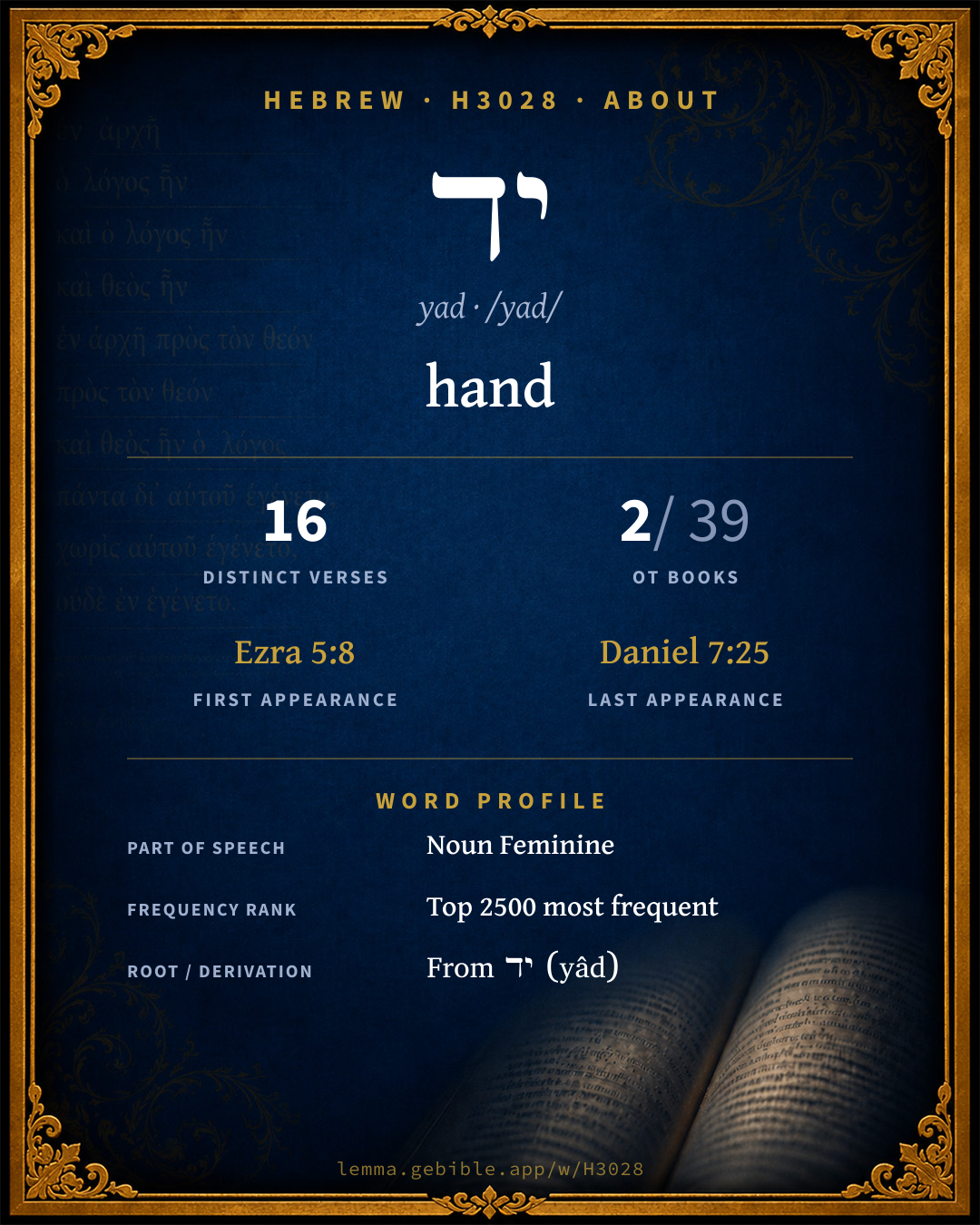
יַד
hand
‘hand’ is one of 2 main senses fuller range ↓
Full lexicon entry — Brown-Driver-Briggs (BDB)
From Brown-Driver-Briggs (BDB)
Where this word appears
See every Construct-state word in the Hebrew Bible →
Grammar key — what these labels mean
Part of speech
- Noun
- A naming word — a person, place, thing, or idea.
Noun type
- Common
- A common noun — a general class of person, place, or thing (“king,” “city,” “water”), not a specific name.
State
- Construct
- A noun bound to a following noun in a possessive / “of” relationship (the construct chain).
- Absolute
- The independent form of a noun, not bound to a following word.
Gender
- Feminine
- Grammatically feminine.
Number
- Singular
- One.
- Dual
- Exactly two — for natural pairs and some measures of time.
- Plural
- More than one (in Hebrew, generally three or more).
2 verses where H3028 appears in the Absolute state in the Book of Daniel. Filtered view — show all forms. Click any verse to open its interlinear word-by-word view. Verse text shown in the World English Bible for context — . Each verse’s Hebrew form is shown with its reference; the English is not keyword-highlighted, since the data carries no word-level English alignment. Use “Compare translations” on any verse to read it across multiple English versions. This concordance covers the Hebrew Bible; Septuagint (Greek Old Testament) occurrences are not indexed here.
Daniel
- Daniel 2:34 בִ/ידַ֔יִן prep + n c fd You saw until a stone was cut out without hands, which struck the image on its feet that were of iron and clay, and broke them in pieces.
- Daniel 2:45 בִ/ידַ֗יִן prep + n c fd Because you saw that a stone was cut out of the mountain without hands, and that it broke in pieces the iron, the brass, the clay, the silver, and the gold; the great God has made known to the king what shall happen hereafter: and the dream is certain, and the interpretation of it sure.
About this entry
At a glance — auto-summarized from this page’s data, not written by a person. Every figure links to its source below. This summary describes the numbers; it doesn’t interpret them.
The Hebrew noun יד centers on the idea of “hand.” The word gravitates to Daniel (69%), then Ezra. It appears 16 verses across 2 books of the Hebrew Bible, among its uncommon vocabulary. Its earliest occurrence is Ezra 5:8. Its meaning spans more than one sense — see its full sense range. Dig into 16-verse concordance and the renderings breakdown below.
Gloss history
Strong's 1890 vs modern scholarship
About this word
Strong's H3028 catalogs a Hebrew word from the Hebrew Old Testament.
These counts are not copied from any lexicon or concordance. They are computed here, from the morphology-tagged Hebrew Old Testament. What Lemma adds →
- 16
- distinct verses
- The word appears in 16 distinct verses.
- 2 / 39
- OT books
- The word appears in 2 of 39 Old Testament books.
- #1,671
- by frequency
- Top 2500 most frequent Hebrew words (rank 1,671 of 8,640 Hebrew words by occurrence).
View all 16 occurrences in the concordance →
By traditional corpus
Conventional, traditional groupings — biblical authorship is debated, so this is a traditional corpus grouping, not an authorship claim. Each share is this word’s portion of its verses in that division of the Hebrew canon. Each figure is a share of the word’s 16 distinct verses.
- Writings (Ketuvim) 16 verses · 100%
How translations render this word
Counts come from each version’s own published word-to-Strong’s tagging or interlinear alignment — an approximate guide to how each version renders this word, not a word-level alignment the data otherwise carries. Because each total is that version’s own tagged count, the per-version totals vary from one another and need not match the appearance or distinct-verse counts above. These counts may also differ from a printed concordance because Lemma counts each distinctly tagged rendering and does not collapse phrase taggings into a single head-word total. This is a fixed set of word-tagged versions (KJV, ASV, BSB, ULT) and does not change with the reading translation you choose elsewhere. Each version’s license is shown beside its name below (and on Sources).
- King James Version: Hand 10×, Hands 4×, Is in thine hand 2×
- American Standard Version: Hand 8×, Hands 4×, Is in thy hand 2×
- Berean Standard Bible: Hand 9×, Hands 2×, Human hands 2×
- unfoldingWord Literal Text: Hand 9×, Human hands 2×, Is in your hand 2×
King James Version Public Domain
Renders H3028 across 17 tagged occurrences — most commonly:
Plus 1 rendering that appears only once — usually multi-word phrases or single function words the recovered tagging swept in, not distinct renderings.
American Standard Version Public Domain
Renders H3028 across 17 tagged occurrences — most commonly:
Plus 3 renderings that appear only once — usually multi-word phrases or single function words the recovered tagging swept in, not distinct renderings.
Berean Standard Bible Public Domain
Renders H3028 across 15 tagged occurrences — most commonly:
Plus 2 renderings that appear only once — usually multi-word phrases or single function words the recovered tagging swept in, not distinct renderings. Not rendered by a distinct English word in 2 further occurrences.
unfoldingWord Literal Text CC BY-SA 4.0
Renders H3028 across 19 tagged occurrences — most commonly:
Plus 6 renderings that appear only once — usually multi-word phrases or single function words the recovered tagging swept in, not distinct renderings.
Senses in the full BDB
What do BDB’s symbols mean?
BDB uses these scholarly abbreviations:
| Symbol | Meaning |
|---|---|
| 𝔊 | the Septuagint (the ancient Greek translation, LXX) |
| 𝔙 | the Vulgate (the Latin translation) |
| 𝔖 | the Syriac version (the Peshitta) |
| 𝔗 | the Targum (the Aramaic translation) |
| ψ | the Psalms |
| √ | root (the underlying root or stem) |
| ‖ | parallel passage (a synonymous or contrasted parallel) |
| † | the dagger: every passage where the word occurs is cited |
The 2 senses and sub-senses the full Brown-Driver-Briggs lexicon distinguishes for this word, in lexicon order (not ranked by frequency), with BDB’s own verbatim wording and sub-sense lettering. Shown in Hebrew script with BDB’s own scholarly abbreviations. The condensed entry is in the Lexicon Entry tab. See also the Forms in the corpus table below.
- 1. hand
- 2. power
Senses from the full Brown-Driver-Briggs lexicon (Brown, Driver, Briggs; Oxford 1906 — public domain), digitized via Sefaria, supplemented by the OpenScriptures HebrewLexicon (CC BY 4.0). Full attribution on Sources.
Word origin
Derived from יד (yâd) (H3027) — hand.
Jastrow Dictionary
A second Hebrew/Aramaic lexicon for comparison, covering Aramaic and post-biblical (Talmudic, Targumic, Midrashic) usage that the biblical-Hebrew BDB does not. Matched by lemma rather than by Strong’s number, so a lemma may carry more than one Jastrow headword (shown separately below), and the entries cover usage well beyond the Bible.
יָד
- f. (rarely m.) (b. h.;
- 1. hand; forefoot; handle. Ex. R. s. 42, end מיד ליד from hand to hand, directly, opp. ע"י שלוחו through his messenger.—י׳ רחבה a wide hand, liberality. Y. Ḥag. I, 76ᶜ top עני ויָדוֹ ר׳ a poor man who is liberal, opp. י׳ מעוטה stingy.—Ḥull. 58ᵇ, a. fr. בְּיָד on the forefoot (of a quadruped).—Ukts. I, 1 כל שהוא יד ולא שזמר whatever part of a fruit serves as a handle (as the stem) and not as a protector (as the shell of a nut &c.). Kel. XXIX, 4 יַד הקורדום the handle of an ax; a. v. fr.—Cant. R. to I, 4 לא חלתה יד ליד hand does not fit hand, i.e. the two cases are incongruous.—Trnsf. an intimation, an incomplete statement intelligible from context, surroundings &c. Y. Ned. I, 36ᵈ top תופסין אותו משם יד לקרבן we make him responsible because what he said is suggestive of the word korban (as a vow); a. fr.—Du. יָדַיִם; pl. יָדוֹת. Yad. I, 1 נותנין לי׳ is required for pouring on the hands. Ib. II, 3 הי׳ מטמאות וכ׳ hands (when being washed) become unclean or clean up to the wrist; a. v. fr.—י׳ יפות, v. יָפֶה.—Ned. 2ᵇ ידות נדרים (or ידות) suggestions of vows, contrad. to כינויים, v. כִּינּוּי. Ib. 5ᵇ, a. fr. י׳ שאין מוכיחות לא הויין י׳ suggestions which are not beyond doubt, are no (binding) suggestions; a. fr.
- 2. power, authority, possession, share. B. Mets. 70ᵇ, v. אֶמְצַע. Kidd. 3ᵇ קטנה דלית לה יד וכ׳ a minor who cannot accept a betrothal for herself. Ned. 88ᵇ יד אשה כיד בעלה the wife’s possession is her husband’s possession. Kidd. 23ᵃ גיטו ויָדוֹ באים כאחד his letter of manumission and his right of self-disposal come simultaneously. Yeb. 39ᵃ; Keth. 83ᵃ ידו כיָדָהּ the husband’s right of disposal is as great as the wife’s (concerning what belongs to her); ידו עדיפא מידה his rights are stronger than hers. B. Mets. VI, 2 יָדָן על התחתונה their rights are the lowest, i.e. they are responsible for losses but can derive no benefits from favorable chances; ib. כל המשנה ידו על התחתונה וכ׳ whichever side changes the agreement is at a disadvantage, and whichever side breaks the agreement &c.; a. v. fr.—Du. יָדַיִם, constr. יְדֵי. Ab. Zar. 41ᵇ, a. e. מִירֵי ודאי, v. וַדַּאי.—יְדֵי חובתו, v. יָצָא.
- 3. portion, part.—Pl. יָדוֹת. Tosef. Men. IX, 10 שתי י׳ two thirds; a. fr.—מִיַּד (= מיד ליד) at once, directly, immediately. Tosef. Dem. VIII, 7, v. חָלַל Hif.—Y. Pes. VI, 33ᵃ מיד כל מי וכ׳ presently, every one whose Passover offering was a lamb &c.; a. v. fr.— עַל יַד, על יְדֵי (abbr. ע"י) through, by means of. Gitt. 40ᵇ שמא זיכה לו ע"י אחר he may have benefitted him (given him his liberty) through the agency of another person (without the slave’s knowledge). Nidd. I, 1 מעת לעת ממעטת ע"ו וכ׳ the period of twenty four hours is modified by the interval between one examination and the other (if that interval is less than twenty four hours); a. v. fr.—על ידי ש־ because. Lev. R. s. 32 ע"י שגדרו וכ׳ because the Israelites guarded themselves against unchastity, they were redeemed; a. v. fr.—עַל יָד עַל יָד gradually, little by little. B. Kam. 80ᵃ (opp. מיד); Tosef. ib. VIII, 15. Par. VIII, 7 Hai G. (ed. only once ע"י).—כלאחר יד, v. אַחַי.—יָדַיִם Yadayim, name of a treatise of the Mishnah and Tosefta, of the Order of Tohăroth, containing the laws of levitical cleanness or uncleanness of the hands.
יַד
- Targ. Num. XXXV, 17; a. fr.—V. אִידָא.—Kidd. 30ᵃ top אַדְּיָדָךְ על וכ׳ while thy hand yet rests on thy son’s neck (as long as you have control over him). Ab. Zar. 15ᵃ אַיָּדָא דספסירא (= h. על ידי) through an agent; a. fr.—Pl. יָדִין, יָדַיָּא. Targ. Ez. XXI, 12 (ed. Wil. יְדֵין). Targ. Is. XIII, 7; a. fr.—עַל יַד, על יְדֵי, v. preced. Targ. Ps. LXXXIX, 20. Targ. Y. Num. XXXIII, 1; a. fr.—על יְדֵי ד־ = h. ע"י ש־. Targ. Y. II, Gen. XLIV, 18.—מִן יַד, מִיַּד, v. preced. Targ. Y. Gen. I, 3. Targ. Ps. LIX, 12; a. e.
A Dictionary of the Targumim, the Talmud Babli and Yerushalmi, and the Midrashic Literature (Marcus Jastrow; London, Luzac, 1903) — Public Domain. Digitized via Sefaria. Digitized via Sefaria. Full attribution on Sources.
Forms in the corpus
The 17 distinct written forms H3028 takes in the Hebrew Bible, most frequent first — each parse links to that state’s occurrences in the concordance. Hebrew forms include their vowel points and cantillation, so a single lemma takes many written forms.
Same root — word family
Other BDB entries built from the same root as H3028, grouped by Strong’s listed origin. These share a root / origin per the lexicon — not necessarily a shared meaning. Each links to that word’s own entry.
Derives from
Shares the same root
Compare all same-root words → They share a root, not necessarily a meaning.
Septuagint verse parallels
This word appears in 13 verses that also exist in the Greek Old Testament (Septuagint), out of the 16 Hebrew verses it occurs in. You can read those verses in Greek by switching the Old Testament edition to the Septuagint.
Read these verses in the Septuagint
This is a verse-level parallel only — the same verses exist in both the Hebrew and Greek Old Testaments. No word-level Hebrew↔Greek correspondence is claimed: the data carries no such alignment, so no Greek word is shown as this Hebrew word’s translation. Coverage is not total — the Septuagint omits the deuterocanon and renumbers the Psalms, so some Hebrew verses have no direct Greek parallel.