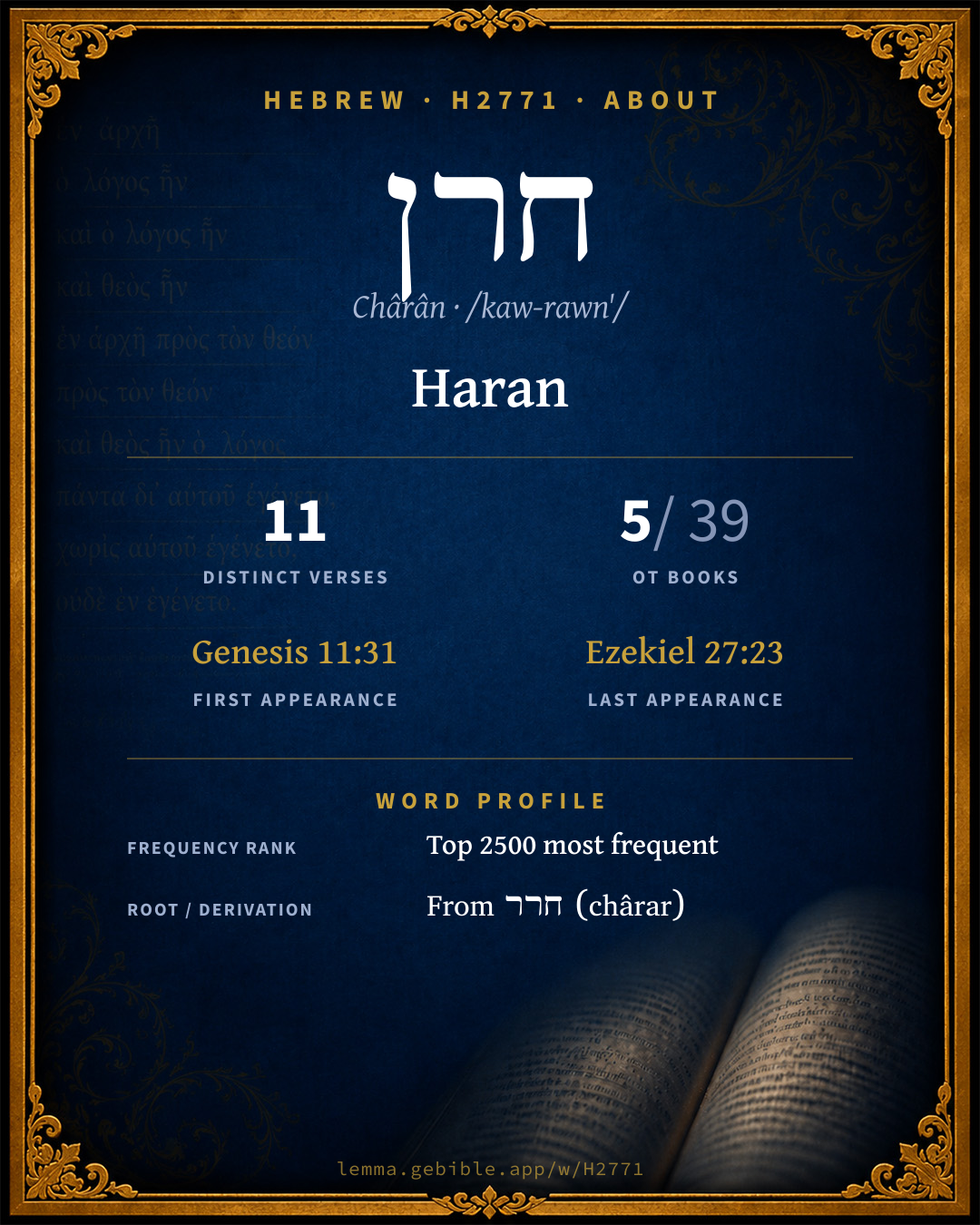
חָרָן
Haran
BDB lists 3 entries for ‘Haran’ fuller range ↓
Full lexicon entry — Brown-Driver-Briggs (BDB)
From Brown-Driver-Briggs (BDB)
Where this word appears
Grammar key — what these labels mean
Part of speech
- Noun
- A naming word — a person, place, thing, or idea.
Noun type
- Proper
- A name of a specific person, place, or people (e.g. Abraham, Zion, Israel).
Every verse where H2771 appears in the Book of Genesis — 7 distinct verses. Click any verse to open its interlinear word-by-word view. Verse text shown in the World English Bible for context — . Each verse’s Hebrew form is shown with its reference; the English is not keyword-highlighted, since the data carries no word-level English alignment. Use “Compare translations” on any verse to read it across multiple English versions. This concordance covers the Hebrew Bible; Septuagint (Greek Old Testament) occurrences are not indexed here.
Genesis
- Genesis 11:31 חָרָ֖ן n Proper Terah took Abram his son, Lot the son of Haran, his son's son, and Sarai his daughter-in-law, his son Abram's wife. They went forth from Ur of the Chaldees, to go into the land of Canaan. They came to Haran, and lived there.
- Genesis 11:32 בְּ/חָרָֽן prep + n Proper The days of Terah were two hundred five years. Terah died in Haran.
- Genesis 12:4 מֵ/חָרָֽן prep + n Proper So Abram went, as Yahweh had spoken to him. Lot went with him. Abram was seventy-five years old when he departed out of Haran.
- Genesis 12:5 בְ/חָרָ֑ן prep + n Proper Abram took Sarai his wife, Lot his brother's son, all their substance that they had gathered, and the souls who they had gotten in Haran; and they went forth to go into the land of Canaan. Into the land of Canaan they came.
- Genesis 27:43 חָרָֽנָ/ה n Proper + sfx dem Now therefore, my son, obey my voice. Arise, flee to Laban, my brother, in Haran.
- Genesis 28:10 חָרָֽנָ/ה n Proper + sfx dem Jacob went out from Beersheba, and went toward Haran.
- Genesis 29:4 מֵ/חָרָ֖ן prep + n Proper Jacob said to them, "My relatives, where are you from?" They said, "We are from Haran."
About this entry
At a glance — auto-summarized from this page’s data, not written by a person. Every figure links to its source below. This summary describes the numbers; it doesn’t interpret them.
חרן — transliterated Chârân — is a Hebrew name carrying the sense “Haran.” Its uses cluster heavily in Genesis (64% of all occurrences). With 11 verses in 5 books, it is an uncommon word in the Hebrew Bible. It first appears in Genesis 11:31. See 11-verse concordance and the renderings breakdown below.
Gloss history
Strong's 1890 vs modern scholarship
About this word
Strong's H2771 catalogs a Hebrew word from the Hebrew Old Testament.
These counts are not copied from any lexicon or concordance. They are computed here, from the morphology-tagged Hebrew Old Testament. What Lemma adds →
- 11
- distinct verses
- The word appears in 11 distinct verses.
- 5 / 39
- OT books
- The word appears in 5 of 39 Old Testament books.
- #2,101
- by frequency
- Top 2500 most frequent Hebrew words (rank 2,101 of 8,640 Hebrew words by occurrence).
View all 11 occurrences in the concordance →
Most concentrated in
- Genesis 7 verses 64%
- 2 Kings 1 verse 9%
- 1 Chronicles 1 verse 9%
By section of the Old Testament
By traditional corpus
Conventional, traditional groupings — biblical authorship is debated, so this is a traditional corpus grouping, not an authorship claim. Each share is this word’s portion of its verses in that division of the Hebrew canon. Each figure is a share of the word’s 11 distinct verses.
- Torah (Pentateuch) 7 verses · 64%
- Prophets (Nevi'im) 3 verses · 27%
- Writings (Ketuvim) 1 verse · 9%
How translations render this word
Counts come from each version’s own published word-to-Strong’s tagging or interlinear alignment — an approximate guide to how each version renders this word, not a word-level alignment the data otherwise carries. Because each total is that version’s own tagged count, the per-version totals vary from one another and need not match the appearance or distinct-verse counts above. These counts may also differ from a printed concordance because Lemma counts each distinctly tagged rendering and does not collapse phrase taggings into a single head-word total. This is a fixed set of word-tagged versions (KJV, ASV, BSB, ULT) and does not change with the reading translation you choose elsewhere. Each version’s license is shown beside its name below (and on Sources).
BDB lists this Strong’s number as 2 distinct words (homographs). Each count above pools all of them and is not split by sense — see the Senses section below. A low-frequency rendering may belong to a different one of those words, not the primary meaning.
- King James Version†: Haran 11×
- American Standard Version†: Haran 10×
- Berean Standard Bible†: Haran 12×
- unfoldingWord Literal Text†: Haran 10×
King James Version Public Domain
Renders H2771 across 12† tagged occurrences — most commonly:
Plus 1 rendering that appears only once — usually multi-word phrases or single function words the recovered tagging swept in, not distinct renderings.
American Standard Version Public Domain
Renders H2771 across 12† tagged occurrences — most commonly:
Plus 2 renderings that appear only once — usually multi-word phrases or single function words the recovered tagging swept in, not distinct renderings.
Berean Standard Bible Public Domain
Renders H2771 across 12† tagged occurrences — most commonly:
unfoldingWord Literal Text CC BY-SA 4.0
Renders H2771 across 12† tagged occurrences — most commonly:
Plus 2 renderings that appear only once — usually multi-word phrases or single function words the recovered tagging swept in, not distinct renderings.
Senses in the full BDB
What do BDB’s symbols mean?
BDB uses these scholarly abbreviations:
| Symbol | Meaning |
|---|---|
| 𝔊 | the Septuagint (the ancient Greek translation, LXX) |
| 𝔙 | the Vulgate (the Latin translation) |
| 𝔖 | the Syriac version (the Peshitta) |
| 𝔗 | the Targum (the Aramaic translation) |
| ψ | the Psalms |
| √ | root (the underlying root or stem) |
| ‖ | parallel passage (a synonymous or contrasted parallel) |
| † | the dagger: every passage where the word occurs is cited |
The 0 senses and sub-senses the full Brown-Driver-Briggs lexicon distinguishes for this word, in lexicon order (not ranked by frequency), with BDB’s own verbatim wording and sub-sense lettering. Shown in Hebrew script with BDB’s own scholarly abbreviations. The condensed entry is in the Lexicon Entry tab. See also the Forms in the corpus table below.
חרן I loc. city in northern Mesopotamia (Assyrian ḫarrânu = road, path COTGloss.
חרן II m. son of Caleb of Judah 1 Ch 2
Senses from the full Brown-Driver-Briggs lexicon (Brown, Driver, Briggs; Oxford 1906 — public domain), digitized via Sefaria, supplemented by the OpenScriptures HebrewLexicon (CC BY 4.0). Full attribution on Sources.
Word origin
I. n.pr.loc. city in northern Mesopotamia (Assyrian ḫarrânu = road, path COTGloss.; cf. DlPa 185; JensenKosmologie 28 ‘junction of trading-routes’ = cross-roads)—mentioned as city of Abram’s sojourn Gn 11:31, where his father Teraḥ died v 32, and whence he departed for Canaan 12:4, 5; where Laban, Jacob’s uncle, lived, and whither Jacob fled 27:43; 28:10 (both חָרָ֫נָה), 29:4; as conquered by fathers of Sennacherib 2 K 19:12 = Is 37:12; as place of trade Ez 27:23; Assyrian Ḫarrana (-ni), SchrCOT on Gn 11:31; 27:43 𝔊 Χαρραν. It was an ancient seat of worship of moon-god (Sin), v. SchrKG 355, 536; see further ChwolsohnSsabier i, 303 ff. WüstenfeldZMG 1864, 443 f. SchrKG 355, 536 SachauReise 217 ff. Mez Gesch. d. Stadt Harran, 1892.
II. n.pr.m. son of Caleb of Judah 1 Ch 2:46(×2); 𝔊 Αρραν, 𝔊L Ωρων (Sab. n.pr. חרן DHMEpigr. Dakm. 56).
— Brown-Driver-Briggs (Oxford 1906, public domain), digitized via Sefaria, supplemented by the OpenScriptures HebrewLexicon (CC BY 4.0). See Sources.
Derived from חרר (chârar) (H2787) — to burn.
Jastrow Dictionary
A second Hebrew/Aramaic lexicon for comparison, covering Aramaic and post-biblical (Talmudic, Targumic, Midrashic) usage that the biblical-Hebrew BDB does not. Matched by lemma rather than by Strong’s number, so a lemma may carry more than one Jastrow headword (shown separately below), and the entries cover usage well beyond the Bible.
חֹרָן
- , v. חוֹרָ׳
A Dictionary of the Targumim, the Talmud Babli and Yerushalmi, and the Midrashic Literature (Marcus Jastrow; London, Luzac, 1903) — Public Domain. Digitized via Sefaria. Digitized via Sefaria. Full attribution on Sources.
Forms in the corpus
The 10 distinct written forms H2771 takes in the Hebrew Bible, most frequent first — each parse links to that state’s occurrences in the concordance. Hebrew forms include their vowel points and cantillation, so a single lemma takes many written forms.
| Form | Parsing | Example | Uses |
|---|---|---|---|
| חָרָ֑ן | Noun, Proper | 2 Kings 19:12 | 2 |
| חָרָֽנָ/ה | Noun, Proper | Genesis 27:43 | 2 |
| בְ/חָרָ֑ן | Noun, Proper | Genesis 12:5 | 1 |
| בְּ/חָרָֽן | Noun, Proper | Genesis 11:32 | 1 |
| וְ/חָרָ֖ן | Noun, Proper | 1 Chronicles 2:46 | 1 |
| חָרָ֖ן | Noun, Proper | Genesis 11:31 | 1 |
| חָרָ֤ן | Noun, Proper | Ezekiel 27:23 | 1 |
| חָרָ֥ן | Noun, Proper | 1 Chronicles 2:46 | 1 |
| מֵ/חָרָ֖ן | Noun, Proper | Genesis 29:4 | 1 |
| מֵ/חָרָֽן | Noun, Proper | Genesis 12:4 | 1 |
Same root — word family
Other BDB entries built from the same root as H2771, grouped by Strong’s listed origin. These share a root / origin per the lexicon — not necessarily a shared meaning. Each links to that word’s own entry.
Derives from
Shares the same root
- חר chôr H2715 noble
- חרה chârâh H2734 to be angry
- חרחר charchur H2746 fever
- חרך chărak H2761 to singe
- חרר chârêr H2788 parched place
Proper names from this root
People and places named from this root — a name, not an additional meaning of the word.
Compare all same-root words → Showing 4 of 8 — not the complete family. 1 of the same-root words is a proper name (a person or place). They share a root, not necessarily a meaning.
Bible dictionary
Public-domain dictionary articles matched to this entry by name (Haran). A biblical name can be shared by more than one person or place, so an article may treat several.
Easton's Bible Dictionary · M. G. Easton, 1897
(1.) Heb. haran; i.e., "mountaineer." The eldest son of Terah, brother of Abraham and Nahor, and father of Lot, Milcah, and Iscah. He died before his father (Gen. 11:27), in Ur of the Chaldees.
(2.) Heb. haran, i.e., "parched;" or probably from the Accadian charana, meaning "a road." A celebrated city of Western Asia, now Harran, where Abram remained, after he left Ur of the Chaldees, till his father Terah died (Gen. 11:31, 32), when he continued his journey into the land of Canaan. It is called "Charran" in the LXX. and in Acts 7:2. It is called the "city of Nahor" (Gen. 24:10), and Jacob resided here with Laban (30:43). It stood on the river Belik, an affluent of the Euphrates, about 70 miles above where it joins that river in Upper Mesopotamia or Padan-aram, and about 600 miles northwest of Ur in a direct line. It was on the caravan route between the east and west. It is afterwards mentioned among the towns taken by the king of Assyria (2 Kings 19:12; Isa. 37:12). It was known to the Greeks and Romans under the name Carrhae.
(3.) The son of Caleb of Judah (1 Chr. 2:46) by his concubine Ephah.
Smith's Bible Dictionary · William Smith, 1863
(a mountaineer).
+ The third son of Terah, and therefore youngest brother of Abram. (Genesis 11:26) (B.C. 1926.) Three children are ascribed to him--Lot, vs. (Genesis 11:27,31) and two daughters, viz., Milcah, who married her uncle Nahor, ver. (Genesis 11:29) and Iscah. ver. (Genesis 11:29) Haran was born in Ur of the Chaldees, and he died there while his father was still living. ver. (Genesis 11:28) + A Gershonite Levite in the time of David, one of the family of Shimei. (1 Chronicles 23:9) + A son of the great Caleb by his concubine Ephah. (1 Chronicles 2:46) + HARAN or Charran, (Acts 7:2,4) name of the place whither Abraham migrated with his family from Ur of the Chaldees, and where the descendants of his brother Nahor established themselves. Comp. (Genesis 24:10) with Genesis27:43 It is said to be in Mesopotamia, (Genesis 24:10) or more definitely in Padan-aram, ch. (Genesis 25:20) the cultivated district at the foot of the hills, a name well applying to the beautiful stretch of country which lies below Mount Masius between the Khabour and the Euphrates. Here, about midway in this district, is a small village still called Harran . It was celebrated among the Romans, under the name of Charrae, as the scene of the defeat of Crassus.
Hitchcock's Bible Names Dictionary · Roswell D. Hitchcock, 1869
mountainous country
Classic public-domain reference works; full attribution on Sources.
Septuagint verse parallels
This word appears in 11 verses that also exist in the Greek Old Testament (Septuagint), out of the 11 Hebrew verses it occurs in. You can read those verses in Greek by switching the Old Testament edition to the Septuagint.
Read these verses in the Septuagint
This is a verse-level parallel only — the same verses exist in both the Hebrew and Greek Old Testaments. No word-level Hebrew↔Greek correspondence is claimed: the data carries no such alignment, so no Greek word is shown as this Hebrew word’s translation. Coverage is not total — the Septuagint omits the deuterocanon and renumbers the Psalms, so some Hebrew verses have no direct Greek parallel.