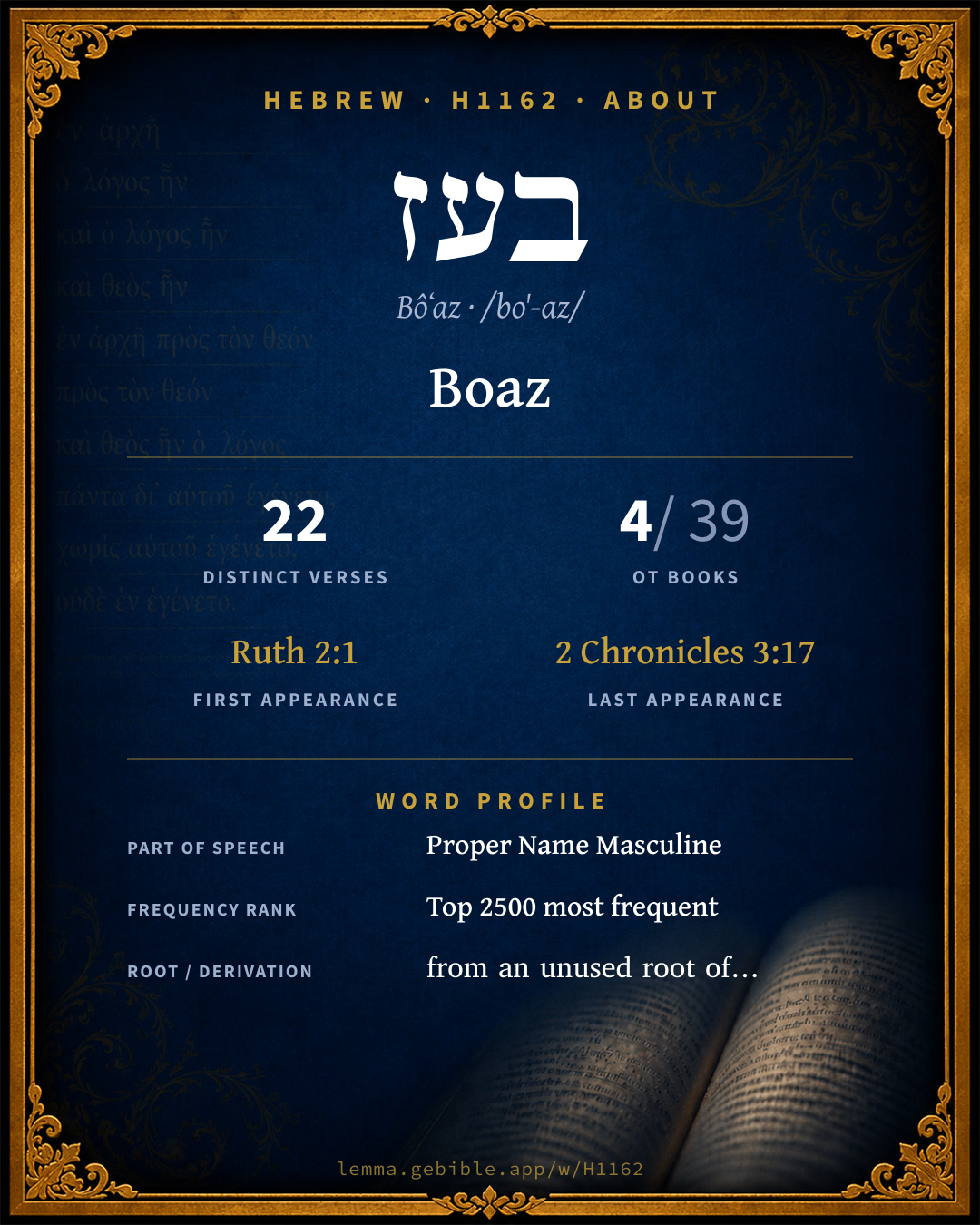
בֹּ֫עַז
Boaz
BDB lists 3 entries for ‘Boaz’ fuller range ↓
Full lexicon entry — Brown-Driver-Briggs (BDB)
From Brown-Driver-Briggs (BDB)
Where this word appears
Grammar key — what these labels mean
Part of speech
- Noun
- A naming word — a person, place, thing, or idea.
Noun type
- Proper
- A name of a specific person, place, or people (e.g. Abraham, Zion, Israel).
Every verse where H1162 appears in the Book of 2 Chronicles — 1 distinct verse. Click any verse to open its interlinear word-by-word view. Verse text shown in the World English Bible for context — . Each verse’s Hebrew form is shown with its reference; the English is not keyword-highlighted, since the data carries no word-level English alignment. Use “Compare translations” on any verse to read it across multiple English versions. This concordance covers the Hebrew Bible; Septuagint (Greek Old Testament) occurrences are not indexed here.
2 Chronicles
About this entry
At a glance — auto-summarized from this page’s data, not written by a person. Every figure links to its source below. This summary describes the numbers; it doesn’t interpret them.
“Boaz” is the headline sense of the Hebrew name בעז (Bôʻaz). It clusters heavily in Ruth, which alone accounts for 82% of its uses. With 22 verses in 4 books, it is an uncommon word in the Hebrew Bible. Scripture first uses it in Ruth 2:1. See 22-verse concordance and the renderings breakdown below.
Gloss history
Strong's 1890 vs modern scholarship
About this word
Strong's H1162 catalogs a Hebrew word from the Hebrew Old Testament.
These counts are not copied from any lexicon or concordance. They are computed here, from the morphology-tagged Hebrew Old Testament. What Lemma adds →
- 22
- distinct verses
- The word appears in 22 distinct verses.
- 4 / 39
- OT books
- The word appears in 4 of 39 Old Testament books.
- #1,327
- by frequency
- Top 2500 most frequent Hebrew words (rank 1,327 of 8,640 Hebrew words by occurrence).
View all 22 occurrences in the concordance →
Most concentrated in
- Ruth 18 verses 82%
- 1 Chronicles 2 verses 9%
- 1 Kings 1 verse 5%
By section of the Old Testament
By traditional corpus
Conventional, traditional groupings — biblical authorship is debated, so this is a traditional corpus grouping, not an authorship claim. Each share is this word’s portion of its verses in that division of the Hebrew canon. Each figure is a share of the word’s 22 distinct verses.
- Writings (Ketuvim) 21 verses · 95%
- Prophets (Nevi'im) 1 verse · 5%
How translations render this word
Counts come from each version’s own published word-to-Strong’s tagging or interlinear alignment — an approximate guide to how each version renders this word, not a word-level alignment the data otherwise carries. Because each total is that version’s own tagged count, the per-version totals vary from one another and need not match the appearance or distinct-verse counts above. These counts may also differ from a printed concordance because Lemma counts each distinctly tagged rendering and does not collapse phrase taggings into a single head-word total. This is a fixed set of word-tagged versions (KJV, ASV, BSB, ULT) and does not change with the reading translation you choose elsewhere. Each version’s license is shown beside its name below (and on Sources).
- King James Version: Boaz 18×
- American Standard Version: Boaz 16×
- Berean Standard Bible: Boaz 20×
- unfoldingWord Literal Text: Boaz 22×
King James Version Public Domain
Renders H1162 across 24 tagged occurrences — most commonly:
Plus 6 renderings that appear only once — usually multi-word phrases or single function words the recovered tagging swept in, not distinct renderings.
American Standard Version Public Domain
Renders H1162 across 24 tagged occurrences — most commonly:
Plus 8 renderings that appear only once — usually multi-word phrases or single function words the recovered tagging swept in, not distinct renderings.
Berean Standard Bible Public Domain
Renders H1162 across 24 tagged occurrences — most commonly:
Plus 4 renderings that appear only once — usually multi-word phrases or single function words the recovered tagging swept in, not distinct renderings.
unfoldingWord Literal Text CC BY-SA 4.0
Renders H1162 across 24 tagged occurrences — most commonly:
Plus 2 renderings that appear only once — usually multi-word phrases or single function words the recovered tagging swept in, not distinct renderings.
Senses in the full BDB
What do BDB’s symbols mean?
BDB uses these scholarly abbreviations:
| Symbol | Meaning |
|---|---|
| 𝔊 | the Septuagint (the ancient Greek translation, LXX) |
| 𝔙 | the Vulgate (the Latin translation) |
| 𝔖 | the Syriac version (the Peshitta) |
| 𝔗 | the Targum (the Aramaic translation) |
| ψ | the Psalms |
| √ | root (the underlying root or stem) |
| ‖ | parallel passage (a synonymous or contrasted parallel) |
| † | the dagger: every passage where the word occurs is cited |
The 2 senses and sub-senses the full Brown-Driver-Briggs lexicon distinguishes for this word, in lexicon order (not ranked by frequency), with BDB’s own verbatim wording and sub-sense lettering. Shown in Hebrew script with BDB’s own scholarly abbreviations. The condensed entry is in the Lexicon Entry tab. See also the Forms in the corpus table below.
- 1. kinsman of Naomi, who married Ruth Ru 2:1, 3, 4, 5, 8, 11, 14, 15, 19, 23; 3:2, 7; 4:1(×2), 5, 8, 9, 13, also v 21(×2) 1 Ch 2:11, 12 (𝔊 Βοος, Βοοζ). e.g. Ruth 2:1
- 2. name of the left hand of two pillars set up before temple (cf. also יָכִין sub כון) 1 K 7:21 = 2 Ch 3:17; (meaning obscure; MT appar. ref. to 1, cf. 𝔗 2 Ch 3:17; Thes supposes name of architect or donor; Ew perhaps sons of Solomon, etc.; read possibly בְּעֹז in strength, 𝔊 2 Ch 3:17 ἰσχύς; Th thinks יכין בעז a sentence, one word being engraved on each pillar, he (God) established in strength; against him, however, Ke Be; Öt thinks an exclamation, in strength! expressing satisfaction of architect; Klo proposes for בעז, בַּעַל עֹז (cf. B 1 K 7:21 Βαλαζ)). e.g. 1 Kings 7:21
Senses from the full Brown-Driver-Briggs lexicon (Brown, Driver, Briggs; Oxford 1906 — public domain), digitized via Sefaria, supplemented by the OpenScriptures HebrewLexicon (CC BY 4.0). Full attribution on Sources.
Word origin
n.pr.m. (quickness?)—
— Brown-Driver-Briggs (Oxford 1906, public domain), digitized via Sefaria, supplemented by the OpenScriptures HebrewLexicon (CC BY 4.0). See Sources.
Origin: from an unused root of uncertain meaning
Jastrow Dictionary
A second Hebrew/Aramaic lexicon for comparison, covering Aramaic and post-biblical (Talmudic, Targumic, Midrashic) usage that the biblical-Hebrew BDB does not. Matched by lemma rather than by Strong’s number, so a lemma may carry more than one Jastrow headword (shown separately below), and the entries cover usage well beyond the Bible.
עוֹז I
- fortitude, strength, majesty. Ber. 6ᵃ התפלין ע׳ הם לישראל T’fillin are a sign of strength to Israel. Ex. R. s. 8 לבושו של הקב"ה ע׳ the garment of the Lord is strength (with ref. to Ps. XCIII, 1). Midr. Till. to Ps. VIII, 3 אין ע׳ אלא תורה וכ׳ ‘strength’ means the Law, as we read (Ps. XXIX, 11) &c.; Mekh. B’shall., Shir., s. 3 אין עָוִּי וכ׳ ‘my strength’ (Ex. XV, 2) means &c. Ber. 16ᵇ תתכסה בעָזְּךָ clothe thyself in thy majesty; a. fr. e.g. Psalms 93:1
עַז
- strong, firm; vehement, rough; (of colors) bright, intense; (of smell and taste) pungent, acrid. Yoma 67ᵇ (expl. עזאזל) שיהא עז וקשה the mountain must be rough and hard (rocky). Yalk. Ps. 852 (ref. to Ps. XCIX, 4) you will find, מי שהוא עז וכ׳ he who is powerful does not care to abide by the law; Midr. Till. to Ps. l. c. ed. Bub. עוז (corr. acc.). Ab. V, 20 הוי עז כנמר וכ׳ be strong (energetic) like a tiger … to do the will of thy Father in heaven; a. fr.—עז פנים insolent, impudent. Ab. l. c.; a. e.—Fem. עַזָּה. Neg. I, 1, a. fr., v. בַּהֶרֶת. Ker. 6ᵃ כדי שתהא ע׳ that it may have a pungent flavor.—Pl. עַזִּים, עַזִּין; עַזּוֹת. Bets. 25ᵇ מפני מה … מפניּ שהם ע׳ why was the Law given to Israel? Because they are impetuous (and the Law was to discipline them). Ib. שלשה ע׳ הן וכ׳ three (creatures) are of a vehement temper, Israel among the nations, the dog among the beasts &c.; a. fr.—Sabb. 30ᵇ; Ber. 16ᵇ עַזֵּי פנים insolent people, v. עַזּוּת. Taan. 7ᵇ; a. e. e.g. Psalms 99:4
עֹז
- , v. עוֹז
עֵז
- c. (b. h.; goat. Bets. 25ᵇ אף עז וכ׳ (among the aggressive creatures, v. עַז) also the goat among the small cattle. Bekh. III, 1 עז בת שנתה וכ׳ that born of a goat in her first year belongs surely to the priest (as first-born); a. fr.—Pl. עִזִּים. Ḥull. 113ᵇ; a. fr.—V. עִיזָּה.
עֵז ²
- ch., v. עִיז
A Dictionary of the Targumim, the Talmud Babli and Yerushalmi, and the Midrashic Literature (Marcus Jastrow; London, Luzac, 1903) — Public Domain. Digitized via Sefaria. Digitized via Sefaria. Full attribution on Sources.
Forms in the corpus
The 13 distinct written forms H1162 takes in the Hebrew Bible, most frequent first — each parse links to that state’s occurrences in the concordance. Hebrew forms include their vowel points and cantillation, so a single lemma takes many written forms.
| Form | Parsing | Example | Uses |
|---|---|---|---|
| בֹּֽעַז | Noun, Proper | 1 Chronicles 2:11 | 5 |
| בֹּ֔עַז | Noun, Proper | Ruth 4:1 | 3 |
| בֹּ֨עַז | Noun, Proper | Ruth 2:8 | 3 |
| בֹּ֨עַז֙ | Noun, Proper | Ruth 2:5 | 3 |
| בֹּ֤עַז | Noun, Proper | Ruth 3:7 | 2 |
| בֹ֗עַז | Noun, Proper | Ruth 2:4 | 1 |
| בֹ֜עַז | Noun, Proper | Ruth 2:14 | 1 |
| בֹ֨עַז֙ | Noun, Proper | Ruth 3:2 | 1 |
| וּ/בֹ֖עַז | Noun, Proper | Ruth 4:21 | 1 |
| וּ/בֹ֨עַז | Noun, Proper | Ruth 4:1 | 1 |
| וּ/בֹ֨עַז֙ | Noun, Proper | 1 Chronicles 2:12 | 1 |
| לְ/בֹ֔עַז | Noun, Proper | Ruth 2:3 | 1 |
| לְ/בֹ֖עַז | Noun, Proper | Ruth 4:8 | 1 |
Same root — word family
Other BDB entries built from the same root as H1162, grouped by Strong’s listed origin. These share a root / origin per the lexicon — not necessarily a shared meaning. Each links to that word’s own entry.
Proper names from this root
People and places named from this root — a name, not an additional meaning of the word.
Compare all same-root words → 1 of the same-root words is a proper name (a person or place). They share a root, not necessarily a meaning.
Bible dictionary
Public-domain dictionary articles matched to this entry by name (Boaz). A biblical name can be shared by more than one person or place, so an article may treat several.
Easton's Bible Dictionary · M. G. Easton, 1897
Alacrity. (1.) The husband of Ruth, a wealthy Bethlehemite. By the "levirate law" the duty devolved on him of marrying Ruth the Moabitess (Ruth 4:1-13). He was a kinsman of Mahlon, her first husband.
(2.) The name given (for what reason is unknown) to one of the two (the other was called Jachin) brazen pillars which Solomon erected in the court of the temple (1 Kings 7:21; 2 Chr. 3:17). These pillars were broken up and carried to Babylon by Nebuchadnezzar.
Smith's Bible Dictionary · William Smith, 1863
(fleetness).
+ A wealthy Bethlehemite kinsman to Elimelech the husband of Naomi. He married Ruth, and redeemed the estates of her deceased husband Mahlon. (Ruth 4:1) Boaz is mentioned in the genealogy of Christ, (Matthew 1:5) (B.C. 1250, but there is great difficulty in assigning his date.) + The name of one of Solomon's brazen pillars erected in the temple porch. [Jachin] It stood on the left, and was eighteen cubits high. (1 Kings 7:15; 21; 2 Chronicles 3:15; Jeremiah 52:21)
Hitchcock's Bible Names Dictionary · Roswell D. Hitchcock, 1869
or Booz, in strength
Classic public-domain reference works; full attribution on Sources.
Septuagint verse parallels
This word appears in 22 verses that also exist in the Greek Old Testament (Septuagint), out of the 22 Hebrew verses it occurs in. You can read those verses in Greek by switching the Old Testament edition to the Septuagint.
Read these verses in the Septuagint
This is a verse-level parallel only — the same verses exist in both the Hebrew and Greek Old Testaments. No word-level Hebrew↔Greek correspondence is claimed: the data carries no such alignment, so no Greek word is shown as this Hebrew word’s translation. Coverage is not total — the Septuagint omits the deuterocanon and renumbers the Psalms, so some Hebrew verses have no direct Greek parallel.