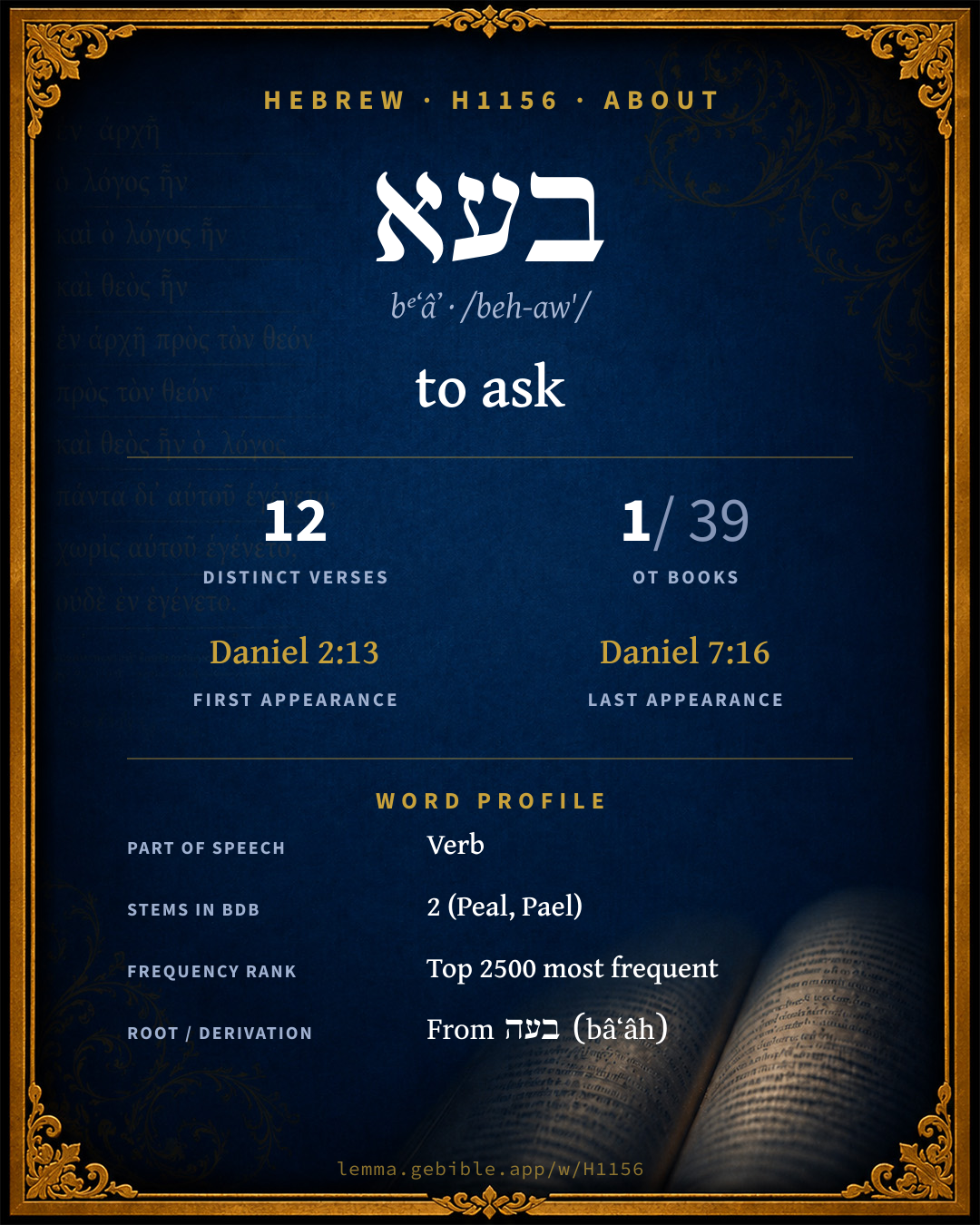
בְּעָא
to ask
also: seek, request, desire, pray fuller range ↓
Full lexicon entry — Brown-Driver-Briggs (BDB)
From Brown-Driver-Briggs (BDB)
Where this word appears
See every Qal verb in the Hebrew Bible →
Grammar key — what these labels mean
Part of speech
- Verb
- An action or state-of-being word.
Stem
- Qal
- The basic, simple active stem — the plain form of the verb (“he wrote”).
- Piel
- An intensive or resultative active stem.
Form
- Imperfect
- An incomplete, ongoing, or future action (“he will / would write”).
- Participle Active
- A verbal adjective expressing ongoing or characteristic action (“writing / one who writes”).
- Perfect
- A completed action or state — Hebrew marks aspect (completeness) more than strict tense (“he wrote”).
- Infinitive Construct
- A bound verbal noun, frequently with prepositions (“to write / in writing”).
State
- Absolute
- The independent form of a noun, not bound to a following word.
Person
- 3rd Person
- The one spoken about (“he / she / it / they”).
- 1st Person
- The speaker (“I / we”).
Gender
- Masculine
- Grammatically masculine.
- Common
- Either gender — not distinguished for this form.
Number
- Singular
- One.
- Plural
- More than one (in Hebrew, generally three or more).
1 distinct verse where H1156 appears in the Piel stem, across 1 book. Filtered view — show all forms. Click any verse to open its interlinear word-by-word view. Verse text shown in the World English Bible for context — . Each verse’s Hebrew form is shown with its reference; the English is not keyword-highlighted, since the data carries no word-level English alignment. Use “Compare translations” on any verse to read it across multiple English versions. This concordance covers the Hebrew Bible; Septuagint (Greek Old Testament) occurrences are not indexed here.
Daniel 1 verse
About this entry
At a glance — auto-summarized from this page’s data, not written by a person. Every figure links to its source below. This summary describes the numbers; it doesn’t interpret them.
“to ask” is the headline sense of the Hebrew verb בעא (bᵉʻâʼ). It clusters heavily in Daniel, which alone accounts for 100% of its uses. It turns up in 12 verses across 1 book, an uncommon footprint. First canonically at Daniel 2:13, it enters the text early. As a verb its force shifts by stem, across 2 stems (Peal, Pael, and more). See the sense tree, 12-verse concordance, and the renderings breakdown below.
Gloss history
Strong's 1890 vs modern scholarship
About this word
Strong's H1156 catalogs a Hebrew word from the Hebrew Old Testament.
These counts are not copied from any lexicon or concordance. They are computed here, from the morphology-tagged Hebrew Old Testament. What Lemma adds →
- 12
- distinct verses
- The word appears in 12 distinct verses.
- 1 / 39
- OT books
- The word appears in 1 of 39 Old Testament books.
- #2,101
- by frequency
- Top 2500 most frequent Hebrew words (rank 2,101 of 8,640 Hebrew words by occurrence).
View all 12 occurrences in the concordance →
Most concentrated in
- Daniel 12 verses 100%
By section of the Old Testament
By traditional corpus
Conventional, traditional groupings — biblical authorship is debated, so this is a traditional corpus grouping, not an authorship claim. Each share is this word’s portion of its verses in that division of the Hebrew canon. Each figure is a share of the word’s 12 distinct verses.
- Writings (Ketuvim) 12 verses · 100%
How translations render this word
Counts come from each version’s own published word-to-Strong’s tagging or interlinear alignment — an approximate guide to how each version renders this word, not a word-level alignment the data otherwise carries. Because each total is that version’s own tagged count, the per-version totals vary from one another and need not match the appearance or distinct-verse counts above. These counts may also differ from a printed concordance because Lemma counts each distinctly tagged rendering and does not collapse phrase taggings into a single head-word total. This is a fixed set of word-tagged versions (KJV, ASV, BSB, ULT) and does not change with the reading translation you choose elsewhere. Each version’s license is shown beside its name below (and on Sources).
- King James Version: Asked 1×, Desired 1×, Maketh 1×
- American Standard Version: Asked 1×, Desired 1×, Maketh 1×
- Berean Standard Bible: Petitions 2×
- unfoldingWord Literal Text: Makes 2×
King James Version Public Domain
Renders H1156 across 11 tagged occurrences — most commonly:
Not rendered by a distinct English word in 1 further occurrence.
American Standard Version Public Domain
Renders H1156 across 11 tagged occurrences — most commonly:
Berean Standard Bible Public Domain
Renders H1156 across 11 tagged occurrences — most commonly:
Plus 9 renderings that appear only once — usually multi-word phrases or single function words the recovered tagging swept in, not distinct renderings. Not rendered by a distinct English word in 1 further occurrence.
unfoldingWord Literal Text CC BY-SA 4.0
Renders H1156 across 12 tagged occurrences — most commonly:
Plus 10 renderings that appear only once — usually multi-word phrases or single function words the recovered tagging swept in, not distinct renderings.
Senses in the full BDB
Hebrew verbs can shift meaning by stem (binyan): Qal is the basic action, Niphal is often passive or reflexive, Piel often intensifies or makes it factitive, and Hiphil is typically causative. The senses below are grouped under the stem BDB assigns to each. This entry also uses Peal (the basic Aramaic stem, parallel to Qal) and Pael (the intensive Aramaic stem, parallel to Piel).
What do BDB’s symbols mean?
BDB uses these scholarly abbreviations:
| Symbol | Meaning |
|---|---|
| 𝔊 | the Septuagint (the ancient Greek translation, LXX) |
| 𝔙 | the Vulgate (the Latin translation) |
| 𝔖 | the Syriac version (the Peshitta) |
| 𝔗 | the Targum (the Aramaic translation) |
| ψ | the Psalms |
| √ | root (the underlying root or stem) |
| ‖ | parallel passage (a synonymous or contrasted parallel) |
| † | the dagger: every passage where the word occurs is cited |
The 3 senses and sub-senses the full Brown-Driver-Briggs lexicon distinguishes for this word, in lexicon order (not ranked by frequency), with BDB’s own verbatim wording and sub-sense lettering. Shown in Hebrew script with BDB’s own scholarly abbreviations. The condensed entry is in the Lexicon Entry tab. See also the Forms in the corpus table below.
Peal
- 1. ask, request
- 2. seek
Pael
- . resort (for favours)
Senses from the full Brown-Driver-Briggs lexicon (Brown, Driver, Briggs; Oxford 1906 — public domain), digitized via Sefaria, supplemented by the OpenScriptures HebrewLexicon (CC BY 4.0). Full attribution on Sources.
Word origin
בְּעָא vb. ask, seek, only Dn
— Brown-Driver-Briggs (Oxford 1906, public domain), digitized via Sefaria, supplemented by the OpenScriptures HebrewLexicon (CC BY 4.0). See Sources.
Derived from בעה (bâʻâh) (H1158) — to seek.
Jastrow Dictionary
A second Hebrew/Aramaic lexicon for comparison, covering Aramaic and post-biblical (Talmudic, Targumic, Midrashic) usage that the biblical-Hebrew BDB does not. Matched by lemma rather than by Strong’s number, so a lemma may carry more than one Jastrow headword (shown separately below), and the entries cover usage well beyond the Bible.
בְּעֵי I
- (v. preced.; cmp. בין)
- 1. to search, inquire, ask, examine. Targ. Jud. VI, 29 (h. text בקש); a. fr.—Ber. 2ᵇ ובעו לה מבעיא האי וכ׳ and put it as a question (not as an argument), Does this uba hash-shemesh mean &c.? (opposed to preceding וממאי דהאי וכ׳ how can it be proven that &c.). Y. Ḥall. I, 57ᵇ רבנן … בעיין the Rabbis of … asked. B. Kam. 33ᵃ בעא … מרב וכ׳ R. asked R. N.; a. v. fr.
- 2. to ask, pray, frequ. ב׳ רחמין to ask for mercy, pray. Targ. Y. Num. XII, 13; a. fr.—Ber. 8ᵃ לבעי אינש רחמי man should pray &c., v. זיבולא. Ib. 10ᵃ בְּעִי רחמי עלויהו וכ׳ pray thou for them that they may repent; a. fr.
- 3. to ask, want, desire; to require. Targ. Ex. II, 15; a. fr.—Pes. 9ᵃ ובָעֵי בדיקה and it (the house) requires searching over again. Keth. 39ᵇ לא בעינא לך I do not want thee. B. Kam. 102ᵇ לא יקרייכו בעינא וכ׳ I want neither your honor nor your disrespect; a. fr.—Pes. 2ᵃ בעו שבוחי must give praise.—אי בעית אימא, usu. איבעית אימא, v. אִיבָּעִית. [Y. Yeb. XII, 13ᵃ top בְּעֵא תתן לנו, please, give us.]
- 4. (ellipt.) to beg leave to say; to remark, assert. Y. Ber. I, 2ᵇ top. Y. Peah II, beg. 16ᵈ; a. fr.
- 1. to be searched for, to be wanted. Targ. Jer. L, 20; a. fr.
- 2. to be urged, hurried. Targ. I Sam. XXIII, 26. Targ. II Sam. IV, 4 בְּאִתְבָּעֲיוּתָהּ when she was hurried; v. בְּעַע.
- 1. to be asked. Pes. 4ᵇ, a. v. fr. אִיבָּעְיָא להו it was asked by them (the scholars), i.e. the argument came up.
- 2. to be required; it ought to. Ib. 7ᵇ יצא בו מיבעי ליה it ought to read yatsa bo (he has done his duty). Ib. 15ᵃ מדבריו מ׳ ליה it ought to be midd’barav (not middibrehem); a. fr.—B. Kam. 21ᵇ א׳ ליה לאסוקי דעתא he ought to have borne in mind; a. fr.—לא מיבעיא there is no question. לא מ׳ … אלא אפילו there is no question as to …, but even …; not only … but. Pes. 4ᵇ לא מ׳ באתרא … אלא וכ׳ not only in a place where they pay no wages for searching, but do it themselves, (is there no cause for withdrawing from the agreement,) because a man likes to perform a religious duty: but even in a place where they pay wages, (there is no cause &c.,) for a man likes &c. B. Kam. 54ᵇ לא מ׳ קאמר לא מ׳ שור וכ׳ the Mishnah states a case of ‘not only’; not only for an ox … is he responsible, but even &c.; a. v. fr.—מִיבָּעְיָא is there any question?; v. הַשְׁתָּא.
- to let burst forth, v. יְעָא a. נְבַע.
בְּעָא
- , v. בעי
A Dictionary of the Targumim, the Talmud Babli and Yerushalmi, and the Midrashic Literature (Marcus Jastrow; London, Luzac, 1903) — Public Domain. Digitized via Sefaria. Digitized via Sefaria. Full attribution on Sources.
Forms in the corpus
The 12 distinct written forms H1156 takes in the Hebrew Bible, most frequent first — each parse links to that stem’s occurrences in the concordance. Hebrew forms include their vowel points and cantillation, so a single lemma takes many written forms.
Same root — word family
Other BDB entries built from the same root as H1156, grouped by Strong’s listed origin. These share a root / origin per the lexicon — not necessarily a shared meaning. Each links to that word’s own entry.
Derives from
Shares the same root
Compare all same-root words → They share a root, not necessarily a meaning.
Septuagint verse parallels
This word appears in 11 verses that also exist in the Greek Old Testament (Septuagint), out of the 12 Hebrew verses it occurs in. You can read those verses in Greek by switching the Old Testament edition to the Septuagint.
Read these verses in the Septuagint
This is a verse-level parallel only — the same verses exist in both the Hebrew and Greek Old Testaments. No word-level Hebrew↔Greek correspondence is claimed: the data carries no such alignment, so no Greek word is shown as this Hebrew word’s translation. Coverage is not total — the Septuagint omits the deuterocanon and renumbers the Psalms, so some Hebrew verses have no direct Greek parallel.