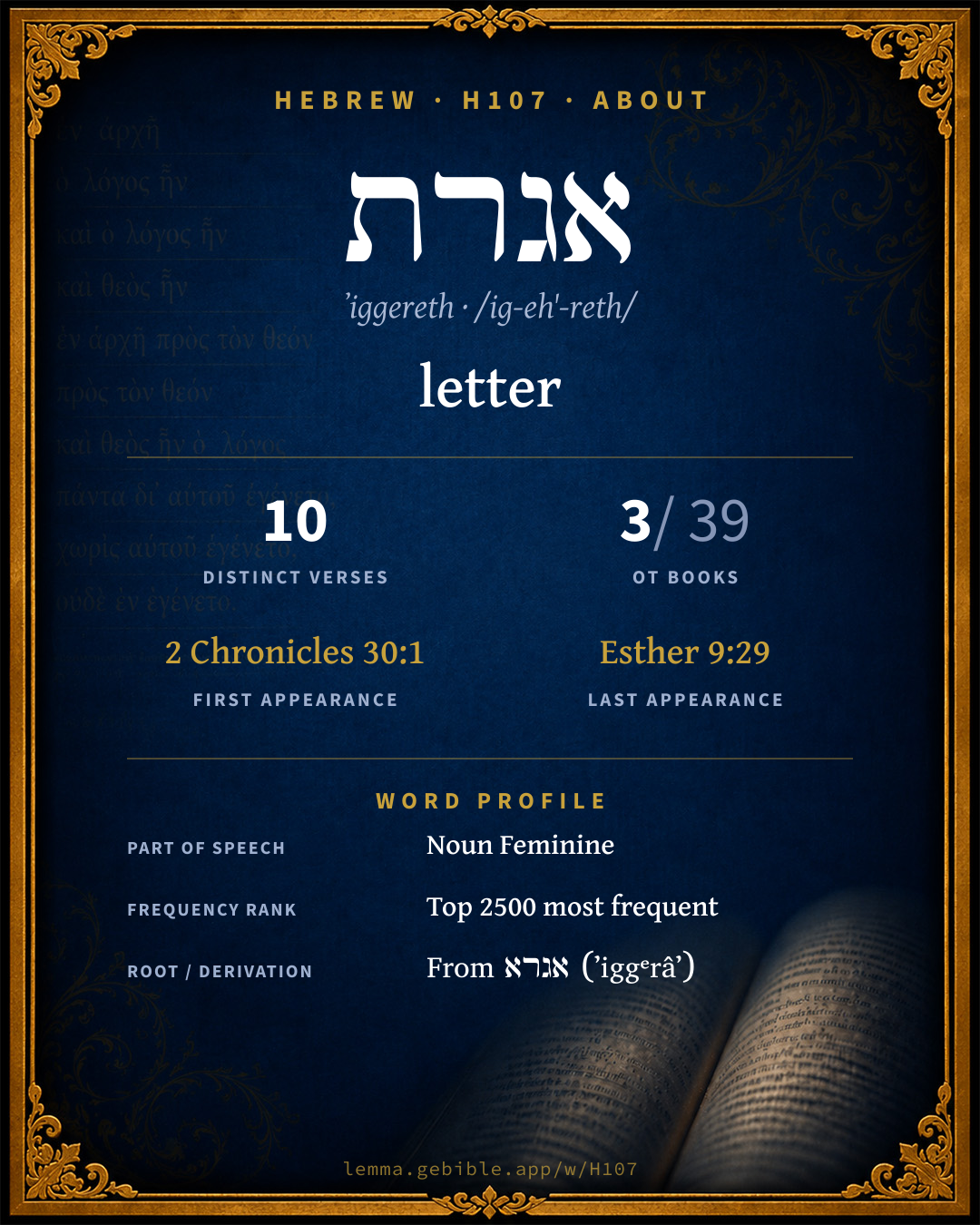
אִגֶּ֫רֶת
letter
Full lexicon entry — Brown-Driver-Briggs (BDB)
From Brown-Driver-Briggs (BDB)
Where this word appears
See every Absolute-state word in the Hebrew Bible →
Grammar key — what these labels mean
Part of speech
- Noun
- A naming word — a person, place, thing, or idea.
Noun type
- Common
- A common noun — a general class of person, place, or thing (“king,” “city,” “water”), not a specific name.
State
- Absolute
- The independent form of a noun, not bound to a following word.
- Construct
- A noun bound to a following noun in a possessive / “of” relationship (the construct chain).
Gender
- Feminine
- Grammatically feminine.
Number
- Plural
- More than one (in Hebrew, generally three or more).
- Singular
- One.
Every verse where H107 appears in the Book of Nehemiah — 6 distinct verses. Click any verse to open its interlinear word-by-word view. Verse text shown in the World English Bible for context — . Each verse’s Hebrew form is shown with its reference; the English is not keyword-highlighted, since the data carries no word-level English alignment. Use “Compare translations” on any verse to read it across multiple English versions. This concordance covers the Hebrew Bible; Septuagint (Greek Old Testament) occurrences are not indexed here.
Nehemiah
- Nehemiah 2:7 אִגְּרוֹת֙ n c fp Moreover I said to the king, If it please the king, let letters be given me to the governors beyond the River, that they may let me pass through until I come to Judah;
- Nehemiah 2:8 וְ/אִגֶּ֡רֶת conj + n c fs and a letter to Asaph the keeper of the king's forest, that he may give me timber to make beams for the gates of the castle which appertains to the house, and for the wall of the city, and for the house that I shall enter into. The king granted me, according to the good hand of my God on me.
- Nehemiah 2:9 אִגְּר֣וֹת n c fp cs Then I came to the governors beyond the River, and gave them the king's letters. Now the king had sent with me captains of the army and horsemen.
- Nehemiah 6:5 וְ/אִגֶּ֥רֶת conj + n c fs cs Then sent Sanballat his servant to me in like manner the fifth time with an open letter in his hand,
- Nehemiah 6:17 אִגְּרֹ֣תֵי/הֶ֔ם n c fp cs + sfx pers 3mp Moreover in those days the nobles of Judah sent many letters to Tobiah, and [the letters] of Tobiah came to them.
- Nehemiah 6:19 אִגְּר֛וֹת n c fp Also they spoke of his good deeds before me, and reported my words to him. Tobiah sent letters to put me in fear.
About this entry
At a glance — auto-summarized from this page’s data, not written by a person. Every figure links to its source below. This summary describes the numbers; it doesn’t interpret them.
“letter” is the headline sense of the Hebrew noun אגרת (ʼiggereth). More than half of its appearances fall in Nehemiah. It appears 10 verses across 3 books of the Hebrew Bible, among its uncommon vocabulary. First canonically at 2 Chronicles 30:1, it enters the text early. The sections below give every sense, occurrence, and version rendering.
Gloss history
Strong's 1890 vs modern scholarship
About this word
Strong's H107 catalogs a Hebrew word from the Hebrew Old Testament.
These counts are not copied from any lexicon or concordance. They are computed here, from the morphology-tagged Hebrew Old Testament. What Lemma adds →
- 10
- distinct verses
- The word appears in 10 distinct verses.
- 3 / 39
- OT books
- The word appears in 3 of 39 Old Testament books.
- #2,342
- by frequency
- Top 2500 most frequent Hebrew words (rank 2,342 of 8,640 Hebrew words by occurrence).
View all 10 occurrences in the concordance →
Most concentrated in
- Nehemiah 6 verses 60%
- 2 Chronicles 2 verses 20%
- Esther 2 verses 20%
By section of the Old Testament
By traditional corpus
Conventional, traditional groupings — biblical authorship is debated, so this is a traditional corpus grouping, not an authorship claim. Each share is this word’s portion of its verses in that division of the Hebrew canon. Each figure is a share of the word’s 10 distinct verses.
- Writings (Ketuvim) 10 verses · 100%
How translations render this word
Counts come from each version’s own published word-to-Strong’s tagging or interlinear alignment — an approximate guide to how each version renders this word, not a word-level alignment the data otherwise carries. Because each total is that version’s own tagged count, the per-version totals vary from one another and need not match the appearance or distinct-verse counts above. These counts may also differ from a printed concordance because Lemma counts each distinctly tagged rendering and does not collapse phrase taggings into a single head-word total. This is a fixed set of word-tagged versions (KJV, ASV, BSB, ULT) and does not change with the reading translation you choose elsewhere. Each version’s license is shown beside its name below (and on Sources).
- King James Version: Letters 5×, Letter 4×
- American Standard Version: Letter 4×, Letters 4×
- Berean Standard Bible: Letters 5×, Letter 3×
- unfoldingWord Literal Text: Letters 5×, Letter 3×
King James Version Public Domain
Renders H107 across 10 tagged occurrences — most commonly:
Plus 1 rendering that appears only once — usually multi-word phrases or single function words the recovered tagging swept in, not distinct renderings.
American Standard Version Public Domain
Renders H107 across 10 tagged occurrences — most commonly:
Plus 2 renderings that appear only once — usually multi-word phrases or single function words the recovered tagging swept in, not distinct renderings.
Berean Standard Bible Public Domain
Renders H107 across 10 tagged occurrences — most commonly:
Plus 2 renderings that appear only once — usually multi-word phrases or single function words the recovered tagging swept in, not distinct renderings.
unfoldingWord Literal Text CC BY-SA 4.0
Renders H107 across 11 tagged occurrences — most commonly:
Plus 3 renderings that appear only once — usually multi-word phrases or single function words the recovered tagging swept in, not distinct renderings.
Senses in BDB
The 1 sense BDB distinguishes for this word, in lexicon order (not ranked by frequency or importance). The full entry — with sub-senses — is in the Lexicon Entry tab.
- letter, missive
Word origin
n.f. letter, letter-missive (late, prob. loan-word, As. egirtu DlW)—abs. Ne 2:8 + 2 textual; cstr. Est 9:29; pl. אִגְּרוֹת abs. 2 Ch 30:1 + 3 textual; cstr. Ne 2:9; אִגְּרֹתֵיהֶם Ne 6:17—letter, especially royal letter 2 Ch 30:1, 6 Ne 2:7, 8, 9; but also others Ne 6:5, 17, 19 Es 9:26, 29 (‖ סֵפֶר vv 20, 30; other syn. מִכְתָּב, נִשְׁתְּוָן q.v.)
— Brown-Driver-Briggs (Oxford 1906, public domain), digitized via Sefaria, supplemented by the OpenScriptures HebrewLexicon (CC BY 4.0). See Sources.
Derived from אגרא (ʼiggᵉrâʼ) (H104) — letter.
Jastrow Dictionary
A second Hebrew/Aramaic lexicon for comparison, covering Aramaic and post-biblical (Talmudic, Targumic, Midrashic) usage that the biblical-Hebrew BDB does not. Matched by lemma rather than by Strong’s number, so a lemma may carry more than one Jastrow headword (shown separately below), and the entries cover usage well beyond the Bible.
*אִגְּרַת
- Igrath, name of the queen of demons Pes. 111ᵃ א׳ אזלת (an incantation). Ib. 112ᵃ. Num. R. s. 12. Cmp. נְגִירָא.
אִגֶּרֶת
- , to join, v. esp. Snh. 11ᵇ; ושלש איגרות וכ׳) tablet, letter, brief, document. Git. IX, 3 (formula of a letter of divorce) ספר … וא׳ … וגט וכ׳. Ib. 85ᵇ ולא … איגרת … אלא אגרת one must not write (in the letter of divorce) egereth with אי׳ which might mean roof (v. אִיגָר), but &c. Keth. 64ᵃ; Y. Kidd. I, 59ᵃ bot. א׳ מרד a document stating a wife’s disobedience. Y. Meg. IV, 75ᵇ top; Y. Snh. I, 19ᵇ top א׳ ביקורת a document fixing the value of a property, v. אַכְרָזָה.—Pl. אִגָּרוֹת, אִיגָּרוֹת. M. Kat. III, 3 א׳ שׁל רשות secular, social correspondence, opp. religious correspondence; cmp. Y. ib. 82ᵃ bot.; [commentaries: documents of secular government, v. רָשׁוּת]. Ib.; B. Mets. I, 8 א׳ שׁום א׳ מזון documents relating to legal assessment and to alimony.
A Dictionary of the Targumim, the Talmud Babli and Yerushalmi, and the Midrashic Literature (Marcus Jastrow; London, Luzac, 1903) — Public Domain. Digitized via Sefaria. Digitized via Sefaria. Full attribution on Sources.
Forms in the corpus
The 9 distinct written forms H107 takes in the Hebrew Bible, most frequent first — each parse links to that state’s occurrences in the concordance. Hebrew forms include their vowel points and cantillation, so a single lemma takes many written forms.
| Form | Parsing | Example | Uses |
|---|---|---|---|
| אִגְּרוֹת֙ | Noun, Common, Feminine, Plural, Absolute | 2 Chronicles 30:1 | 2 |
| אִגְּר֛וֹת | Noun, Common, Feminine, Plural, Absolute | Nehemiah 6:19 | 1 |
| אִגְּר֣וֹת | Noun, Common, Feminine, Plural, Construct | Nehemiah 2:9 | 1 |
| אִגְּרֹ֣תֵי/הֶ֔ם | Noun, Common, Feminine, Plural, Construct | Nehemiah 6:17 | 1 |
| אִגֶּ֧רֶת | Noun, Common, Feminine, Singular, Construct | Esther 9:29 | 1 |
| בָּֽ/אִגְּר֜וֹת | Noun, Common, Feminine, Plural, Absolute | 2 Chronicles 30:6 | 1 |
| הָ/אִגֶּ֣רֶת | Noun, Common, Feminine, Singular, Absolute | Esther 9:26 | 1 |
| וְ/אִגֶּ֡רֶת | Noun, Common, Feminine, Singular, Absolute | Nehemiah 2:8 | 1 |
| וְ/אִגֶּ֥רֶת | Noun, Common, Feminine, Singular, Construct | Nehemiah 6:5 | 1 |
Septuagint verse parallels
This word appears in 4 verses that also exist in the Greek Old Testament (Septuagint), out of the 10 Hebrew verses it occurs in. You can read those verses in Greek by switching the Old Testament edition to the Septuagint.
Read these verses in the Septuagint
This is a verse-level parallel only — the same verses exist in both the Hebrew and Greek Old Testaments. No word-level Hebrew↔Greek correspondence is claimed: the data carries no such alignment, so no Greek word is shown as this Hebrew word’s translation. Coverage is not total — the Septuagint omits the deuterocanon and renumbers the Psalms, so some Hebrew verses have no direct Greek parallel.