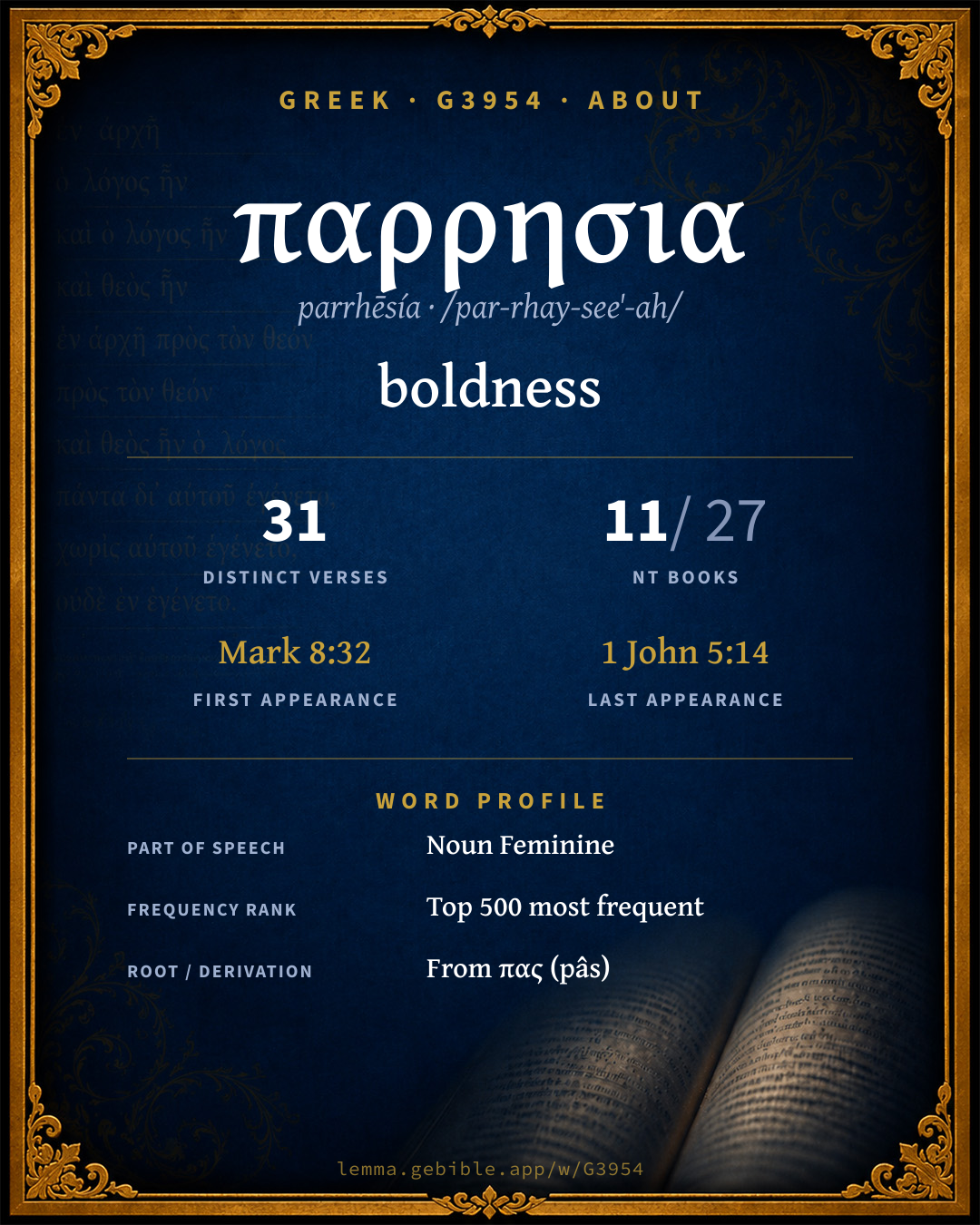
παῤῥησία
boldness
‘boldness’ is one of 3 main senses fuller range ↓
Full lexicon entry — Thayer's Greek Lexicon
From Thayer's Greek Lexicon
Where this word appears
See every Dative-case word in the Greek New Testament →
Grammar key — what these labels mean
Part of speech
- Noun
- A naming word — a person, place, thing, or idea.
Case
- Dative
- The case of the indirect object, means, or location — “to / for / with / in.”
- Accusative
- The case of the direct object and of extent.
- Genitive
- The case of source, possession, or “of” — answers “whose / from what.”
- Nominative
- The case of the subject (and the predicate nominative).
Gender
- Feminine
- Grammatically feminine.
Number
- Singular
- One.
5 distinct verses where G3954 appears in the Genitive case, across 2 books. Filtered view — show all forms. Click any verse to open its interlinear word-by-word view. Verse text shown in the World English Bible for context — . Each verse’s Greek form is shown with its reference; the English is not keyword-highlighted, since the data carries no word-level English alignment. Use “Compare translations” on any verse to read it across multiple English versions. This concordance covers the Greek New Testament; Septuagint (Greek Old Testament) occurrences of this word are not indexed here.
Acts 4 verses
- Acts 2:29 παρρησίας n gen sg fem "Brothers, I may tell you freely of the patriarch David, that he both died and was buried, and his tomb is with us to this day.
- Acts 4:29 παρρησίας n gen sg fem Now, Lord, look at their threats, and grant to your servants to speak your word with all boldness,
- Acts 4:31 παρρησίας n gen sg fem When they had prayed, the place was shaken where they were gathered together. They were all filled with the Holy Spirit, and they spoke the word of God with boldness.
- Acts 28:31 παρρησίας n gen sg fem preaching the Kingdom of God, and teaching the things concerning the Lord Jesus Christ with all boldness, without hinderance.
Hebrews 1 verse
About this entry
At a glance — auto-summarized from this page’s data, not written by a person. Every figure links to its source below. This summary describes the numbers; it doesn’t interpret them.
παρρησια — transliterated parrhēsía — is a Greek noun carrying the sense “boldness.” Debuting at Mark 8:32, it then recurs through the corpus. Spanning 31 verses in 11 books, it ranks among the moderately common words of the Greek New Testament. Its uses concentrate in John (29% of all occurrences). Its lexical range runs to 3 senses. See the sense tree, 31-verse concordance, and the renderings breakdown below.
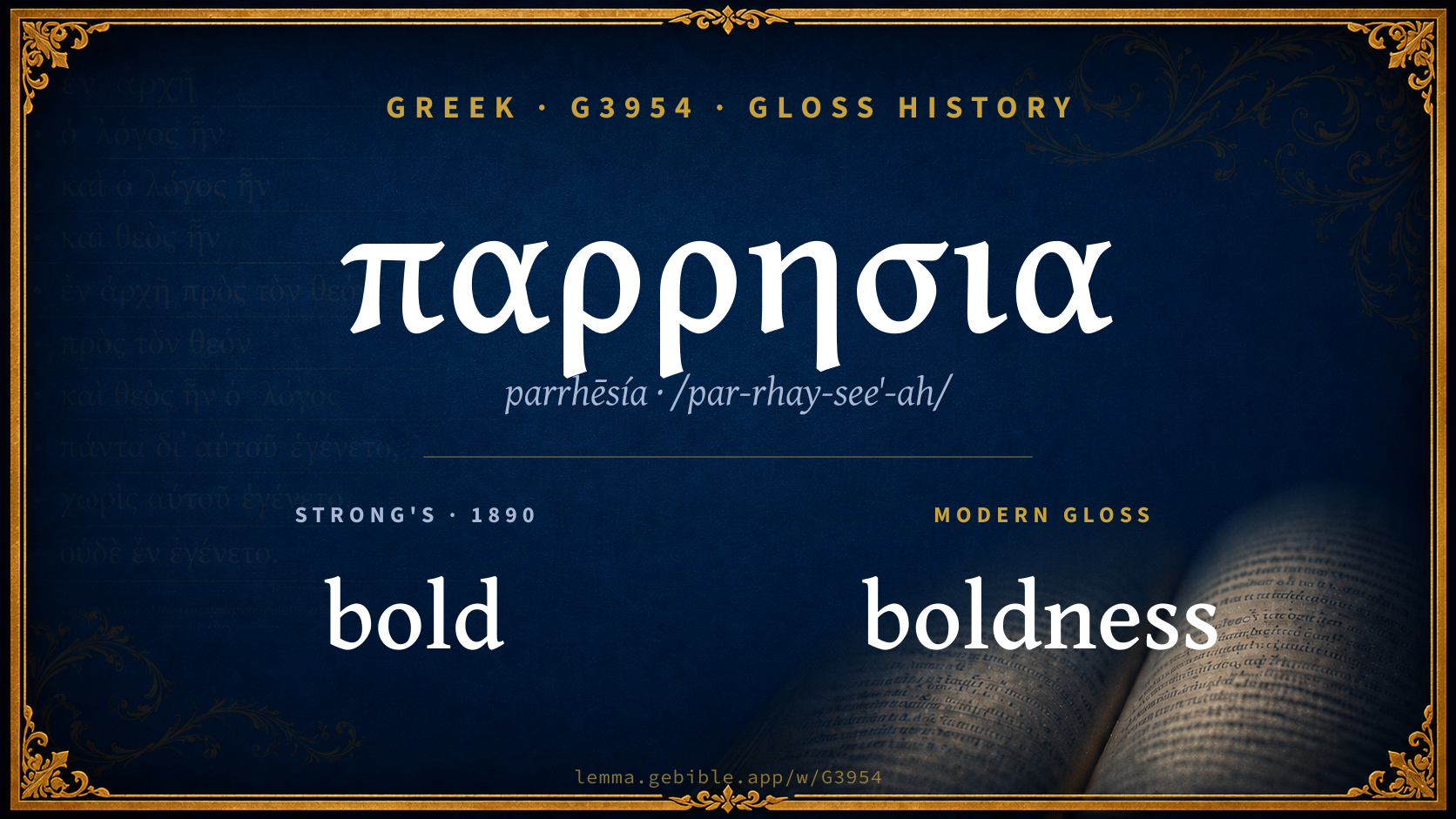
Gloss history
Strong's 1890 vs modern scholarship
About this word
Strong's G3954 catalogs a Greek word from the Greek New Testament.
These counts are not copied from any lexicon or concordance. They are computed here, from the morphology-tagged Greek New Testament. What Lemma adds →
- 31
- distinct verses
- The word appears in 31 distinct verses.
- 11 / 27
- NT books
- The word appears in 11 of 27 New Testament books.
- #448
- by frequency
- Top 500 most frequent Greek words (rank 448 of 5,347 Greek words by occurrence).
View all 31 occurrences in the concordance →
By section of the New Testament
By traditional corpus
Conventional, traditional groupings — biblical authorship is debated, so this is a traditional corpus grouping, not an authorship claim. Some books belong to more than one corpus (Luke is in both the Gospels and the Lukan corpus, and so on), so these shares overlap and need not total 100%. Each figure is a share of the word’s 31 distinct verses.
- Johannine 13 verses · 42%
- Gospels 10 verses · 32%
- Pauline corpus 8 verses · 26%
- Lukan (Luke–Acts) 5 verses · 16%
- Hebrews 4 verses · 13%
- General (Catholic) Epistles 4 verses · 13%
How translations render this word
Counts come from each version’s own published word-to-Strong’s tagging or interlinear alignment — an approximate guide to how each version renders this word, not a word-level alignment the data otherwise carries. Because each total is that version’s own tagged count, the per-version totals vary from one another and need not match the appearance or distinct-verse counts above. These counts may also differ from a printed concordance because Lemma counts each distinctly tagged rendering and does not collapse phrase taggings into a single head-word total. This is a fixed set of word-tagged versions (KJV, ASV, BSB, ULT) and does not change with the reading translation you choose elsewhere. Each version’s license is shown beside its name below (and on Sources).
- King James Version: Boldness 8×, Confidence 6×, Openly 4×
- American Standard Version: Boldness 16×, Openly 6×, Plainly 3×
- Berean Standard Bible: Confidence 10×, Plainly 4×, Publicly 4×
- unfoldingWord Literal Text: Confidence 10×, Boldness 9×, Openly 5×
King James Version Public Domain
Renders G3954 across 26 tagged occurrences — most commonly:
Plus 4 renderings that appear only once — usually multi-word phrases or single function words the recovered tagging swept in, not distinct renderings. Not rendered by a distinct English word in 5 further occurrences.
American Standard Version Public Domain
Renders G3954 across 30 tagged occurrences — most commonly:
Plus 3 renderings that appear only once — usually multi-word phrases or single function words the recovered tagging swept in, not distinct renderings.
Berean Standard Bible Public Domain
Renders G3954 across 30 tagged occurrences — most commonly:
Plus 4 renderings that appear only once — usually multi-word phrases or single function words the recovered tagging swept in, not distinct renderings. Not rendered by a distinct English word in 1 further occurrence.
unfoldingWord Literal Text CC BY-SA 4.0
Renders G3954 across 33 tagged occurrences — most commonly:
Plus 4 renderings that appear only once — usually multi-word phrases or single function words the recovered tagging swept in, not distinct renderings.
Senses in Thayer's
The 3 senses Thayer's distinguishes for this word, in lexicon order (not ranked by frequency or importance). The full entry — with sub-senses — is in the Lexicon Entry tab.
- freedom in speaking, unreservedness in speech
- free and fearless confidence, cheerful courage, boldness, assurance
- the deportment by which one becomes conspicuous or secures publicity
Word origin
Derived from πας (pâs) (G3956) — all.
Forms in the corpus
The 4 distinct written forms G3954 takes in the Greek New Testament, most frequent first — each parse links to that case’s occurrences in the concordance.
| Form | Parsing | Example | Uses |
|---|---|---|---|
| παρρησίᾳ parrēsía | Noun, Dative, Singular, Feminine | Mark 8:32 | 14 |
| παρρησίαν parrēsían | Noun, Accusative, Singular, Feminine | Acts 4:13 | 10 |
| παρρησίας parrēsías | Noun, Genitive, Singular, Feminine | Acts 2:29 | 5 |
| παρρησία parrēsía | Noun, Nominative, Singular, Feminine | 2 Corinthians 7:4 | 2 |
Same root — word family
Other Thayer's entries built from the same root as G3954, grouped by Strong’s listed origin. These share a root / origin per the lexicon — not necessarily a shared meaning. Each links to that word’s own entry.
Derives from
Shares the same root
- παμπληθει pamplētheí G3826 all together
- παμπολυς pámpolys G3827 very great
- πανδοχειον pandocheîon G3829 inn
- πανηγυρις panḗgyris G3831 public assembly
- πανοικι panoikí G3832 with whole family
- πανοπλια panoplía G3833 full armor
- πανουργος panoûrgos G3835 skillful
- πανταχου pantachoû G3837 everywhere
- παντελης pantelḗs G3838 completely
- παντη pántē G3839 everywhere
- παντοθεν pántothen G3840 from every quarter
- παντοτε pántote G3842 always
- παντως pántōs G3843 altogether
Derived from this word
Proper names from this root
People and places named from this root — a name, not an additional meaning of the word.
Compare all same-root words → Showing 4 of 18 — not the complete family. 2 of the same-root words are proper names (people or places). They share a root, not necessarily a meaning.
Septuagint usage
The same Greek word παρρησια appears 5 times in the Greek Old Testament (Septuagint), across 5 verses in 3 books.
- 5
- LXX occurrences
- Tagged occurrences of this Greek word in the Septuagint.
- 5
- verses
- Distinct Septuagint verses containing this word.
- 3 / 39
- OT books
- The word appears in 3 of the 39 Old Testament books.
Sample Septuagint occurrences
- Leviticus 26:13 παρρησία
- Job 27:10 παρρησία
- Proverbs 1:20 παρρησία
Septuagint occurrences (same lexeme)
Every verse where the same Strong’s number (G3954) appears in the Greek Septuagint. Verse text shown in the World English Bible for context; the Greek form is the matched word — the English is not keyword-highlighted.
- Leviticus 26:13 παρρησία I am Yahweh your God, who brought you forth out of the land of Egypt, that you should not be their slaves; and I have broken the bars of your yoke, and made you go upright.
- Job 27:10 παρρησία Will he delight himself in the Almighty, And call on God at all times?
- Proverbs 1:20 παρρησία Wisdom calls aloud in the street. She utters her voice in the public squares.
- Proverbs 10:10 παρρησία One winking with the eye causes sorrow, But a chattering fool will fall.
- Proverbs 13:5 παρρησία A righteous man hates lies, But a wicked man brings shame and disgrace.
These are occurrences of the same Greek lexeme (G3954) in the Septuagint — not a translation of any one Hebrew word. The store carries no word-level Hebrew↔Greek alignment, so no Hebrew original is asserted here. Counts come from the recovered LXX Strong's tagging — high-frequency vocabulary is well covered, while rare or late forms may be untagged — so they reflect tagged occurrences and may slightly undercount.