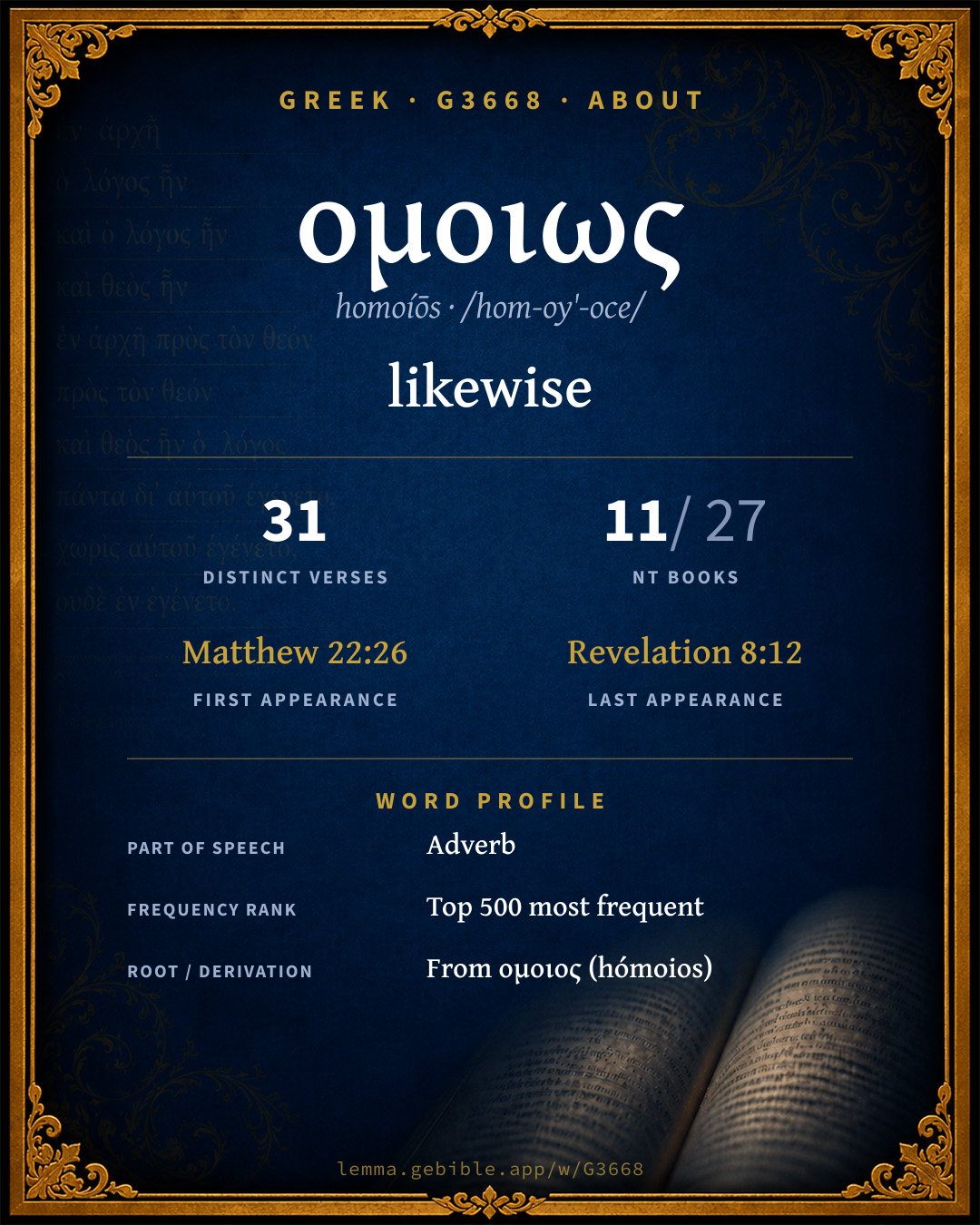
ὁμοίως
likewise
Full lexicon entry — Thayer's Greek Lexicon
From Thayer's Greek Lexicon
Where this word appears
Grammar key — what these labels mean
Part of speech
- Adverb
- A word that modifies a verb, adjective, or other adverb.
Every verse where G3668 appears in the Book of Revelation — 2 distinct verses. Click any verse to open its interlinear word-by-word view. Verse text shown in the World English Bible for context — . Each verse’s Greek form is shown with its reference; the English is not keyword-highlighted, since the data carries no word-level English alignment. Use “Compare translations” on any verse to read it across multiple English versions. This concordance covers the Greek New Testament; Septuagint (Greek Old Testament) occurrences of this word are not indexed here.
Revelation
- Revelation 2:15 ὁμοίως adv So you also have some who hold to the teaching of the Nicolaitans likewise.
- Revelation 8:12 ὁμοίως adv The fourth angel sounded, and one third of the sun was struck, and one third of the moon, and one third of the stars; so that one third of them would be darkened, and the day wouldn't shine for one third of it, and the night in the same way.
About this entry
At a glance — auto-summarized from this page’s data, not written by a person. Every figure links to its source below. This summary describes the numbers; it doesn’t interpret them.
ομοιως (homoíōs) is a Greek verb most often rendered “likewise.” Where the King James Version says “likewise,” newer translations reach for “same way” (Berean Standard Bible); the renderings breakdown has the detail. The Greek New Testament uses it across 31 verses — moderately common. Luke dominates its distribution — 11 of 31 verses. Debuting at Matthew 22:26, it then recurs through the corpus. The sections below give every sense, occurrence, and version rendering.
Gloss history
Strong's 1890 vs modern scholarship
About this word
Strong's G3668 catalogs a Greek word from the Greek New Testament.
These counts are not copied from any lexicon or concordance. They are computed here, from the morphology-tagged Greek New Testament. What Lemma adds →
- 31
- distinct verses
- The word appears in 31 distinct verses.
- 11 / 27
- NT books
- The word appears in 11 of 27 New Testament books.
- #448
- by frequency
- Top 500 most frequent Greek words (rank 448 of 5,347 Greek words by occurrence).
View all 31 occurrences in the concordance →
By section of the New Testament
By traditional corpus
Conventional, traditional groupings — biblical authorship is debated, so this is a traditional corpus grouping, not an authorship claim. Some books belong to more than one corpus (Luke is in both the Gospels and the Lukan corpus, and so on), so these shares overlap and need not total 100%. Each figure is a share of the word’s 31 distinct verses.
- Gospels 19 verses · 61%
- Lukan (Luke–Acts) 11 verses · 35%
- Johannine 5 verses · 16%
- General (Catholic) Epistles 5 verses · 16%
- Pauline corpus 4 verses · 13%
- Revelation 2 verses · 6%
- Hebrews 1 verse · 3%
How translations render this word
Counts come from each version’s own published word-to-Strong’s tagging or interlinear alignment — an approximate guide to how each version renders this word, not a word-level alignment the data otherwise carries. Because each total is that version’s own tagged count, the per-version totals vary from one another and need not match the appearance or distinct-verse counts above. These counts may also differ from a printed concordance because Lemma counts each distinctly tagged rendering and does not collapse phrase taggings into a single head-word total. This is a fixed set of word-tagged versions (KJV, ASV, BSB, ULT) and does not change with the reading translation you choose elsewhere. Each version’s license is shown beside its name below (and on Sources).
- King James Version: Likewise 27×
- American Standard Version: Likewise 15×, Like manner 7×, Like 5×
- Berean Standard Bible: Same way 9×, Likewise 6×, Same 2×
- unfoldingWord Literal Text: Likewise 18×, Similarly 6×, Same way 4×
King James Version Public Domain
Renders G3668 across 28 tagged occurrences — most commonly:
Plus 1 rendering that appears only once — usually multi-word phrases or single function words the recovered tagging swept in, not distinct renderings. Not rendered by a distinct English word in 2 further occurrences.
American Standard Version Public Domain
Renders G3668 across 29 tagged occurrences — most commonly:
Plus 2 renderings that appear only once — usually multi-word phrases or single function words the recovered tagging swept in, not distinct renderings.
Berean Standard Bible Public Domain
Renders G3668 across 26 tagged occurrences — most commonly:
Plus 9 renderings that appear only once — usually multi-word phrases or single function words the recovered tagging swept in, not distinct renderings. Not rendered by a distinct English word in 4 further occurrences.
unfoldingWord Literal Text CC BY-SA 4.0
Renders G3668 across 31 tagged occurrences — most commonly:
Plus 1 rendering that appears only once — usually multi-word phrases or single function words the recovered tagging swept in, not distinct renderings.
Senses in Thayer's
The 1 sense Thayer's distinguishes for this word, in lexicon order (not ranked by frequency or importance). The full entry — with sub-senses — is in the Lexicon Entry tab.
- likewise, equally, in the same way
Word origin
Derived from ομοιος (hómoios) (G3664) — like.
Adverb from G3664 ; similarly : - likewise so.
— Strong’s Exhaustive Concordance (1890), public domain.
Forms in the corpus
The 2 distinct written forms G3668 takes in the Greek New Testament, most frequent first — each parse links to that case’s occurrences in the concordance.
| Form | Parsing | Example | Uses |
|---|---|---|---|
| ὁμοίως homoíōs | Adverb | Matthew 22:26 | 29 |
| Ὁμοίως Homoíōs | Adverb | 1 Peter 3:1 | 2 |
Same root — word family
Other Thayer's entries built from the same root as G3668, grouped by Strong’s listed origin. These share a root / origin per the lexicon — not necessarily a shared meaning. Each links to that word’s own entry.
Derives from
Shares the same root
- ομοιαζω homoiázō G3662 to be like
- ομοιοπαθης homoiopathḗs G3663 having like feelings
- ομοιοτης homoiótēs G3665 likeness
- ομοιοω homoióō G3666 to make like
Compare all same-root words → Showing 4 of 6 — not the complete family. They share a root, not necessarily a meaning.
Septuagint usage
The same Greek word ομοιως appears 8 times in the Greek Old Testament (Septuagint), across 8 verses in 6 books.
- 8
- LXX occurrences
- Tagged occurrences of this Greek word in the Septuagint.
- 8
- verses
- Distinct Septuagint verses containing this word.
- 6 / 39
- OT books
- The word appears in 6 of the 39 Old Testament books.
Sample Septuagint occurrences
- 1 Chronicles 28:16 ὁμοίως
- Esther 1:18 ὁμοίως
- Job 1:16 ὁμοίως
- Psalms 67:7 ὁμοίως
- Proverbs 1:27 ὁμοίως
- Ezekiel 14:10 ὁμοίως
Septuagint occurrences (same lexeme)
Every verse where the same Strong’s number (G3668) appears in the Greek Septuagint. Verse text shown in the World English Bible for context; the Greek form is the matched word — the English is not keyword-highlighted.
- 1 Chronicles 28:16 ὁμοίως and the gold by weight for the tables of show bread, for every table; and silver for the tables of silver;
- Esther 1:18 ὁμοίως This day will the princesses of Persia and Media who have heard of the deed of the queen say [the like] to all the king's princes. So [will there arise] much contempt and wrath.
- Job 1:16 ὁμοίως While he was still speaking, there also came another, and said, "The fire of God has fallen from the sky, and has burned up the sheep and the servants, and consumed them, and I alone have escaped to tell you."
- Psalms 67:7 ὁμοίως God will bless us. All the ends of the earth shall fear him.
- Proverbs 1:27 ὁμοίως When calamity overtakes you like a storm, When your disaster comes on like a whirlwind; When distress and anguish come on you.
- Proverbs 4:18 ὁμοίως But the path of the righteous is like the dawning light, That shines more and more until the perfect day.
- Ezekiel 14:10 ὁμοίως They shall bear their iniquity: the iniquity of the prophet shall be even as the iniquity of him who seeks [to him];
- Ezekiel 45:11 ὁμοίως The ephah and the bath shall be of one measure, that the bath may contain the tenth part of a homer, and the ephah the tenth part of a homer: the measure of it shall be after the homer.
These are occurrences of the same Greek lexeme (G3668) in the Septuagint — not a translation of any one Hebrew word. The store carries no word-level Hebrew↔Greek alignment, so no Hebrew original is asserted here. Counts come from the recovered LXX Strong's tagging — high-frequency vocabulary is well covered, while rare or late forms may be untagged — so they reflect tagged occurrences and may slightly undercount.