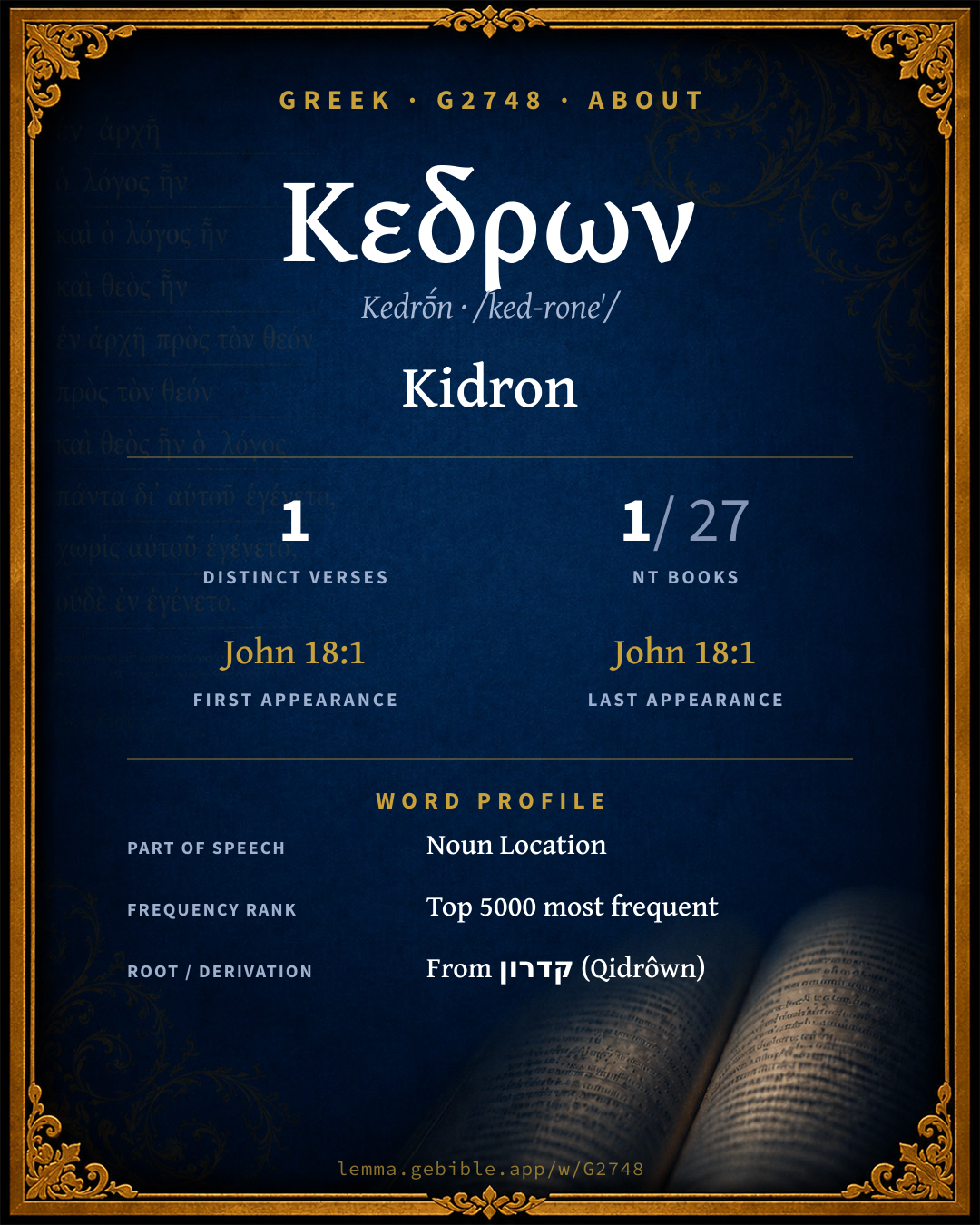
Κεδρών
Kidron
Thayer's lists 2 entries for ‘Kidron’ fuller range ↓
Full lexicon entry — Thayer's Greek Lexicon
From Thayer's Greek Lexicon
Where this word appears
Grammar key — what these labels mean
Part of speech
- Noun
- A naming word — a person, place, thing, or idea.
Case
- Genitive
- The case of source, possession, or “of” — answers “whose / from what.”
Gender
- Masculine
- Grammatically masculine.
Number
- Singular
- One.
Every verse where G2748 appears — 1 distinct verse across 1 book. Click any verse to open its interlinear word-by-word view. Verse text shown in the World English Bible for context — . Each verse’s Greek form is shown with its reference; the English is not keyword-highlighted, since the data carries no word-level English alignment. Use “Compare translations” on any verse to read it across multiple English versions. This concordance covers the Greek New Testament; Septuagint (Greek Old Testament) occurrences of this word are not indexed here.
John 1 verse
About this entry
At a glance — auto-summarized from this page’s data, not written by a person. Every figure links to its source below. This summary describes the numbers; it doesn’t interpret them.
Κεδρων (Kedrṓn) is a Greek name most often rendered “Kidron.” A scarce word — 1 verse in all of the Greek New Testament. John dominates its distribution — 1 of 1 verses. Its lone occurrence is John 18:1. For the data behind this summary, explore 1-verse concordance and the renderings breakdown below.
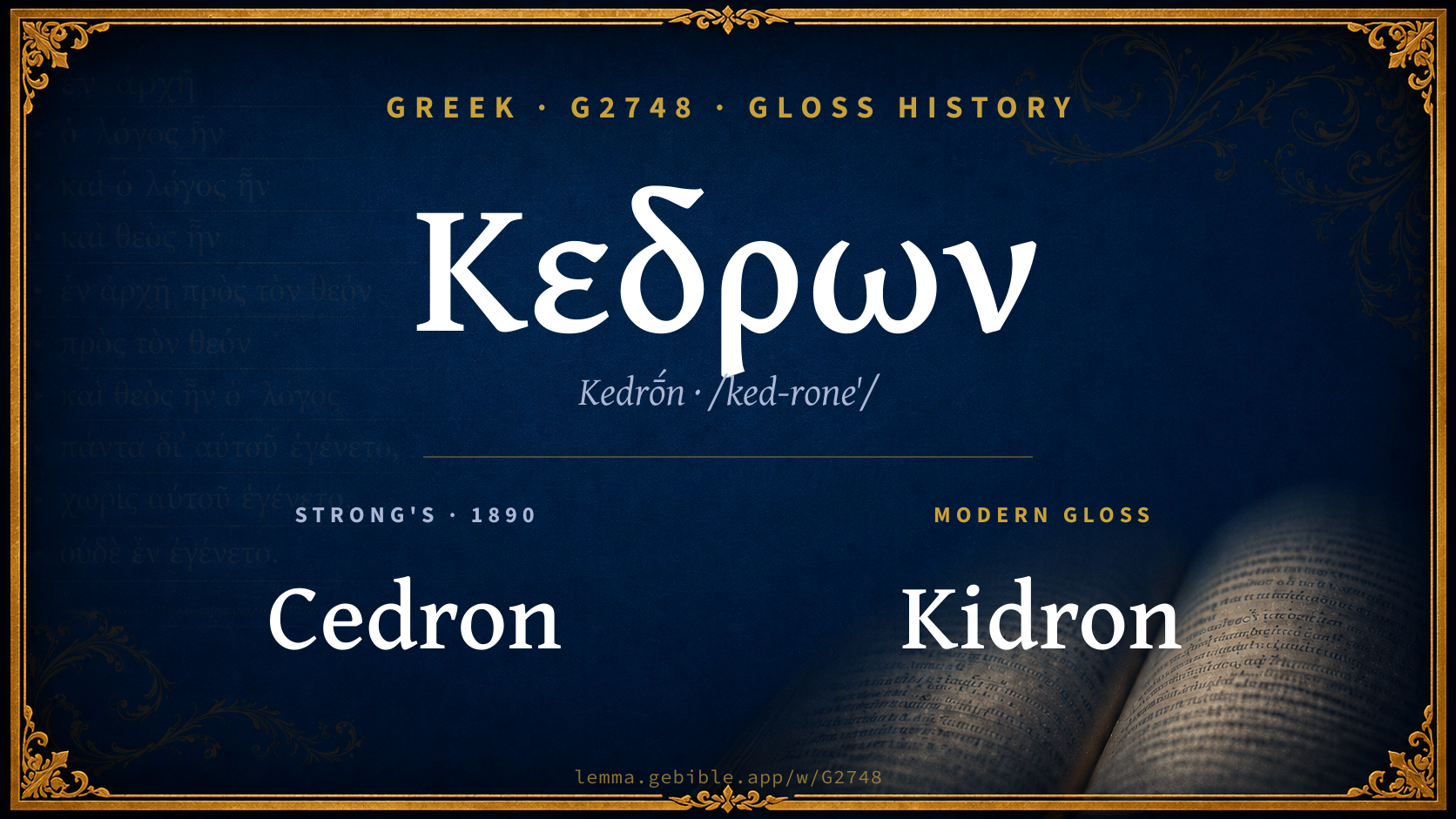
Gloss history
Strong's 1890 vs modern scholarship
About this word
Strong's G2748 catalogs a Greek word from the Greek New Testament.
These counts are not copied from any lexicon or concordance. They are computed here, from the morphology-tagged Greek New Testament. What Lemma adds →
- 1
- distinct verses
- The word appears in 1 distinct verse.
- 1 / 27
- NT books
- The word appears in 1 of 27 New Testament books.
- #3,503
- by frequency
- Top 5000 most frequent Greek words (rank 3,503 of 5,347 Greek words by occurrence).
View all 1 occurrence in the concordance →
Most concentrated in
- John 1 verse 100%
By section of the New Testament
By traditional corpus
Conventional, traditional groupings — biblical authorship is debated, so this is a traditional corpus grouping, not an authorship claim. Some books belong to more than one corpus (Luke is in both the Gospels and the Lukan corpus, and so on), so these shares overlap and need not total 100%. Each figure is a share of the word’s 1 distinct verse.
- Gospels 1 verse · 100%
- Johannine 1 verse · 100%
How translations render this word
Counts come from each version’s own published word-to-Strong’s tagging or interlinear alignment — an approximate guide to how each version renders this word, not a word-level alignment the data otherwise carries. Because each total is that version’s own tagged count, the per-version totals vary from one another and need not match the appearance or distinct-verse counts above. These counts may also differ from a printed concordance because Lemma counts each distinctly tagged rendering and does not collapse phrase taggings into a single head-word total. This is a fixed set of word-tagged versions (KJV, ASV, BSB, ULT) and does not change with the reading translation you choose elsewhere. Each version’s license is shown beside its name below (and on Sources).
- King James Version: Cedron 1×
- American Standard Version: Kidron 1×
- Berean Standard Bible: Kidron 1×
- unfoldingWord Literal Text: Kidron 1×
King James Version Public Domain
Renders G2748 across 1 tagged occurrence — most commonly:
American Standard Version Public Domain
Renders G2748 across 1 tagged occurrence — most commonly:
Berean Standard Bible Public Domain
Renders G2748 across 1 tagged occurrence — most commonly:
unfoldingWord Literal Text CC BY-SA 4.0
Renders G2748 across 1 tagged occurrence — most commonly:
Senses in Thayer's
The 2 senses Thayer's distinguishes for this word, in lexicon order (not ranked by frequency or importance). The full entry — with sub-senses — is in the Lexicon Entry tab.
- Cedron or Kidron = "turbid"
- the name of a winter torrent…
Word origin
Derived from קדרון (Qidrôwn) (H6939) — Kidron.
Of hebrew origin [ H6939 ]; Cedron (that is Kidron ) a brook near Jerusalem : - Cedron.
— Strong’s Exhaustive Concordance (1890), public domain.
Bible dictionary
Public-domain dictionary articles matched to this entry by name (Kidron). A biblical name can be shared by more than one person or place, so an article may treat several.
Easton's Bible Dictionary · M. G. Easton, 1897
= Kedron = Cedron, turbid, the winter torrent which flows through the Valley of Jehoshaphat, on the eastern side of Jerusalem, between the city and the Mount of Olives. This valley is known in Scripture only by the name "the brook Kidron." David crossed this brook bare-foot and weeping, when fleeing from Absalom (2 Sam. 15:23, 30), and it was frequently crossed by our Lord in his journeyings to and fro (John 18:1). Here Asa burned the obscene idols of his mother (1 Kings 15:13), and here Athaliah was executed (2 Kings 11:16). It afterwards became the receptacle for all manner of impurities (2 Chr. 29:16; 30:14); and in the time of Josiah this valley was the common cemetery of the city (2 Kings 23:6; comp. Jer. 26:23).
Through this mountain ravine no water runs, except after heavy rains in the mountains round about Jerusalem. Its length from its head to en-Rogel is 2 3/4 miles. Its precipitous, rocky banks are filled with ancient tombs, especially the left bank opposite the temple area. The greatest desire of the Jews is to be buried there, from the idea that the Kidron is the "valley of Jehoshaphat" mentioned in Joel 3:2.
Below en-Rogel the Kidron has no historical or sacred interest. It runs in a winding course through the wilderness of Judea to the north-western shore of the Dead Sea. Its whole length, in a straight line, is only some 20 miles, but in this space its descent is about 3,912 feet. (See KEDRON.)
Recent excavations have brought to light the fact that the old bed of the Kidron is about 40 feet lower than its present bed, and about 70 feet nearer the sanctuary wall.
Hitchcock's Bible Names Dictionary · Roswell D. Hitchcock, 1869
obscure; making black or sad
Classic public-domain reference works; full attribution on Sources.
Septuagint usage
The same Greek word Κεδρων appears 13 times in the Greek Old Testament (Septuagint), across 11 verses in 6 books.
- 13
- LXX occurrences
- Tagged occurrences of this Greek word in the Septuagint.
- 11
- verses
- Distinct Septuagint verses containing this word.
- 6 / 39
- OT books
- The word appears in 6 of the 39 Old Testament books.
Sample Septuagint occurrences
- Judges 1:30 κεδρων
- 2 Samuel 15:23 κεδρων
- 1 Kings 2:37 κεδρων
- 2 Kings 23:4 κεδρων
- 2 Chronicles 15:16 κεδρων
- Jeremiah 38:40 κεδρων
Septuagint occurrences (same lexeme)
Every verse where the same Strong’s number (G2748) appears in the Greek Septuagint. Verse text shown in the World English Bible for context; the Greek form is the matched word — the English is not keyword-highlighted.
- Judges 1:30 κεδρων Zebulun didn't drive out the inhabitants of Kitron, nor the inhabitants of Nahalol; but the Canaanites lived among them, and became subject to forced labor.
- 2 Samuel 15:23 κεδρων All the country wept with a loud voice, and all the people passed over: the king also himself passed over the brook Kidron, and all the people passed over, toward the way of the wilderness.
- 1 Kings 2:37 κεδρων For on the day you go out, and pass over the brook Kidron, know you for certain that you shall surely die: your blood shall be on your own head.
- 1 Kings 15:13 κεδρων Also Maacah his mother he removed from being queen, because she had made an abominable image for an Asherah; and Asa cut down her image, and burnt it at the brook Kidron.
- 2 Kings 23:4 κεδρων The king commanded Hilkiah the high priest, and the priests of the second order, and the keepers of the threshold, to bring forth out of the temple of Yahweh all the vessels that were made for Baal, and for the Asherah, and for all the host of the sky, and he burned them outside of Jerusalem in the fields of the Kidron, and carried the ashes of them to Bethel.
- 2 Kings 23:6 κεδρων He brought out the Asherah from the house of Yahweh, outside of Jerusalem, to the brook Kidron, and burned it at the brook Kidron, and beat it to dust, and cast the dust of it on the graves of the common people.
- 2 Kings 23:12 κεδρων The altars that were on the roof of the upper chamber of Ahaz, which the kings of Judah had made, and the altars which Manasseh had made in the two courts of the house of Yahweh, did the king break down, and beat [them] down from there, and cast the dust of them into the brook Kidron.
- 2 Chronicles 15:16 κεδρων Also Maacah, the mother of Asa the king, he removed from being queen, because she had made an abominable image for an Asherah; and Asa cut down her image, and made dust of it, and burnt it at the brook Kidron.
- 2 Chronicles 29:16 κεδρων The priests went in to the inner part of the house of Yahweh, to cleanse it, and brought out all the uncleanness that they found in the temple of Yahweh into the court of the house of Yahweh. The Levites took it, to carry it out abroad to the brook Kidron.
- 2 Chronicles 30:14 κεδρων They arose and took away the altars that were in Jerusalem, and all the altars for incense took they away, and cast them into the brook Kidron.
- Jeremiah 38:40 κεδρων
These are occurrences of the same Greek lexeme (G2748) in the Septuagint — not a translation of any one Hebrew word. The store carries no word-level Hebrew↔Greek alignment, so no Hebrew original is asserted here. Counts come from the recovered LXX Strong's tagging — high-frequency vocabulary is well covered, while rare or late forms may be untagged — so they reflect tagged occurrences and may slightly undercount.