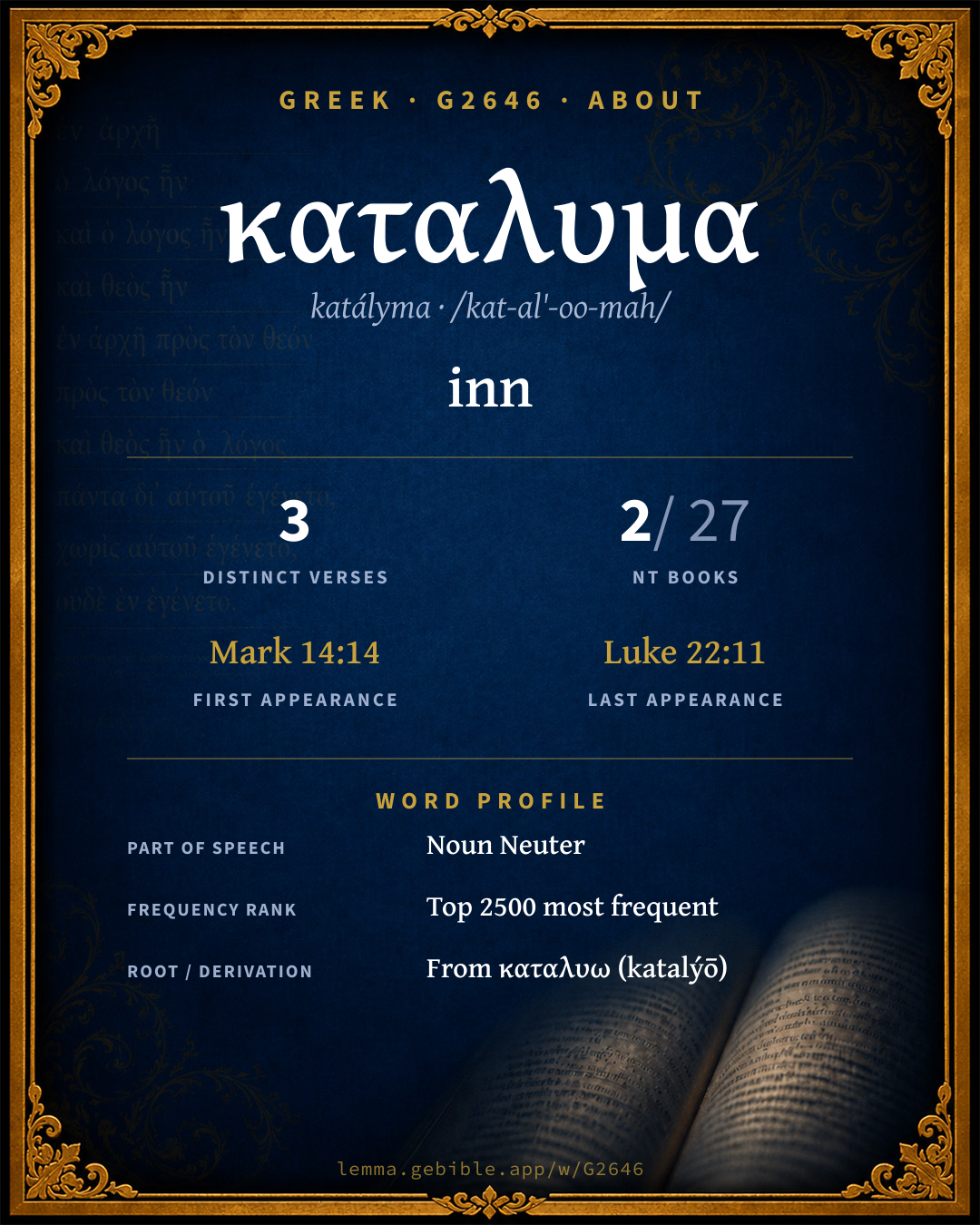
κατάλυμα
inn
‘inn’ is one of 2 main senses fuller range ↓
Full lexicon entry — Thayer's Greek Lexicon
From Thayer's Greek Lexicon
Where this word appears
Grammar key — what these labels mean
Part of speech
- Noun
- A naming word — a person, place, thing, or idea.
Case
- Nominative
- The case of the subject (and the predicate nominative).
- Dative
- The case of the indirect object, means, or location — “to / for / with / in.”
Gender
- Neuter
- Grammatically neuter.
Number
- Singular
- One.
Every verse where G2646 appears in the Book of Mark — 1 distinct verse. Click any verse to open its interlinear word-by-word view. Verse text shown in the World English Bible for context — . Each verse’s Greek form is shown with its reference; the English is not keyword-highlighted, since the data carries no word-level English alignment. Use “Compare translations” on any verse to read it across multiple English versions. This concordance covers the Greek New Testament; Septuagint (Greek Old Testament) occurrences of this word are not indexed here.
Mark
About this entry
At a glance — auto-summarized from this page’s data, not written by a person. Every figure links to its source below. This summary describes the numbers; it doesn’t interpret them.
The Greek noun καταλυμα centers on the idea of “inn.” It is rare — just 3 verses in the entire Greek New Testament. Luke dominates its distribution — 2 of 3 verses. Its earliest occurrence is Mark 14:14. Lexicons map it across 2 senses. For the data behind this summary, explore the sense tree and the renderings breakdown below.
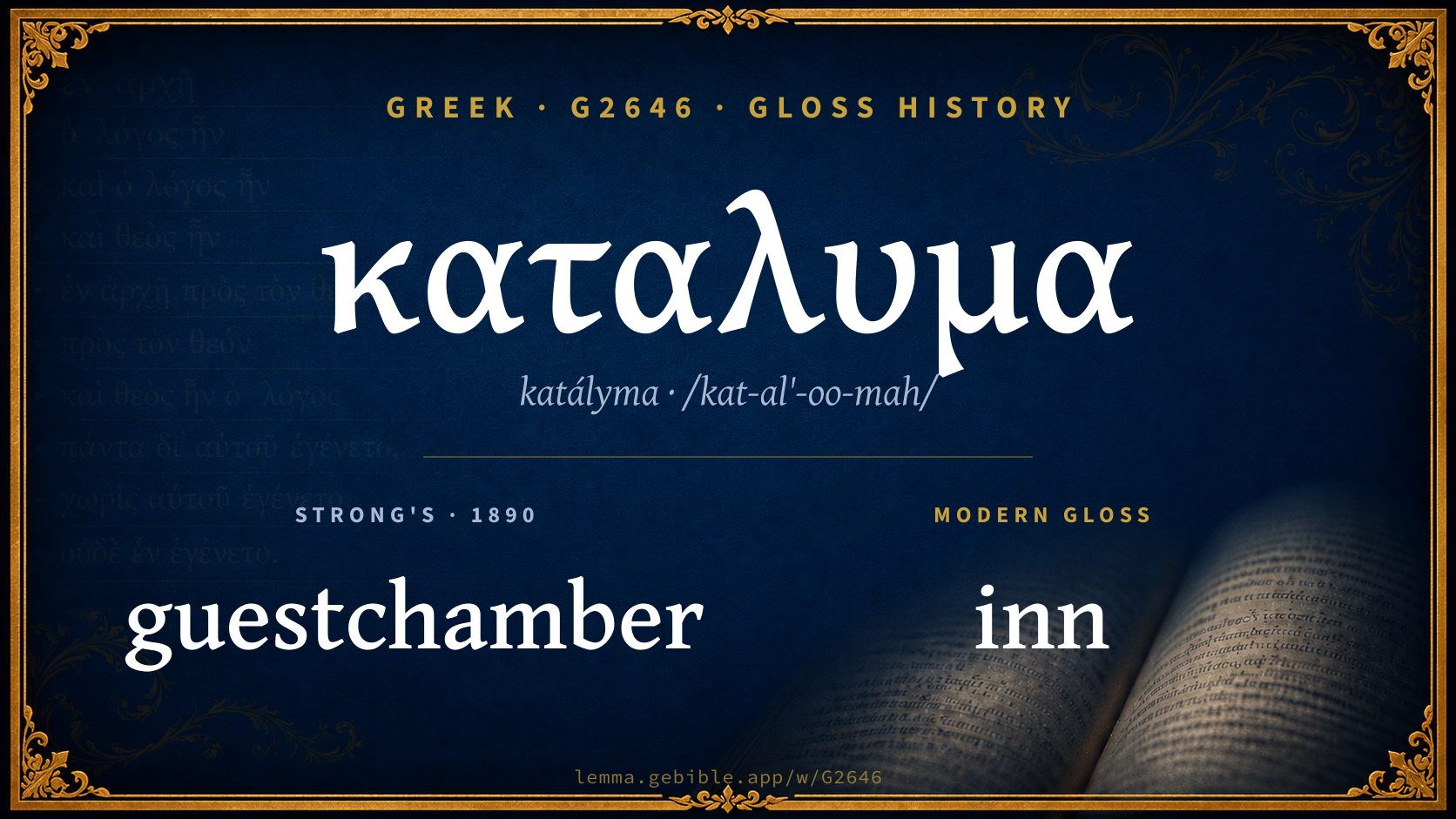
Gloss history
Strong's 1890 vs modern scholarship
About this word
Strong's G2646 catalogs a Greek word from the Greek New Testament.
These counts are not copied from any lexicon or concordance. They are computed here, from the morphology-tagged Greek New Testament. What Lemma adds →
- 3
- distinct verses
- The word appears in 3 distinct verses.
- 2 / 27
- NT books
- The word appears in 2 of 27 New Testament books.
- #2,203
- by frequency
- Top 2500 most frequent Greek words (rank 2,203 of 5,347 Greek words by occurrence).
View all 3 occurrences in the concordance →
By traditional corpus
Conventional, traditional groupings — biblical authorship is debated, so this is a traditional corpus grouping, not an authorship claim. Some books belong to more than one corpus (Luke is in both the Gospels and the Lukan corpus, and so on), so these shares overlap and need not total 100%. Each figure is a share of the word’s 3 distinct verses.
- Gospels 3 verses · 100%
- Lukan (Luke–Acts) 2 verses · 67%
How translations render this word
Counts come from each version’s own published word-to-Strong’s tagging or interlinear alignment — an approximate guide to how each version renders this word, not a word-level alignment the data otherwise carries. Because each total is that version’s own tagged count, the per-version totals vary from one another and need not match the appearance or distinct-verse counts above. These counts may also differ from a printed concordance because Lemma counts each distinctly tagged rendering and does not collapse phrase taggings into a single head-word total. This is a fixed set of word-tagged versions (KJV, ASV, BSB, ULT) and does not change with the reading translation you choose elsewhere. Each version’s license is shown beside its name below (and on Sources).
- King James Version: Guestchamber 2×
- American Standard Version: Guest-chamber 1×, Guestchamber 1×, Inn 1×
- Berean Standard Bible: Guest room 2×
- unfoldingWord Literal Text: Guest room 2×
King James Version Public Domain
Renders G2646 across 3 tagged occurrences — most commonly:
Plus 1 rendering that appears only once — usually multi-word phrases or single function words the recovered tagging swept in, not distinct renderings.
American Standard Version Public Domain
Renders G2646 across 3 tagged occurrences — most commonly:
Berean Standard Bible Public Domain
Renders G2646 across 3 tagged occurrences — most commonly:
Plus 1 rendering that appears only once — usually multi-word phrases or single function words the recovered tagging swept in, not distinct renderings.
unfoldingWord Literal Text CC BY-SA 4.0
Renders G2646 across 3 tagged occurrences — most commonly:
Plus 1 rendering that appears only once — usually multi-word phrases or single function words the recovered tagging swept in, not distinct renderings.
Senses in Thayer's
The 2 senses Thayer's distinguishes for this word, in lexicon order (not ranked by frequency or importance). The full entry — with sub-senses — is in the Lexicon Entry tab.
- an inn, lodging place
- an eating room, dining room
Word origin
Derived from καταλυω (katalýō) (G2647) — to dissolve.
From G2647 ; properly a dissolution (breaking up of a journey) that is (by implication) a lodging place : - guestchamber inn.
— Strong’s Exhaustive Concordance (1890), public domain.
Forms in the corpus
The 3 distinct written forms G2646 takes in the Greek New Testament, most frequent first — each parse links to that case’s occurrences in the concordance.
| Form | Parsing | Example | Uses |
|---|---|---|---|
| κατάλυμά katálymá | Noun, Nominative, Singular, Neuter | Mark 14:14 | 1 |
| κατάλυμα katályma | Noun, Nominative, Singular, Neuter | Luke 22:11 | 1 |
| καταλύματι katalýmati | Noun, Dative, Singular, Neuter | Luke 2:7 | 1 |
Septuagint usage
The same Greek word καταλυμα appears 11 times in the Greek Old Testament (Septuagint), across 11 verses in 6 books.
- 11
- LXX occurrences
- Tagged occurrences of this Greek word in the Septuagint.
- 11
- verses
- Distinct Septuagint verses containing this word.
- 6 / 39
- OT books
- The word appears in 6 of the 39 Old Testament books.
Sample Septuagint occurrences
- Exodus 4:24 κατάλυμα
- 1 Samuel 1:18 κατάλυμα
- 2 Samuel 7:6 κατάλυμα
- 1 Chronicles 17:5 κατάλυμα
- Jeremiah 14:8 κατάλυμα
- Ezekiel 23:21 κατάλυμα
Septuagint occurrences (same lexeme)
Every verse where the same Strong’s number (G2646) appears in the Greek Septuagint. Verse text shown in the World English Bible for context; the Greek form is the matched word — the English is not keyword-highlighted.
- Exodus 4:24 κατάλυμα It happened on the way at a lodging place, that Yahweh met him and wanted to kill him.
- Exodus 15:13 κατάλυμα "You, in your loving kindness, have led the people that you have redeemed. You have guided them in your strength to your holy habitation.
- 1 Samuel 1:18 κατάλυμα She said, Let your handmaid find favor in your sight. So the woman went her way, and ate; and her facial expression wasn't sad any more.
- 1 Samuel 9:22 κατάλυμα Samuel took Saul and his servant, and brought them into the guest-chamber, and made them sit in the best place among those who were invited, who were about thirty persons.
- 2 Samuel 7:6 κατάλυμα for I have not lived in a house since the day that I brought up the children of Israel out of Egypt, even to this day, but have walked in a tent and in a tent.
- 1 Chronicles 17:5 κατάλυμα for I have not lived in a house since the day that I brought up Israel, to this day, but have gone from tent to tent, and from [one] tent [to another].
- 1 Chronicles 28:13 κατάλυμα also for the divisions of the priests and the Levites, and for all the work of the service of the house of Yahweh, and for all the vessels of service in the house of Yahweh;
- Jeremiah 14:8 κατάλυμα You hope of Israel, the Savior of it in the time of trouble, why should you be as a foreigner in the land, and as a wayfaring man who turns aside to stay for a night?
- Jeremiah 32:25 κατάλυμα You have said to me, Lord Yahweh, Buy you the field for money, and call witnesses; whereas the city is given into the hand of the Chaldeans.
- Jeremiah 40:12 κατάλυμα then all the Jews returned out of all places where they were driven, and came to the land of Judah, to Gedaliah, to Mizpah, and gathered wine and summer fruits very much.
- Ezekiel 23:21 κατάλυμα Thus you called to memory the lewdness of your youth, in the handling of your bosom by the Egyptians for the breasts of your youth.
These are occurrences of the same Greek lexeme (G2646) in the Septuagint — not a translation of any one Hebrew word. The store carries no word-level Hebrew↔Greek alignment, so no Hebrew original is asserted here. Counts come from the recovered LXX Strong's tagging — high-frequency vocabulary is well covered, while rare or late forms may be untagged — so they reflect tagged occurrences and may slightly undercount.