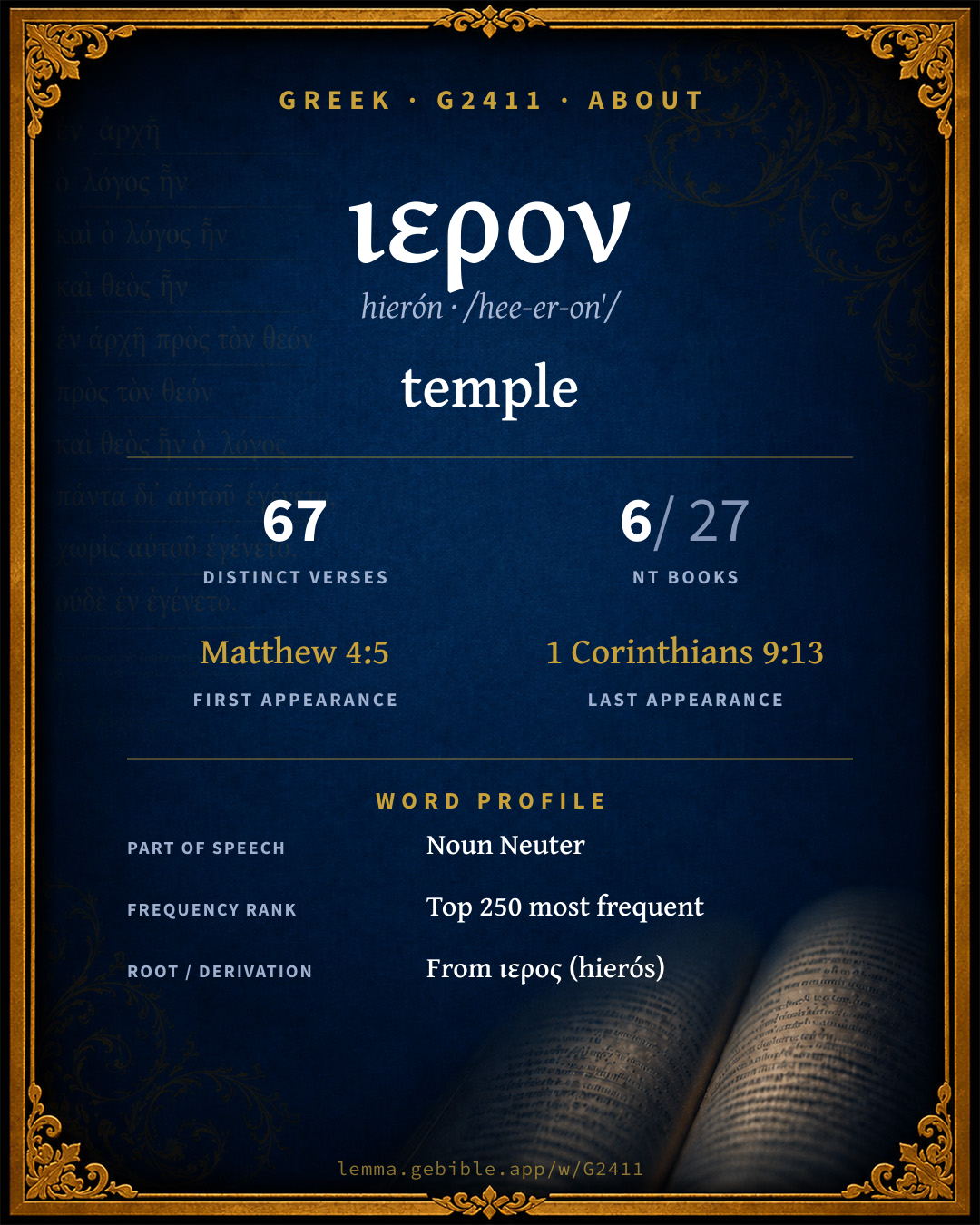
ἱερόν
temple
‘temple’ is one of 2 main senses fuller range ↓
Full lexicon entry — Thayer's Greek Lexicon
From Thayer's Greek Lexicon
Where this word appears
See every Dative-case word in the Greek New Testament →
Grammar key — what these labels mean
Part of speech
- Noun
- A naming word — a person, place, thing, or idea.
Case
- Dative
- The case of the indirect object, means, or location — “to / for / with / in.”
- Accusative
- The case of the direct object and of extent.
- Genitive
- The case of source, possession, or “of” — answers “whose / from what.”
Gender
- Neuter
- Grammatically neuter.
Number
- Singular
- One.
20 distinct verses where G2411 appears in the Accusative case, across 5 books. Filtered view — show all forms. Click any verse to open its interlinear word-by-word view. Verse text shown in the World English Bible for context — . Each verse’s Greek form is shown with its reference; the English is not keyword-highlighted, since the data carries no word-level English alignment. Use “Compare translations” on any verse to read it across multiple English versions. This concordance covers the Greek New Testament; Septuagint (Greek Old Testament) occurrences of this word are not indexed here.
Matthew 2 verses
- Matthew 21:12 ἱερόν ἱερῷ n acc sg neut n dat sg neut Jesus entered into the temple of God, and drove out all of those who sold and bought in the temple, and overthrew the money-changers' tables and the seats of those who sold the doves.
- Matthew 21:23 ἱερὸν n acc sg neut When he had come into the temple, the chief priests and the elders of the people came to him as he was teaching, and said, "By what authority do you do these things? Who gave you this authority?"
Mark 2 verses
- Mark 11:11 ἱερόν n acc sg neut Jesus entered into the temple in Jerusalem. When he had looked around at everything, it being now evening, he went out to Bethany with the twelve.
- Mark 11:15 ἱερὸν ἱερῷ n acc sg neut n dat sg neut They came to Jerusalem, and Jesus entered into the temple, and began to throw out those who sold and those who bought in the temple, and overthrew the tables of the money-changers, and the seats of those who sold the doves.
Luke 3 verses
- Luke 2:27 ἱερόν n acc sg neut He came in the Spirit into the temple. When the parents brought in the child, Jesus, that they might do concerning him according to the custom of the law,
- Luke 18:10 ἱερὸν n acc sg neut "Two men went up into the temple to pray; one was a Pharisee, and the other was a tax collector.
- Luke 19:45 ἱερὸν n acc sg neut He entered into the temple, and began to drive out those who bought and sold in it,
John 2 verses
Acts 11 verses
- Acts 3:1 ἱερὸν n acc sg neut Peter and John were going up into the temple at the hour of prayer, the ninth hour.
- Acts 3:2 ἱεροῦ ἱερόν n gen sg neut n acc sg neut A certain man who was lame from his mother's womb was being carried, whom they laid daily at the door of the temple which is called Beautiful, to ask gifts for the needy of those who entered into the temple.
- Acts 3:3 ἱερὸν n acc sg neut Seeing Peter and John about to go into the temple, he asked to receive gifts for the needy.
- Acts 3:8 ἱερὸν n acc sg neut Leaping up, he stood, and began to walk. He entered with them into the temple, walking, leaping, and praising God.
- Acts 5:21 ἱερὸν n acc sg neut When they heard this, they entered into the temple about daybreak, and taught. But the high priest came, and those who were with him, and called the council together, and all the senate of the children of Israel, and sent to the prison to have them brought.
- Acts 19:27 ἱερὸν n acc sg neut Not only is there danger that this our trade come into disrepute, but also that the temple of the great goddess Artemis will be counted as nothing, and her majesty destroyed, whom all Asia and the world worships."
- Acts 21:26 ἱερόν n acc sg neut Then Paul took the men, and the next day, purified himself and went with them into the temple, declaring the fulfillment of the days of purification, until the offering was offered for every one of them.
- Acts 21:28 ἱερὸν n acc sg neut crying out, "Men of Israel, help! This is the man who teaches all men everywhere against the people, and the law, and this place. Moreover, he also brought Greeks into the temple, and has defiled this holy place!"
- Acts 21:29 ἱερὸν n acc sg neut For they had seen Trophimus, the Ephesian, with him in the city, and they supposed that Paul had brought him into the temple.
- Acts 24:6 ἱερὸν n acc sg neut He even tried to profane the temple, and we arrested him.
- Acts 25:8 ἱερὸν n acc sg neut while he said in his defense, "Neither against the law of the Jews, nor against the temple, nor against Caesar, have I sinned at all."
About this entry
At a glance — auto-summarized from this page’s data, not written by a person. Every figure links to its source below. This summary describes the numbers; it doesn’t interpret them.
ιερον — transliterated hierón — is a Greek noun carrying the sense “temple.” Debuting at Matthew 4:5, it then recurs through the corpus. The Greek New Testament uses it across 67 verses — moderately common. More than a third of its appearances fall in Acts. Thayer's distinguishes 2 senses for it. See the sense tree, 67-verse concordance, and the renderings breakdown below.
Gloss history
Strong's 1890 vs modern scholarship
About this word
Strong's G2411 catalogs a Greek word from the Greek New Testament.
These counts are not copied from any lexicon or concordance. They are computed here, from the morphology-tagged Greek New Testament. What Lemma adds →
- 67
- distinct verses
- The word appears in 67 distinct verses.
- 6 / 27
- NT books
- The word appears in 6 of 27 New Testament books.
- #236
- by frequency
- Top 250 most frequent Greek words (rank 236 of 5,347 Greek words by occurrence).
View all 67 occurrences in the concordance →
By section of the New Testament
By traditional corpus
Conventional, traditional groupings — biblical authorship is debated, so this is a traditional corpus grouping, not an authorship claim. Some books belong to more than one corpus (Luke is in both the Gospels and the Lukan corpus, and so on), so these shares overlap and need not total 100%. Each figure is a share of the word’s 67 distinct verses.
- Gospels 42 verses · 63%
- Lukan (Luke–Acts) 38 verses · 57%
- Johannine 11 verses · 16%
- Pauline corpus 1 verse · 1%
How translations render this word
Counts come from each version’s own published word-to-Strong’s tagging or interlinear alignment — an approximate guide to how each version renders this word, not a word-level alignment the data otherwise carries. Because each total is that version’s own tagged count, the per-version totals vary from one another and need not match the appearance or distinct-verse counts above. These counts may also differ from a printed concordance because Lemma counts each distinctly tagged rendering and does not collapse phrase taggings into a single head-word total. This is a fixed set of word-tagged versions (KJV, ASV, BSB, ULT) and does not change with the reading translation you choose elsewhere. Each version’s license is shown beside its name below (and on Sources).
- King James Version: Temple 71×
- American Standard Version: Temple 70×
- Berean Standard Bible: Temple 63×
- unfoldingWord Literal Text: Temple 71×
King James Version Public Domain
Renders G2411 across 71 tagged occurrences — most commonly:
American Standard Version Public Domain
Renders G2411 across 70 tagged occurrences — most commonly:
Berean Standard Bible Public Domain
Renders G2411 across 65 tagged occurrences — most commonly:
Plus 2 renderings that appear only once — usually multi-word phrases or single function words the recovered tagging swept in, not distinct renderings. Not rendered by a distinct English word in 6 further occurrences.
unfoldingWord Literal Text CC BY-SA 4.0
Renders G2411 across 72 tagged occurrences — most commonly:
Plus 1 rendering that appears only once — usually multi-word phrases or single function words the recovered tagging swept in, not distinct renderings.
Senses in Thayer's
The 2 senses Thayer's distinguishes for this word, in lexicon order (not ranked by frequency or importance). The full entry — with sub-senses — is in the Lexicon Entry tab.
- used of the temple of Artemis at Ephesus
- used of the temple at Jerusalem
Word origin
Derived from ιερος (hierós) (G2413) — sacred.
Forms in the corpus
The 4 distinct written forms G2411 takes in the Greek New Testament, most frequent first — each parse links to that case’s occurrences in the concordance.
| Form | Parsing | Example | Uses |
|---|---|---|---|
| ἱερῷ hierō̂ | Noun, Dative, Singular, Neuter | Matthew 12:5 | 32 |
| ἱεροῦ hieroû | Noun, Genitive, Singular, Neuter | Matthew 4:5 | 19 |
| ἱερὸν hieròn | Noun, Accusative, Singular, Neuter | Matthew 21:23 | 14 |
| ἱερόν hierón | Noun, Accusative, Singular, Neuter | Matthew 21:12 | 6 |
Same root — word family
Other Thayer's entries built from the same root as G2411, grouped by Strong’s listed origin. These share a root / origin per the lexicon — not necessarily a shared meaning. Each links to that word’s own entry.
Derives from
Shares the same root
- ιερευς hiereús G2409 priest
- ιεροπρεπης hieroprepḗs G2412 reverent
- ιερωσυνη hierōsýnē G2420 priesthood
Derived from this word
Proper names from this root
People and places named from this root — a name, not an additional meaning of the word.
Compare all same-root words → Showing 4 of 8 — not the complete family. 1 of the same-root words is a proper name (a person or place). They share a root, not necessarily a meaning.
Septuagint usage
The same Greek word ιερον appears 1 time in the Greek Old Testament (Septuagint), across 1 verse in 1 book.
- 1
- LXX occurrences
- Tagged occurrences of this Greek word in the Septuagint.
- 1
- verse
- Distinct Septuagint verses containing this word.
- 1 / 39
- OT books
- The word appears in 1 of the 39 Old Testament books.
Sample Septuagint occurrences
- Ezekiel 28:18 ἱερόν
Septuagint occurrences (same lexeme)
Every verse where the same Strong’s number (G2411) appears in the Greek Septuagint. Verse text shown in the World English Bible for context; the Greek form is the matched word — the English is not keyword-highlighted.
These are occurrences of the same Greek lexeme (G2411) in the Septuagint — not a translation of any one Hebrew word. The store carries no word-level Hebrew↔Greek alignment, so no Hebrew original is asserted here. Counts come from the recovered LXX Strong's tagging — high-frequency vocabulary is well covered, while rare or late forms may be untagged — so they reflect tagged occurrences and may slightly undercount.