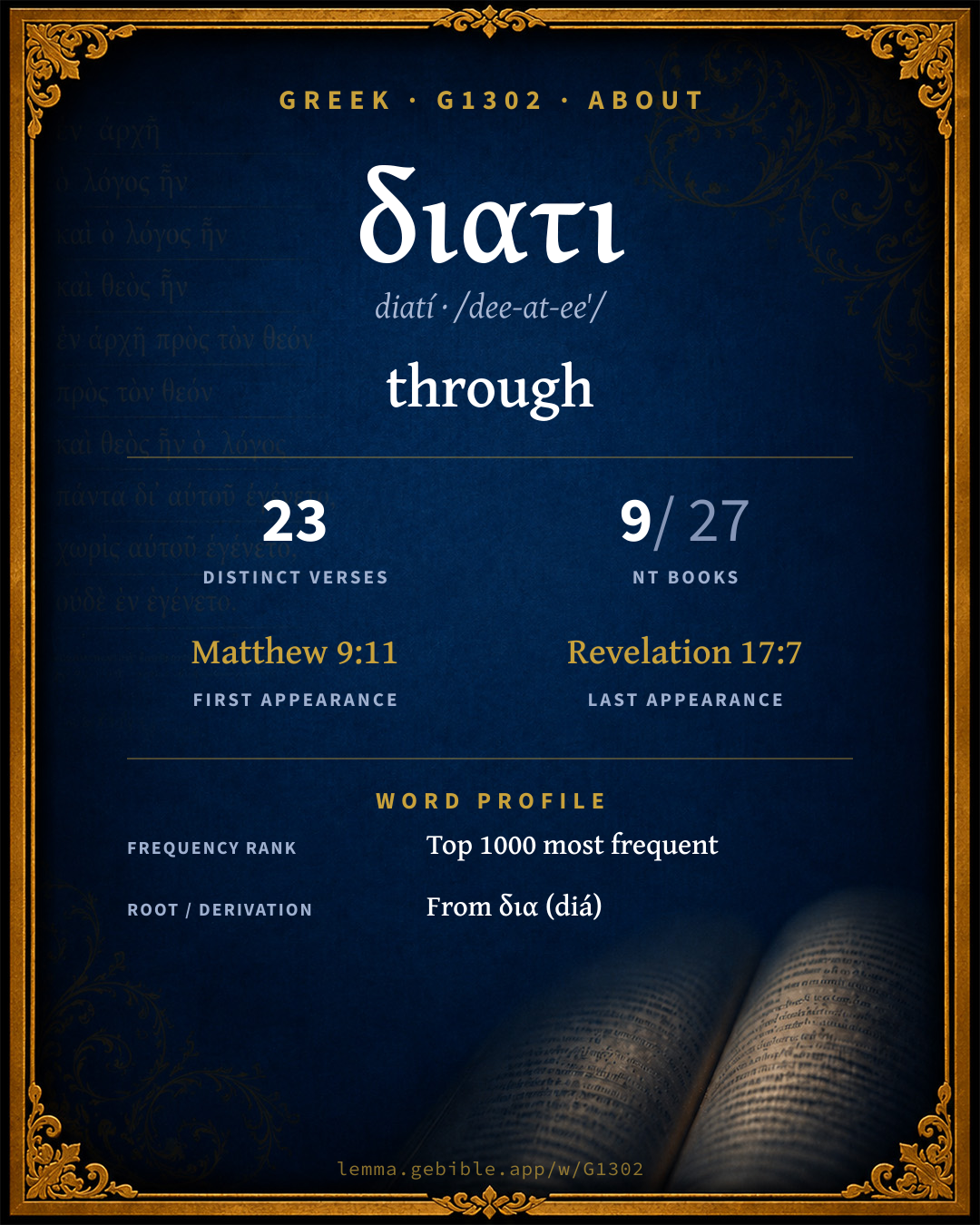
διατί
through
Full lexicon entry — Thayer's Greek Lexicon
From Thayer's Greek Lexicon
Where this word appears
Grammar key — what these labels mean
Part of speech
- Particle
- A short, often untranslatable function word adding nuance or connection.
Degree
- Interrogative
- Marks an interrogative form.
Every verse where G1302 appears — 23 distinct verses across 9 books. Click any verse to open its interlinear word-by-word view. Verse text shown in the World English Bible for context — . Each verse’s Greek form is shown with its reference; the English is not keyword-highlighted, since the data carries no word-level English alignment. Use “Compare translations” on any verse to read it across multiple English versions. This concordance covers the Greek New Testament; Septuagint (Greek Old Testament) occurrences of this word are not indexed here.
Matthew 5 verses
- Matthew 9:11 διατί ptcl interrog When the Pharisees saw it, they said to his disciples, "Why does your teacher eat with tax collectors and sinners?"
- Matthew 9:14 διατί ptcl interrog Then John's disciples came to him, saying, "Why do we and the Pharisees fast often, but your disciples don't fast?"
- Matthew 13:10 διατί ptcl interrog The disciples came, and said to him, "Why do you speak to them in parables?"
- Matthew 15:2 διατί ptcl interrog "Why do your disciples disobey the tradition of the elders? For they don't wash their hands when they eat bread."
- Matthew 15:3 διατί ptcl interrog He answered them, "Why do you also disobey the commandment of God because of your tradition?
Mark 3 verses
- Mark 2:18 διατί ptcl interrog John's disciples and the Pharisees were fasting, and they came and asked him, "Why do John's disciples and the disciples of the Pharisees fast, but your disciples don't fast?"
- Mark 7:5 διατί ptcl interrog The Pharisees and the scribes asked him, "Why don't your disciples walk according to the tradition of the elders, but eat their bread with unwashed hands?"
- Mark 11:31 διατί ptcl interrog They reasoned with themselves, saying, "If we should say, 'From heaven;' he will say, 'Why then did you not believe him?'
Luke 5 verses
- Luke 5:30 διατί ptcl interrog Their scribes and the Pharisees murmured against his disciples, saying, "Why do you eat and drink with the tax collectors and sinners?"
- Luke 19:23 διατί ptcl interrog Then why didn't you deposit my money in the bank, and at my coming, I might have earned interest on it?'
- Luke 19:31 διατί ptcl interrog If anyone asks you, 'Why are you untying it?' say to him: 'The Lord needs it.'"
- Luke 20:5 διατί ptcl interrog They reasoned with themselves, saying, "If we say, 'From heaven,' he will say, 'Why didn't you believe him?'
- Luke 24:38 διατί ptcl interrog He said to them, "Why are you troubled? Why do doubts arise in your hearts?
John 5 verses
- John 7:45 διατί ptcl interrog The officers therefore came to the chief priests and Pharisees, and they said to them, "Why didn't you bring him?"
- John 8:43 διατί ptcl interrog Why don't you understand my speech? Because you can't hear my word.
- John 8:46 διατί ptcl interrog Which of you convicts me of sin? If I tell the truth, why do you not believe me?
- John 12:5 διατί ptcl interrog "Why wasn't this ointment sold for three hundred denarii, and given to the poor?"
- John 13:37 διατί ptcl interrog Peter said to him, "Lord, why can't I follow you now? I will lay down my life for you."
Acts 1 verse
Romans 1 verse
1 Corinthians 1 verse
2 Corinthians 1 verse
Revelation 1 verse
About this entry
At a glance — auto-summarized from this page’s data, not written by a person. Every figure links to its source below. This summary describes the numbers; it doesn’t interpret them.
διατι — transliterated diatí — is a Greek word carrying the sense “through.” It first appears in Matthew 9:11. With 23 verses in 9 books, it is an uncommon word in the Greek New Testament. From the same root come δια, διαβαινω and διαβαλλω. Each statement above links to its evidence; the full detail follows below.
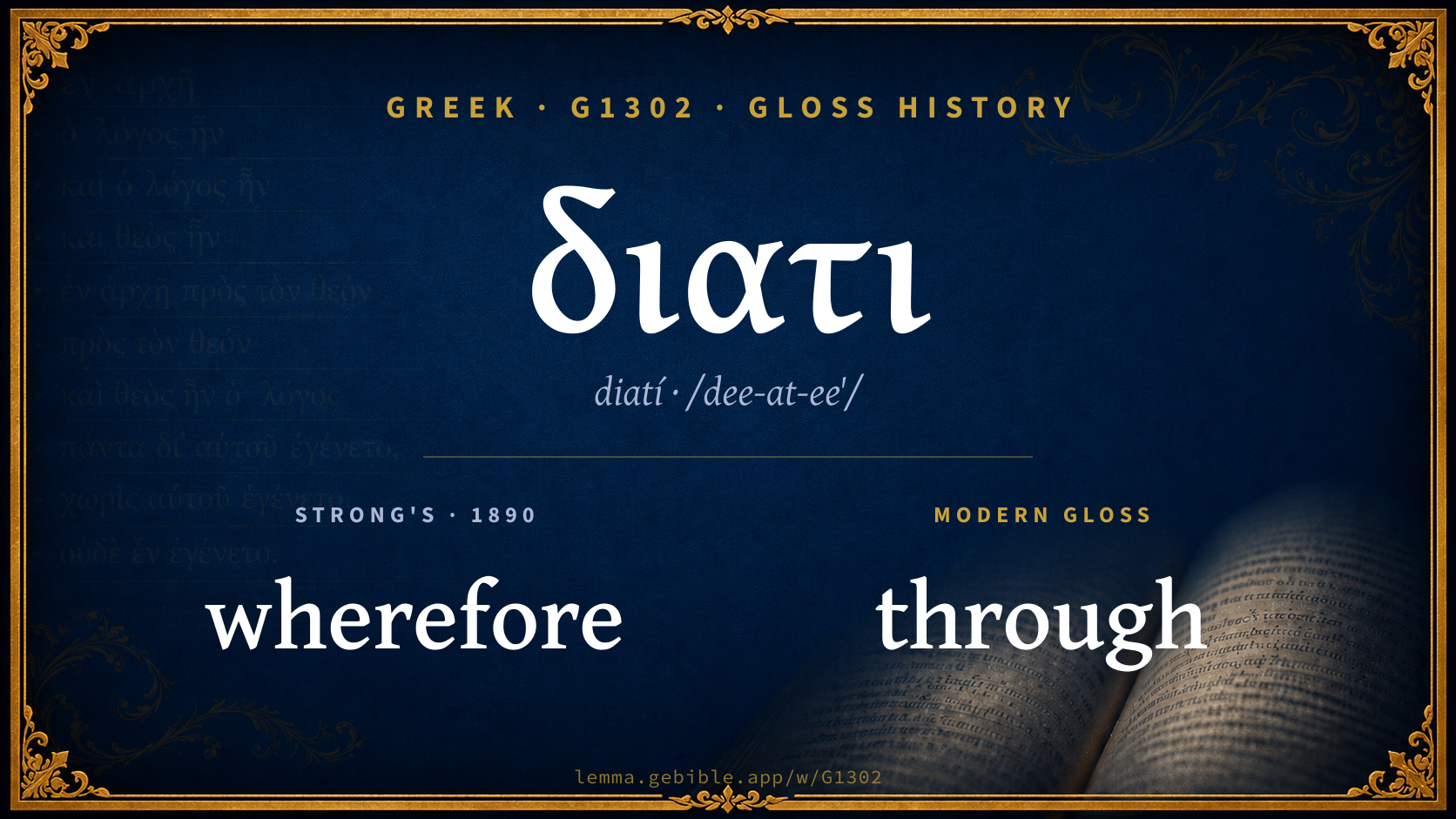
Gloss history
Strong's 1890 vs modern scholarship
About this word
Strong's G1302 catalogs a Greek word from the Greek New Testament.
These counts are not copied from any lexicon or concordance. They are computed here, from the morphology-tagged Greek New Testament. What Lemma adds →
- 23
- distinct verses
- The word appears in 23 distinct verses.
- 9 / 27
- NT books
- The word appears in 9 of 27 New Testament books.
- #548
- by frequency
- Top 1000 most frequent Greek words (rank 548 of 5,347 Greek words by occurrence).
View all 23 occurrences in the concordance →
By section of the New Testament
By traditional corpus
Conventional, traditional groupings — biblical authorship is debated, so this is a traditional corpus grouping, not an authorship claim. Some books belong to more than one corpus (Luke is in both the Gospels and the Lukan corpus, and so on), so these shares overlap and need not total 100%. Each figure is a share of the word’s 23 distinct verses.
- Gospels 18 verses · 78%
- Lukan (Luke–Acts) 6 verses · 26%
- Johannine 6 verses · 26%
- Pauline corpus 3 verses · 13%
- Revelation 1 verse · 4%
How translations render this word
Counts come from each version’s own published word-to-Strong’s tagging or interlinear alignment — an approximate guide to how each version renders this word, not a word-level alignment the data otherwise carries. Because each total is that version’s own tagged count, the per-version totals vary from one another and need not match the appearance or distinct-verse counts above. These counts may also differ from a printed concordance because Lemma counts each distinctly tagged rendering and does not collapse phrase taggings into a single head-word total. This is a fixed set of word-tagged versions (KJV, ASV, BSB, ULT) and does not change with the reading translation you choose elsewhere. Each version’s license is shown beside its name below (and on Sources).
- King James Version: Why 22×, Wherefore 4×
- American Standard Version: Wherefore 1×
King James Version Public Domain
Renders G1302 across 27 tagged occurrences — most commonly:
Plus 1 rendering that appears only once — usually multi-word phrases or single function words the recovered tagging swept in, not distinct renderings.
American Standard Version Public Domain
Renders G1302 across 1 tagged occurrence — most commonly:
Senses in Thayer's
The 1 sense Thayer's distinguishes for this word, in lexicon order (not ranked by frequency or importance). The full entry — with sub-senses — is in the Lexicon Entry tab.
- through, by, with, because of, for the sake of
Word origin
Derived from δια (diá) (G1223) — through.
Same root — word family
Other Thayer's entries built from the same root as G1302, grouped by Strong’s listed origin. These share a root / origin per the lexicon — not necessarily a shared meaning. Each links to that word’s own entry.
Derives from
Shares the same root
- διαβαινω diabaínō G1224 to pass through
- διαβαλλω diabállō G1225 to slander
- διαβεβαιοομαι diabebaióomai G1226 to affirm strongly
- διαβλεπω diablépō G1227 to look through
- διαγγελλω diangéllō G1229 to proclaim
- διαγινομαι diagínomai G1230 to continue
- διαγινωσκω diaginṓskō G1231 to ascertain
- διαγογγυζω diagongýzō G1234 to murmur
- διαγρηγορεω diagrēgoréō G1235 to watch through
- διαγω diágō G1236 to lead through
- διαδεχομαι diadéchomai G1237 to receive in succession
- διαδημα diádēma G1238 diadem
- διαδιδωμι diadídōmi G1239 to distribute
- διαζωννυμι diazṓnnymi G1241 to gird around
- διαιρεω diairéō G1244 to divide
- διακαθαριζω diakatharízō G1245 to cleanse thoroughly
- διακατελεγχομαι diakatelénchomai G1246 to confute
- διακουομαι diakoúomai G1251 to hear fully
- διακρινω diakrínō G1252 to distinguish
- διακωλυω diakōlýō G1254 to hinder
- διαλαλεω dialaléō G1255 to converse
- διαλεγομαι dialégomai G1256 to discuss
- διαλειπω dialeípō G1257 to intermit
- διαλλασσω diallássō G1259 to reconcile
+62 more words share this root (not shown).
Compare all same-root words → Showing 4 of 88 — not the complete family. They share a root, not necessarily a meaning.