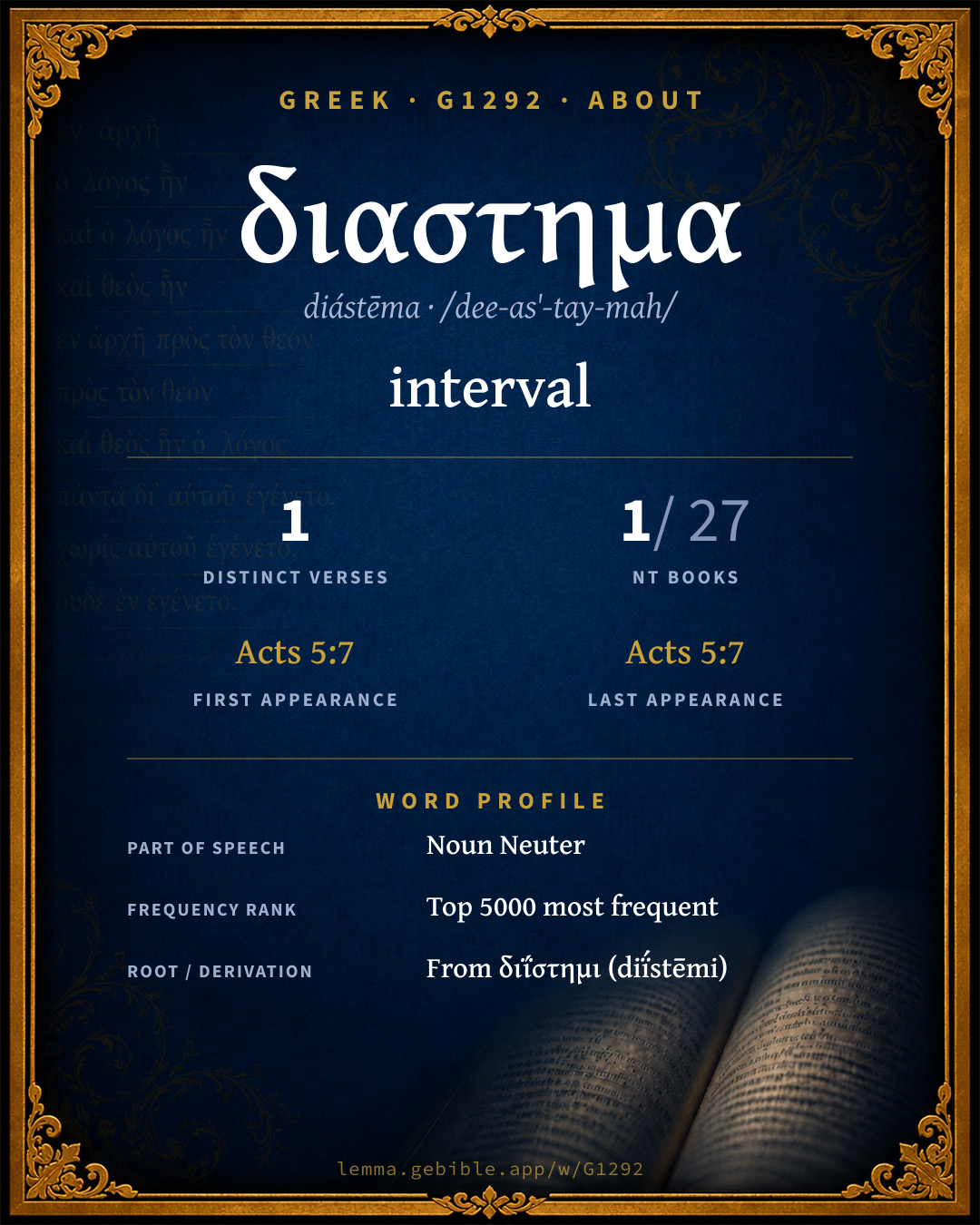
διάστημα
interval
Full lexicon entry — Thayer's Greek Lexicon
From Thayer's Greek Lexicon
Where this word appears
Grammar key — what these labels mean
Part of speech
- Noun
- A naming word — a person, place, thing, or idea.
Case
- Nominative
- The case of the subject (and the predicate nominative).
Gender
- Neuter
- Grammatically neuter.
Number
- Singular
- One.
Every verse where G1292 appears — 1 distinct verse across 1 book. Click any verse to open its interlinear word-by-word view. Verse text shown in the World English Bible for context — . Each verse’s Greek form is shown with its reference; the English is not keyword-highlighted, since the data carries no word-level English alignment. Use “Compare translations” on any verse to read it across multiple English versions. This concordance covers the Greek New Testament; Septuagint (Greek Old Testament) occurrences of this word are not indexed here.
Acts 1 verse
About this entry
At a glance — auto-summarized from this page’s data, not written by a person. Every figure links to its source below. This summary describes the numbers; it doesn’t interpret them.
διαστημα — transliterated diástēma — is a Greek noun carrying the sense “interval.” A scarce word — 1 verse in all of the Greek New Testament. More than three-quarters of its appearances fall in Acts. A true hapax — its single appearance is Acts 5:7. See the sense tree, 1-verse concordance, and the renderings breakdown below.
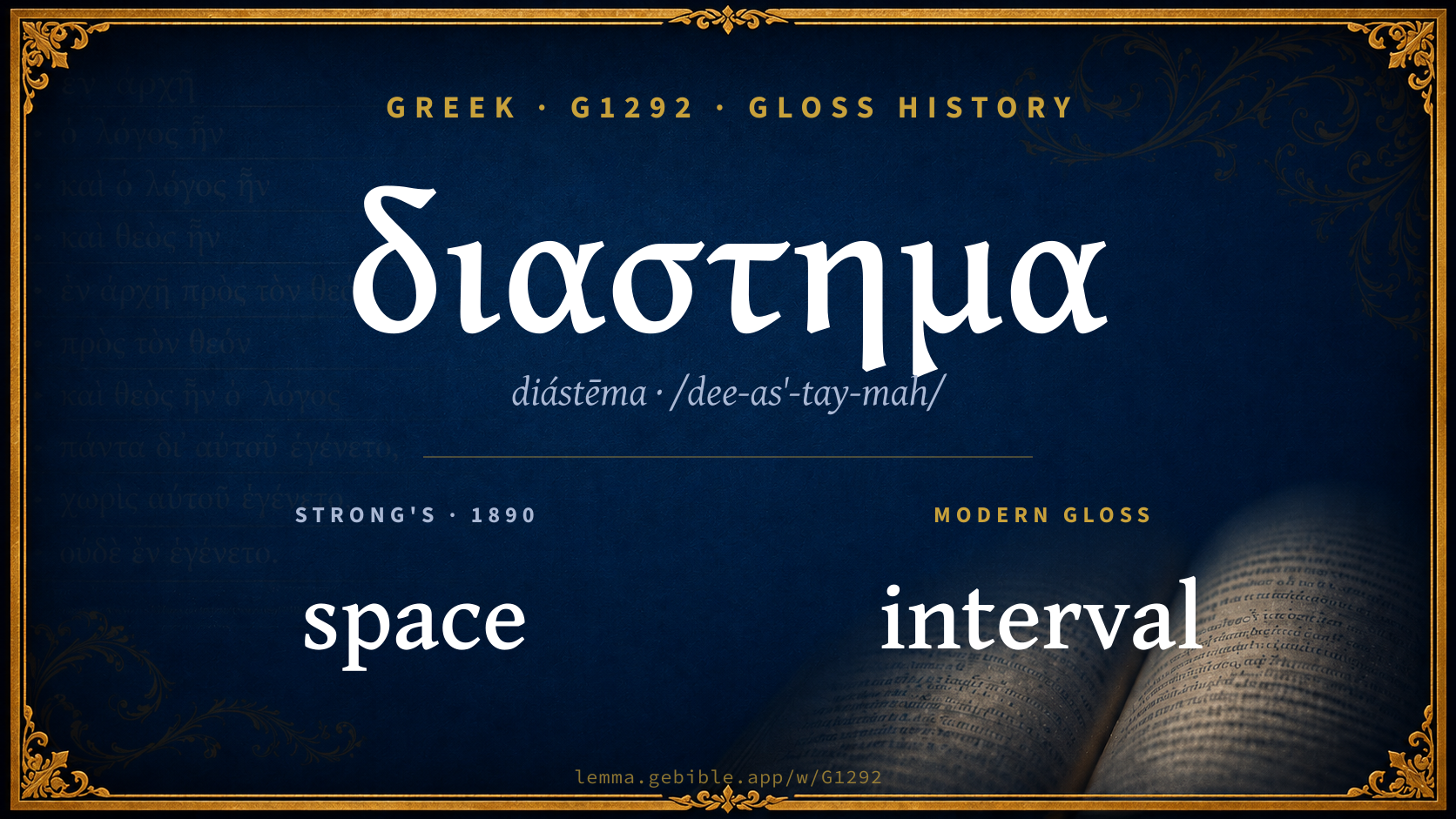
Gloss history
Strong's 1890 vs modern scholarship
About this word
Strong's G1292 catalogs a Greek word from the Greek New Testament.
These counts are not copied from any lexicon or concordance. They are computed here, from the morphology-tagged Greek New Testament. What Lemma adds →
- 1
- distinct verses
- The word appears in 1 distinct verse.
- 1 / 27
- NT books
- The word appears in 1 of 27 New Testament books.
- #3,503
- by frequency
- Top 5000 most frequent Greek words (rank 3,503 of 5,347 Greek words by occurrence).
View all 1 occurrence in the concordance →
Most concentrated in
- Acts 1 verse 100%
By section of the New Testament
By traditional corpus
Conventional, traditional groupings — biblical authorship is debated, so this is a traditional corpus grouping, not an authorship claim. Some books belong to more than one corpus (Luke is in both the Gospels and the Lukan corpus, and so on), so these shares overlap and need not total 100%. Each figure is a share of the word’s 1 distinct verse.
- Lukan (Luke–Acts) 1 verse · 100%
How translations render this word
Counts come from each version’s own published word-to-Strong’s tagging or interlinear alignment — an approximate guide to how each version renders this word, not a word-level alignment the data otherwise carries. Because each total is that version’s own tagged count, the per-version totals vary from one another and need not match the appearance or distinct-verse counts above. These counts may also differ from a printed concordance because Lemma counts each distinctly tagged rendering and does not collapse phrase taggings into a single head-word total. This is a fixed set of word-tagged versions (KJV, ASV, BSB, ULT) and does not change with the reading translation you choose elsewhere. Each version’s license is shown beside its name below (and on Sources).
- King James Version: After 1×, Space 1×
- American Standard Version: Space 1×
- Berean Standard Bible: Later 1×
- unfoldingWord Literal Text: Interval 1×
King James Version Public Domain
Renders G1292 across 2 tagged occurrences — most commonly:
American Standard Version Public Domain
Renders G1292 across 1 tagged occurrence — most commonly:
Berean Standard Bible Public Domain
Renders G1292 across 1 tagged occurrence — most commonly:
unfoldingWord Literal Text CC BY-SA 4.0
Renders G1292 across 1 tagged occurrence — most commonly:
Senses in Thayer's
The 1 sense Thayer's distinguishes for this word, in lexicon order (not ranked by frequency or importance). The full entry — with sub-senses — is in the Lexicon Entry tab.
- an interval, distance, space of time
Word origin
Derived from διΐστημι (diḯstēmi) (G1339) — to stand apart.
From G1339 ; an interval : - space.
— Strong’s Exhaustive Concordance (1890), public domain.
Septuagint usage
The same Greek word διαστημα appears 13 times in the Greek Old Testament (Septuagint), across 11 verses in 3 books.
- 13
- LXX occurrences
- Tagged occurrences of this Greek word in the Septuagint.
- 11
- verses
- Distinct Septuagint verses containing this word.
- 3 / 39
- OT books
- The word appears in 3 of the 39 Old Testament books.
Sample Septuagint occurrences
- Genesis 32:17 διάστημα
- 1 Kings 6:6 διάστημα
- Ezekiel 41:6 διάστημα
Septuagint occurrences (same lexeme)
Every verse where the same Strong’s number (G1292) appears in the Greek Septuagint. Verse text shown in the World English Bible for context; the Greek form is the matched word — the English is not keyword-highlighted.
- Genesis 32:17 διάστημα He commanded the foremost, saying, "When Esau, my brother, meets you, and asks you, saying, 'Whose are you? Where are you going? Whose are these before you?'
- 1 Kings 6:6 διάστημα The nethermost story was five cubits broad, and the middle was six cubits broad, and the third was seven cubits broad; for on the outside he made offsets [in the wall] of the house round about, that [the beams] should not have hold in the walls of the house.
- 1 Kings 7:46 διάστημα In the plain of the Jordan did the king cast them, in the clay ground between Succoth and Zarethan.
- Ezekiel 41:6 διάστημα The side-chambers were in three stories, one over another, and thirty in order; and they entered into the wall which belonged to the house for the side-chambers round about, that they might have hold [therein], and not have hold in the wall of the house.
- Ezekiel 41:8 διάστημα I saw also that the house had a raised base round about: the foundations of the side-chambers were a full reed of six great cubits.
- Ezekiel 42:5 διάστημα Now the upper chambers were shorter; for the galleries took away from these, more than from the lower and the middle, in the building.
- Ezekiel 42:12 διάστημα According to the doors of the chambers that were toward the south was a door at the head of the way, even the way directly before the wall toward the east, as one enters into them.
- Ezekiel 42:13 διάστημα Then said he to me, The north chambers and the south chambers, which are before the separate place, they are the holy chambers, where the priests who are near to Yahweh shall eat the most holy things: there shall they lay the most holy things, and the meal-offering, and the sin-offering, and the trespass-offering; for the place is holy.
- Ezekiel 45:2 διάστημα Of this there shall be for the holy place five hundred [in length] by five hundred [in breadth], square round about; and fifty cubits for the suburbs of it round about.
- Ezekiel 48:15 διάστημα The five thousand that are left in the breadth, in front of the twenty-five thousand, shall be for common use, for the city, for dwelling and for suburbs; and the city shall be in the midst of it.
- Ezekiel 48:17 διάστημα The city shall have suburbs: toward the north two hundred fifty, and toward the south two hundred fifty, and toward the east two hundred fifty, and toward the west two hundred fifty.
These are occurrences of the same Greek lexeme (G1292) in the Septuagint — not a translation of any one Hebrew word. The store carries no word-level Hebrew↔Greek alignment, so no Hebrew original is asserted here. Counts come from the recovered LXX Strong's tagging — high-frequency vocabulary is well covered, while rare or late forms may be untagged — so they reflect tagged occurrences and may slightly undercount.