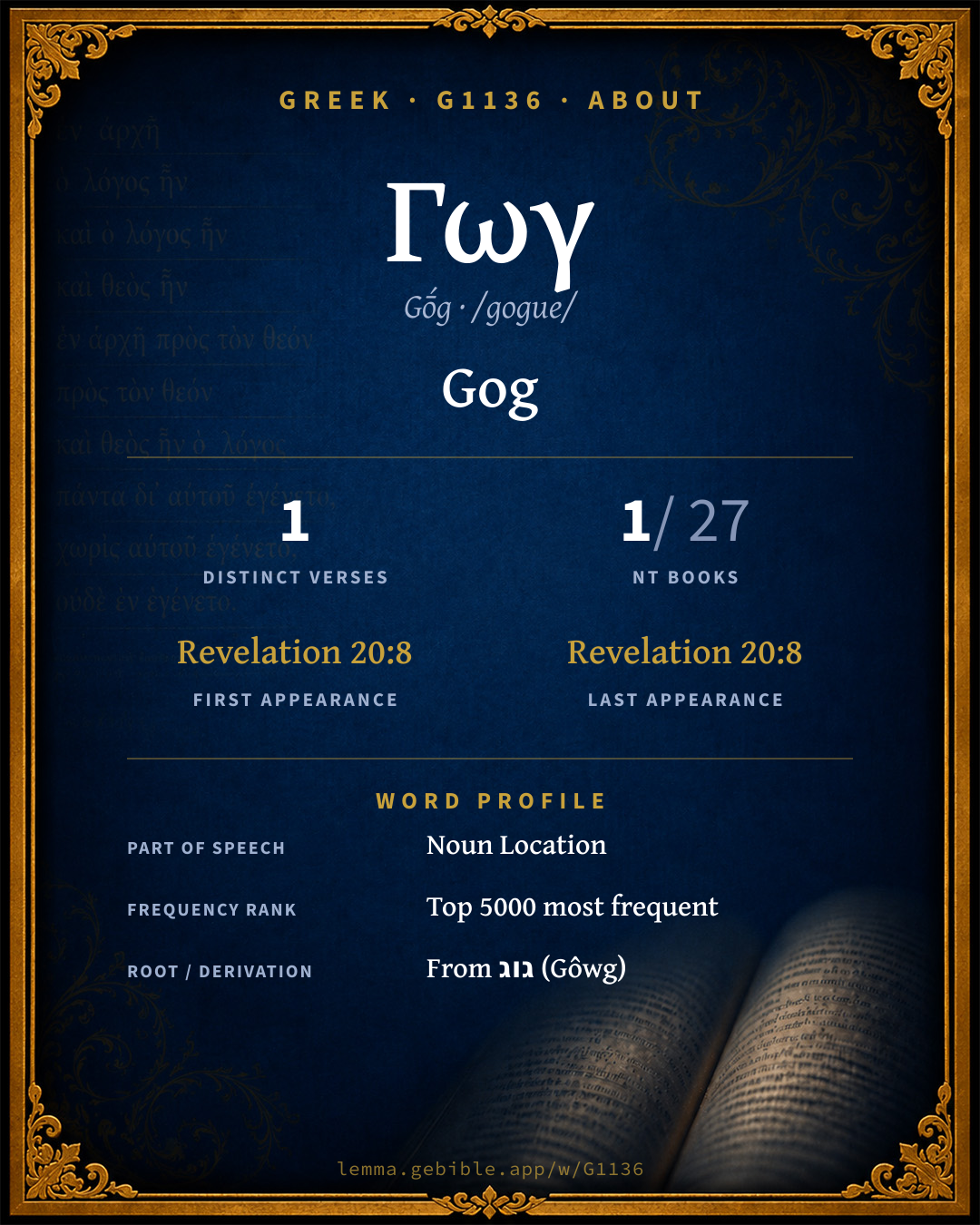
Γώγ
Gog
Thayer's lists 2 entries for ‘Gog’ fuller range ↓
Full lexicon entry — Thayer's Greek Lexicon
From Thayer's Greek Lexicon
Where this word appears
Every verse where G1136 appears — 1 distinct verse across 1 book. Click any verse to open its interlinear word-by-word view. Verse text shown in the World English Bible for context — . Each verse’s Greek form is shown with its reference; the English is not keyword-highlighted, since the data carries no word-level English alignment. Use “Compare translations” on any verse to read it across multiple English versions. This concordance covers the Greek New Testament; Septuagint (Greek Old Testament) occurrences of this word are not indexed here.
Revelation 1 verse
About this entry
At a glance — auto-summarized from this page’s data, not written by a person. Every figure links to its source below. This summary describes the numbers; it doesn’t interpret them.
“Gog” is the headline sense of the Greek name Γωγ (Gṓg). The Greek New Testament uses it only 1 verse. It clusters heavily in Revelation, which alone accounts for 100% of its uses. It occurs only once, in Revelation 20:8. See 1-verse concordance and the renderings breakdown below.
Gloss history
Strong's 1890 vs modern scholarship
About this word
Strong's G1136 catalogs a Greek word from the Greek New Testament.
These counts are not copied from any lexicon or concordance. They are computed here, from the morphology-tagged Greek New Testament. What Lemma adds →
- 1
- distinct verses
- The word appears in 1 distinct verse.
- 1 / 27
- NT books
- The word appears in 1 of 27 New Testament books.
- #3,503
- by frequency
- Top 5000 most frequent Greek words (rank 3,503 of 5,347 Greek words by occurrence).
View all 1 occurrence in the concordance →
Most concentrated in
- Revelation 1 verse 100%
By section of the New Testament
By traditional corpus
Conventional, traditional groupings — biblical authorship is debated, so this is a traditional corpus grouping, not an authorship claim. Some books belong to more than one corpus (Luke is in both the Gospels and the Lukan corpus, and so on), so these shares overlap and need not total 100%. Each figure is a share of the word’s 1 distinct verse.
- Johannine 1 verse · 100%
- Revelation 1 verse · 100%
How translations render this word
Counts come from each version’s own published word-to-Strong’s tagging or interlinear alignment — an approximate guide to how each version renders this word, not a word-level alignment the data otherwise carries. Because each total is that version’s own tagged count, the per-version totals vary from one another and need not match the appearance or distinct-verse counts above. These counts may also differ from a printed concordance because Lemma counts each distinctly tagged rendering and does not collapse phrase taggings into a single head-word total. This is a fixed set of word-tagged versions (KJV, ASV, BSB, ULT) and does not change with the reading translation you choose elsewhere. Each version’s license is shown beside its name below (and on Sources).
- King James Version: Gog 1×
- American Standard Version: Gog 1×
- Berean Standard Bible: Gog 1×
- unfoldingWord Literal Text: Gog 1×
King James Version Public Domain
Renders G1136 across 1 tagged occurrence — most commonly:
American Standard Version Public Domain
Renders G1136 across 1 tagged occurrence — most commonly:
Berean Standard Bible Public Domain
Renders G1136 across 1 tagged occurrence — most commonly:
unfoldingWord Literal Text CC BY-SA 4.0
Renders G1136 across 1 tagged occurrence — most commonly:
Senses in Thayer's
The 2 senses Thayer's distinguishes for this word, in lexicon order (not ranked by frequency or importance). The full entry — with sub-senses — is in the Lexicon Entry tab.
- Gog = "mountain"
- the king of the land of Magog who will come from the north and attack the land of Israel
Word origin
Derived from גוג (Gôwg) (H1463) — Gog.
Of hebrew origin [ H1463 ]; Gog a symbolic name for some future Antichrist : - Gog.
— Strong’s Exhaustive Concordance (1890), public domain.
Same root — word family
Other Thayer's entries built from the same root as G1136, grouped by Strong’s listed origin. These share a root / origin per the lexicon — not necessarily a shared meaning. Each links to that word’s own entry.
Derives from
Proper names from this root
People and places named from this root — a name, not an additional meaning of the word.
Compare all same-root words → 2 of the same-root words are proper names (people or places). They share a root, not necessarily a meaning.
Bible dictionary
Public-domain dictionary articles matched to this entry by name (Gog). A biblical name can be shared by more than one person or place, so an article may treat several.
Easton's Bible Dictionary · M. G. Easton, 1897
(1.) A Reubenite (1 Chr. 5:4), the father of Shimei.
(2.) The name of the leader of the hostile party described in Ezek. 38, 39, as coming from the "north country" and assailing the people of Israel to their own destruction. This prophecy has been regarded as fulfilled in the conflicts of the Maccabees with Antiochus, the invasion and overthrow of the Chaldeans, and the temporary successes and destined overthrow of the Turks. But "all these interpretations are unsatisfactory and inadequate. The vision respecting Gog and Magog in the Apocalypse (Rev. 20:8) is in substance a reannouncement of this prophecy of Ezekiel. But while Ezekiel contemplates the great conflict in a more general light as what was certainly to be connected with the times of the Messiah, and should come then to its last decisive issues, John, on the other hand, writing from the commencement of the Messiah's times, describes there the last struggles and victories of the cause of Christ. In both cases alike the vision describes the final workings of the world's evil and its results in connection with the kingdom of God, only the starting-point is placed further in advance in the one case than in the other."
It has been supposed to be the name of a district in the wild north-east steppes of Central Asia, north of the Hindu-Kush, now a part of Turkestan, a region about 2,000 miles north-east of Nineveh.
Smith's Bible Dictionary · William Smith, 1863
(mountain).
+ A Reubenite, (1 Chronicles 5:4) son of Shemaiah.
Hitchcock's Bible Names Dictionary · Roswell D. Hitchcock, 1869
roof; covering
Classic public-domain reference works; full attribution on Sources.
Septuagint usage
The same Greek word Γωγ appears 14 times in the Greek Old Testament (Septuagint), across 11 verses in 3 books.
- 14
- LXX occurrences
- Tagged occurrences of this Greek word in the Septuagint.
- 11
- verses
- Distinct Septuagint verses containing this word.
- 3 / 39
- OT books
- The word appears in 3 of the 39 Old Testament books.
Sample Septuagint occurrences
- Numbers 24:7 γωγ
- Ezekiel 38:2 γωγ
- Amos 7:1 γωγ
Septuagint occurrences (same lexeme)
Every verse where the same Strong’s number (G1136) appears in the Greek Septuagint. Verse text shown in the World English Bible for context; the Greek form is the matched word — the English is not keyword-highlighted.
- Numbers 24:7 γωγ Water shall flow from his buckets, His seed shall be in many waters, His king shall be higher than Agag, His kingdom shall be exalted.
- Ezekiel 38:2 γωγ Son of man, set your face toward Gog, of the land of Magog, the prince of Rosh, Meshech, and Tubal, and prophesy against him,
- Ezekiel 38:3 γωγ and say, Thus says the Lord Yahweh: Behold, I am against you, Gog, prince of Rosh, Meshech, and Tubal:
- Ezekiel 38:14 γωγ Therefore, son of man, prophesy, and tell Gog, Thus says the Lord Yahweh: In that day when my people Israel dwells securely, shall you not know it?
- Ezekiel 38:17 γωγ Thus says the Lord Yahweh: Are you he of whom I spoke in old time by my servants the prophets of Israel, who prophesied in those days for [many] years that I would bring you against them?
- Ezekiel 38:18 γωγ It shall happen in that day, when Gog shall come against the land of Israel, says the Lord Yahweh, that my wrath shall come up into my nostrils.
- Ezekiel 39:1 γωγ You, son of man, prophesy against Gog, and say, Thus says the Lord Yahweh: Behold, I am against you, Gog, prince of Rosh, Meshech, and Tubal:
- Ezekiel 39:6 γωγ I will send a fire on Magog, and on those who dwell securely in the isles; and they shall know that I am Yahweh.
- Ezekiel 39:11 γωγ It shall happen in that day, that I will give to Gog a place for burial in Israel, the valley of those who pass through on the east of the sea; and it shall stop those who pass through: and there shall they bury Gog and all his multitude; and they shall call it The valley of Hamon Gog.
- Ezekiel 39:15 γωγ Those who pass through the land shall pass through; and when any sees a man's bone, then shall he set up a sign by it, until the undertakers have buried it in the valley of Hamon Gog.
- Amos 7:1 γωγ Thus the Lord Yahweh showed me: and, behold, he formed locusts in the beginning of the shooting up of the latter growth; and, behold, it was the latter growth after the king's harvest.
These are occurrences of the same Greek lexeme (G1136) in the Septuagint — not a translation of any one Hebrew word. The store carries no word-level Hebrew↔Greek alignment, so no Hebrew original is asserted here. Counts come from the recovered LXX Strong's tagging — high-frequency vocabulary is well covered, while rare or late forms may be untagged — so they reflect tagged occurrences and may slightly undercount.