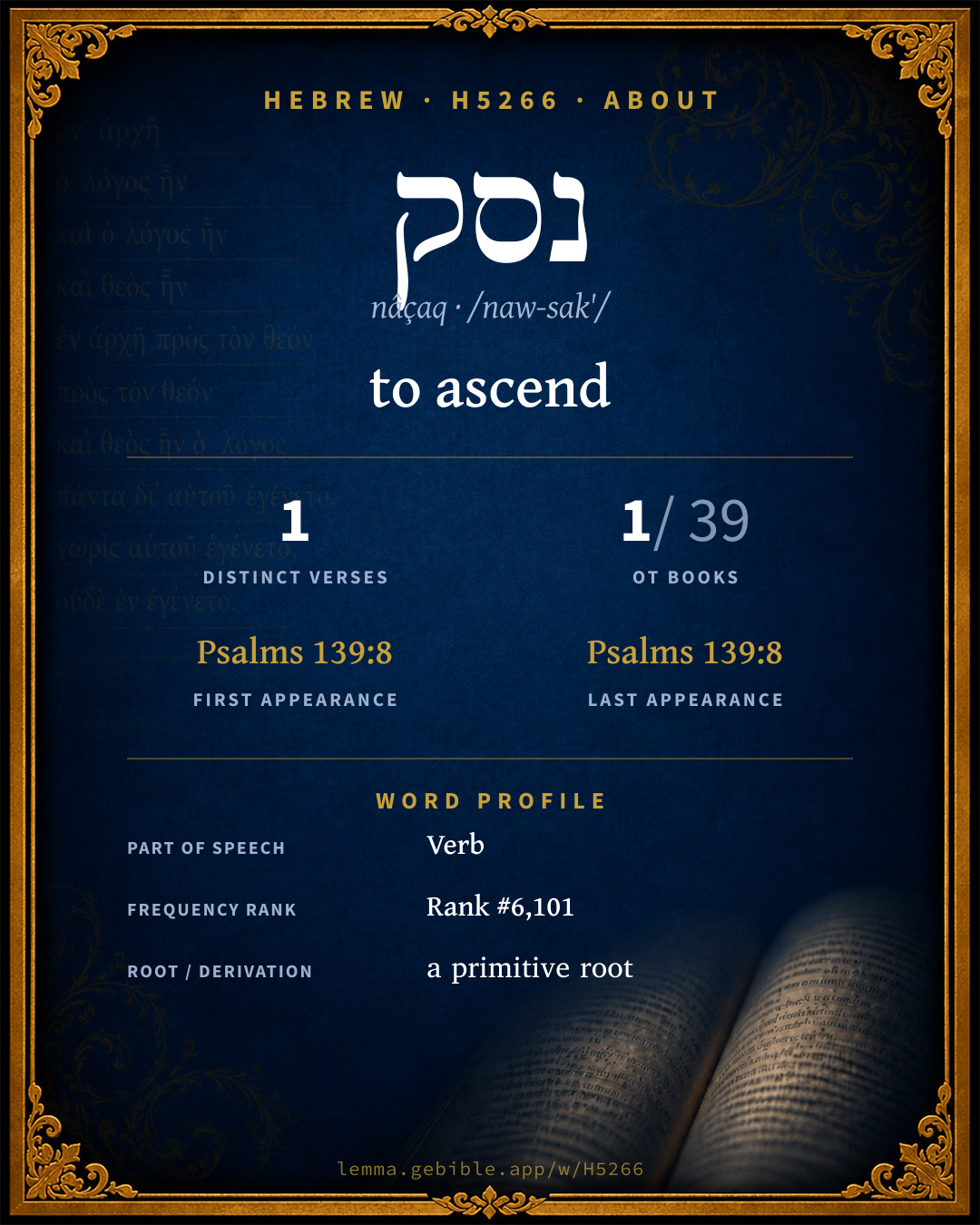
נסק
to ascend
Full lexicon entry — Brown-Driver-Briggs (BDB)
From Brown-Driver-Briggs (BDB)
Where this word appears
Grammar key — what these labels mean
Part of speech
- Verb
- An action or state-of-being word.
Stem
- Qal
- The basic, simple active stem — the plain form of the verb (“he wrote”).
Form
- Imperfect
- An incomplete, ongoing, or future action (“he will / would write”).
Person
- 1st Person
- The speaker (“I / we”).
Gender
- Common
- Either gender — not distinguished for this form.
Number
- Singular
- One.
Every verse where H5266 appears — 1 distinct verse across 1 book. Click any verse to open its interlinear word-by-word view. Verse text shown in the World English Bible for context — . Each verse’s Hebrew form is shown with its reference; the English is not keyword-highlighted, since the data carries no word-level English alignment. Use “Compare translations” on any verse to read it across multiple English versions. This concordance covers the Hebrew Bible; Septuagint (Greek Old Testament) occurrences are not indexed here.
Psalms 1 verse
About this entry
At a glance — auto-summarized from this page’s data, not written by a person. Every figure links to its source below. This summary describes the numbers; it doesn’t interpret them.
“to ascend” is the headline sense of the Hebrew verb נסק (nâçaq). It occurs a mere 1 verse across Scripture. More than three-quarters of its appearances fall in Psalms. Found nowhere else but Psalms 139:8. It shares a root with נסק. See the sense tree, 1-verse concordance, and the renderings breakdown below.
Gloss history
Strong's 1890 vs modern scholarship
About this word
Strong's H5266 catalogs a Hebrew word from the Hebrew Old Testament.
These counts are not copied from any lexicon or concordance. They are computed here, from the morphology-tagged Hebrew Old Testament. What Lemma adds →
- 1
- distinct verses
- The word appears in 1 distinct verse.
- 1 / 39
- OT books
- The word appears in 1 of 39 Old Testament books.
- #6,101
- by frequency
- Rank #6,101 (rank 6,101 of 8,640 Hebrew words by occurrence).
View all 1 occurrence in the concordance →
Most concentrated in
- Psalms 1 verse 100%
By section of the Old Testament
By traditional corpus
Conventional, traditional groupings — biblical authorship is debated, so this is a traditional corpus grouping, not an authorship claim. Each share is this word’s portion of its verses in that division of the Hebrew canon. Each figure is a share of the word’s 1 distinct verse.
- Writings (Ketuvim) 1 verse · 100%
How translations render this word
Counts come from each version’s own published word-to-Strong’s tagging or interlinear alignment — an approximate guide to how each version renders this word, not a word-level alignment the data otherwise carries. Because each total is that version’s own tagged count, the per-version totals vary from one another and need not match the appearance or distinct-verse counts above. These counts may also differ from a printed concordance because Lemma counts each distinctly tagged rendering and does not collapse phrase taggings into a single head-word total. This is a fixed set of word-tagged versions (KJV, ASV, BSB, ULT) and does not change with the reading translation you choose elsewhere. Each version’s license is shown beside its name below (and on Sources).
- King James Version: I ascend up 1×
- American Standard Version: I ascend up 1×
- Berean Standard Bible: I ascend 1×
- unfoldingWord Literal Text: I ascend 1×
King James Version Public Domain
Renders H5266 across 1 tagged occurrence — most commonly:
American Standard Version Public Domain
Renders H5266 across 1 tagged occurrence — most commonly:
Berean Standard Bible Public Domain
Renders H5266 across 1 tagged occurrence — most commonly:
unfoldingWord Literal Text CC BY-SA 4.0
Renders H5266 across 1 tagged occurrence — most commonly:
Senses in BDB
The 1 sense BDB distinguishes for this word, in lexicon order (not ranked by frequency or importance). The full entry — with sub-senses — is in the Lexicon Entry tab.
- (Qal) to ascend
Word origin
[ סָלֵק ] vb. ascend;—only Qal ψ 139:8
— Brown-Driver-Briggs (Oxford 1906, public domain), digitized via Sefaria, supplemented by the OpenScriptures HebrewLexicon (CC BY 4.0). See Sources.
Origin: a primitive root
Jastrow Dictionary
A second Hebrew/Aramaic lexicon for comparison, covering Aramaic and post-biblical (Talmudic, Targumic, Midrashic) usage that the biblical-Hebrew BDB does not. Matched by lemma rather than by Strong’s number, so a lemma may carry more than one Jastrow headword (shown separately below), and the entries cover usage well beyond the Bible.
נָסַק
- to go up, ascend; v. מָסַק.
- 1. to impose a tax, to assess, v. מַסִּיק II.
- 2. to bring to a conclusion, v. מַסִּיק I. I.
- 3. to put on wood, to make the flame rise; [cmp. עָלָה Hif.,] to start a fire, to heat. Bets. 32ᵃ, a. e. מַסִּיקִין בכלים וכ׳ you may, on the Holy Day, use wooden vessels for heating &c. Pes. 27ᵇ המַסִּיק he who put the wood on. Ib. תנור שהִסִּיקוֹ וכ׳ if one heated an oven with wood belonging to the sanctuary &c. Sabb. III, 1 כירה שהִסִּיקוּהָ בקש וכ׳ a range which they heated with straw &c. Tosef. Yoma II, 5; Yoma 38ᵃ מַסִּיקִין מבפנים placed the fire deep into the stove. Sabb. 41ᵃ; a. fr.—[Midr. Till. to Ps. XXVIII, v. infra.]
- ; Hof. הוּסָּק to be heated. Y. Ber. IV, 8ᵇ top נִסּוֹקֶת; ib. IX, 14ᵇ top נִיסּ׳, v. מֶרְחָץ.—Pes. 30ᵇ top הא ה׳ התנור but if the oven has been made glowing. Midr. Till. to Ps. XXVIII אם הוא נ׳ … יהא ני׳ וכ׳ if it (the furnace) is usually heated with one bundle, let it now be heated with seven; ib. אם הוא מסיק בשבעה יהא מסיק וכ׳ (corr. acc.) if it is heated with seven bundles, let it be heated &c. Kel. V, 4. Tosef. Ḥull. I, 22 עד שלא הוּסְּקוּ before they are hardened by heating; a. fr.
נְסַק
- , to go up. Impf. יִסַּק, יֵיסַק; inf. מִיסַּק, מֵיסַק; imper. סַק, סוּק. Targ. II Sam. V, 22, sq. Targ. O. Num. XX, 19 נֵיסָּק ed. Berl. Targ. Gen. XLIV, 17; a. fr.—Kidd. 50ᵃ אדעתא למֵיסַק וכ׳ with the idea of going up to Palestine. Bets. 27ᵃ אזכי ואִסַּק; M. Kat. 22ᵃ ואֵיסק (not ואסיק), a. e., v. זְכֵי; a. fr.
- 1. to cause to rise, to bring up, offer. Targ. Lev. II, 9, a. fr. (h. text הקטיר). Targ. II Sam. VI, 2 לַאֲסָקָא ed. Wil. Targ. Lev. XI, 3, sq.; a. fr.—Targ. Josh. XVII, 13 מַסְקֵי מסין tributaries.—Y. Keth. XI, 34ᵇ bot. והוה מַסֵּיק לון מזונין וכ׳ and he offered them support as long as they lived. Gitt. 56ᵇ, a. fr. אַסְּקֵיה וכ׳, v. נְגִידָא III. Y. Peah I, 15ᶜ אַסְּקוּנֵיה למאתים וכ׳ they raised the offer to two hundred, to one thousand; Y. Kidd. I, 61ᵇ top אַסְּקִינֵיה. Y. Maas. Sh. IV, end, 55ᶜ מַסִּיק חסין will produce lettuce; a. fr.
- 2. (sub. בישרא) to produce new flesh, to heal. Gitt. 69ᵃ לאַסּוּקֵי וכ׳ for healing let him take &c.
- 3. to heat. Targ. Koh. II, 6.
- 4. to finish. Succ. 39ᵃ אַסּוּקֵי מילתא the winding up of a proceeding; Yeb. 106ᵇ Ar. (ed. אפסוקי).
- 5. (with בִּשְׁמָא) to name after, to adopt a name. Yoma 38ᵇ לא מַסְּקִינָן בשמייהו we do not name children after them. Gitt. 11ᵇ דלא שכיחי ישראל דמַסְּקֵי בשמהתייהו names which Israelites are not in the habit of adopting. Shebu. 29ᵃ ואסיק להו (שמא) זוזי and named them coins; a. e.
- 6. (with זוזי, a. ב of person) to produce a claim against. Shebu. 41ᵇ הב לי … דמַסִּיקְנָא בך give me the one hundred Zuz which I claim against thee (which thou owest me). Keth. 85ᵃ הוו מַסְּקֵּי ביה זוזי וכ׳, v. חוֹזָאֵי. B. Kam. 97ᵃ אינשי דמסיק בהו זוזי persons against whom he had a claim; a. e.
- 7. (with אדעתא) to have in mind. Shebu. 29ᵃ דמסקי אדעתייהו וכ׳ they might have in mind an idol.
- 1. to be offered up. Targ. O. Lev. II, 12 יִתַּסְּקוּן ed. Berl. (oth. ed. a. Y. יְתַסְקוּן); a. e.
- 2. to be kindled, burnt. Targ. Ps. LXXVIII, 21; a. e.
A Dictionary of the Targumim, the Talmud Babli and Yerushalmi, and the Midrashic Literature (Marcus Jastrow; London, Luzac, 1903) — Public Domain. Digitized via Sefaria. Digitized via Sefaria. Full attribution on Sources.
Same root — word family
Other BDB entries built from the same root as H5266, grouped by Strong’s listed origin. These share a root / origin per the lexicon — not necessarily a shared meaning. Each links to that word’s own entry.
Derived from this word
Compare all same-root words → They share a root, not necessarily a meaning.
Septuagint verse parallels
This word appears in 1 verse that also exists in the Greek Old Testament (Septuagint), out of the 1 Hebrew verse it occurs in. You can read those verses in Greek by switching the Old Testament edition to the Septuagint.
Read these verses in the Septuagint
This is a verse-level parallel only — the same verses exist in both the Hebrew and Greek Old Testaments. No word-level Hebrew↔Greek correspondence is claimed: the data carries no such alignment, so no Greek word is shown as this Hebrew word’s translation. Coverage is not total — the Septuagint omits the deuterocanon and renumbers the Psalms, so some Hebrew verses have no direct Greek parallel.