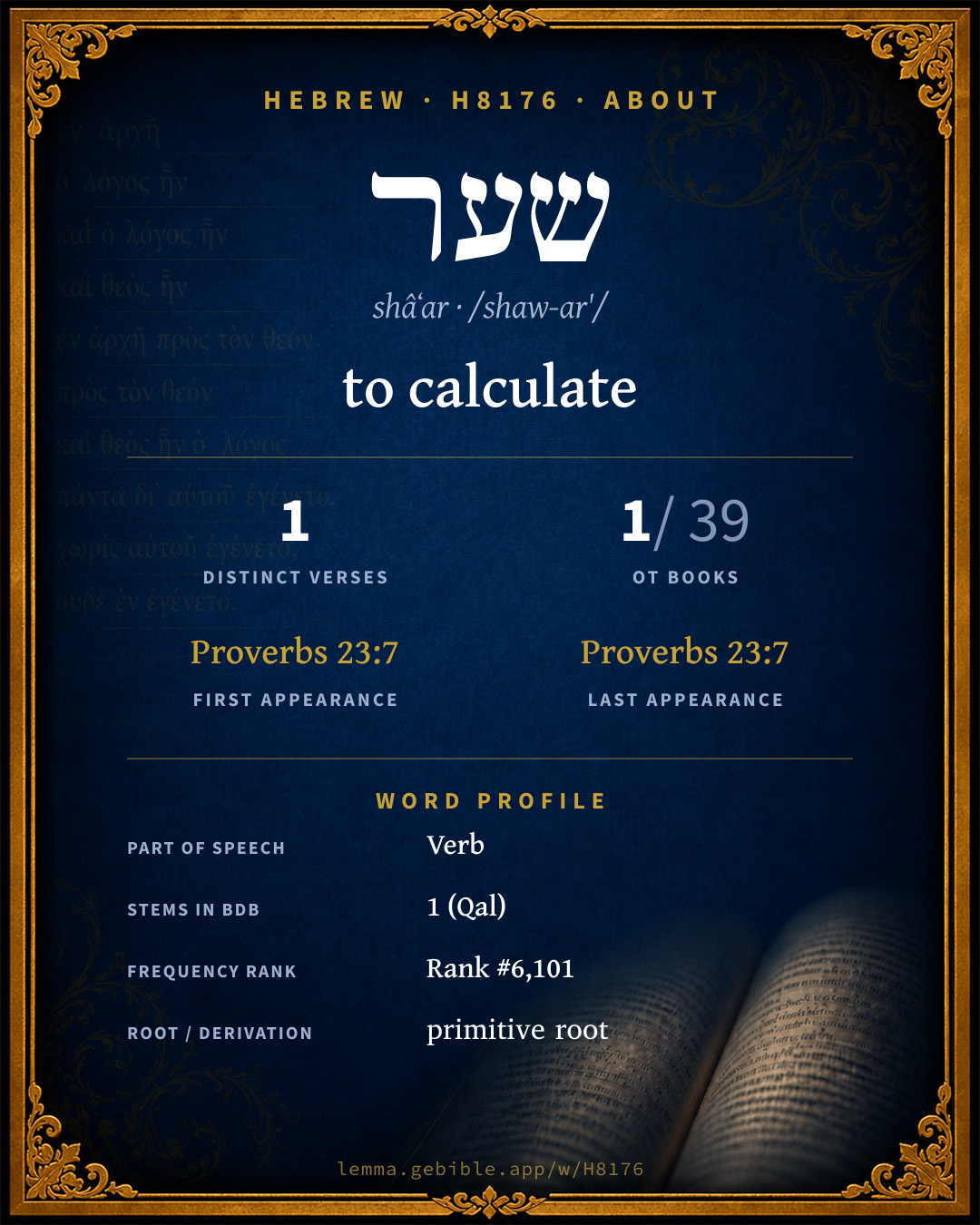
שָׁעַר
to calculate
‘to calculate’ is one of 2 main senses fuller range ↓
Full lexicon entry — Brown-Driver-Briggs (BDB)
From Brown-Driver-Briggs (BDB)
Where this word appears
Grammar key — what these labels mean
Part of speech
- Verb
- An action or state-of-being word.
Stem
- Qal
- The basic, simple active stem — the plain form of the verb (“he wrote”).
Form
- Perfect
- A completed action or state — Hebrew marks aspect (completeness) more than strict tense (“he wrote”).
Person
- 3rd Person
- The one spoken about (“he / she / it / they”).
Gender
- Masculine
- Grammatically masculine.
Number
- Singular
- One.
Every verse where H8176 appears — 1 distinct verse across 1 book. Click any verse to open its interlinear word-by-word view. Verse text shown in the World English Bible for context — . Each verse’s Hebrew form is shown with its reference; the English is not keyword-highlighted, since the data carries no word-level English alignment. Use “Compare translations” on any verse to read it across multiple English versions. This concordance covers the Hebrew Bible; Septuagint (Greek Old Testament) occurrences are not indexed here.
Proverbs 1 verse
About this entry
At a glance — auto-summarized from this page’s data, not written by a person. Every figure links to its source below. This summary describes the numbers; it doesn’t interpret them.
שער (shâʻar) is a Hebrew verb most often rendered “to calculate.” It is rare — just 1 verse in the entire Hebrew Bible. Proverbs dominates its distribution — 1 of 1 verses. It occurs only once, in Proverbs 23:7. Its meaning spans more than one sense — see its full sense range. The sections below give every sense, occurrence, and version rendering.
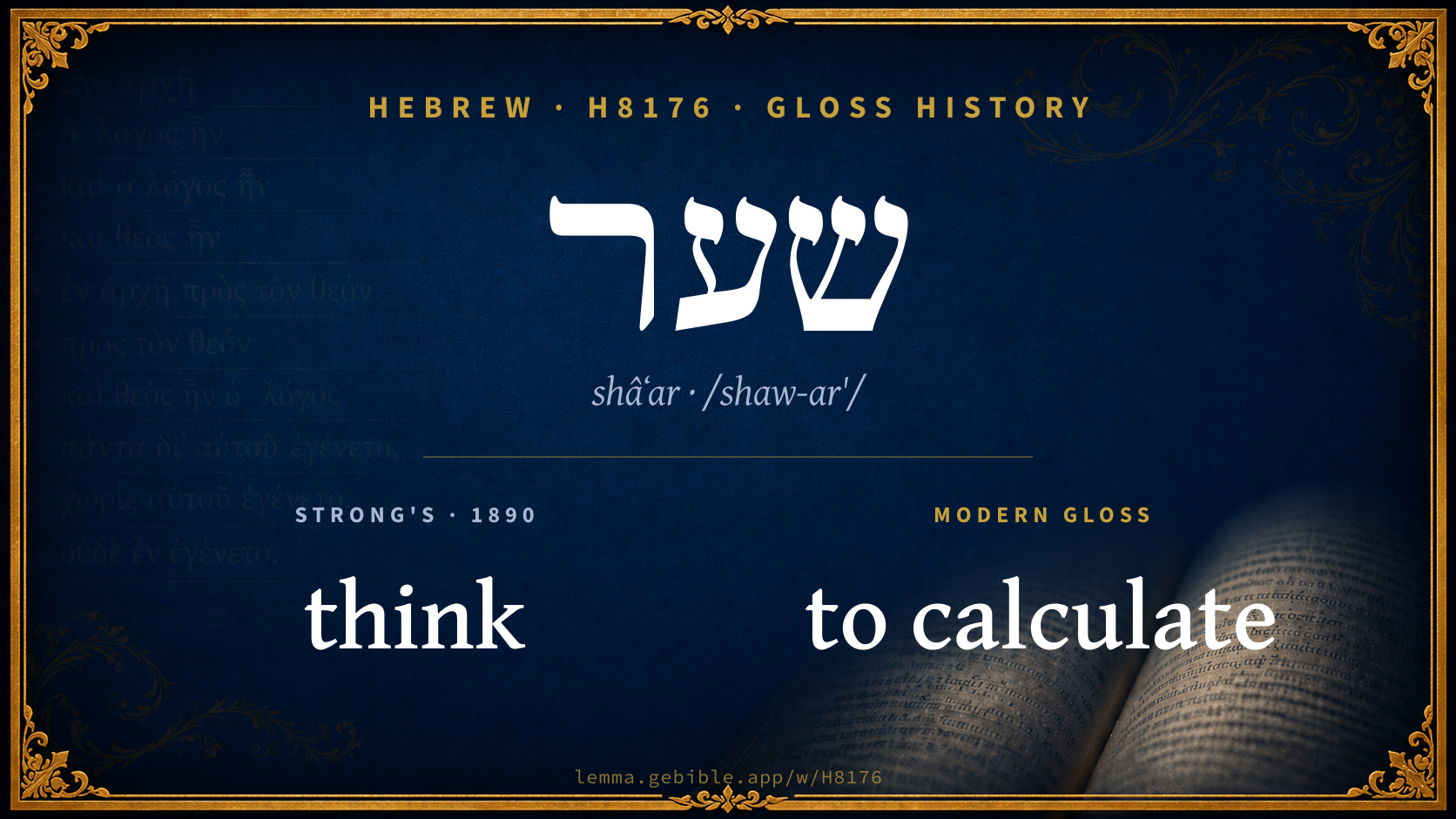
Gloss history
Strong's 1890 vs modern scholarship
About this word
Strong's H8176 catalogs a Hebrew word from the Hebrew Old Testament.
These counts are not copied from any lexicon or concordance. They are computed here, from the morphology-tagged Hebrew Old Testament. What Lemma adds →
- 1
- distinct verses
- The word appears in 1 distinct verse.
- 1 / 39
- OT books
- The word appears in 1 of 39 Old Testament books.
- #6,101
- by frequency
- Rank #6,101 (rank 6,101 of 8,640 Hebrew words by occurrence).
View all 1 occurrence in the concordance →
Most concentrated in
- Proverbs 1 verse 100%
By section of the Old Testament
By traditional corpus
Conventional, traditional groupings — biblical authorship is debated, so this is a traditional corpus grouping, not an authorship claim. Each share is this word’s portion of its verses in that division of the Hebrew canon. Each figure is a share of the word’s 1 distinct verse.
- Writings (Ketuvim) 1 verse · 100%
How translations render this word
Counts come from each version’s own published word-to-Strong’s tagging or interlinear alignment — an approximate guide to how each version renders this word, not a word-level alignment the data otherwise carries. Because each total is that version’s own tagged count, the per-version totals vary from one another and need not match the appearance or distinct-verse counts above. These counts may also differ from a printed concordance because Lemma counts each distinctly tagged rendering and does not collapse phrase taggings into a single head-word total. This is a fixed set of word-tagged versions (KJV, ASV, BSB, ULT) and does not change with the reading translation you choose elsewhere. Each version’s license is shown beside its name below (and on Sources).
- King James Version: He thinketh 1×
- American Standard Version: He thinketh 1×
- Berean Standard Bible: He is keeping track 1×
- unfoldingWord Literal Text: One who calculates 1×
King James Version Public Domain
Renders H8176 across 1 tagged occurrence — most commonly:
American Standard Version Public Domain
Renders H8176 across 1 tagged occurrence — most commonly:
Berean Standard Bible Public Domain
Renders H8176 across 1 tagged occurrence — most commonly:
unfoldingWord Literal Text CC BY-SA 4.0
Renders H8176 across 1 tagged occurrence — most commonly:
Senses in the full BDB
What do BDB’s symbols mean?
BDB uses these scholarly abbreviations:
| Symbol | Meaning |
|---|---|
| 𝔊 | the Septuagint (the ancient Greek translation, LXX) |
| 𝔙 | the Vulgate (the Latin translation) |
| 𝔖 | the Syriac version (the Peshitta) |
| 𝔗 | the Targum (the Aramaic translation) |
| ψ | the Psalms |
| √ | root (the underlying root or stem) |
| ‖ | parallel passage (a synonymous or contrasted parallel) |
| † | the dagger: every passage where the word occurs is cited |
The 1 sense the full Brown-Driver-Briggs lexicon distinguishes for this word, in lexicon order (not ranked by frequency), with BDB’s own verbatim wording and sub-sense lettering. Shown in Hebrew script with BDB’s own scholarly abbreviations. The condensed entry is in the Lexicon Entry tab.
Qal
- Pf. 3 ms. כְּמוֹ־שׁ׳ בְּנַפְשׁוֹ כֶּן־הוּא Pr 23:7 as he has calculated in his soul, so is he, but dub.: De שֹׁעֵר as one who calculates; more radical conj. in Bi Toy. e.g. Proverbs 23:7
Senses from the full Brown-Driver-Briggs lexicon (Brown, Driver, Briggs; Oxford 1906 — public domain), digitized via Sefaria, supplemented by the OpenScriptures HebrewLexicon (CC BY 4.0). Full attribution on Sources.
Word origin
vb. calculate, reckon (NH Pi. J.Aram Pa. put a valuation on, estimate; J.Aram; שַׁעֲרָא interest, market-price; Arabic سِعْرٌ market-price is loan-word Frä189);—
— Brown-Driver-Briggs (Oxford 1906, public domain), digitized via Sefaria, supplemented by the OpenScriptures HebrewLexicon (CC BY 4.0). See Sources.
Origin: primitive root
Jastrow Dictionary
A second Hebrew/Aramaic lexicon for comparison, covering Aramaic and post-biblical (Talmudic, Targumic, Midrashic) usage that the biblical-Hebrew BDB does not. Matched by lemma rather than by Strong’s number, so a lemma may carry more than one Jastrow headword (shown separately below), and the entries cover usage well beyond the Bible.
שָׁעַר I
- to keep the gate.—V. שׁוֹעֵר.
- same. Arakh. 11ᵇ משורר ששי׳ בשל חבירו a Levite chorister that helped in attending to the gate in his neighbor’s stead.—Part. מְשׁוֹעֵר; pl. מְשׁוֹעֲרִים (formed by analogy to מְשׁוֹרֵר, v. שִׁיר I). Ib. מש׳ ששורר, v. שִׁיר I. Ib. ולא מן המש׳ (Sifré Num. 116; Yalk. ib. 752 השׁוֹעֲרִים), v. שִׁיר I.
שָׁעַר II
- v. שַׁעַר) to divide, distribute. [Midr. Till. to Ps. XIV שיערו, v. infra.]
- 1. to apportion, estimate, measure, calculate. Ḥull. VII, 4 כיצד מְשׁעֲרִין אותה וכ׳ how do we define the proportions of the mixture (to find out whether the forbidden admixture is large enough to impart its taste to the permitted portion)? As if it were an admixture of meat in a vegetable dish. Ib. 97ᵇ כשהן משערין משערין וכ׳ when we define the proportions, we include in the calculation the broth &c. Ib. כל איסורין … מְשַׁעֲרִינָן וכ׳ in all admixtures of Biblically forbidden matter we assume for calculation that the forbidden matter was onions or porret. Ib. שִׁיעֲרוּ חכמים וכ׳ the scholars have calculated that of all forbidden substances none give a stronger taste than onions &c. Lev. R. s. 37 מְשָׁעֵר את … באיטלקית (some ed. מְשָׁעֵיר) do you estimate that in all I drank at my meal there would have been a quarter of a Log of Italian (unmixed) wine? Koh. R. to V, 8 שיערו אותה, v. next w.; a. fr.—Midr. Till. to Ps. CXIV (expl. סֹלּוּ, Ps. LXVIII, 5) שַׁעֲרוּ לפניו דרכיכם (not שיע׳; ed. Bub. שפרו, a glossator’s emendation) measure your ways before the Lord (cmp. שׁוּם I). Pesik. Zutr. Haaz. (ed. Bub. p. 114) (ref. to שערום, Deut. XXXII, 17) לא שִׁיעֲרוּם וכ׳ whom your fathers never appraised, to find out whether or not they are of use; Yalk. Deut. 545 לא שערום. e.g. Psalms 68:5
- 2. (v. שַׁעַר) to superintend the market, v. מְשָׁעֵר.
- to be estimated, measured. Ukts. II, 8 מִשְׁתַּעֲרִין בכמות שהן are measured as they are (not compressed); מִשְׁתַּעֶרֶת בכמות שהיא is measured as it is.
שְׁעַר
- Pa. שַׁעֵיר same, to measure, calculate. Targ. O. Gen. XXVI, 12 בדשַׁעֲרוּהִי ed. Berl. (oth. ed. בדשַׁעֲרוֹהִי; Y. בדשַׁעֲרוֹי; h. text שערים).—Ḥull. 97ᵇ ולִישַׁעֲרִינְהוּ בפלפלין וכ׳ why not use as a standard (for calculation in the case of admixtures of forbidden substances) pepper or spices which are not neutralized in a mass of a thousand times their quantity? Ib. בדידיה מְשַׁעֲרִינָן או בדנפיק מיניה משערינן do we calculate the proportions by the actual size of the admixture, or by the quantity that has come out of it (has been absorbed in the dish)? Y. Kil. IX, 32ᵈ top שַׁעֲרוּנָהּ רבנין וכ׳ the Rabbis made the calculation, and it (the well of Miriam) was exactly opposite the middle gate &c.; Lev. R. s. 22 שערותא (corr. acc.); Koh. R. to V, 8 שיערו אותה וכ׳ (Hebr.).
שָׂעַר
- to be rough, denom. שֵׂעָר; to shudder, fear. Sifré Deut. 318 (expl. שערום, Deut. XXXII, 17) שלא עמדה שערת וכ׳ your fathers’ hair did not stand on end before them (v. שָׁעַר II); Yalk. ib. 545. e.g. Deuteronomy 32:17
- (denom. of שֵׂעָר) to grow hair, be hairy. Ḥull. 44ᵃ עד מקום שיַשְׂעִיר Ms. M. a Rashi (ed. כדי, corr. acc.) to the place (of the stomach) where it becomes covered with hair. Ib. (Chald. diction) תורא דמַשְׂעִיר טפי an ox, which is more hairy (on the stomach). Nidd. 25ᵇ עד שישעיר until the embryo has hair.
שְׂעַר
- , Af. אַשְׂעִיר, v. preced.
שֵׂעָר
- preced.) hair. Meg. 18ᵃ, a. e. מסלסל בשׂעַרְךָ, v. סִלְסֵל. Naz. I, 2 הכביד שַׂעֲרוֹ, v. כָּבֵד I. Ib. 4ᵇ לשחת ש׳ וכ׳ to ruin such fine hair; Tosef. ib. IV, 7. Yoma 47ᵃ קלעי שַׂעֲרִי, v. קֶלַע II; a. fr.—Trnsf. crown, ramification of a tree; panicle, stem and pod of leguminous plants. Peah II, 3, a. e. ש׳ כותש, v. כָּתַשׁ; Y. ib. 17ᵃ top סֵעָר. Kil. IV, 9 היה הופך ש׳ שתי וכ׳ he turned the branches of two rows of vines towards one side; B. Bath. 82ᵇ. Sabb. XXI, 3 ש׳ של אפונין וש׳ וכ׳ the panicles (pods) of beans and of lentils. Tosef. Ukts. I, 8 סֵיאָר ed. Zuck. (Var. שיע, read as ed. T’bul Yom III: שיער) the panicle of a pomegranate; a. fr.—Pl., v. שַׂעֲרָה
שְׂעַר ²
- ch., v. שַׂעֲרָא
שַׁעַר
- שער to divide, break open)
- 1. gate, open place for public and private transactions. Sifré Deut. 242 (ref. to Deut. XXII, 24 ש׳ שנמצאת בו וכ׳ the gate (of the place) where she was found, and not the gate where she was judged. Keth. 45ᵇ (ref. to Deut. XVII, 5) ש׳ שעבד בו the gate (of the place) where he worshipped the idol. Midd. I, 3 ש׳ המזרחי the eastern Temple gate; a. v. fr.—Pl. שְׁעָרִים, שְׁעָרִין; constr. שַׁעֲרֵי. Ib. חמשה ש׳ היו וכ׳ the Temple mount had five gates; שני ש׳ חולדה two ḥuldah gates, v. חוּלְדָּה II. Ib. 4; a. v. fr. e.g. Deuteronomy 22:24
- 2. market, market price. B. Mets. V, 7 שיצא הש׳, v. פָּסַק. Ib. (72ᵇ) כש׳ הגבוה (Bab. ed. בש׳) according to the price at the height of the market, i.e. the lowest price. Ib. 8 כש׳ הזול according to the lowest market price. Ib. 1 לקח … וכן הש׳ if he bought wheat of him, at a gold Denar a Kor, and such was the market price. Gitt. 57ᵃ נחסר הש׳ מודיא אחת the price went down one Modius, i.e. from forty Modii to thirty-nine for a Denar; וחזר הש׳ למקומו the price went back to its former figure; a. fr.—Pl. as ab. B. Bath. 89ᵃ לש׳ for the regulation of market prices, v. אֲגַרְדְּמִיס; Y. ib. V, end, 15ᵇ שִׁיעוּרִין, a. שִׁיעוּרַיָּיא.
שַׁעַר II
- estimation, proportion. — Pl. שְׁעָרִים. Gen. R. s. 64 (ref. to Gen. XXVI, 12) מאה כורים מאה ש׳ מאה מניינים מאה ש׳ וכ׳ one hundred Kor; one hundred proportions, one hundred quantities; one hundred sh’ʿarim, this shows that they had made an estimate of it (the crop of the field), and it brought a hundred times the estimated quantity; Yalk. ib. 111 (corr. acc.); Pirké d’R. El. ch. XXXIII וכל דבר … מאה ש׳ של ממון וכ׳ and for every thing that he gave tithes of, the Lord sent him one hundred times the value, and he blessed him. e.g. Genesis 26:12
A Dictionary of the Targumim, the Talmud Babli and Yerushalmi, and the Midrashic Literature (Marcus Jastrow; London, Luzac, 1903) — Public Domain. Digitized via Sefaria. Digitized via Sefaria. Full attribution on Sources.
Same root — word family
Other BDB entries built from the same root as H8176, grouped by Strong’s listed origin. These share a root / origin per the lexicon — not necessarily a shared meaning. Each links to that word’s own entry.
Derived from this word
- שער shaʻar H8179 gate
- שער shaʻar H8180 measure
- שער shôʻâr H8182 vile
- שערורה shaʻărûwrâh H8186 horrible thing
Proper names from this root
People and places named from this root — a name, not an additional meaning of the word.
Compare all same-root words → Showing 4 of 6 — not the complete family. 1 of the same-root words is a proper name (a person or place). They share a root, not necessarily a meaning.
Septuagint verse parallels
This word appears in 1 verse that also exists in the Greek Old Testament (Septuagint), out of the 1 Hebrew verse it occurs in. You can read those verses in Greek by switching the Old Testament edition to the Septuagint.
Read these verses in the Septuagint
This is a verse-level parallel only — the same verses exist in both the Hebrew and Greek Old Testaments. No word-level Hebrew↔Greek correspondence is claimed: the data carries no such alignment, so no Greek word is shown as this Hebrew word’s translation. Coverage is not total — the Septuagint omits the deuterocanon and renumbers the Psalms, so some Hebrew verses have no direct Greek parallel.