
Numbers 8:5

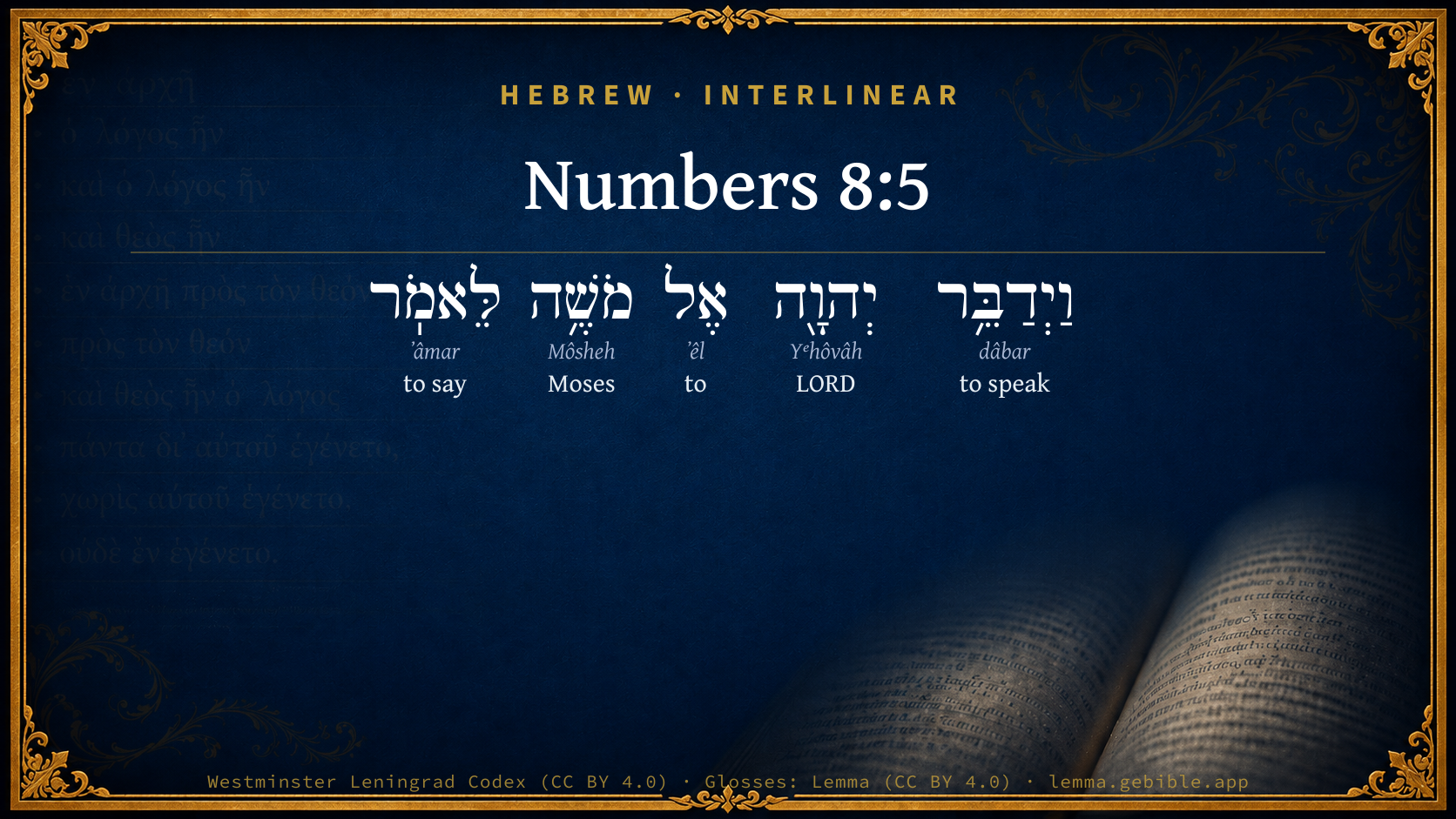
Hebrew (Westminster Leningrad Codex) Numbers 8:5 appears in the Hebrew Old Testament. The text above is from the Westminster Leningrad Codex. Each word links to its Strong’s number, a concise gloss, and parsing drawn from the Open Scriptures Hebrew Bible morphology. Click any word for its full Brown-Driver-Briggs (BDB) entry.
Download image
Cite this verse

Numbers 8:5 (World English Bible). Public Domain. Lemma interlinear Bible study tool, https://lemma.gebible.app/v/numbers/8/5.

Show BibTeX & RIS
BibTeX
RIS
English Translation
Yahweh spoke to Moses, saying,
World English Bible · Public Domain
Download a study sheet

One document with this verse’s original text, its word-by-word gloss line, the meaning frame, cross-references with their text, attributed commentary, and full source and license credits — printable, and it pastes into notes with its structure intact.

This verse Autodidact and up

Study sheet (.html) Plain text (.txt)

A passage Seminary Student

Up to 50 verses in one chapter. A passage sheet keeps up to 6 commentary sources and 12 cross-references per verse, in the order this page ranks them, and says so on the sheet whenever that leaves anything out. Ask for a single verse and you get the Autodidact verse sheet above.

Everything on this page stays free to read, with no account — the sheet is a download of what is already on screen, not access to it.

Want to remove ads? Support Godless Engineer
Compare translations 3

The same verse in 3 English versions, stacked beneath the original-language interlinear above. Click any original word for its lexicon entry.

Each is an independent rendering of the whole verse — the interlinear is not word-aligned to these translations.

Highlighted words mark where these versions differ — a whole-verse word diff, not a word-by-word alignment.

  • World English Bible Public Domain
    Yahweh spoke to Moses, saying,
  • King James Version Public Domain
    And the LORD spake unto Moses, saying,
  • unfoldingWord Literal Text CC BY-SA 4.0
    And Yahweh spoke to Moses, saying,

unfoldingWord Literal Text — © unfoldingWord, licensed CC BY-SA 4.0. Word-aligned USFM3 via Door43 (git.door43.org/unfoldingWord/en_ult).

Versions to compare (up to 4)

3 of 4 selected

Show all 18 translations

Every available English version of this verse, each an independent rendering of the whole verse.

  • World English Bible Public Domain
    Yahweh spoke to Moses, saying,
  • Berean Standard Bible Public Domain
    Again the LORD spoke to Moses, saying,
  • Majority Standard Bible Public Domain
    Again the LORD spoke to Moses, saying,
  • King James Version Public Domain
    And the LORD spake unto Moses, saying,
  • American Standard Version (1901) Public Domain
    And Jehovah spake unto Moses, saying,
  • Revised Version (1885) Public Domain
    And the LORD spake unto Moses, saying,
  • Geneva Bible (1599) Public Domain
    And the Lord spake vnto Moses, saying,
  • Douay-Rheims (1899) Public Domain
    And the Lord spoke to Moses, saying:
  • Young's Literal Translation Public Domain
    And Jehovah speaketh unto Moses, saying,
  • Literal Standard Version CC BY-SA 4.0
    And YHWH speaks to Moses, saying,
  • Unlocked Literal Bible CC BY-SA 4.0
    Again, Yahweh spoke to Moses. He said,
  • unfoldingWord Literal Text CC BY-SA 4.0
    And Yahweh spoke to Moses, saying,
  • Darby Bible Public Domain
    And Jehovah spoke to Moses, saying,
  • World Messianic Bible Public Domain
    The LORD spoke to Moses, saying,
  • Webster's Bible Public Domain
    And the LORD spoke to Moses, saying,
  • Free Bible Version CC BY-SA 4.0
    The Lord told Moses,
  • Bible in Basic English Public Domain
    And the Lord said to Moses,
  • JPS Tanakh (1917) Public Domain
    And the LORD spoke unto Moses, saying:

Literal Standard Version (2020), Covenant Press — licensed CC BY-SA 4.0. Text via the HelloAO Bible API (eBible.org). Unlocked Literal Bible (unfoldingWord) — licensed CC BY-SA 4.0. Text via the HelloAO Bible API (eBible.org). unfoldingWord Literal Text — © unfoldingWord, licensed CC BY-SA 4.0. Word-aligned USFM3 via Door43 (git.door43.org/unfoldingWord/en_ult). Free Bible Version, Dr. Jonathan Gallagher — licensed CC BY-SA 4.0. Text via the HelloAO Bible API (eBible.org).

Word by word

More ways to search: Search by grammar → Find every occurrence → Compare this word →

Practice this passage: Drill this verse → Learn its vocabulary →

About this verse

These counts appear in no published source. They are computed here, from the morphology-tagged text and Lemma’s own curated glosses. What Lemma adds →

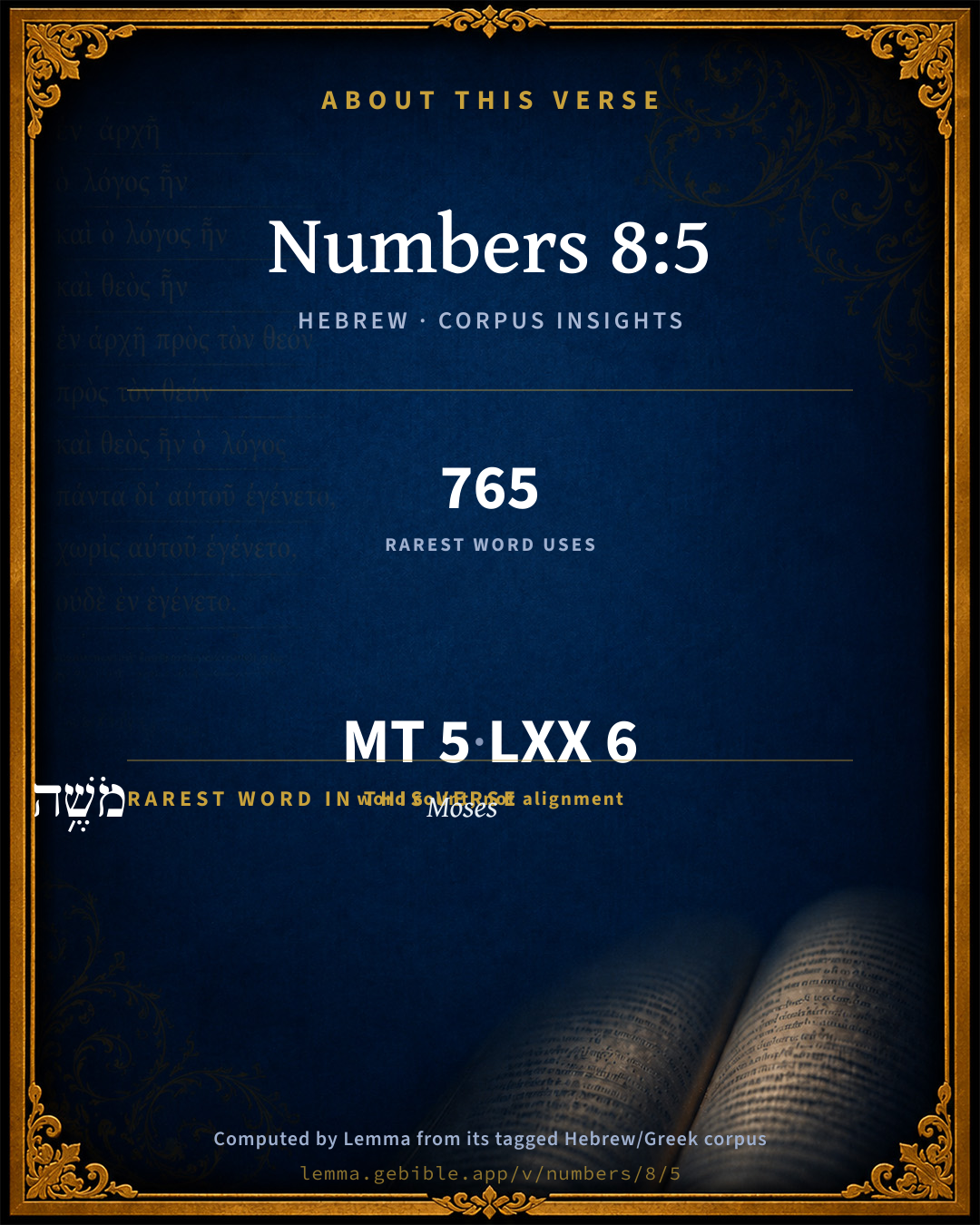
5
words
5
distinct lemmas
Pentateuch
section

Grammatical profile

  • 2 verbs
  • 2 nouns
  • 1 preposition

Verb forms

  • וַיְדַבֵּ֥ר Piel · Sequential Imperfect
  • לֵּאמֹֽר Qal · Infinitive Construct

Hebrew & Septuagint length

In English translation the verse runs 5 words from the Hebrew and 7 from the Septuagint (LXX English) — closely comparable.

A rough comparison of the two English renderings, which tokenize alike — not a word-level alignment.

Word counts can differ between the Hebrew and the Greek without any difference in meaning — e.g. the Hebrew direct-object marker אֵת has no separate Greek word, and Greek often adds the article ὁ.

In the original languages it is 5 Hebrew tokens and 6 Greek tokens — but the two are counted differently (Hebrew bundles its prefixes and suffixes into one token; the Greek is in lemma form), so that isn’t a like-for-like length.

Hebrew and Greek witnesses Masoretic Hebrew ↔ Greek Septuagint

The same verse in the two great witnesses to the Old Testament, shown verse-for-verse.

These are two independent witnesses, not word-aligned to each other, and the Septuagint is shown in lemma (dictionary) form.

Hebrew Numbers 8:5 Masoretic · Westminster Leningrad Codex

וַיְדַבֵּ֥ר יְהוָ֖ה אֶל מֹשֶׁ֥ה לֵּאמֹֽר

Yahweh spoke to Moses, saying,

World English Bible · Public Domain

Greek LXX Numbers 8:5 Septuagint · lemma form

καί λαλέω κύριος πρός μωυσῆς λέγω

And the Lord spoke to Moses, saying,

LXX2012 (modern English Septuagint) · Public Domain

Hebrew: Westminster Leningrad Codex (CC BY 4.0). Greek: Septuagint (public domain); English from LXX2012 (modern English Septuagint) (Public Domain). How the Septuagint differs from the Hebrew →

Targum (Aramaic paraphrase)

2

The Targum is the ancient Jewish Aramaic paraphrase of the Hebrew Scriptures — an interpretive translation, not the Hebrew text itself. Onkelos (literal) and Pseudo-Jonathan (expansive) render the Torah, and Jonathan the Prophets. Coverage is partial: where no permissively-licensed English translation exists for a verse, only the Aramaic is shown. This is verse-level text, not a word-by-word alignment to the Hebrew.

  1. Targum Onkelos Torah (Genesis–Deuteronomy)
    וּמַלִיל יְיָ עִם משֶׁה לְמֵימָר

    (no public-domain English translation for this verse)

    Targum Onkelos — Aramaic: “Onkelos Genesis” (public domain); “Onkelos Exodus” (public domain); “Onkelos Leviticus” (public domain); “Onkelos Numbers” (public domain); “Onkelos Deuteronomy” (public domain). English: “Sefaria Community Translation” (CC0 1.0 (public-domain dedication)); “J.W. Etheridge. The Targums of Onkelos and Jonathan Ben Uzziel on the Pentateuch. London: Longmans, Green, 1862” (public domain). Text via Sefaria.

  2. Targum Pseudo-Jonathan Torah (Genesis–Deuteronomy)
    וּמַלֵיל יְיָ עִם משֶׁה לְמֵימָר

    And the Lord spake with Mosheh, saying:

    Targum Pseudo-Jonathan — Aramaic: “Targum Jonathan on Genesis” (public domain); “Targum Jonathan on Exodus” (public domain); “Targum Jonathan on Leviticus” (public domain); “Targum Jonathan on Numbers” (public domain); “Targum Jonathan on Deuteronomy” (public domain). English: “The Targum of Jonathan ben Uzziel, trans. J. W. Etheridge, London, 1862” (public domain). Text via Sefaria.

Commentary

Notes on Numbers 8:5 from classic Christian and Jewish commentators (each source and its license shown beneath its notes). The classic Christian expositions comment on the surrounding passage and are grouped to its opening verse, so a note may address several verses; the Jewish commentaries on the Tanakh (Rashi and others) are per-verse, so they appear only where the commentator wrote on this verse.

Lemma curates 59 commentaries, every one of them public domain or Creative Commons licensed, each selected and text-cleaned for this edition rather than reprinted as found. About our sources →

The Cambridge Bible for Schools and Colleges

gen. ed. J. J. S. Perowne

5–26. The Levites

Num_8:5-22. Their purification and dedication, Num_8:23-26. The age of service. The passage is an expansion of Num_3:5-13, with the addition of the rite of purification. The Levites are inferior to the priests, and are therefore merely cleansed from the ceremonial pollution of ordinary life, while the priests receive something higher, an actual quality which the Hebrews called ‘holiness,’ i.e. not moral excellence, but separation, exclusiveness (Exodus 29, Leviticus 8).

The Cambridge Bible for Schools and Colleges (gen. ed. J. J. S. Perowne; Cambridge University Press, 1878–1918) — public domain. Text from a community e-Sword module.

The Biblical Illustrator

Joseph S. Exell

Num_8:5-7

Take the Levites and cleanse them.

The Divine principle of cleansing

Here we have, in type, the only Divine principle of cleansing. It is the application of death to nature and all its habits. It is the word of God brought to bear upon the heart and conscience in a living way. Moses, as representing the claims of God, cleanses the Levites according to those claims; and they, being cleansed, are able to bring the sharp razor to bear upon all that was the mere growth of nature, and to wash their garments, which expresses, in typical form, the cleansing their habits according to the word of God. This was Gods way of meeting all that appertained to Levis natural state--the self-will, the fierceness, and the cruelty. The pure water and the sharp razor were called into action--the washing and shaving had to go on, ere Levi was fit to approach the vessels of the sanctuary. Thus it is in every case. There is, there can be, no allowance of nature among Gods workers. There never was a more fatal mistake than to attempt to enlist nature in the service of God. It matters not how you may endeavour to improve or regulate it. It is not improvement, but death that will avail. What is the meaning of the initiatory act of Christianity--the act of baptism? Does it not set forth the blessed fact that our old man--our fallen nature--is completely set aside, and that we are introduced into an entirely new position? Truly so. And how do we use the razor? By rigid self-judgment, day by day; by the stern disallowance of all that is of natures growth. This is the true path for all Gods workers in the wilderness. (C. H. Mackintosh.)

The Biblical Illustrator, edited by Joseph S. Exell (c. 1880s–1900s) — public domain. Text from a community e-Sword module.

Whedon's Commentary on the Bible

Daniel D. Whedon

THE CONSECRATION OF THE LEVITES, Num_8:5-22.

Already have Aaron and his sons, the purely sacerdotal family of the tribe of Levi, been anointed and inducted into their sacred office. It remains now to set apart the rest of the tribe to their calling as the bearers and custodians of the tabernacle and its furniture. They had recently been presented to Aaron, and by him charged with the duties to which they were to be set apart as substitutes for the firstborn males. Num_3:5-13, notes. Thus was fulfilled with singular precision the prophecy of Jacob, Gen_49:5-7. Up to the time of these ordinations the Israelites had worshipped the God of their fathers after their fathers’ manner, the firstborn being priests, the eldest son of each house inheriting the priestly office. Exo_24:5. The first step toward a change was made in the institution of an hereditary priesthood in the family of Aaron, during the first retirement of Moses to the solitudes of Sinai. Exo_28:1. The next extension of the priestly order grew out of the terrible crisis of Exodus 32. The first, and awful self-consecration of the Levites, was when they rallied at the call of Moses, every man against his idolatrous brother-Hebrew, and thus stemmed the progress of the evil. From this hour the tribe stood forth apart, recognizing in this bloody vindication of Jehovah the spiritual as higher in value than the natural, and therefore they were counted worthy to be henceforth what Ewald styles “an Israel within an Israel.”

Daniel D. Whedon (gen. ed.), Commentary on the Old and New Testaments (1874–1909) — public domain. Text from a community e-Sword module.

Tyndale Open Study Notes

Tyndale Open Resources

8:5-22 The Lord prescribed the dedication and cleansing of the Levites.

Tyndale Open Study Notes — © Tyndale Open Resources, licensed CC BY-SA 4.0. Text via the HelloAO Bible API.

Matthew Henry's Commentary

We read before of the separating of the Levites from among the children of Israel when they were numbered, and the numbering of them by themselves (Num 3:6, Num 3:15), that they might be employed in the service of the tabernacle. Now here we have directions given for their solemn ordination (Num 8:6), and the performance of it, Num 8:20. All Israel must know that they took not this honour to themselves, but were called of God to it; nor was it enough that they were distinguished from their neighbours, but they must be solemnly devoted to God. Note, All that are employed for God must be dedicated to him, according as the degree of employment is. Christian musts be baptized, ministers must be ordained; we must first give ourselves unto the Lord, and then our services. Observe in what method this was done:

I. The Levites must be cleansed, and were so. The rites and ceremonies of their cleansing were to be performed, 1. By themselves. They must wash their clothes, and not only bathe, but shave all their flesh, as the leper was to do when he was cleansed, Lev 14:8. They must cause a razor to pass over all their flesh, to clear themselves from that defilement which would not wash off. Jacob, whom God loved, was a smooth man; it was Esau that was hairy. The great pains they were to take with themselves to make themselves clean teaches all Christians, and ministers particularly, by repentance and mortification, to cleanse themselves from all filthiness of flesh and spirit, that they may perfect holiness. Those must be clean that bear the vessels of the Lord. 2. By Moses. He must sprinkle the water of purifying upon them, which was prepared by divine direction. This signified the application of the blood of Christ to our souls by faith, to purify us from an evil conscience, that we may be fit to serve the living God. It is our duty to cleanse ourselves, and God's promise that he will cleanse us.

II. The Levites, being thus prepared, must be brought before the Lord in a solemn assembly of all Israel, and the children of Israel must put their hands upon them (Num 8:10), so transferring their interest in them and in their service (to which, as a part, the whole body of the people was entitled) to God and to his sanctuary. They presented them to God as living sacrifices, holy and acceptable, to perform a reasonable service; and therefore, as the offerers in all other cases did, they laid their hands upon them, desiring that their service might be accepted in lieu of the attendance of the whole congregation, particularly the first-born, which they acknowledge God might have insisted on. This will not serve to prove a power in the people to ordain ministers; for this imposition of hands by the children of Israel upon the Levites did not make them ministers of the sanctuary, but only signified the people's parting with that tribe out of their militia, and civil incorporations, in order to their being made ministers by Aaron, who was to offer them before the Lord. All the congregation of the children of Israel could not lay hands on them, but it is probable that the rulers and elders did it as the representative body of the people. Some think that the first-born did it because in their stead the Levites were consecrated to God. Whatever God calls for from us to serve his own glory by, we must cheerfully resign it, lay our hands upon it, not to detain it but to surrender it, and let it go to him that is entitled to it.

III. Sacrifices were to be offered for them, a sin-offering first (Num 8:12), and then a burnt-offering, to make an atonement for the Levites, who, as the parties concerned, were to lay their hands upon the head of the sacrifices. See here, 1. That we are all utterly unworthy and unfit to be admitted into and employed in the service of God, till atonement be made for sin, and thereby our peace made with God. That interposing cloud must be scattered before there can be any comfortable communion settled between God and our souls. 2. That it is by sacrifice, by Christ the great sacrifice, that we are reconciled to God, and made fit to be offered to him. It is by him that Christians are sanctified to the work of their Christianity, and ministers to the work of their ministry. The learned bishop Patrick's notion of the sacrifice offered by the Levites is that the Levites were themselves considered as an expiatory sacrifice, for they were given to make atonement for the children of Israel, (Num 8:19), and yet not being devoted to death, any more than the first-born were, these two sacrifices were substituted in their stead, upon which therefore they were to lay their hands, that the sin which the children of Israel laid upon them (Num 8:10) might be transferred to these beasts.

IV. The Levites themselves were offered before the Lord for an offering of the children of Israel, Num 8:11. Aaron gave them up to God, as being first given up by themselves, and by the children of Israel. The original word signifies a wave-offering, not that they were actually waved, but they were presented to God as the God of heaven, and the Lord of the whole earth, as the wave-offerings were. And in calling them wave-offerings it was intimated to them that they must continually lift up themselves towards God in his service, lift up their eyes, lift up their hearts, and must move to and fro with readiness in the business of their profession. They were not ordained to be idle, but to be active and stirring.

V. God here declares his acceptance of them: The Levites shall be mine, Num 8:14. God took them instead of the first-born (Num 8:16-18), of which before, Num 3:41. Note, What is in sincerity offered to God shall be graciously owned and accepted by him. And his ministers who have obtained mercy of him to be faithful have particular marks of favour and honour put upon them: they shall be mine, and then (Num 8:15) they shall go in to do the service of the tabernacle. God takes them for his own, that they may serve him. All that expect to share in the privileges of the tabernacle must resolve to do the service of the tabernacle. As, on the one hand, none of God's creatures are his necessary servants (he needs not the service of any of them), so, on the other hand, none are taken merely as honorary servants, to do nothing. All whom God owns he employs; angels themselves have their services.

VI. They are then given as a gift to Aaron and his sons (Num 8:19), yet so as that the benefit accrued to the children of Israel. 1. The Levites must act under the priests as attendants on them, and assistants to them, in the service of the sanctuary. Aaron offers them to God (Num 8:11), and then God gives them back to Aaron, Num 8:19. Note, Whatever we give up to God, he will give back to us unspeakably to our advantage. Our hearts, our children, our estates, are never more ours, more truly, more comfortably ours, than when we have offered them up to God. 2. They must act for the people. They were taken to do the service of the children of Israel, that is, not only to do the service which they should do, but to serve their interests, and do that which would really redound to the honour, safety, and prosperity of the whole nation. Note, Those that faithfully perform the service of God do one of the best services that can be done to the public; God's ministers, while they keep within the sphere of their office and conscientiously discharge the duty of it, must be looked upon as some of the most useful servants of their country. The children of Israel can as ill spare the tribe of Levi as any of their tribes. But what is the service they do the children of Israel? It follows, it is to make an atonement for them, that there be no plague among them. It was the priests' work to make atonement by sacrifice, but the Levites made atonement by attendance, and preserved the peace with heaven which was made by sacrifice. If the service of the priests in the tabernacle had been left to all the first-born of Israel promiscuously, it would have been either neglected or done unskillfully and irreverently, being done by those that were not so closely tied to it, nor so diligently trained to it, nor so constantly used to it, as the Levites were; and this would bring a plague among the children of Israel - meaning, perhaps, the death of the first-born themselves, which was the last and greatest of the plagues of Egypt. To prevent this, and to preserve the atonement, the Levites were appointed to do this service, who should be bred up to it under their parents from their infancy, and therefore would be well versed in it; and so the children of Israel, that is, the first-born, should not need to come nigh to the sanctuary; or, when any Israelites had occasion, the Levites would be ready to instruct them, and introduce them, and so prevent any fatal miscarriage or mistake. Note, It is a very great kindness to the church that ministers are appointed to go before the people in the things of God, as guides, overseers, and rulers, in religious worship, and to make that their business. When Christ ascended on high, he gave these gifts, Eph 4:8, Eph 4:11, Eph 4:12.

VII. The time of their ministration is fixed. 1. They were to enter upon the service at twenty-five years old, Num 8:24. They were not charged with the carrying of the tabernacle and the utensils of it till they were thirty years old, Num 4:3. But they were entered to be otherwise serviceable at twenty-five years old, a very good age for ministers to begin their public work at. The work then required that strength of body and the work now requires that maturity of judgment and steadiness of behaviour which men rarely arrive at till about that age; and novices are in danger of being lifted up with pride. 2. They were to have a writ of ease at fifty years old; then they were to return from the warfare, as the phrase is (Num 8:25), not cashiered with disgrace, but preferred rather to the rest which their age required, to be loaded with the honours of their office, as hitherto they had been with the burdens of it. They shall minister with their brethren in the tabernacle, to direct the junior Levites, and set them in; and they shall keep the charge, as guards upon the avenues of the tabernacle, to see that no stranger intruded, nor any person in his uncleanness, but they shall not be put upon any service which may be a fatigue to them. If God's grace provide that men shall have ability according to their work, man's prudence should take care that men have work only according to their ability. The aged are most fit for trusts, and to keep the charge; the younger are most fit for work, and to do the service. Those that have used the office of a servant well purchase to themselves a good degree, Ti1 3:13. Yet indeed gifts are not tied to ages (Job 32:9), but all these worketh that one and the self-same Spirit. Thus was the affair of the Levites settled.

Matthew Henry's Commentary on the Whole Bible (1708–1710) — public domain (CC PDM 1.0). Text via the HelloAO Bible API.

Ellicott's Commentary for English Readers

(5) And the Lord spake unto Moses.—As Moses had already officiated in the consecration of the priests (Leviticus 8), so now, notwithstanding the fact that Aaron and his sons were already consecrated, he is commanded to officiate at the cleansing of the Levites.

A Bible Commentary for English Readers, edited by Charles John Ellicott (1878–1897) — public domain. Text from a community e-Sword module.

John Gill's Exposition

And the Lord spake unto Moses,.... the same time the order about lighting the lamps was given; and this section is joined to the former, Aben Ezra thinks, to show that Aaron employed himself in lighting the lamps, but in the rest of the services the Levites helped him, and stood before him to do what he commanded them: they were ordered to be taken and given to Aaron before; and they were numbered, and their services appointed to each division of them; and now they are ordered to be ordained and consecrated to their office:

saying; as follows.

John Gill's Exposition of the Whole Bible (1746–1763) — public domain (CC PDM 1.0). Text via the HelloAO Bible API.

Albert Barnes' Notes on the Bible

The Levites could only undertake their duties Num. 3; 4 after the formal exchange of the Levites for the first-born Num 3:44-51.

The distinction between the “consecration” of the priests Lev. 8 and the less solemn “purification” Num 8:21 of the Levites is marked. These rites of purification are similar to those incumbent on the priests of Egypt.

Num 8:7

Water of purifying - literally, “sin water:” i. e. water to cleanse from sin; no doubt taken from the laver of the sanctuary, which was used by the priests for purification before they went into the tabernacle to minister (compare Num 5:17; Exo 30:18 ff).

The “sprinkling” of so large a body of men could have been only general, but tokens of individual purification are specified (compare also Lev 14:8).

Num 8:8

The two bullocks were “to make an atonement for the Levites,” and therefore are presented in their name. These offerings are similar to those prescribed in Lev 8:14 ff at the consecration of the priests, except that the burnt-offering was on that occasion a ram. The larger victim corresponds to the larger number of the Levites.

Num 8:10

The children of Israel - i. e. through the heads of their tribes, who Num 7:2 no doubt acted for their tribesmen. This act, the distinguishing feature of the ceremony, represented the transfer to the Levites of the sacred duties originally incumbent on the whole people.

Num 8:11

Offer ... offering - Compare the margin Aaron pointed to the Levites, and then waved his hands, indicating (compare Lev 7:30 note) that the offering was dedicated to God, and, again, by grant from Him, withdrawn for the use of the priests.

Num 8:19

Make an atonement for the children of Israel - i. e. by performing those services which were due from the children of Israel; the omission of which by the children of Israel would, but for the interposition of the Levites, have called down “wrath” from God, or Num 1:53 “plague.” The institution of the Levites was an extension of that mediatorial system which the people themselves, terrified at the direct manifestations to them of the divine presence, desired; see Deu 5:25. Further, it is suggested to us here as an act of mercy on the part of God; yet even the priests and Levites themselves were not always sufficiently heedful and reverent. Compare Num 17:10; Lev 10:1 ff; 2Sa 6:6 following.

Num 8:21

Were purified - Rather, purified themselves; as directed in Num 8:7.

Albert Barnes' Notes on the Bible (1834–1885) — public domain. Text from a community e-Sword/MySword module.

The Pulpit Commentary

THE HALLOWING OF THE LEVITES (verses Num_3:6-13, and no doubt before the passover.

Vers. 5-23. The dedication of the Levites.

In this section we have the due preparation of those who are specially devoted to the service of God. Consider, therefore

I THAT BEFORE THEY COULD SERVE THEY MUST BE CLEANSED. Even so all that would do God service, or be useful to others in religions concerns, must first themselves be cleansed; because all that is human is unclean, (Job_15:14) and nothing that is unclean can do God service, for he requireth holiness in his servants. (Pro_20:9 Psa_5:5 Isa_52:11 Hab_1:13 Mat_5:48 Mat_22:12)

II THAT THIS CLEANSING WAS TWOFOLD, PARTLY WROUGHT UPON THEM, PARTLY WROUGHT BY THEM. Even so the cleansing which prepares for the service of God, and for his nearer presence, is twofold; partly it is done for us by the Mediator, partly by us through our own efforts. (Psa_51:7 2Co_7:1)

III THAT THE CLEANSING A PARTE DEI WAS BY SPRINKLING OF SIN WATER, THE EXACT NATURE OF WHICH IS DISPUTED. Even so every one that would belong to the kingdom of God must receive that washing of water and of the Holy Spirit, which is in its nature mysterious, and in definition controverted. (Eze_36:25 Joh_3:5 Act_22:16 Heb_10:22)

IV THAT THE CLEANSING A PARTE SUA WAS BY SEDULOUSLY GETTING RID OF ANY POSSIBLE IMPURITY WHICH MIGHT ADHERE FROM WITHOUT. Even so he who would truly serve God must be not only careful, but conscious, and according to the ordinary standard extreme, to detach and remove from himself all those impurities of common life which so easily cling to us; to reform those private, social, and domestic habits, which sit as closely to us as our clothes, which seem as much a part of us as our hair, and which, as it were, absorb and retain the inherent sinfulness of our nature. (1Jn_3:3 2Pe_3:14 Jam_1:21 Jam_4:8)

V THAT FOR THE LEVITES WERE OFFERED FIRST A SIN OFFERING, AND A BURNT OFFERING, FOR AN ATONEMENT. Even so no service, however able and laborious, is acceptable unto God except it have been sanctified through the sacrifice and self-sacrifice of Christ. (Heb_10:10)

VI THAT THE CHILDREN OF ISRAEL LAID THEIR HANDS UPON THE LEVITES WHEN THEY WERE DEVOTED. Even so whatever labour be undertaken for the body of Christ, should receive recognition and sympathy from all members of the body, for all are concerned. (1Co_16:15, 16 Act_13:3 Act_14:26 1Co_12:26)

VII THAT THE LEVITES WERE "WAVED." Even so all who would labour in holy things must present themselves as a living sacrifice to God, to be wholly his and no longer suce potestatis. Those who do religious work, because they like it themselves, "have their reward;" but where the Pharisees had it, in this world only. (Rom_12:1 1Co_6:20 Gal_2:20)

VIII THAT ONLY AFTER THEIR CLEANSING AND WAVING COULD THEY ENTER IN TO WAR THE WARFARE OF THE TABERNACLE. Even so, none can do real service to God unless they are wholly converted and have given themselves to him. (Luk_22:32 b; Act_8:21 Jam_1:8; and cf. Jud_1:7:4, 7)

IX THAT AFTER THE FIFTIETH YEAR THEY WERE RELEASED FROM DOING SERVICE, BUT WERE STILL PERMITTED TO KEEP THE CHARGE. Even so it is part of the goodness of God that no one should be held to do laborious work in the Church when he is old; but also part of his goodness that he should still keep such charge as is fitted to his years.

Note, that the Levites are said to have made an atonement for the children of Israel.

1. By taking upon themselves, in their separated but representative character, those religious obligations of the congregation (especially of the first-born) which they dared not attempt.

2. By performing such obligations rightly, which those could not have done. There is none of us that can do this, because we cannot even do our own duty, far less another"s (Psa_49:7 Luk_17:10 Gal_6:5) Wherefore this applies only unto Christ, by whom we have received the atonement, (Rom_5:11) and throws an important light upon that atonement.

Consider, therefore

1. Christ hath "made atonement" for us, as having undertaken for us those duties of a human life and ministry wholly and perfectly devoted and consecrated to the Father, which we for our unworthiness durst not even have attempted. (Luk_2:49 Joh_4:34 Joh_6:38 Heb_10:5-9 Heb_9:14)

2. Christ hath "made atonement" for us, as having lived that perfect life, and rendered that perfect ministry, which we never could have lived or rendered, and therefore never could have pleased God, nor satisfied his just and necessary requirements. (Mat_3:17 Mat_12:18 Mat_17:5 Mat_19:30 Joh_17:4 Jam_3:2)

3. Christ hath "made atonement" for us, as having thus pleased God, as man, and as our separated and accepted representative, "the Son of man second man.

4. Christ hath saved us thereby from the sorrow which even in heaven itself( could we have got there) our want of will and want of power to serve God acceptably would have brought upon us, (Eph_1:6) having appeared in our behalf in the presence of God with the offering of a perfect human life.

The Pulpit Commentary (1880–1919), ed. H.D.M. Spence-Jones & Joseph S. Exell — public domain. Text from a community e-Sword module.

Keil & Delitzsch

C. F. Keil & F. Delitzsch

Consecration of the Levites for their service in the sanctuary. - The choice of the Levites for service in the sanctuary, in the place of the first-born of the people generally, has been already noticed in Num 3:5., and the duties binding upon them in Num 4:4. But before entering upon their duties they were to be consecrated to the work, and then formally handed over to the priests. This consecration is commanded in Num 8:7., and is not called קדּשׁ, like the consecration of the priests (Exo 29:1; Lev 8:11), but טהר to cleanse. It consisted in sprinkling them with sin-water, shaving off the whole of the hair from their bodies, and washing their clothes, accompanied by a sacrificial ceremony, by which they were presented symbolically to the Lord as a sacrifice for His service. The first part of this ceremony had reference to outward purification, and represented cleansing from the defilement of sin; hence the performance of it is called התחטּא (to cleanse from sin) in Num 8:21. "Sprinkle sin-water upon them." The words are addressed to Moses, who had to officiate at the inauguration of the Levites, as he had already done at that of the priests. "Water of sin" is water having reference to sin, designed to remove it, just as the sacrifice offered for the expiation of sin is called חטּאת (sin) in Lev 4:14, etc.; whilst the "water of uncleanness" in Num 19:9, Num 19:13, signifies water by which uncleanness was removed or wiped away. The nature of this purifying water is not explained, and cannot be determined with any certainty. We find directions for preparing sprinkling water in a peculiar manner, for the purpose of cleansing persons who were cured of leprosy, in Lev 14:5., 50ff.; and also for cleansing both persons and houses that had been defiled by a corpse, in Num 19:9. Neither of these, however, was applicable to the cleansing of the Levites, as they were both of them composed of significant ingredients, which stood in the closest relation to the special cleansing to be effected by them, and had evidently no adaptation to the purification of the Levites. At the same time, the expression "sin-water" precludes our understanding it to mean simply clean water. So that nothing remains but to regard it as referring to the water in the laver of the sanctuary, which was provided for the purpose of cleansing the priests for the performance of their duties (Exo 30:18.), and might therefore be regarded by virtue of this as cleansing from sin, and be called "sin-water" in consequence. "And they shall cause the razor to pass over their whole body," i.e., shave off all the hair upon their body, "and wash their clothes, and so cleanse themselves." תּער העביר is to be distinguished from גּלּח. The latter signifies to make balk or shave the hair entirely off, which was required of the leper when he was cleansed (Lev 14:8-9); the former signifies merely cutting the hair, which was part of the regular mode of adorning the body. The Levites also were not required to bathe their bodies, as lepers were (Lev 13:8-9), and also the priests at their consecration (Lev 8:6), because they were not affected with any special uncleanness, and their duties did not require them to touch the most holy instruments of worship. The washing of the clothes, on the other hand, was a thing generally required as a preparation for acts of worship (Gen 35:2; Exo 19:10), and was omitted in the case of the consecration of the priests, simply because they received a holy official dress. הטּהרוּ for הטּהרוּ, as in Ch2 30:18.

Keil & Delitzsch — Biblical Commentary on the Old Testament (1861–1891) — public domain (CC PDM 1.0). Text via the HelloAO Bible API. (Old Testament only.)

Kretzmann's Popular Commentary

Paul E. Kretzmann

The Purifying of the Levites

v. 5. And the Lord spake unto Moses, saying,

v. 6. Take the Levites from among the children of Israel, and cleanse them. This was done in order to take from them any Levitical defilement and to set them apart as a body of servants for the ministry of the Tabernacle.

v. 7. And thus shalt thou do unto them to cleanse them: Sprinkle water of purifying upon them, probably water mingled with the ashes of the sin-offering, Lev 3:12, the act being symbolical of the washing from sins and impurities of every kind, and let them shave all their flesh, pass over their entire body with a razor, and let them wash their clothes, and so make themselves clean, the rite thus being neither so solemn nor so comprehensive as in the case of the priests.

v. 8. Then let them take a young bullock with his meat-offering, even fine flour mingled with oil, for so it was prescribed. Lev 2:1; and another young bullock shalt thou take for a sin-offering. Cf Leviticus 4.

v. 9. And thou shalt bring the Levites before the Tabernacle of the Congregation, in the eastern part of the court, facing the altar of burnt offering; and thou shall gather the whole assembly of the children of Israel together, especially in its chief representatives;

v. 10. and thou shalt bring the Levites before the Lord, formally present them before the face of Jehovah by having them line up before the altar of burnt offering; and the children of Israel, through their representatives, shall put their hands upon the Levites, thus confessing the obligation of all the people in the service of Jehovah in their first-born sons and transferring this obligation to the Levites as the representatives of the first-born.

v. 11. And Aaron shall offer the Levites before the Lord, in a gesture of waving, whereby they were transferred from the position of ordinary members of the congregation to that of God’s servants in a peculiar sense, for an offering of the children of Israel, for that is the meaning the ceremony intended to convey to the onlooker, that they may execute the service of the Lord, become a part of that army of Jehovah, of Hia true soldiers, that waged a spiritual warfare in His interest. "Most likely Aaron pointed to the Levites, and then waved his hands as in ordinary cases of making the offering. "

v. 12. And the Levites shall lay their hands upon the heads of the bullocks, in the usual gesture conveying their own guilt to the sacrificial animals; and thou shall offer the one for a sin-offering and the other for a burnt offering unto the Lord, to make an atonement for the Levites, and thus to bring them into the proper relationship of most intimate fellowship with Jehovah.

v. 13. And thou shall set the Levites before Aaron and before his sons, for it was as their assistants that they were mainly to serve, and offer them for an offering unto the Lord.

v. 14. Thus shalt thou separate the Levites from among the children of Israel; and the Levites shall be Mine.

v. 15. And after that shall the Levites go in to do the service of the Tabernacle of the Congregation, in performing their ministrations in the court and in transporting the Sanctuary from one station to the next; and thou shalt cleanse them, and offer them for an offering. These verses are a further explication of the preceding passage, for the Lord wanted it clearly understood what the position of the Levites was in the midst of the congregation.

v. 16. For they are wholly given unto Me from among the children of Israel, offered to Jehovah by the entire people as their representatives; instead of such as open every womb, even instead of the first-born of all the children of Israel, have I taken them unto Me.

v. 17. For all the first-born of the children of Israel are Mine, both man and beast, the Lord having an exclusive claim upon them for His service. On the day that I smote every first-born in the land of Egypt I sanctified them for Myself.

v. 18. And I have taken the Levites for, in the place or stead of, all the first-born of the children of Israel.

v. 19. And I have given the Levites as a gift to Aaron and to his sons from among the children of Israel to do the service of the children of Israel, that which should have been performed by them in their first-born, in the Tabernacle of the Congregation, and to make an atonement for the children of Israel; that there be no plague among the children of Israel when the children of Israel come nigh unto the Sanctuary. By their representative service the Levites constituted an atonement for the children of Israel, for the latter were restrained by this arrangement from approaching near to the Sanctuary and thus bringing a calamity upon themselves.

v. 20. And Moses and Aaron and all the congregation of the children of Israel did to the Levites according unto all that the Lord commanded Moses concerning the Levites; so did the children of Israel unto them.

v. 21. And the Levites were purified, and they washed their clothes; and Aaron offered them as an offering before the Lord; and Aaron made an atonement for them to cleanse them.

v. 22. And after that went the Levites in to do their service in the Tabernacle of the Congregation before Aaron and before his sons, under whose immediate direction they worked; as the Lord had commanded Moses concerning the Levites, so did they unto them. While there is no hierarchy by divine appointment in the New Testament, ministers and teachers are nevertheless engaged in the business of the Lord in a peculiar sense, as overseers over the Lord’s flock.

Paul E. Kretzmann, Popular Commentary of the Bible (1921–1924) — public domain. Text from a community e-Sword module.

unfoldingWord translationNotes

Door43 World Missions Community

translationWords

Levi

people group

Israel

pure

unfoldingWord translationNotes — © Distant Shores Media and the Door43 World Missions Community, licensed CC BY-SA 4.0. Source: git.door43.org/Door43/en_tn.

Ramban (Nachmanides)

Rabbi Moshe ben Nachman (Ramban / Nachmanides)

Now after the firstborn and the Levites had been counted, and the Levites were commanded about their [individual] work and charges, and he gave them the wagons, 7:5-8. He completed the commandments referring to the priests with the [laws of the] candelabrum; then He came to give the commandments concerning the Levites so that they could begin their service, and therefore it was necessary to purify them and to effect atonement for them. This is the reason why this chapter [of the purification of the Levites] is put in juxtaposition to this [section on the candelabrum]. He finished [the laws of the Levites] with a commandment applicable for all generations: From twenty and five years old and upward ‘yavo litzvo tzava’ (they shall come to be counted among the host) for the work of the Tent of Meeting. Now Rashi commented: “Here it says, from twenty and five years old; but in another place it is said, from thirty years old! How are these [contradictory verses to be reconciled]? From twenty-five years of age the Levite comes to learn the laws of the service, and he studies for five years, and at the age of thirty he performs the service. From here [we derive the principle] that if a pupil studying under his master does not see progress in his study after five years, he will never see such progress.” If this is so, the expression yavo litzvo tzava means that “he shall come and assemble among those who are gathered” for the work of the Tent of Meeting, meaning that he is to stay with them and continually observe the service [of the older Levites] by day and night, in order to learn the laws of the service in theory and practice. This is why He did not state here “to do service,” as He said above [From thirty years old and upward … ‘to do’ service], Verse 23. For since Scripture speaks there of the Levites above the age of thirty years, it uses the expression ‘la’avod avodah’ (to do service). Here, however, it refers to the five-year period of their training; hence the expression ‘ba’avodath’ (in the service), as they were not yet permitted to do the actual service. but He stated, ‘yavo litzvo tzava’ (they shall come to be counted among the host) ‘ba’avodath’ (for the work of) the Tent of Meeting, meaning that he is to come among those who are gathered for the purpose of the service. But I do not know whether this [explanation that there was a five-year period of training for the Levites] is the unanimous opinion of our Rabbis, for I find it taught in the name of a single Rabbi in the Sifre: 62. “Rabbi Nathan says: One verse states, From twenty and five years old etc.” And it furthermore appears that these words [of the Sifre as quoted by Rashi] are merely Scriptural support for the practice of the pupils [i.e., the new Levites] who used to study the laws of the service for five years.According to the plain meaning of Scripture, the [Levites] counted by the hand of Moses and Aaron were aged thirty years old and over, and it is they whom he appointed every one to his service, and to his burden. But here He commanded that every Levite who [although not counted by Moses] knows himself to have reached the age of twenty-five years, is permitted to do the service, and may come with all the desire of his soul to work with them and help them in the service, but he may not be a chief officer over any particular task. And the reason for this is that every person pays attention to [the passing of] his decades, since there are physical changes at these stages, therefore he knows when he reaches the age of twenty or thirty; for even his neighbors, relatives, his father and mother and his children notice it and inform him of it. But when a person reaches twenty-five years of age, they do not notice it so much; therefore He only commanded Moses to go to the trouble of counting those Levites above the age of thirty, when a man is recognizable by his years. And so did David say, And the Levites were numbered from thirty years old and upward. And Rabbi Abraham ibn Ezra said that the plain meaning of Scripture is that from thirty years old they were to do the work of bearing burdens, and from twenty-five years old they did work in the Tent of Meeting. But this is not correct. For there also [when speaking of the Levites who were more than thirty years old] it is said, all that came to perform the service, to do the work in the Tent of Meeting, and it is also said [of this group], to serve and to bear burdens., Verse 24. Moreover, it is written of the Sanctuary: These were the sons of Levi after their fathers’ houses, even the heads of the fathers’ houses, according to their numberings, in the number of names by their polls, who did the work for the service of the House of the Eternal, from twenty years old and upward. For David said: ‘The Eternal, the G-d of Israel, hath given rest unto His people, and He dwelleth in Jerusalem forever; and also the Levites shall no more have need to carry the Tabernacle and all the vessels of it for the service thereof.’ For by the last ordinances of David the sons of Levi were numbered from twenty years old and upward. For their station was at the side of the sons of Aaron for the service of the House of the Eternal, in the courts, and in the chambers. Thus it is stated that by the last ordinances of David when the House [of G-d] is built and the Levites no longer have to carry [the parts of the Tabernacle] on their shoulders, and their service will be only in the courts, and in the chambers, he counted them from twenty years old and upward, while at first [before the building of the Sanctuary] he counted them from the age of thirty upwards. And according to Rabbi Abraham ibn Ezra’s words, he should have counted them from twenty-five years old [since this is, according to him, the age for general work in the Sanctuary as opposed to the work of carrying its parts]!

Ramban (Nachmanides) on the Tanakh — English translation: “Commentary on the Torah by Ramban (Nachmanides). Translated and annotated by Charles B. Chavel. New York, Shilo Pub. House, 1971-1976” (CC BY 4.0). Text via Sefaria.

Lesson kit

Teaching starters — assembled from the data on this page, not authored interpretation. Every prompt links to the verse data it draws on. Edit before teaching.

Numbers, in the Pentateuch, opens this verse with 5 words (5 distinct Hebrew lemmas). Its most distinctive word is Môsheh (“Moses”). A historical commentator’s framing appears above. Read the whole chapter for the surrounding context.

Discussion questions

  1. What does “Moses” (Môsheh) contribute to the verse as a whole?
  2. These translations render this verse differently. What is at stake in choosing one wording over another?
  3. «וַיְדַבֵּ֥ר» is a Piel Sequential Imperfect verb. How does that grammatical form shape the action described?
  4. Compare how The Cambridge Bible for Schools and Colleges and The Biblical Illustrator read this verse. Where do they agree or differ?

Things to notice

Reading settings

Reading text

Shown beneath each verse's original-language words.

Old Testament
Old Testament edition

Read the OT as the Masoretic Hebrew (MT) or the Greek Septuagint (LXX).

English shown for the Greek Septuagint (in the Hebrew ↔ Greek comparison).

Comparing translations? Open the Compare panel on any verse page to stack up to four side by side.