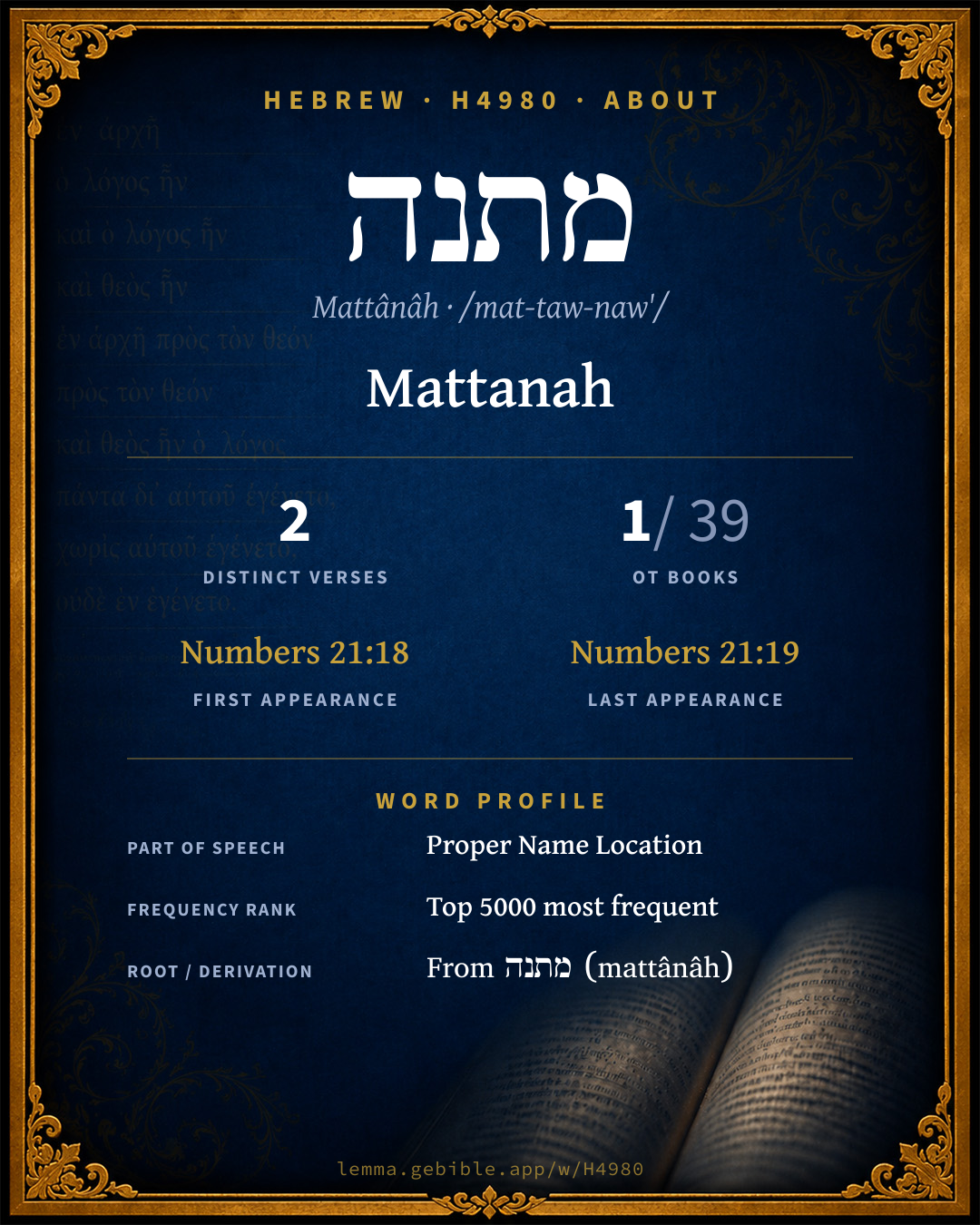
מַתָּנָה
Mattanah
BDB lists 2 entries for ‘Mattanah’ fuller range ↓
Full lexicon entry — Brown-Driver-Briggs (BDB)
From Brown-Driver-Briggs (BDB)
Where this word appears
Grammar key — what these labels mean
Part of speech
- Noun
- A naming word — a person, place, thing, or idea.
Noun type
- Proper
- A name of a specific person, place, or people (e.g. Abraham, Zion, Israel).
Every verse where H4980 appears — 2 distinct verses across 1 book. Click any verse to open its interlinear word-by-word view. Verse text shown in the World English Bible for context — . Each verse’s Hebrew form is shown with its reference; the English is not keyword-highlighted, since the data carries no word-level English alignment. Use “Compare translations” on any verse to read it across multiple English versions. This concordance covers the Hebrew Bible; Septuagint (Greek Old Testament) occurrences are not indexed here.
Numbers 2 verses
- Numbers 21:18 מַתָּנָֽה n Proper The well, which the princes dug, Which the nobles of the people dug, With the scepter, [and] with their poles. From the wilderness [they traveled] to Mattanah;
- Numbers 21:19 וּ/מִ/מַּתָּנָ֖ה conj + prep + n Proper and from Mattanah to Nahaliel; and from Nahaliel to Bamoth;
About this entry
At a glance — auto-summarized from this page’s data, not written by a person. Every figure links to its source below. This summary describes the numbers; it doesn’t interpret them.
“Mattanah” is the headline sense of the Hebrew name מתנה (Mattânâh). It is rare — just 2 verses in the entire Hebrew Bible. More than three-quarters of its appearances fall in Numbers. First canonically at Numbers 21:18, it enters the text early. See 2-verse concordance and the renderings breakdown below.
Gloss history
Strong's 1890 vs modern scholarship
About this word
Strong's H4980 catalogs a Hebrew word from the Hebrew Old Testament.
These counts are not copied from any lexicon or concordance. They are computed here, from the morphology-tagged Hebrew Old Testament. What Lemma adds →
- 2
- distinct verses
- The word appears in 2 distinct verses.
- 1 / 39
- OT books
- The word appears in 1 of 39 Old Testament books.
- #4,807
- by frequency
- Top 5000 most frequent Hebrew words (rank 4,807 of 8,640 Hebrew words by occurrence).
View all 2 occurrences in the concordance →
Most concentrated in
- Numbers 2 verses 100%
By section of the Old Testament
By traditional corpus
Conventional, traditional groupings — biblical authorship is debated, so this is a traditional corpus grouping, not an authorship claim. Each share is this word’s portion of its verses in that division of the Hebrew canon. Each figure is a share of the word’s 2 distinct verses.
- Torah (Pentateuch) 2 verses · 100%
How translations render this word
Counts come from each version’s own published word-to-Strong’s tagging or interlinear alignment — an approximate guide to how each version renders this word, not a word-level alignment the data otherwise carries. Because each total is that version’s own tagged count, the per-version totals vary from one another and need not match the appearance or distinct-verse counts above. These counts may also differ from a printed concordance because Lemma counts each distinctly tagged rendering and does not collapse phrase taggings into a single head-word total. This is a fixed set of word-tagged versions (KJV, ASV, BSB, ULT) and does not change with the reading translation you choose elsewhere. Each version’s license is shown beside its name below (and on Sources).
BDB lists this Strong’s number as 3 distinct words (homographs). Each count above pools all of them and is not split by sense — see the Senses section below. A low-frequency rendering may belong to a different one of those words, not the primary meaning.
- King James Version†: Mattanah 1×, They went to mattanah 1×
- American Standard Version†: Mattanah 1×, They journeyed to mattanah 1×
- Berean Standard Bible†: Mattanah 2×
- unfoldingWord Literal Text†: Mattanah 1×, Mattanah to 1×
King James Version Public Domain
Renders H4980 across 2† tagged occurrences — most commonly:
American Standard Version Public Domain
Renders H4980 across 2† tagged occurrences — most commonly:
Berean Standard Bible Public Domain
Renders H4980 across 2† tagged occurrences — most commonly:
unfoldingWord Literal Text CC BY-SA 4.0
Renders H4980 across 2† tagged occurrences — most commonly:
Senses in the full BDB
What do BDB’s symbols mean?
BDB uses these scholarly abbreviations:
| Symbol | Meaning |
|---|---|
| 𝔊 | the Septuagint (the ancient Greek translation, LXX) |
| 𝔙 | the Vulgate (the Latin translation) |
| 𝔖 | the Syriac version (the Peshitta) |
| 𝔗 | the Targum (the Aramaic translation) |
| ψ | the Psalms |
| √ | root (the underlying root or stem) |
| ‖ | parallel passage (a synonymous or contrasted parallel) |
| † | the dagger: every passage where the word occurs is cited |
The 0 senses and sub-senses the full Brown-Driver-Briggs lexicon distinguishes for this word, in lexicon order (not ranked by frequency), with BDB’s own verbatim wording and sub-sense lettering. Shown in Hebrew script with BDB’s own scholarly abbreviations. The condensed entry is in the Lexicon Entry tab. See also the Forms in the corpus table below.
מתנה I i, ii. מַתָּנָה, מַתְּנַי, מַתַּנְיָה(וּ) v. נתן.
מתנה II gift
מתנה III loc. a station of Isr. E. of Jordan Nu 21
Senses from the full Brown-Driver-Briggs lexicon (Brown, Driver, Briggs; Oxford 1906 — public domain), digitized via Sefaria, supplemented by the OpenScriptures HebrewLexicon (CC BY 4.0). Full attribution on Sources.
Word origin
I. n.f. gift;—abs. מ׳ Nu 18:6 + 4 times; cstr. מַתְּנַת Dt 16:17; pl. מַתָּנֹת Gn 25:6 +, cstr. מַתְּנֹת Ex 28:38, sf. מַתְּנֹתֵיכֶם Ez 20:31 +; etc.;—gift, Gn 25:6 (J) Ez 46:16, 17; 2 Ch 21:3; offerings to י׳ Ex 28:38 (מַתְּנֹת קָדְשֵׁיכֶם), Lv 23:38 (disting. from נֶדֶר and נְדָבָה), Nu 18:29 (cf. מַתָּנָם v 11;—all P); rejected (idolatrous) offerings Ez 20:26, 31, 39; אִישׁ כְּמַתְּנַת יָדוֹ Dt 16:17 each man according to the gift of his hand, i.e. according to his ability; cf. לֶקַחְתָּ מ׳ בָּאָדָם ψ 68:19 thou (י׳) hast received gifts among men (i.e. either tribute gained by battle, cf. Che, or the offerings of those who turn to י׳ Hup-Now; > gifts consisting of men JDMich Hgst Bö Ew DeWette); מ׳ used of Levites, as God’s gift to Aaron and his sons, Nu 18:6, whose priesthood is עֲבֹדַת מ׳ v 7, i.e. a service which is a gift from God; מַתָּנוֹת לָאֶבְיֹנִים Est 9:22 gifts to the poor; = bribe Pr 15:27 Ec 7:7.
II. n.pr.loc. a station of Isr. E. of Jordan Nu 21:18, 19 (JE), 𝔊 Μανθαναειν.
— Brown-Driver-Briggs (Oxford 1906, public domain), digitized via Sefaria, supplemented by the OpenScriptures HebrewLexicon (CC BY 4.0). See Sources.
Derived from מתנה (mattânâh) (H4979) — gift.
Jastrow Dictionary
A second Hebrew/Aramaic lexicon for comparison, covering Aramaic and post-biblical (Talmudic, Targumic, Midrashic) usage that the biblical-Hebrew BDB does not. Matched by lemma rather than by Strong’s number, so a lemma may carry more than one Jastrow headword (shown separately below), and the entries cover usage well beyond the Bible.
מַתְּנָא ²
- (abbrev. of מתניה) Matt’na, an Amora. Ḥull. 42ᵇ. Y. Taan. III, 67ᵃ top; a. fr.
מִתְנָה
- , v. preced.
מַתְּנָה
- , v. מַתְּנָא
מַתָּנָה
- 1. gift, present, donation; grant, privilege. Y. Peah III, 17ᵈ bot. איזו היא מ׳ … מ׳ וכ׳ what is a mattanah? All my property be given to—as a gift from now, contrad. to דִּיאֲתִיקִי. B. Bath. 147ᵃ מניין למַתְּנַת שכיב וכ׳ how can it be proven that the donation of one expecting to die is legal by Biblical law (without formal possession)? Kidd. 6ᵇ, a. fr. מ׳ ע"מ להחזיר שמה מ׳ a present made with the condition that it must be returned, is legally a present (the recipient’s property for the time being); a. v. fr.—Pl. מַתָּנוֹת. Ber. 5ᵃ; a. fr.—מַתְּנוֹת כהונה, v. כְּהוּנָּה.—Tosef. Dem. II, 7 מ׳ גבולין the priestly privileges outside of the Temple. Ib. 8 יש לו במ׳ has a right to priestly gifts. Tosef. Peah II, 13 ארבע מ׳ בכרם there are four gifts for the poor connected with the vineyard; Ḥull. 131ᵃ מַתְּנוֹת עניים; a. fr.
- 2. (Lev. VIII, 15) sprinkling or smearing the blood (on the altar &c.). Zeb. V, 1 מ׳ אחת מהן וכ׳ one of those applications if omitted makes the sacrifice invalid. Ib. VIII, 10 הנתנין מ׳ אחת וכ׳ blood of a sacrifice which requires only one application if mixed with blood &c., v. מַתָּן; a. v. fr.—Pl. as ab. Ib. V, 3 ארבע מ׳ על וכ׳ four applications (with the finger dipped in the blood) at the four corners. Ib. 4 שתי מ׳ שהן ארבע two sprinklings appearing like four, i.e. towards two opposite corners of the altar; a. fr. e.g. Leviticus 8:15
A Dictionary of the Targumim, the Talmud Babli and Yerushalmi, and the Midrashic Literature (Marcus Jastrow; London, Luzac, 1903) — Public Domain. Digitized via Sefaria. Digitized via Sefaria. Full attribution on Sources.
Forms in the corpus
The 2 distinct written forms H4980 takes in the Hebrew Bible, most frequent first — each parse links to that state’s occurrences in the concordance. Hebrew forms include their vowel points and cantillation, so a single lemma takes many written forms.
| Form | Parsing | Example | Uses |
|---|---|---|---|
| וּ/מִ/מַּתָּנָ֖ה | Noun, Proper | Numbers 21:19 | 1 |
| מַתָּנָֽה | Noun, Proper | Numbers 21:18 | 1 |
Same root — word family
Other BDB entries built from the same root as H4980, grouped by Strong’s listed origin. These share a root / origin per the lexicon — not necessarily a shared meaning. Each links to that word’s own entry.
Derives from
Shares the same root
Compare all same-root words → They share a root, not necessarily a meaning.
Bible dictionary
Public-domain dictionary articles matched to this entry by name (Mattanah). A biblical name can be shared by more than one person or place, so an article may treat several.
Easton's Bible Dictionary · M. G. Easton, 1897
A gift, a station of the Israelites (Num. 21:18, 19) between the desert and the borders of Moab, in the Wady Waleh.
Smith's Bible Dictionary · William Smith, 1863
(gift of Jehovah), a station the latter part of the wandering of the Israelites. (Numbers 21:18,19) It was probably situated to the southeast of the Dead Sea.
Classic public-domain reference works; full attribution on Sources.
Septuagint verse parallels
This word appears in 2 verses that also exist in the Greek Old Testament (Septuagint), out of the 2 Hebrew verses it occurs in. You can read those verses in Greek by switching the Old Testament edition to the Septuagint.
Read these verses in the Septuagint
This is a verse-level parallel only — the same verses exist in both the Hebrew and Greek Old Testaments. No word-level Hebrew↔Greek correspondence is claimed: the data carries no such alignment, so no Greek word is shown as this Hebrew word’s translation. Coverage is not total — the Septuagint omits the deuterocanon and renumbers the Psalms, so some Hebrew verses have no direct Greek parallel.