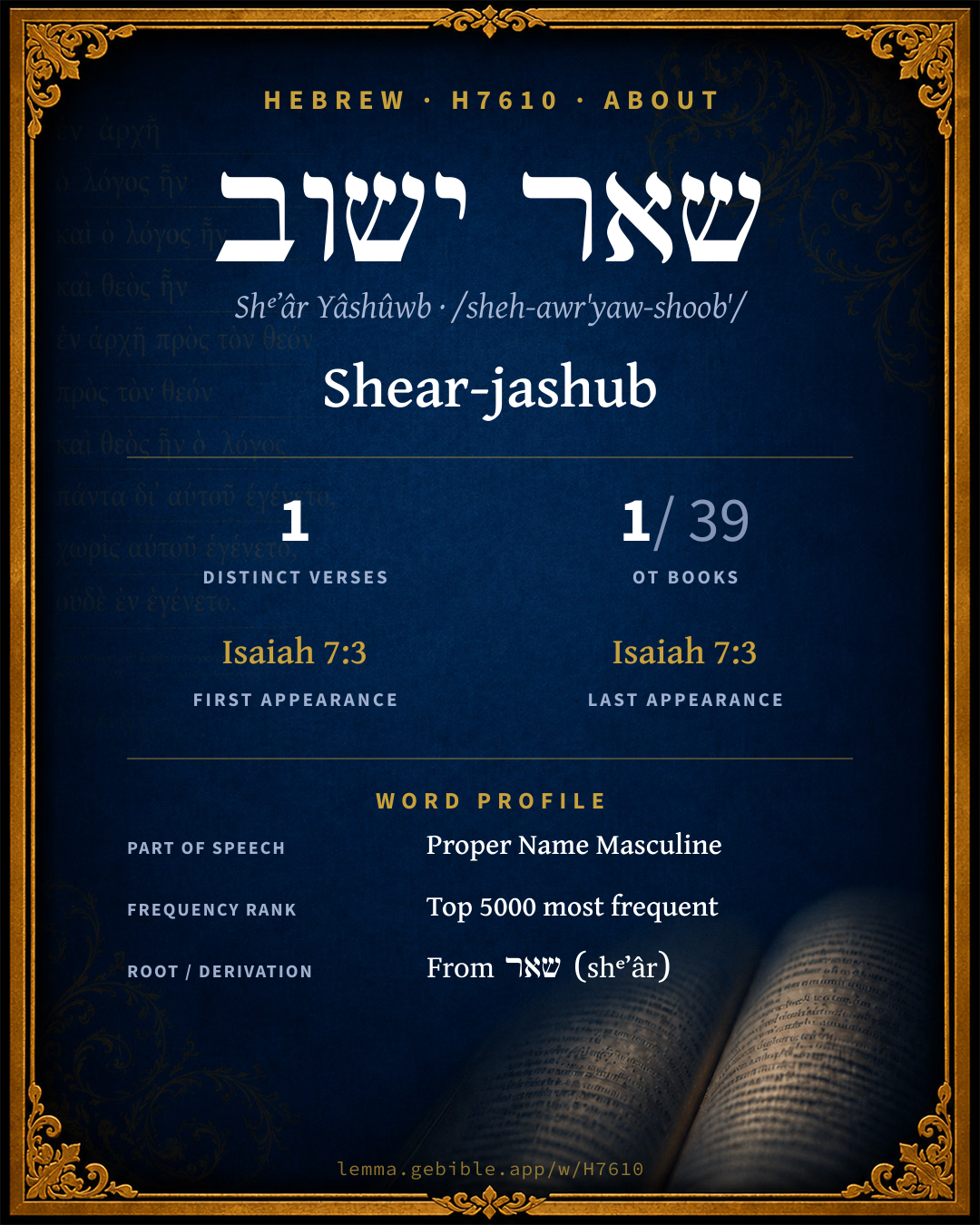
שְׁאָר יָשׁוּב
Shear-jashub
BDB lists 2 entries for ‘Shear-jashub’ fuller range ↓
Full lexicon entry — Brown-Driver-Briggs (BDB)
From Brown-Driver-Briggs (BDB)
Where this word appears
Grammar key — what these labels mean
Part of speech
- Noun
- A naming word — a person, place, thing, or idea.
Noun type
- Proper
- A name of a specific person, place, or people (e.g. Abraham, Zion, Israel).
Every verse where H7610 appears — 1 distinct verse across 1 book. Click any verse to open its interlinear word-by-word view. Verse text shown in the World English Bible for context — . Each verse’s Hebrew form is shown with its reference; the English is not keyword-highlighted, since the data carries no word-level English alignment. Use “Compare translations” on any verse to read it across multiple English versions. This concordance covers the Hebrew Bible; Septuagint (Greek Old Testament) occurrences are not indexed here.
Isaiah 1 verse
About this entry
At a glance — auto-summarized from this page’s data, not written by a person. Every figure links to its source below. This summary describes the numbers; it doesn’t interpret them.
“Shear-jashub” is the headline sense of the Hebrew name שאר ישוב (Shᵉʼâr Yâshûwb). It is rare — just 1 verse in the entire Hebrew Bible. More than three-quarters of its appearances fall in Isaiah. It occurs only once, in Isaiah 7:3. See 1-verse concordance and the renderings breakdown below.
Gloss history
Strong's 1890 vs modern scholarship
About this word
Strong's H7610 catalogs a Hebrew word from the Hebrew Old Testament.
These counts are not copied from any lexicon or concordance. They are computed here, from the morphology-tagged Hebrew Old Testament. What Lemma adds →
- 1
- distinct verses
- The word appears in 1 distinct verse.
- 1 / 39
- OT books
- The word appears in 1 of 39 Old Testament books.
- #4,807
- by frequency
- Top 5000 most frequent Hebrew words (rank 4,807 of 8,640 Hebrew words by occurrence).
View all 1 occurrence in the concordance →
Most concentrated in
- Isaiah 1 verse 100%
By section of the Old Testament
By traditional corpus
Conventional, traditional groupings — biblical authorship is debated, so this is a traditional corpus grouping, not an authorship claim. Each share is this word’s portion of its verses in that division of the Hebrew canon. Each figure is a share of the word’s 1 distinct verse.
- Prophets (Nevi'im) 1 verse · 100%
How translations render this word
Counts come from each version’s own published word-to-Strong’s tagging or interlinear alignment — an approximate guide to how each version renders this word, not a word-level alignment the data otherwise carries. Because each total is that version’s own tagged count, the per-version totals vary from one another and need not match the appearance or distinct-verse counts above. These counts may also differ from a printed concordance because Lemma counts each distinctly tagged rendering and does not collapse phrase taggings into a single head-word total. This is a fixed set of word-tagged versions (KJV, ASV, BSB, ULT) and does not change with the reading translation you choose elsewhere. Each version’s license is shown beside its name below (and on Sources).
- King James Version: Thou and shearjashub 1×
- American Standard Version: Thou 1×
- Berean Standard Bible: Shear-jashub 1×
- unfoldingWord Literal Text: Jashub 1×, Shear 1×
King James Version Public Domain
Renders H7610 across 1 tagged occurrence — most commonly:
American Standard Version Public Domain
Renders H7610 across 1 tagged occurrence — most commonly:
Berean Standard Bible Public Domain
Renders H7610 across 1 tagged occurrence — most commonly:
unfoldingWord Literal Text CC BY-SA 4.0
Renders H7610 across 2 tagged occurrences — most commonly:
Senses in BDB
The 2 senses BDB distinguishes for this word, in lexicon order (not ranked by frequency or importance). The full entry — with sub-senses — is in the Lexicon Entry tab.
- Shear-jashub = "a remnant shall return"
- a symbolical name for the son of Isaiah the prophet
Word origin
שְׁאָר יָשׁוּב n.pr.m. of Isaiah's son Is 7:3 (= a remnant shall return )
— Brown-Driver-Briggs (Oxford 1906, public domain), digitized via Sefaria, supplemented by the OpenScriptures HebrewLexicon (CC BY 4.0). See Sources.
Derived from שאר (shᵉʼâr) (H7605) — remnant.
Jastrow Dictionary
A second Hebrew/Aramaic lexicon for comparison, covering Aramaic and post-biblical (Talmudic, Targumic, Midrashic) usage that the biblical-Hebrew BDB does not. Matched by lemma rather than by Strong’s number, so a lemma may carry more than one Jastrow headword (shown separately below), and the entries cover usage well beyond the Bible.
יִשּׁוּב
- (יָשַׁב)
- 1. settlement, inhabited land, opp. מדבר or ים; cultivation, social world, civilization; public welfare. Koh. R. to I, 15; Ruth. R. to I, 17 אם אין אדם מתקן ביי׳ וכ׳ if man does not prepare provision in the inhabited settlement (this world), what will he have to eat in the desert (the hereafter)?—Y. B. Kam. V, end, 5ᵃ, v. אָוָוז. Ber. 31ᵃ, v. יָשַׁב. Ib. 58ᵇ הרואה בתי … ביִשּׁוּבָן he who sees Israelitish places in their inhabitable condition (restoration), opp. בחורבנן. Ib. עתיד הקב"ה להחזירו ליִשּׁוּבוֹ the Lord will restore it again. Tam. 29ᵇ; B. Kam. 80ᵇ משום י׳ א"י in order to maintain the cultivation of Palestine. Y. B. Bath. II, end, 13ᶜ י׳ עולם בבורות social welfare depends on wells; באילנות on trees. Kidd. I, 10 אינו מן הי׳ does not belong to the civilized world. Gen. R. s. 35 בני אדם של י׳ civilized (polite) people; a. fr.
- 2. (with or without דעת) ease of mind, calmness. Gen. R. s. 19 בי׳ הדעת באת עליו she came to him with deliberation (logical arguments). Y. Ned. I, 36ᵈ bot.; Num. R. s. 10 מתיך י׳ (הדעת) in a calm state of mind, opp. אקפדה; a. fr.
שָׁאַר
- (b. h.) to swell, rise; to run over; (cmp. יָתַר, עָדַף) to remain over. Denom. מִשְׁאֶרֶת, שְׁאָר, שְׁאֵר &c.
- to be left over, reserved, preserved, spared. Gen. R. s. 76 (ref. to Gen. XXXII, 9) אלו אחינו … אע"פ שנִשְׁאֲרוּ לפליטה וכ׳ this refers to our brethren in the diaspora …; although they have been spared for escape (from Roman persecution), yet they fasted for us (Palestinians) &c. Cant. R. to II, 13 הנִשְׁאָרִים the survivors of the Messianic days; a. e. e.g. Genesis 32:9
- ,) שִׁיֵּיר to leave over, reserve. B. Bath. IX, 6 שכיב … וש׳ וכ׳ if an ill person donated all his property to others and reserved some land for himself, his donation is valid (even if he recovers). Ib. 148ᵃ דקל לאחד וש׳ פירותיו לפניו ש׳ מקום פירי if he donated a palm-tree (for the wood of it) to a person, and reserved its fruit for himself, he meant to reserve for himself the place whereon the fruit grows (the branches). Ib. כל … בעין יפה מְשַׁיֵּיר whatever one reserves for one’s self, one reserves liberally; a. v. fr.—Part. pass. מְשׁוֹאָר, (מְשׁוּיָּיר). Y. Pes. VII, 35ᵃ top לא עשה בה המש׳ כיוצא the law does not treat that which is left over (of the sacrifice) like that which has been carried outside of its limits. Peah III, 3 נותּן מן המש׳ על מה ששייר he must give to the poor out of the remainder in proportion to that which he left over; נותן מן המש׳ על הכל he must give out of the remainder a quantity corresponding to the whole (including that which he has taken out before); a. fr.
- same. Midr. Till. to Ps. IX שלא להַשְׁאִיר זכר וכ׳ that he will not leave a remainder of the memory of Amalek; Yalk. ib. 642 להשאר (corr. acc.); a. e.
- to be left over. Ḥull. III, 1 ניטל … ולא נ׳ וכ׳ if the liver of a slaughtered animal is found consumed without any part of it left. Yoma 77ᵃ לא נִשְׁתַּיְירוּ משונאיהן וכ׳ no remnant or survivor would have been left of the enemies of Israel (euphem. for ‘of Israel’); a. fr.
שְׁאַר I
- to leave over. Targ. O. Ex. X, 12 (Y. שייר). Ib. 26 נַשְׁאַר ed. Berl. (ed. Vien. תִּשְׁתָּאַר Ithpa.); a. fr.
- , שַׁיֵּר same. Targ. Y. Ex. XII, 10 (O. Af.). Ib. X, 12, v. supra; a. fr.—B. Kam. 15ᵃ תנא וש׳ מאי ש׳ דהאי ש׳ ש׳ וכ׳ the Mishnah states some cases, but leaves over (does not state all cases coming under the same category). But what else did it omit, so as to be justified in omitting this? It omitted a case when half the assessed fine is to be paid; Succ. 54ᵃ; a. fr.
- to leave over, spare. Targ. Ps. LXXIX, 11 Var. ed. Lag. (ed. Lag. a. oth. שרי; h. text הוֹתֵר).
- to be left over, remain. Targ. Gen. VII, 23. Targ. Ex. VIII, 5; a. fr.—B. Mets. 25ᵃ א׳ בה מידי some of it was left behind; a. e.
שְׁאַר II
- Pa. שָׁאֵר (denom. of מֵשָׁאר, v. מֵישָׁרָא) to plant in beds. B. Kam. 81ᵃ שַׁאֲרֵיה מֵשָׁארֵי לאדם וכ׳ (Ms. M. שדיא משראי לשראי, read: משארי משארי; v. Rabb. D. S. a. l. note) if he planted in beds, it shows that he planted it for human food; if not, it is intended for cattle.
שְׁאֵר
- v. שָׁאַר) [preservation, existence,]
- 1. sustenance, alimentation;
- 2. (sub. בשר) body, flesh;
- 3. bodily contact, intimacy. Mekh. Mishp. s. 3 (ref. to שארה, Ex. XXI, 10) שְׁאֵרָהּ אלו מזונותיה וכ׳ sh’erah means her alimentation &c. (ref. to Mic. III, 3, a. Ps. LXXVIII, 27); ib. (anoth. opin.) שארה כסותה כסות … לשְׁאֵרָהּ וכ׳ sh’erah k’suthah means, garments suited to her body (according to age and season) &c.; ib. (anoth. opin.) שארה זו דרך ארץ sh’erah means (intimacy) marital duty (ref. to Lev. XVIII, 6; 12; 13, cmp. Targ.); Keth. 47ᵇ לפום שארה תן כסותה וכ׳ according to her body (age) give her garments …, according to the season give her &c.; Y. ib. V, 30ᵇ top. Sabb. 137ᵇ חוק בשְׁאֵרוֹ, v. חוֹק; Y. Ber. IX, 14ᵃ bot. בשְׁאֵירוֹ.—Trnsf. [flesh and blood,] relationship, relatives; race. Ib. שְׁאֵירֵנוּ; Sabb. l. c. שְׁאֵרֵינוּ, v. יְדִידוּת. Lev. R. v. 34 (expl. עכר שארו, Prov. XI, 17) זה שמגעת … את קרוביו וכ׳ that is he to whom joy (a festive occasion) happens, and who lets not his nearest relatives join him because they are poor; Yalk. Prov. 947. Yeb. 90ᵇ (ref. to Lev. XXI, 2) שארו זו אשתו his flesh (sh’er), this means his wife (cmp. Gen. II, 24); Sifra Emor beg.; a. e. e.g. Exodus 21:10
שְׁאָר
- remainder, rest. Sot. VII, 7 ועל ש׳ התפלה (Y. ed. וש׳ תפילה) and a special benediction for the remaining (general) prayer; Bab. ed. 40ᵇ והש׳ תפלה and the remainder is a general prayer; ib. 41ᵃ; Y. ib. VII, end, 22ᵃ; Yoma 70ᵃ וש׳ התפלה רינה וכ׳ and the remaining prayer is song, supplication &c. B. Mets. III, 4 והש׳ יהא מונח וכ׳ and what is left must be deposited &c., v. אֵלִיָּהוּ. Peah IV, 3; a. fr.—V. שְׁיָ֫יר.
שְׁאָר ²
- Targ. O. Gen. XLV, 7 (Y. שיורא; h. text שארית). Targ. Is. X, 19, sq. Targ. II Sam. III, 8 (h. text אשר?); a. fr.—Targ. II Chr. XXXVI, 20 (fem.).—Ruth R. to III, 3 והיא עבדא ש׳ (some ed. שְׁאָרָהּ); Yalk. ib. 604 שְׁיָרָהּ, v. נְפֵי.—[שאריא, Yalk. Jer. 321, v. שְׁמָרָא.]
A Dictionary of the Targumim, the Talmud Babli and Yerushalmi, and the Midrashic Literature (Marcus Jastrow; London, Luzac, 1903) — Public Domain. Digitized via Sefaria. Digitized via Sefaria. Full attribution on Sources.
Forms in the corpus
The 2 distinct written forms H7610 takes in the Hebrew Bible, most frequent first — each parse links to that state’s occurrences in the concordance. Hebrew forms include their vowel points and cantillation, so a single lemma takes many written forms.
| Form | Parsing | Example | Uses |
|---|---|---|---|
| וּ/שְׁאָ֖ר | Noun, Proper | Isaiah 7:3 | 1 |
| יָשׁ֣וּב | Noun, Proper | Isaiah 7:3 | 1 |
Same root — word family
Other BDB entries built from the same root as H7610, grouped by Strong’s listed origin. These share a root / origin per the lexicon — not necessarily a shared meaning. Each links to that word’s own entry.
Derives from
Shares the same root
Compare all same-root words → They share a root, not necessarily a meaning.
Bible dictionary
Public-domain dictionary articles matched to this entry by name (Shear-jashub). A biblical name can be shared by more than one person or place, so an article may treat several.
Easton's Bible Dictionary · M. G. Easton, 1897
A remnant shall escape or return (i.e., to God), a symbolical name which the prophet Isaiah gave to his son (Isa. 7:3), perhaps his eldest son.
Smith's Bible Dictionary · William Smith, 1863
(lit. a remnant shall return), the symbolical name of the son of Isaiah the prophet. (Isaiah 7:3)
Hitchcock's Bible Names Dictionary · Roswell D. Hitchcock, 1869
the remnant shall return
Classic public-domain reference works; full attribution on Sources.
Septuagint verse parallels
This word appears in 1 verse that also exists in the Greek Old Testament (Septuagint), out of the 1 Hebrew verse it occurs in. You can read those verses in Greek by switching the Old Testament edition to the Septuagint.
Read these verses in the Septuagint
This is a verse-level parallel only — the same verses exist in both the Hebrew and Greek Old Testaments. No word-level Hebrew↔Greek correspondence is claimed: the data carries no such alignment, so no Greek word is shown as this Hebrew word’s translation. Coverage is not total — the Septuagint omits the deuterocanon and renumbers the Psalms, so some Hebrew verses have no direct Greek parallel.