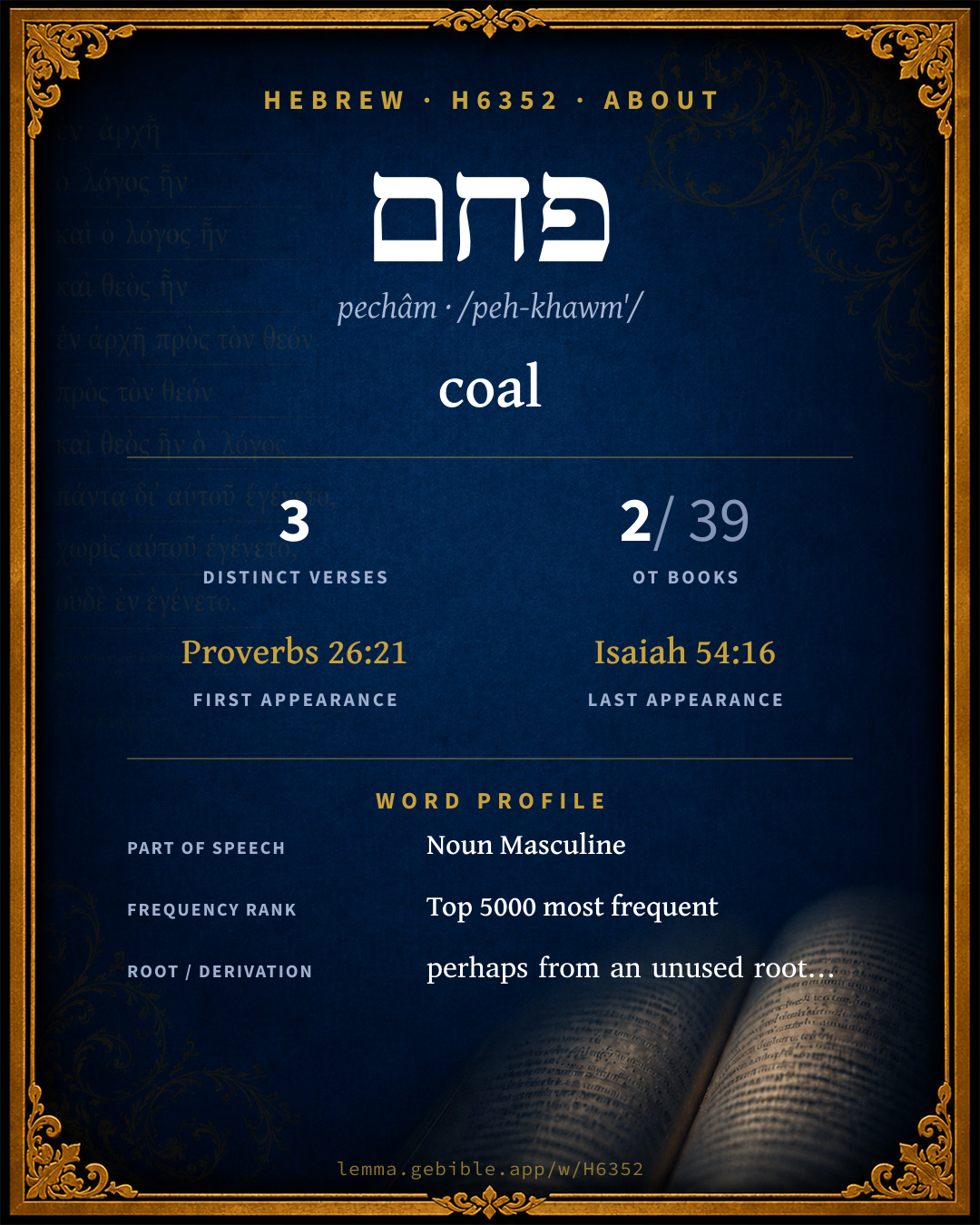
פֶּחָם
coal
Full lexicon entry — Brown-Driver-Briggs (BDB)
From Brown-Driver-Briggs (BDB)
Where this word appears
Grammar key — what these labels mean
Part of speech
- Noun
- A naming word — a person, place, thing, or idea.
Noun type
- Common
- A common noun — a general class of person, place, or thing (“king,” “city,” “water”), not a specific name.
State
- Absolute
- The independent form of a noun, not bound to a following word.
Gender
- Masculine
- Grammatically masculine.
Number
- Singular
- One.
Every verse where H6352 appears — 3 distinct verses across 2 books. Click any verse to open its interlinear word-by-word view. Verse text shown in the World English Bible for context — . Each verse’s Hebrew form is shown with its reference; the English is not keyword-highlighted, since the data carries no word-level English alignment. Use “Compare translations” on any verse to read it across multiple English versions. This concordance covers the Hebrew Bible; Septuagint (Greek Old Testament) occurrences are not indexed here.
Proverbs 1 verse
Isaiah 2 verses
- Isaiah 44:12 בַּ/פֶּחָ֔ם prep det + n c ms The smith [makes] an axe, and works in the coals, and fashions it with hammers, and works it with his strong arm: yes, he is hungry, and his strength fails; he drinks no water, and is faint.
- Isaiah 54:16 פֶּחָ֔ם n c ms Behold, I have created the smith who blows the fire of coals, and brings forth a weapon for his work; and I have created the waster to destroy.
About this entry
At a glance — auto-summarized from this page’s data, not written by a person. Every figure links to its source below. This summary describes the numbers; it doesn’t interpret them.
“coal” is the headline sense of the Hebrew noun פחם (pechâm). It occurs a mere 3 verses across Scripture. More than two-thirds of its appearances fall in Isaiah. Scripture first uses it in Proverbs 26:21. See the sense tree, 3-verse concordance, and the renderings breakdown below.
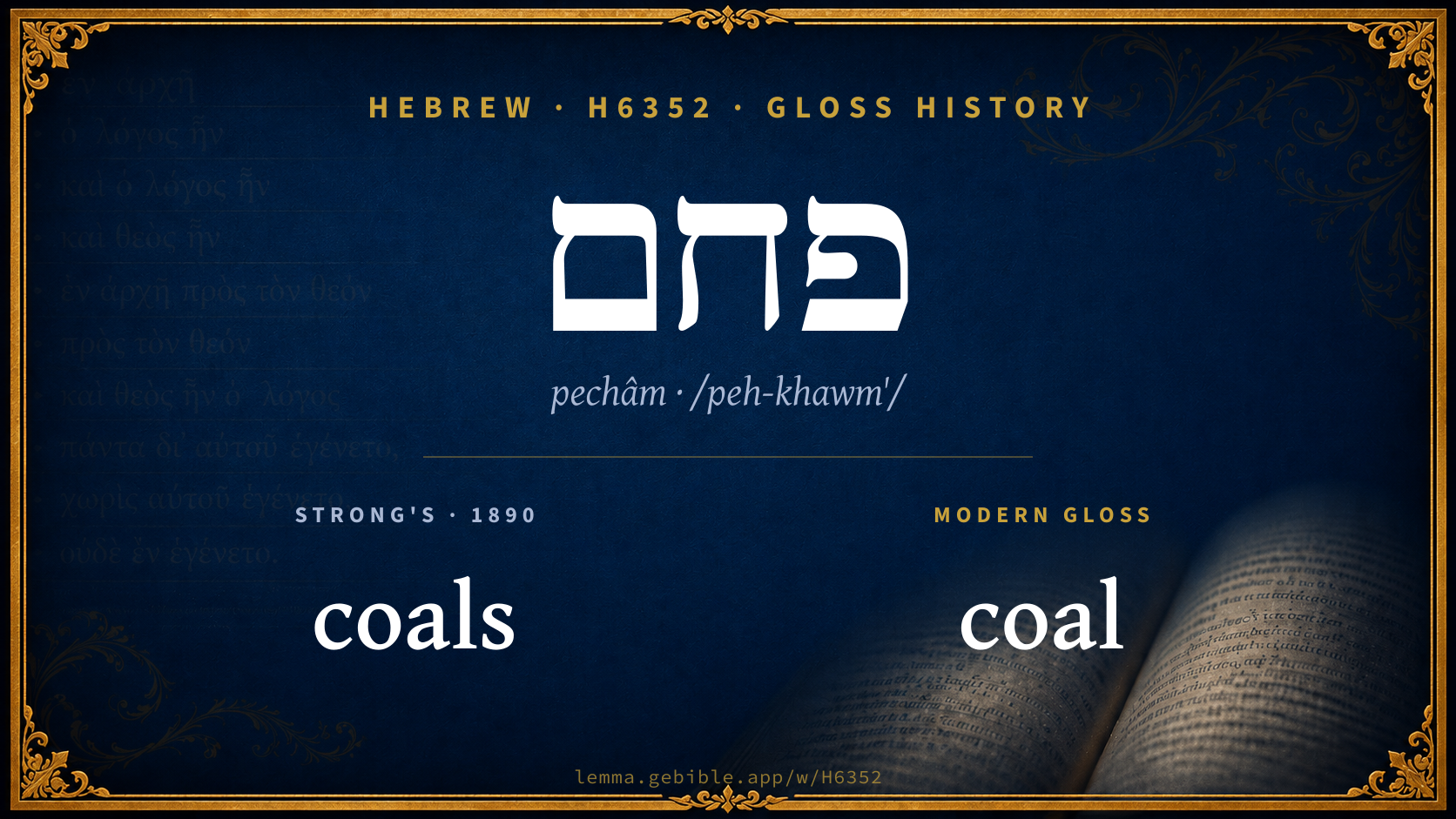
Gloss history
Strong's 1890 vs modern scholarship
About this word
Strong's H6352 catalogs a Hebrew word from the Hebrew Old Testament.
These counts are not copied from any lexicon or concordance. They are computed here, from the morphology-tagged Hebrew Old Testament. What Lemma adds →
- 3
- distinct verses
- The word appears in 3 distinct verses.
- 2 / 39
- OT books
- The word appears in 2 of 39 Old Testament books.
- #4,179
- by frequency
- Top 5000 most frequent Hebrew words (rank 4,179 of 8,640 Hebrew words by occurrence).
View all 3 occurrences in the concordance →
By traditional corpus
Conventional, traditional groupings — biblical authorship is debated, so this is a traditional corpus grouping, not an authorship claim. Each share is this word’s portion of its verses in that division of the Hebrew canon. Each figure is a share of the word’s 3 distinct verses.
- Prophets (Nevi'im) 2 verses · 67%
- Writings (Ketuvim) 1 verse · 33%
How translations render this word
Counts come from each version’s own published word-to-Strong’s tagging or interlinear alignment — an approximate guide to how each version renders this word, not a word-level alignment the data otherwise carries. Because each total is that version’s own tagged count, the per-version totals vary from one another and need not match the appearance or distinct-verse counts above. These counts may also differ from a printed concordance because Lemma counts each distinctly tagged rendering and does not collapse phrase taggings into a single head-word total. This is a fixed set of word-tagged versions (KJV, ASV, BSB, ULT) and does not change with the reading translation you choose elsewhere. Each version’s license is shown beside its name below (and on Sources).
- King James Version: Coals 3×
- American Standard Version: Coals 3×
- Berean Standard Bible: Coals 1×, Like charcoal 1×, Over the coals 1×
- unfoldingWord Literal Text: Charcoal 1×, Coal 1×, Over the coal 1×
King James Version Public Domain
Renders H6352 across 3 tagged occurrences — most commonly:
American Standard Version Public Domain
Renders H6352 across 3 tagged occurrences — most commonly:
Berean Standard Bible Public Domain
Renders H6352 across 3 tagged occurrences — most commonly:
unfoldingWord Literal Text CC BY-SA 4.0
Renders H6352 across 3 tagged occurrences — most commonly:
Senses in BDB
The 1 sense BDB distinguishes for this word, in lexicon order (not ranked by frequency or importance). The full entry — with sub-senses — is in the Lexicon Entry tab.
- coal, charcoal, ember
Word origin
n.[m.] coal (coll.); abs. פ׳, as inflammable, פ׳ לְגֶחָלִים Pr 26:21 (charcoal for embers, Toy); of glowing coal Is 44:12, אֵשׁ פ׳ 54:16; ψ 11:6 for MT פַּחִ֑ים אֵשׁ read פַּחַם אֵשׁ (or פַּחֲמֵי) coals of fire (‖ גָּפְרִית), so Ew al.
— Brown-Driver-Briggs (Oxford 1906, public domain), digitized via Sefaria, supplemented by the OpenScriptures HebrewLexicon (CC BY 4.0). See Sources.
Origin: perhaps from an unused root probably meaning to be black
Jastrow Dictionary
A second Hebrew/Aramaic lexicon for comparison, covering Aramaic and post-biblical (Talmudic, Targumic, Midrashic) usage that the biblical-Hebrew BDB does not. Matched by lemma rather than by Strong’s number, so a lemma may carry more than one Jastrow headword (shown separately below), and the entries cover usage well beyond the Bible.
פָּחַם
- (denom. of פֶּחָם) to be black, v. infra.
- to blacken. Y. Maas. Sh. V, beg. 55ᵈ; Tosef. Maas. Sh. V, 13 בית ע"ז מְפַחֲמִין אותו בפיחמין the site of an idolatrous temple is marked by blackening it (its debris) with coal. Y. Pes. VI, 33ᵃ bot. [read:] מה … ומפציע ומְפַחֵם כך אני יורד בו as a kettle (thrown at a person) scalds and wounds and blackens, so will I come down at him; a. e.—Part. pass. מְפוּחָם; f. מְפוּחֶמֶת; pl. מְפוּחָמִים, מְפוּחָמִין; מְפוּחָמוֹת. Gen. R. s. 36, v. כָּעַר; Y. Taan. I, end, 64ᵈ חם יצא מפ׳ Ham came out (of the ark) black. Y. Sot. II, 17ᵈ bot. לא במפ׳ not in a sooty vessel. Cant. R. to I, 6 ידיה מפ׳ her hands were blackened. Ib. את שכולך מפ׳ thou (negress) who art black all over; a. e.
- , Nithpa. נִתְפַּחֵם to be blackened. Yalk. Num. 764; Yalk. Cant. 982 נפ׳ בשמש became black through exposure to the sun, v. כִּרְכֵּם. Gen. R. s. 18 נִתְפַּחֲמוּ פני הנשים מפני השמש the faces of the (Jewish) women had become black &c. Gen. R. s. 19, beg. ככלי פשתן … מִתְפַּחֲמִין קימעא וכ׳ (a scholar’s reputation is) like the fine linen clothes from Bethshan, if they are in the least stained, they are ruined; Koh. R. to I, 18 אם נִתְפַּחֲמוּ וכ׳. Ib. אם פָּחֲמוּ (Kal). Deut. R. s. 1 ונתפחמו ידיה and her hands were soiled with soot; אם מקנחת … מתפחם if she wipes her hands on the wall, the wall will be soiled; a. fr.
פְּחַם
- , v. פָּחֵים
פֶּחָם
- that which is used for kindling, charcoal. Sabb. II, 5 מפני שהוא עושה פ׳ because (by extinguishing the light) he makes kindling material, i.e. prepares the wick for easier lighting (v. הִבְהֵב). Ib. 31ᵇ. Koh. R. to IX, 8 נפח לפֶחָמוֹ the smith (the charcoal-burner) turns to his coal. Ib. to VII, 1; Yalk. Josh. 35, v. פּוּצָם; a. fr.—Pl. פֶּחָמִין, פֶּי׳. Tosef. Maas. Sh. V, 13; Y. ib. V, beg. 55ᵈ, v. פָּחַם. Tosef. Bets. III, 14 אין עושין פ׳ וכ׳ you must not make charcoal (prepare kindling material) even for immediate use (on the Holy Day). Mikv. IX, 2 לא יטבול … בפ׳ וכ׳ one must not immerse a kettle with remnants of coal in it (which had been put there to be extinguished in water), unless one washes it again, Maim.; [oth. opin.: with the soot on it, but he must scrape it off]. Koh. R. to I, 8 לכו … האיש ועל אותה החמת … מלאה פ׳ go ye and pray for this man (me), and for this bag formerly filled with precious stones and pearls, and now with pieces of coal; a. e.
A Dictionary of the Targumim, the Talmud Babli and Yerushalmi, and the Midrashic Literature (Marcus Jastrow; London, Luzac, 1903) — Public Domain. Digitized via Sefaria. Digitized via Sefaria. Full attribution on Sources.
Forms in the corpus
The 3 distinct written forms H6352 takes in the Hebrew Bible, most frequent first — each parse links to that state’s occurrences in the concordance. Hebrew forms include their vowel points and cantillation, so a single lemma takes many written forms.
| Form | Parsing | Example | Uses |
|---|---|---|---|
| בַּ/פֶּחָ֔ם | Noun, Common, Masculine, Singular, Absolute | Isaiah 44:12 | 1 |
| פֶּחָ֔ם | Noun, Common, Masculine, Singular, Absolute | Isaiah 54:16 | 1 |
| פֶּחָ֣ם | Noun, Common, Masculine, Singular, Absolute | Proverbs 26:21 | 1 |
Septuagint verse parallels
This word appears in 3 verses that also exist in the Greek Old Testament (Septuagint), out of the 3 Hebrew verses it occurs in. You can read those verses in Greek by switching the Old Testament edition to the Septuagint.
Read these verses in the Septuagint
This is a verse-level parallel only — the same verses exist in both the Hebrew and Greek Old Testaments. No word-level Hebrew↔Greek correspondence is claimed: the data carries no such alignment, so no Greek word is shown as this Hebrew word’s translation. Coverage is not total — the Septuagint omits the deuterocanon and renumbers the Psalms, so some Hebrew verses have no direct Greek parallel.