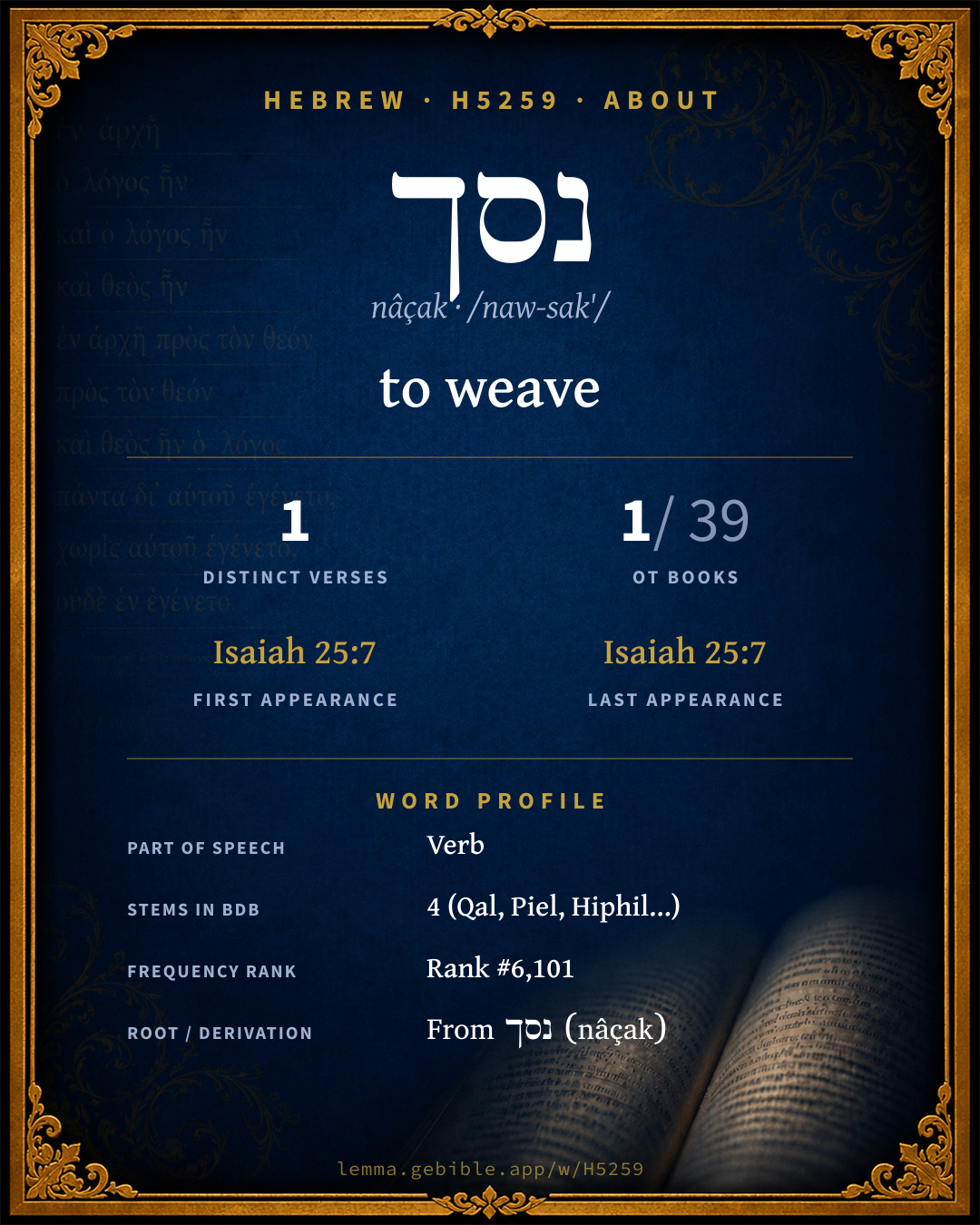
נָסַךְ
to weave
Full lexicon entry — Brown-Driver-Briggs (BDB)
From Brown-Driver-Briggs (BDB)
Where this word appears
Grammar key — what these labels mean
Stem
- Qal
- The basic, simple active stem — the plain form of the verb (“he wrote”). Here: ‘pour out’
Form
- Participle Passive
- A verbal adjective expressing action received (“written”).
State
- Absolute
- The independent form of a noun, not bound to a following word.
Gender
- Feminine
- Grammatically feminine.
Number
- Singular
- One.
Every verse where H5259 appears — 1 distinct verse across 1 book. Click any verse to open its interlinear word-by-word view. Verse text shown in the World English Bible for context — . Each verse’s Hebrew form is shown with its reference; the English is not keyword-highlighted, since the data carries no word-level English alignment. Use “Compare translations” on any verse to read it across multiple English versions. This concordance covers the Hebrew Bible; Septuagint (Greek Old Testament) occurrences are not indexed here.
Isaiah 1 verse
About this entry
At a glance — auto-summarized from this page’s data, not written by a person. Every figure links to its source below. This summary describes the numbers; it doesn’t interpret them.
“to weave” is the headline sense of the Hebrew verb נסך (nâçak). It is rare — just 1 verse in the entire Hebrew Bible. It clusters heavily in Isaiah, which alone accounts for 100% of its uses. It occurs only once, in Isaiah 25:7. Across 4 stems, its meaning turns on the binyan (Qal, Piel). See the sense tree, 1-verse concordance, and the renderings breakdown below.
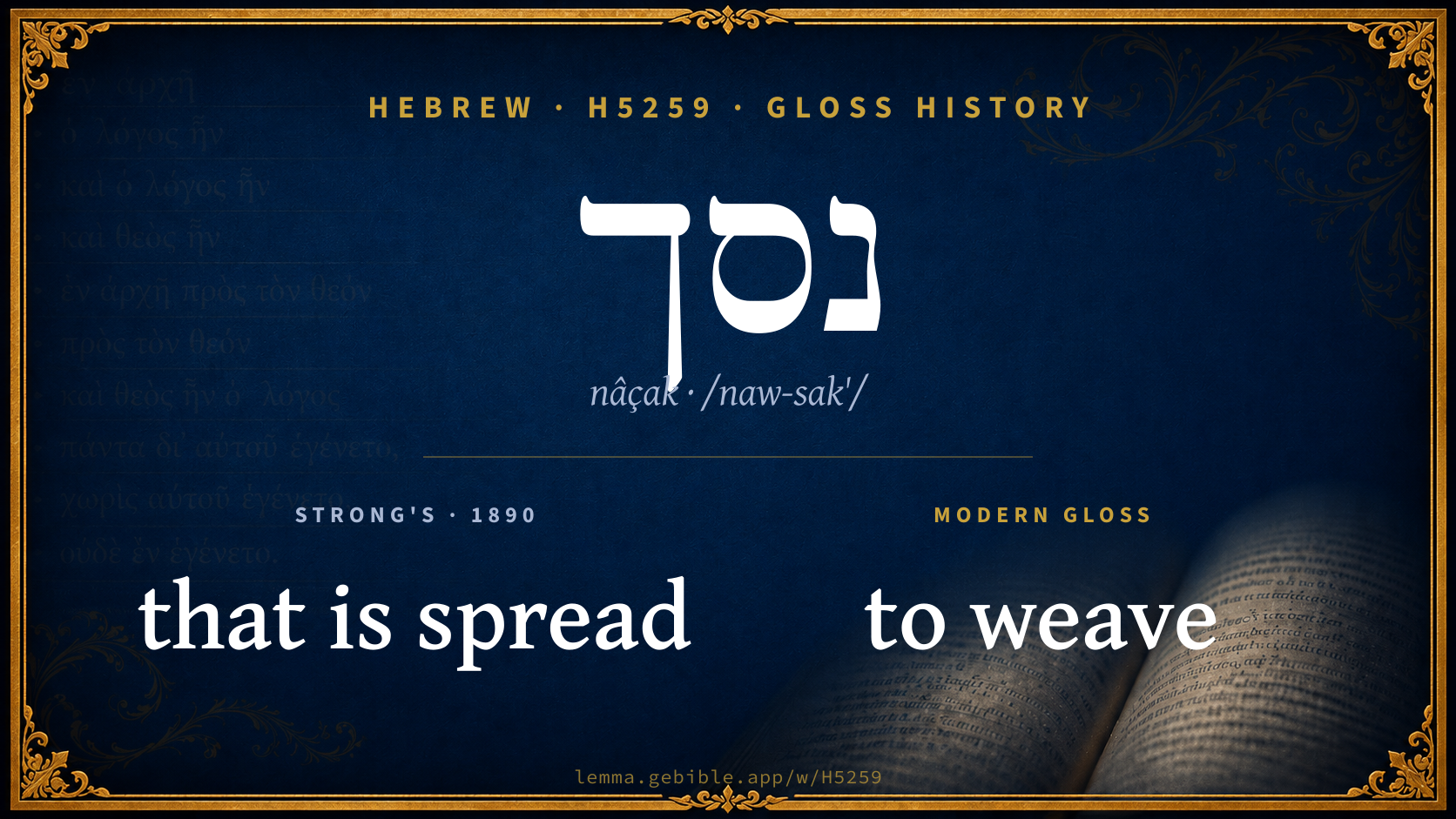
Gloss history
Strong's 1890 vs modern scholarship
About this word
Strong's H5259 catalogs a Hebrew word from the Hebrew Old Testament.
These counts are not copied from any lexicon or concordance. They are computed here, from the morphology-tagged Hebrew Old Testament. What Lemma adds →
- 1
- distinct verses
- The word appears in 1 distinct verse.
- 1 / 39
- OT books
- The word appears in 1 of 39 Old Testament books.
- #6,101
- by frequency
- Rank #6,101 (rank 6,101 of 8,640 Hebrew words by occurrence).
View all 1 occurrence in the concordance →
Most concentrated in
- Isaiah 1 verse 100%
By section of the Old Testament
By traditional corpus
Conventional, traditional groupings — biblical authorship is debated, so this is a traditional corpus grouping, not an authorship claim. Each share is this word’s portion of its verses in that division of the Hebrew canon. Each figure is a share of the word’s 1 distinct verse.
- Prophets (Nevi'im) 1 verse · 100%
How translations render this word
Counts come from each version’s own published word-to-Strong’s tagging or interlinear alignment — an approximate guide to how each version renders this word, not a word-level alignment the data otherwise carries. Because each total is that version’s own tagged count, the per-version totals vary from one another and need not match the appearance or distinct-verse counts above. These counts may also differ from a printed concordance because Lemma counts each distinctly tagged rendering and does not collapse phrase taggings into a single head-word total. This is a fixed set of word-tagged versions (KJV, ASV, BSB, ULT) and does not change with the reading translation you choose elsewhere. Each version’s license is shown beside its name below (and on Sources).
BDB lists this Strong’s number as 3 distinct words (homographs). Each count above pools all of them and is not split by sense — see the Senses section below. A low-frequency rendering may belong to a different one of those words, not the primary meaning.
- King James Version†: Is spread 1×
- American Standard Version†: Is spread 1×
- Berean Standard Bible†: Covers 1×
- unfoldingWord Literal Text†: Woven 1×
King James Version Public Domain
Renders H5259 across 1† tagged occurrence — most commonly:
American Standard Version Public Domain
Renders H5259 across 1† tagged occurrence — most commonly:
Berean Standard Bible Public Domain
Renders H5259 across 1† tagged occurrence — most commonly:
unfoldingWord Literal Text CC BY-SA 4.0
Renders H5259 across 1† tagged occurrence — most commonly:
9 senses and sub-senses in the full BDB
Hebrew verbs can shift meaning by stem (binyan): Qal is the basic action, Niphal is often passive or reflexive, Piel often intensifies or makes it factitive, and Hiphil is typically causative. The senses below are grouped under the stem BDB assigns to each.
What do BDB’s symbols mean?
BDB uses these scholarly abbreviations:
| Symbol | Meaning |
|---|---|
| 𝔊 | the Septuagint (the ancient Greek translation, LXX) |
| 𝔙 | the Vulgate (the Latin translation) |
| 𝔖 | the Syriac version (the Peshitta) |
| 𝔗 | the Targum (the Aramaic translation) |
| ψ | the Psalms |
| √ | root (the underlying root or stem) |
| ‖ | parallel passage (a synonymous or contrasted parallel) |
| † | the dagger: every passage where the word occurs is cited |
The 9 senses and sub-senses the full Brown-Driver-Briggs lexicon distinguishes for this word, in lexicon order (not ranked by frequency), with BDB’s own verbatim wording and sub-sense lettering. Shown in Hebrew script with BDB’s own scholarly abbreviations. The condensed entry is in the Lexicon Entry tab.
נסך I pour out (NH id., pour, cast (metals, Pi. make libation
Qal
- Pf. 3 ms. נָסַךְ Is 29:10; 40:19; נָסָ֑ךְ 44:10; Impf. 3 mpl. יִסְּכוּ. Ho 9:4; 2 ms. תִּסְּכוּ Ex 30:9; Inf. לִנְסֹךְ Is 30:1; v. ii. נסך for Is 25:7;— e.g. Isaiah 29:10
- 1. pour out (the spirit of deep sleep) c. על pers. Is 29:10. e.g. Isaiah 29:10
- 2. pour out libations, c. acc. נֶסֶךְ Ex 30:9 (P); מַסֵּכָה Is 30:1; יַיִן Ho 9:4. e.g. Exodus 30:9
- 3. cast metal images, c. acc. פֶּסֶל Is 40:19; 44:10. e.g. Isaiah 40:19
Piel
- Impf. יְנַסֵּךְ 1 Ch 11:18 pour out as libation, c. acc. מַיִם + ליהוה (= 2 S 23:16 Hiph.). e.g. 1 Chronicles 11:18
Hiphil
- Pf. 3 mpl. הִסִּכוּ Je 32:39; Impf. 3 ms. וַיַּסֵּךְ Gn 35:14 + 2 times; 1 s. אַסִּיךְ ψ 16:4; 3 mpl. וַיַסִּיכוּ Ez 20:28; Imv. הַסֵּךְ Nu 28:7; Inf. abs. הַסֵּיךְ Je 44:17; הַסֵּךְ Je 7:18 + 3 times; cstr. לְהַסֵּךְ Je 44:19, 25 (Köi. 309);—pour out libations, c. acc. נֶסֶךְ Gn 35:14 (E), 2 K 16:13; Nu 28:7 (P), מַיִם 2 S 23:16 ליהוה; elsewhere, נְסָכִים to other gods Je 7:18; 19:13; 32:29; 44:17, 18, 19(×2), 25, 19 Ez 20:28 ψ 16:4. Hop. Impf. 3 ms. יֻסַּךְ be poured out, Ex 25:29; 37:16, of holy wine, c. בְ of vessels. e.g. Jeremiah 32:39
נסך II weave (Arabic نَسَجَ has same meaning)
Qal
- Pt. pass. f. נְסוּכָה Is 25:7; perhaps also Inf. cstr. לִנְסֹךְ 30:1; on both v. foll. e.g. Isaiah 25:7
נסך III set, install (Assyrian nasâku, id., whence nasîku, prince, DlHWB 472
Qal
- Pf. 1 s. נָסַכְתִּי מַלְכִּי עַל־צִיּוֹן ψ 2:6 I have installed my king upon Zion. e.g. Psalms 2:6
Niphal
- Pf. 1 s. נִסַּכְתִּי Pr 8:23 I was installed (of Wisdom). e.g. Proverbs 8:23
Senses from the full Brown-Driver-Briggs lexicon (Brown, Driver, Briggs; Oxford 1906 — public domain), digitized via Sefaria, supplemented by the OpenScriptures HebrewLexicon (CC BY 4.0). Full attribution on Sources.
Word origin
I. vb. pour out (NH id., pour, cast (metals, Pi. make libation; Ph. נסך cast gold or iron Lzb323f.; 𝔗 נְסַךְ make libation; Syriac ܢܣܰܟ pour out; Arabic نَسَكَ, orig. be-pour, water NöZMG xli (1887), 719 (rare), usually worship Lane3032 (cf. RSSem. i. 213; 2d ed. 229), i.e. pour out blood of victim, pour out wine WeHeid. 2, 114, 118, 142);—
II. vb. weave (Arabic نَسَجَ has same meaning);—
III. vb. set, install (Assyrian nasâku, id., whence nasîku, prince, DlHWB 472; v. also Muss-ArnoltHbr. vi. 89, R. 17 and reff.);—
— Brown-Driver-Briggs (Oxford 1906, public domain), digitized via Sefaria, supplemented by the OpenScriptures HebrewLexicon (CC BY 4.0). See Sources.
Derived from נסך (nâçak) (H5258) — to pour out.
Jastrow Dictionary
A second Hebrew/Aramaic lexicon for comparison, covering Aramaic and post-biblical (Talmudic, Targumic, Midrashic) usage that the biblical-Hebrew BDB does not. Matched by lemma rather than by Strong’s number, so a lemma may carry more than one Jastrow headword (shown separately below), and the entries cover usage well beyond the Bible.
נָסַךְ
- (b. h.) to pour, cast. Y. Ber. I, 2ᵈ top, v. מָסַךְ II.
- 1. to offer a libation. Succ. IV, 9 ולִמְנַסֵּךְ אומרים לו וכ׳ and they said to him who offered the libation (of water), raise thy hand. Ib. שפעם אחת ני׳ אחד וכ׳ for once it happened, that a priest poured the libation out at his feet. Snh. 62ᵇ זיבח … וני׳ וכ׳ if one sacrificed, burnt incense, and offered a libation (to an idol) &c.; a. fr.—Cant. R. to IV, 12 מֵאָן היו ישראל מנטרים כל וכ׳ (read: מְנַסְּכִים, v. Matt. K. a. l.) whence did the Israelites take wine for their festive gatherings during the forty years &c.?
- 2. to make wine forbidden (יֵין נֶסֶךְ) by the manipulation of a gentile suspected of dedicating it to idolatrous purposes. Keth. 27ᵃ; Sabb. 41ᵃ אין פנאי לנַסֵּךְ they do not take the time to manipulate the wine. Ab. Zar. 56ᵇ (in Chald. dict.) והא קא מנסך בידיה but might he not dedicate it to idolatry by putting his hand into it?; והא קא מנסך ברגל might he not do it with his foot (while treading the wine)? Gitt. V, 4 המנסך he who does damage to his neighbor by touching his wine for idolatrous purposes (v. interpret. ib. 52ᵇ). Y. Ab. Zar. IV, 44ᵃ bot. מנסך כל הבור he causes all the wine in the pit to be forbidden; a. fr.
- to be offered as libation, to be poured on the altar. Pes. 22ᵃ כמים הנִיסָּסִין like the water which is poured on the altar, opp. הנשפכין which is poured out at the foot of the altar.
- 1. same. Ib. המִתְנַּסְּכִים; a. fr.
- 2. to be made forbidden (as dedicated to idolatry). Y. Ab. Zar. l. c. נתנ׳ הבור וכ׳ if the wine in the pit has been manipulated and become forbidden, the jet of wine poured into the pit becomes forbidden (affecting the wine in the vessel).
נְסַךְ
- , esp. to offer a libation. Targ. Cant. IV, 15; a. e.
- as preced. Pi. Targ. Ex. XXX, 9; a. fr.—Sabb. 41ᵃ לא מְנַסְּכֵי they will not take the time to manipulate &c., v. preced.
- as preced. Hithpa. Targ. Num. XXVIII, 7; a. e.—Ab. Zar. 71ᵇ קמא קמא אינ׳ ליה every drop as it comes out becomes forbidden.
נֶסֶךְ
- preced.)
- 1. libation. Ex. R. s. 15 יֵין נ׳ wine from which a libation has been poured on the altar.—Pl. נְסָכִים, נְסָכִין; constr. נִסְכֶי, נִי׳. Zeb. IX, 1 הנ׳ ירדו the libations brought on the altar illegally, may be taken down. Tosef. ib. V, 1; Men. 15ᵇ, a. e. נסכי בהמה the libations connected with an animal sacrifice. Ib. II, 4 ונְסָכָיו and the libations belonging thereto; a. v. fr.
- 2. יֵין נ׳ (יין שנתנסך לע"ז; abbrev. י"נ) wine known (or suspected) to have been manipulated by an idolater, wine forbidden to Jews because of such (known or suspected) manipulation. Ab. Zar. IV, 8 (55ᵃ) ואינו נעשה י׳'נ וכ׳ (Bab. ed. עושה) it does not become (the gentile does not make it) forbidden wine until &c. Ib. V, 1 לעשות עמו ביין נ׳ to work with him in wine dedicated to an idol. Ib. 2 יין נ׳ שנפל וכ׳ if forbidden wine was poured over grapes. Ib. 74ᵃ bot. יין נ׳ really idolatrous wine, opp. סתם יין suspected; a. fr.
A Dictionary of the Targumim, the Talmud Babli and Yerushalmi, and the Midrashic Literature (Marcus Jastrow; London, Luzac, 1903) — Public Domain. Digitized via Sefaria. Digitized via Sefaria. Full attribution on Sources.
Same root — word family
Other BDB entries built from the same root as H5259, grouped by Strong’s listed origin. These share a root / origin per the lexicon — not necessarily a shared meaning. Each links to that word’s own entry.
Derives from
Shares the same root
- מסכה maççêkâh H4541 molten image
- נסיך nᵉçîyk H5257 libation
- נסך nᵉçak H5260 to pour out
- נסך neçek H5262 drink offering
Derived from this word
Compare all same-root words → Showing 4 of 7 — not the complete family. They share a root, not necessarily a meaning.
Septuagint verse parallels
This word appears in 1 verse that also exists in the Greek Old Testament (Septuagint), out of the 1 Hebrew verse it occurs in. You can read those verses in Greek by switching the Old Testament edition to the Septuagint.
Read these verses in the Septuagint
This is a verse-level parallel only — the same verses exist in both the Hebrew and Greek Old Testaments. No word-level Hebrew↔Greek correspondence is claimed: the data carries no such alignment, so no Greek word is shown as this Hebrew word’s translation. Coverage is not total — the Septuagint omits the deuterocanon and renumbers the Psalms, so some Hebrew verses have no direct Greek parallel.