
1 Chronicles 1:48

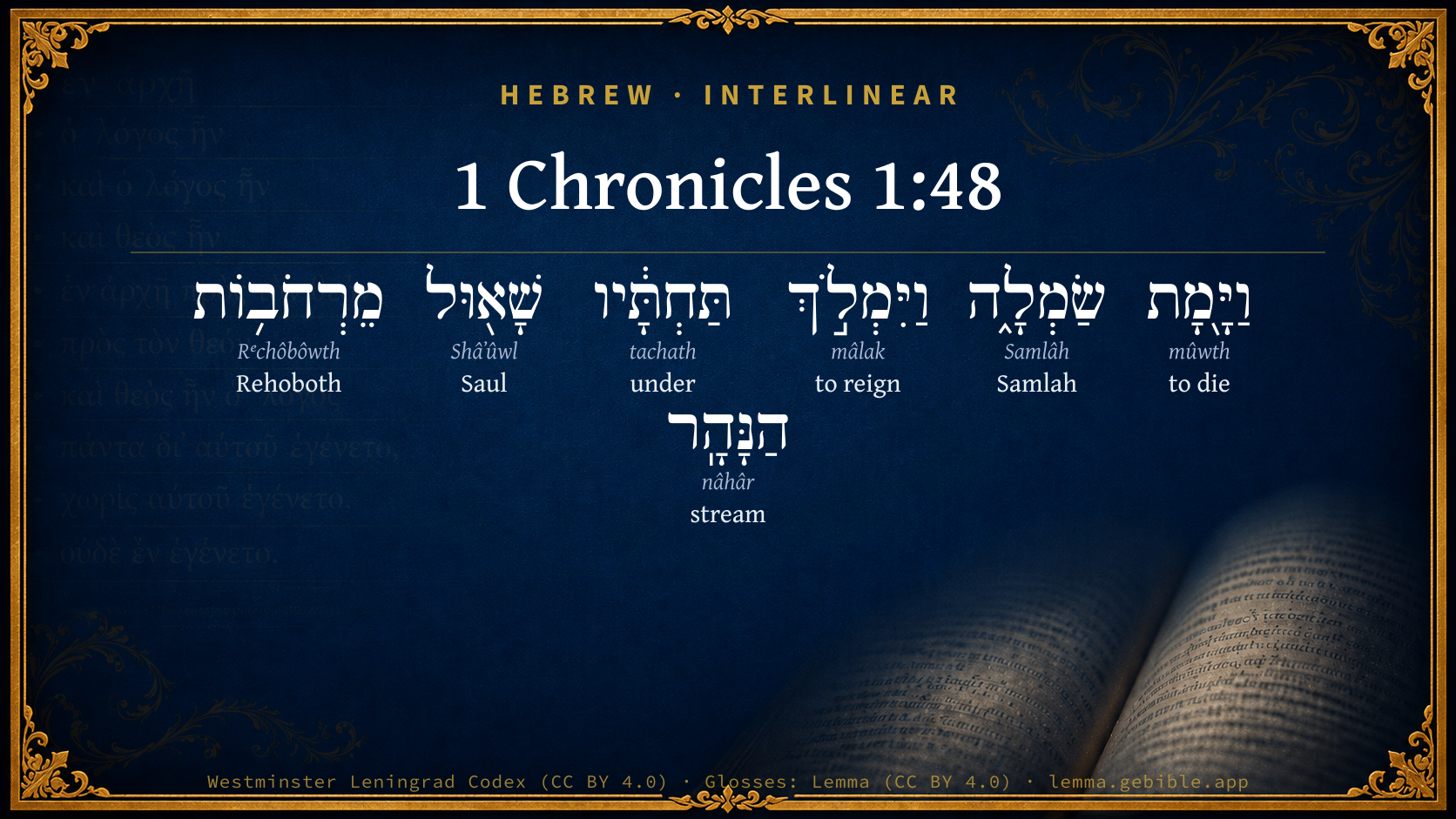
Hebrew (Westminster Leningrad Codex) 1 Chronicles 1:48 appears in the Hebrew Old Testament. The text above is from the Westminster Leningrad Codex. Each word links to its Strong’s number, a concise gloss, and parsing drawn from the Open Scriptures Hebrew Bible morphology. Click any word for its full Brown-Driver-Briggs (BDB) entry.
Download image
Cite this verse

1 Chronicles 1:48 (World English Bible). Public Domain. Lemma interlinear Bible study tool, https://lemma.gebible.app/v/1-chronicles/1/48.

Show BibTeX & RIS
BibTeX
RIS
English Translation
Samlah died, and Shaul of Rehoboth by the River reigned in his place.
World English Bible · Public Domain
Download a study sheet

One document with this verse’s original text, its word-by-word gloss line, the meaning frame, cross-references with their text, attributed commentary, and full source and license credits — printable, and it pastes into notes with its structure intact.

This verse Autodidact and up

Study sheet (.html) Plain text (.txt)

A passage Seminary Student

Up to 50 verses in one chapter. A passage sheet keeps up to 6 commentary sources and 12 cross-references per verse, in the order this page ranks them, and says so on the sheet whenever that leaves anything out. Ask for a single verse and you get the Autodidact verse sheet above.

Everything on this page stays free to read, with no account — the sheet is a download of what is already on screen, not access to it.

Want to remove ads? Support Godless Engineer
Compare translations 3

The same verse in 3 English versions, stacked beneath the original-language interlinear above. Click any original word for its lexicon entry.

Each is an independent rendering of the whole verse — the interlinear is not word-aligned to these translations.

Highlighted words mark where these versions differ — a whole-verse word diff, not a word-by-word alignment.

  • World English Bible Public Domain
    Samlah died, and Shaul of Rehoboth by the River reigned in his place.
  • King James Version Public Domain
    And when Samlah was dead, Shaul of Rehoboth by the river reigned in his stead.
  • unfoldingWord Literal Text CC BY-SA 4.0
    And Samlah died, and Shaul from Rehoboth of the River reigned in his place. ts\*

unfoldingWord Literal Text — © unfoldingWord, licensed CC BY-SA 4.0. Word-aligned USFM3 via Door43 (git.door43.org/unfoldingWord/en_ult).

Versions to compare (up to 4)

3 of 4 selected

Show all 18 translations

Every available English version of this verse, each an independent rendering of the whole verse.

  • World English Bible Public Domain
    Samlah died, and Shaul of Rehoboth by the River reigned in his place.
  • Berean Standard Bible Public Domain
    When Samlah died, Shaul from Rehoboth on the Euphrates reigned in his place.
  • Majority Standard Bible Public Domain
    When Samlah died, Shaul from Rehoboth on the Euphrates reigned in his place.
  • King James Version Public Domain
    And when Samlah was dead, Shaul of Rehoboth by the river reigned in his stead.
  • American Standard Version (1901) Public Domain
    And Samlah died, and Shaul of Rehoboth by the River reigned in his stead.
  • Revised Version (1885) Public Domain
    And Samlah died, and Shaul of Rehoboth by the River reigned in his stead.
  • Geneva Bible (1599) Public Domain
    And Samlah dyed, and Shaul of Rehoboth by the riuer reigned in his stead.
  • Douay-Rheims (1899) Public Domain
    Semla also died, and Saul of Rohoboth, which is near the river, reigned in his stead.
  • Young's Literal Translation Public Domain
    and Samlah dieth, and reign in his stead doth Shaul from Rehoboth of the River;
  • Literal Standard Version CC BY-SA 4.0
    and Samlah dies, and Shaul from Rehoboth of the River reigns in his stead;
  • Unlocked Literal Bible CC BY-SA 4.0
    When Samlah died, Shaul of Rehoboth on the river reigned in his place.
  • unfoldingWord Literal Text CC BY-SA 4.0
    And Samlah died, and Shaul from Rehoboth of the River reigned in his place. ts\*
  • Darby Bible Public Domain
    And Samlah died; and Saul of Rehoboth on the river reigned in his stead.
  • World Messianic Bible Public Domain
    Samlah died, and Shaul of Rehoboth by the River reigned in his place.
  • Webster's Bible Public Domain
    And when Samlah was dead, Shaul of Rehoboth by the river reigned in his stead.
  • Free Bible Version CC BY-SA 4.0
    When Samlah died, Shaul from Rehoboth on the River took over as king.
  • Bible in Basic English Public Domain
    And at the death of Samlah, Shaul of Rehoboth by the river became king in his place,
  • JPS Tanakh (1917) Public Domain
    And Samlah died, and Shaul of Rehoboth by the River reigned in his stead.

Literal Standard Version (2020), Covenant Press — licensed CC BY-SA 4.0. Text via the HelloAO Bible API (eBible.org). Unlocked Literal Bible (unfoldingWord) — licensed CC BY-SA 4.0. Text via the HelloAO Bible API (eBible.org). unfoldingWord Literal Text — © unfoldingWord, licensed CC BY-SA 4.0. Word-aligned USFM3 via Door43 (git.door43.org/unfoldingWord/en_ult). Free Bible Version, Dr. Jonathan Gallagher — licensed CC BY-SA 4.0. Text via the HelloAO Bible API (eBible.org).

Word by word

More ways to search: Search by grammar → Find every occurrence → Compare this word →

Practice this passage: Drill this verse → Learn its vocabulary →

About this verse

These counts appear in no published source. They are computed here, from the morphology-tagged text and Lemma’s own curated glosses. What Lemma adds →

7
words
7
distinct lemmas
Historical
section

Notable vocabulary

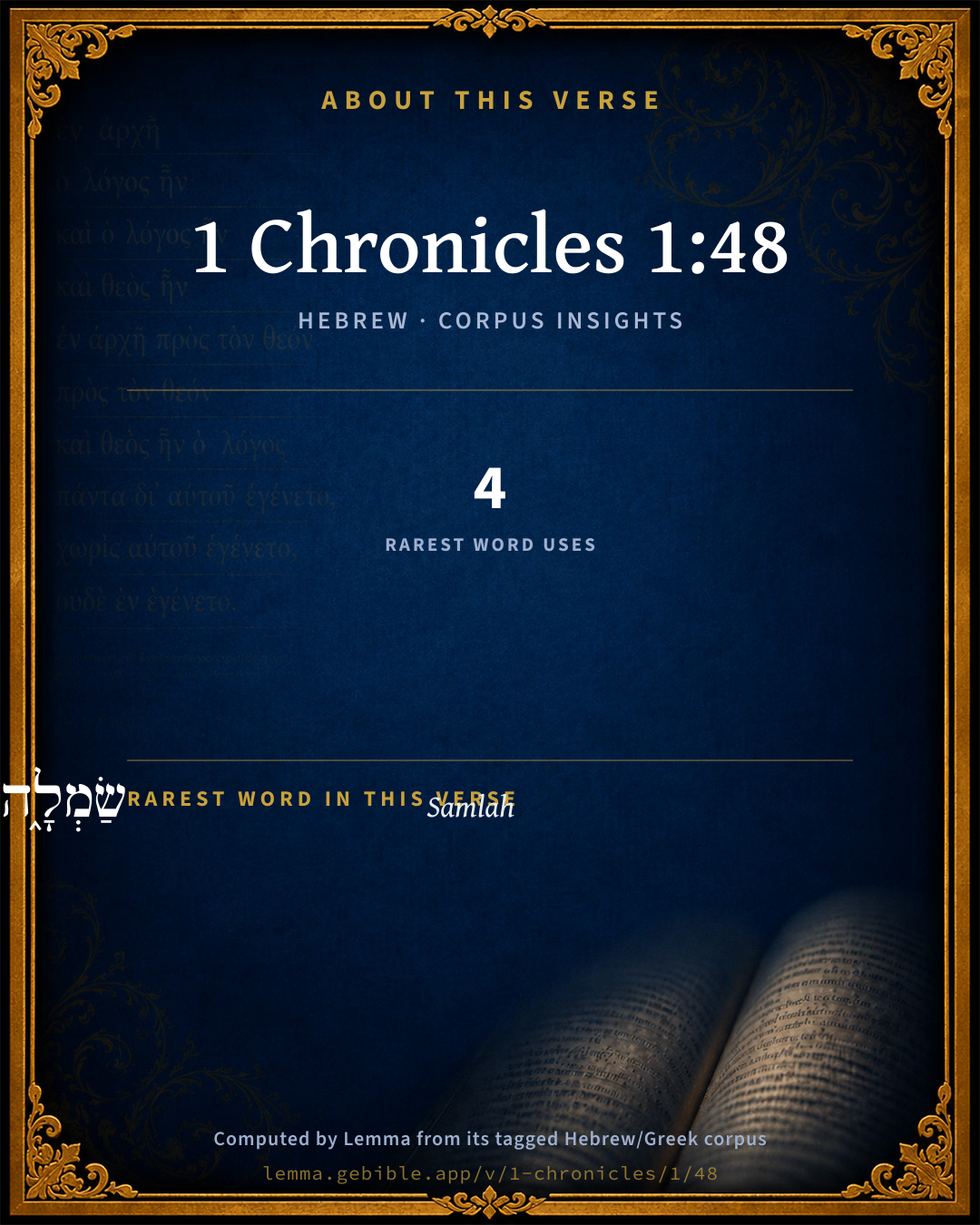
The rarest word here is שַׂמְלָ֑ה Samlah H8072 — appearing just 4 times in the whole Hebrew Bible.

Shared distinctive vocabulary

שַׂמְלָ֑ה Samlah H8072 occurs in 4 verses of the Hebrew Bible. Also found in:

Grammatical profile

  • 2 verbs
  • 4 nouns
  • 1 preposition

Verb forms

  • וַיָּ֖מָת Qal · Sequential Imperfect
  • וַיִּמְלֹ֣ךְ Qal · Sequential Imperfect

Hebrew & Septuagint length

In English translation the verse runs 13 words from the Hebrew and 14 from the Septuagint (LXX English) — closely comparable.

A rough comparison of the two English renderings, which tokenize alike — not a word-level alignment.

Word counts can differ between the Hebrew and the Greek without any difference in meaning — e.g. the Hebrew direct-object marker אֵת has no separate Greek word, and Greek often adds the article ὁ.

Cross-references

1

Topical passages linked to 1 Chronicles 1:48 in the Treasury of Scripture Knowledge — connected by theme and wording, ordered by reader-vote popularity; previews shown in the World English Bible.

  • Genesis 36:37 Samlah died, and Shaul of Rehoboth by the river, reigned in his place.

Cross-references courtesy of OpenBible.info (CC BY 4.0).

Hebrew and Greek witnesses Masoretic Hebrew ↔ Greek Septuagint

The same verse in the two great witnesses to the Old Testament, shown verse-for-verse.

These are two independent witnesses, not word-aligned to each other, and the Septuagint is shown in lemma (dictionary) form.

Hebrew 1 Chronicles 1:48 Masoretic · Westminster Leningrad Codex

וַיָּ֖מָת שַׂמְלָ֑ה וַיִּמְלֹ֣ךְ תַּחְתָּ֔יו שָׁא֖וּל מֵרְחֹב֥וֹת הַנָּהָֽר

Samlah died, and Shaul of Rehoboth by the River reigned in his place.

World English Bible · Public Domain

Greek LXX 1 Chronicles 1:48 Septuagint · lemma form
And Sebla died, and Saul of Rhoboth by the river reigned in his stead.

LXX2012 (modern English Septuagint) · Public Domain

Hebrew: Westminster Leningrad Codex (CC BY 4.0). Greek: Septuagint (public domain); English from LXX2012 (modern English Septuagint) (Public Domain). How the Septuagint differs from the Hebrew →

Commentary

Notes on 1 Chronicles 1:48 from classic Christian and Jewish commentators (each source and its license shown beneath its notes). The classic Christian expositions comment on the surrounding passage and are grouped to its opening verse, so a note may address several verses; the Jewish commentaries on the Tanakh (Rashi and others) are per-verse, so they appear only where the commentator wrote on this verse.

Lemma curates 59 commentaries, every one of them public domain or Creative Commons licensed, each selected and text-cleaned for this edition rather than reprinted as found. About our sources →

The Biblical Illustrator

Joseph S. Exell

1Ch_1:48

And when Samlah was dead, Shaul of Rehoboth by the river reigned in his stead.

The race and the individual

The king is dead. Long live the king! After the Saxon comes the Norman; after George the First George the Second, and then George the Third. So is history written with wearying monotony. These chapters have their lessons, and not the least significant is contained in the words reigned in his stead. We hear the tramp of many generations as we read these verses. The march of the human family has been always towards a grave. That is the end of every life. And so death passed on all men; for all have sinned. Who were Bela, and Jobad, and Husham, and Hadad, Samlah, and Shaul? They were kings once, but who cares anything about them now? They are dead, and their deeds are forgotten. Another man shall fill my pulpit; another man shall attend to your business; another man shall sit in your chair. Our text suggests the thought of the death of the individual and the perpetuation of the race. Instead of father comes the son. Whether we like it or not, our children will soon be pushing us out of our places. The world demands strong hands and nimble intellects. The cry is for young men. It is pathetic, it is sometimes heart-breaking, to see how cavalierly the world treats the aged. With rude hands it pushes them aside to make way for their successors. The moral suggestiveness of the genealogical chapters is great. The Bible has a wonderful method of epitomising. It informs us of the creation of the world, the sun, moon, and stars, earth, heaven, and sea in a single chapter. It tells the whole story of Redemption in one verse (Joh_3:16). The very brevity is significant. What importance we poor mortals attach to very trifling things! Our pleasures, our troubles, our work, our family, its marriages, its funerals; and we sometimes feel aggrieved that these things have not a deeper interest for others. Here are many generations of men all crammed into one chapter. Behold God is very great. And so He tells of many generations of men in a few verses. It is such a small thing to Him. The individual passes away, but the race continues. Men die, but man endures. One generation cometh and another goeth. The earth is very beautiful, hut it is, after all, one vast cemetery, in which repose the ashes of our forefathers. It is a lovely garden full of flowers and singing birds, but in the garden there is always a new tomb. The dead outnumber the living. We pride ourselves on our possessions. A few years ago they were not ours, they belonged to the departed; in a few years to come they will not be ours, they will be held by our successors. God lends us a house to live in, clothes to wear, money to use, and we grow arrogant, and exclaim, See how rich I am! We shut our fists tight over our gold, and say, This is mine; I will keep it. Nobody else shall have it. And Death comes, and says, Give it up. Thou mayest retain it no longer. Twenty--thirty generations of men. What solemn thoughts the words suggest! But who could not weep over this vast host who have all felt the joy and beauty of life, but are now dead? Where are the ancient seers and prophets whose eagle vision peered through the mists of time and read with unerring certainty the fate of great nations and the purposes of God? Gone! Prepare thyself! Thou shalt die and another reign in thy stead. Our text suggests the solidarity of our race. We are all children of one earthly father, as we are an the children of one Heavenly Father. All the fountains of history have their rise in the solitary pair who were driven from the gates of Paradise by the flaming sword of the angel sentinel of God. We are all descendants of a gardener, and the proudest crest might well have upon it a spade. The common brotherhood of the race is, I trust, soon to receive practical recognition by statesmen. Long enough have poets sung of equal rights and preachers repeated stale platitudes about all men being as one in Gods sight; and yet the nations have gone on murdering one another, and, under the plea of extending civilisation, have extirpated many a tribe whose only crime was that they would not give up the land of their fathers to satisfy the territorial greed of the white man. Our text reminds us of our indebtedness to the past. Every man is an epitome of the race. In him history has its reflection and development. He is the incarnation of the past and the prophecy of the future. No man can isolate himself. Where did this man get that imagination which transforms the commonplaces of life, and gives to the veriest mudbank hues of iridescent beauty? Where did that other get his logical faculty, his mathematical accuracy, or his genius for construction? You would have to trace his ancestry back through centuries to answer those questions. Some of us, alas! have inherited from the past other qualities which are the bane and cross of our life. But there is another way in which we are indebted to the past. We have come into a heritage of noble deeds and splendid thoughts. We are heirs of all the ages. For us the thinkers of past ages burned the midnight oil, for us the workers tolled when Nature bade them sleep. For a shilling I can purchase the plays it took Shakespeare a lifetime to write. A few coppers will make Milton my life companion. We are indebted to the nameless dead, as well as to those favoured few who have snatched immortality from the hand of fate. The world is better for their unrecorded heroism, their quiet, patient suffering, as the atmosphere is sweeter for the fragrance of the violet. The civil liberties we enjoy, the freedom to worship God according to the dictates of our own conscience, have been bought for us by the rich blood of brave men and women. Let us hand to our sons unimpaired the holy legacy of our sires. Our text also suggests the debt we owe to the future. Posterity has a claim upon us as well as the past. Let it be ours to make the bounds of freedom wider yet; to leave at least one evil less than when we were born. It is glorious, and yet it is awful to think that in writing our own history we are also determining the character of generations to come. To the young I say, Prepare yourselves to take our places. We mean to make it as easy for you to reign in our stead as we can by removing out of the way some of the difficulties and dangers that have beset our own lives. We mean to make it u hard for you to succeed us as we can by living so well that it shall only be by the most strenuous efforts that you shall surpass us in moral effort, in high purpose, in brave deeds, and aspiring thoughts. Get ready, I say, for the larger duties and greater responsibilities the future has in store for you. The business of the world, its philanthropies and its religion, will soon be in your hands. Another lesson of these chapters is that of our own insignificance. They tend to correct our overwhelming self-esteem. Men come and pass away, but the old world goes on. There is no place but what can be filled; no man is indispensable. Who will succeed you? Who will lift the sword that you lay down, who will wear your mantle, who will fill your office? Can anybody do it? Yes; but you have nothing to do with that. It is yours to make it difficult for any man to succeed you by doing your work so well that it cannot be done better. We are all apt to magnify our own importance. Our place may not be so hard to fill as we imagine. Some ruddy country lad may come with his sling and stone, and in simple faith hurl a pebble in the name of God at the giants before where we have trembled and fled. At the weavers loom may be another David Livingston, in the market garden a Robert Moffat, at the cobblers bench a William Carey, in the school a Charles Haddon Spurgeon. One closing thought, rues to us, and that is, in the common aspirations, longings, and desires of men; in their common origin and destiny, we find an argument for a common redemption. As in Adam all die, even so in Christ shall all be made alive. Generation after generation of men and not one absolutely holy save Him who bore all our sins on the Cross, but had no sin of His own. In due time Christ died for the ungodly. The cry of all ages has been a cry for deliverance from the curse of sin. That cry found its answer at Calvary. Jesus is the only King of whom the text will never be true. He sits on an eternal throne. His crown will never lose its lustre. We sinners cannot do without the Redeemer. The gospel we proclaim is a resurection gospel. Because He lives we shall live also. (S. Horton.)

The Biblical Illustrator, edited by Joseph S. Exell (c. 1880s–1900s) — public domain. Text from a community e-Sword module.

Adam Clarke's Commentary

Verse 48. By the river] "Shaul of Plathiutha, a great city, built on the banks of the Euphrates." - T.

Adam Clarke's Commentary on the Bible (1810–1826) — public domain. Text from a community e-Sword/MySword module.

Ellicott's Commentary for English Readers

(48) Shaul.—Saul, the name of the first king of Israel.

Rehoboth by the river.—Probably the same as Rehoboth Ir in Gen_10:11, i.e., the suburbs of Nineveh. The river is Euphrates.

A Bible Commentary for English Readers, edited by Charles John Ellicott (1878–1897) — public domain. Text from a community e-Sword module.

The Cambridge Bible for Schools and Colleges

gen. ed. J. J. S. Perowne

48. Rehoboth by the River] The Euphrates is meant. See Map 6 in the Cambridge Companion to the Bible.

The Cambridge Bible for Schools and Colleges (gen. ed. J. J. S. Perowne; Cambridge University Press, 1878–1918) — public domain. Text from a community e-Sword module.

Haydock's Catholic Bible Commentary

River. Euphrates is commonly so designated. See Genesis x. 11. (Calmet) --- Pagnin translates, "from the river Rohoboth." (Du Hamel)

George Leo Haydock (1774–1849), Haydock's Catholic Family Bible and Commentary, 1859 edition — public domain. Excludes Psalms (Douay-Rheims chapter numbering differs from Protestant) and Deuterocanonical books (Catholic canon only).

The Pulpit Commentary

Rehoboth by the river; i.e. the Euphrates, to distinguish it probably from "the city Rehoboth" of Gen_10:11.

The Pulpit Commentary (1880–1919), ed. H.D.M. Spence-Jones & Joseph S. Exell — public domain. Text from a community e-Sword module.

Lesson kit

Teaching starters — assembled from the data on this page, not authored interpretation. Every prompt links to the verse data it draws on. Edit before teaching.

1 Chronicles, in the Historical, opens this verse with 7 words (7 distinct Hebrew lemmas). Its most distinctive word is Samlâh (“Samlah”). A historical commentator’s framing appears above. Read the whole chapter for the surrounding context.

Discussion questions

  1. How does “Samlah” (Samlâh) shape what this verse is saying?
  2. Genesis 36:36 shares the word «Samlah» with this verse. How do the two illuminate each other?
  3. These translations render this verse differently. What is at stake in choosing one wording over another?
  4. The verb «וַיָּ֖מָת» is Qal Sequential Imperfect. How does its form color the action?
  5. Reading how The Biblical Illustrator and Adam Clarke's Commentary read this verse, where do the two commentators agree and where do they part?

Things to notice

Reading settings

Reading text

Shown beneath each verse's original-language words.

Old Testament
Old Testament edition

Read the OT as the Masoretic Hebrew (MT) or the Greek Septuagint (LXX).

English shown for the Greek Septuagint (in the Hebrew ↔ Greek comparison).

Comparing translations? Open the Compare panel on any verse page to stack up to four side by side.