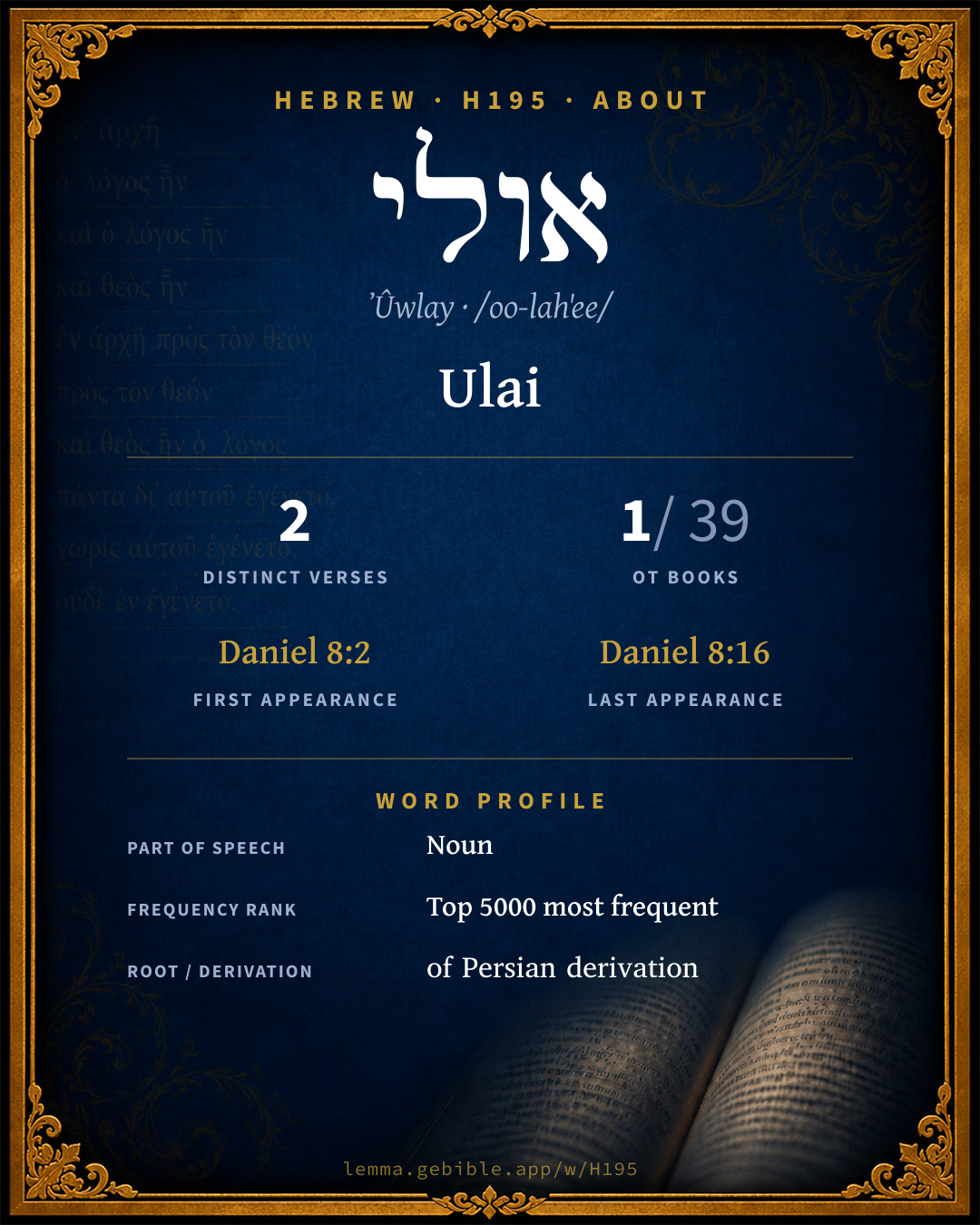
אוּלַי
Ulai
BDB lists 2 entries for ‘Ulai’ fuller range ↓
Full lexicon entry — Brown-Driver-Briggs (BDB)
From Brown-Driver-Briggs (BDB)
Where this word appears
Grammar key — what these labels mean
Part of speech
- Noun
- A naming word — a person, place, thing, or idea.
Noun type
- Proper
- A name of a specific person, place, or people (e.g. Abraham, Zion, Israel).
Every verse where H195 appears — 2 distinct verses across 1 book. Click any verse to open its interlinear word-by-word view. Verse text shown in the World English Bible for context — . Each verse’s Hebrew form is shown with its reference; the English is not keyword-highlighted, since the data carries no word-level English alignment. Use “Compare translations” on any verse to read it across multiple English versions. This concordance covers the Hebrew Bible; Septuagint (Greek Old Testament) occurrences are not indexed here.
Daniel 2 verses
- Daniel 8:2 אוּלָֽי n Proper I saw in the vision; now it was so, that when I saw, I was in Shushan the palace, which is in the province of Elam; and I saw in the vision, and I was by the river Ulai.
- Daniel 8:16 אוּלָ֑י n Proper I heard a man's voice between [the banks of] the Ulai, which called, and said, Gabriel, make this man to understand the vision.
About this entry
At a glance — auto-summarized from this page’s data, not written by a person. Every figure links to its source below. This summary describes the numbers; it doesn’t interpret them.
אולי (ʼÛwlay) is a Hebrew name most often rendered “Ulai.” A scarce word — 2 verses in all of the Hebrew Bible. It clusters heavily in Daniel, which alone accounts for 100% of its uses. Scripture first uses it in Daniel 8:2. The sections below give every occurrence and version rendering.
Gloss history
Strong's 1890 vs modern scholarship
About this word
Strong's H195 catalogs a Hebrew word from the Hebrew Old Testament.
These counts are not copied from any lexicon or concordance. They are computed here, from the morphology-tagged Hebrew Old Testament. What Lemma adds →
- 2
- distinct verses
- The word appears in 2 distinct verses.
- 1 / 39
- OT books
- The word appears in 1 of 39 Old Testament books.
- #4,807
- by frequency
- Top 5000 most frequent Hebrew words (rank 4,807 of 8,640 Hebrew words by occurrence).
View all 2 occurrences in the concordance →
Most concentrated in
- Daniel 2 verses 100%
By section of the Old Testament
By traditional corpus
Conventional, traditional groupings — biblical authorship is debated, so this is a traditional corpus grouping, not an authorship claim. Each share is this word’s portion of its verses in that division of the Hebrew canon. Each figure is a share of the word’s 2 distinct verses.
- Writings (Ketuvim) 2 verses · 100%
How translations render this word
Counts come from each version’s own published word-to-Strong’s tagging or interlinear alignment — an approximate guide to how each version renders this word, not a word-level alignment the data otherwise carries. Because each total is that version’s own tagged count, the per-version totals vary from one another and need not match the appearance or distinct-verse counts above. These counts may also differ from a printed concordance because Lemma counts each distinctly tagged rendering and does not collapse phrase taggings into a single head-word total. This is a fixed set of word-tagged versions (KJV, ASV, BSB, ULT) and does not change with the reading translation you choose elsewhere. Each version’s license is shown beside its name below (and on Sources).
BDB lists this Strong’s number as 2 distinct words (homographs). Each count above pools all of them and is not split by sense — see the Senses section below. A low-frequency rendering may belong to a different one of those words, not the primary meaning.
- King James Version†: Between the banks of ulai 1×, Ulai 1×
- American Standard Version†: Between the banks of the ulai 1×, Ulai 1×
- Berean Standard Bible†: Ulai 2×
- unfoldingWord Literal Text†: Banks of the ulai 1×, Ulai 1×
King James Version Public Domain
Renders H195 across 2† tagged occurrences — most commonly:
American Standard Version Public Domain
Renders H195 across 2† tagged occurrences — most commonly:
Berean Standard Bible Public Domain
Renders H195 across 2† tagged occurrences — most commonly:
unfoldingWord Literal Text CC BY-SA 4.0
Renders H195 across 2† tagged occurrences — most commonly:
Senses in the full BDB
What do BDB’s symbols mean?
BDB uses these scholarly abbreviations:
| Symbol | Meaning |
|---|---|
| 𝔊 | the Septuagint (the ancient Greek translation, LXX) |
| 𝔙 | the Vulgate (the Latin translation) |
| 𝔖 | the Syriac version (the Peshitta) |
| 𝔗 | the Targum (the Aramaic translation) |
| ψ | the Psalms |
| √ | root (the underlying root or stem) |
| ‖ | parallel passage (a synonymous or contrasted parallel) |
| † | the dagger: every passage where the word occurs is cited |
The 3 senses and sub-senses the full Brown-Driver-Briggs lexicon distinguishes for this word, in lexicon order (not ranked by frequency), with BDB’s own verbatim wording and sub-sense lettering. Shown in Hebrew script with BDB’s own scholarly abbreviations. The condensed entry is in the Lexicon Entry tab. See also the Forms in the corpus table below.
אולי I fl. Ulai, Eulaeus (Assyrian Ulâi, cf. DlPa 329 Gr. Εὐλαιος) only אוּלָ֑י, river of Elam Dn 8
אולי II and (Gn 24
- 1. peradventure, perhaps; usually expressing a hope, as Gn 16:2 Nu 22:6, 11; 23:3 1 S 6:5 Je 20:10; but also a fear or doubt, as Gn 27:12 Jb 1:5, sq. לֹא Gn 24:5, 39; in mockery Is 47:12; Je 51:8. e.g. Genesis 16:2
- 2. followed by another clause ἀσυνδέτως, it expresses virtually the protasis = if peradventure Gn 18:24, 28 (cf. v 29–32) Ho 8:7 the blade shall yield no meal; אוּלַי יַעֲשֶׂה זָרִים יִבְלָעֻהוּ if perchance it yield strangers shall swallow it up. e.g. Genesis 18:24
- 3. in Nu 22:33 לוּלֵי (q.v.) must be read; unless she had turned aside from me, surely, etc. e.g. Numbers 22:33
Senses from the full Brown-Driver-Briggs lexicon (Brown, Driver, Briggs; Oxford 1906 — public domain), digitized via Sefaria, supplemented by the OpenScriptures HebrewLexicon (CC BY 4.0). Full attribution on Sources.
Word origin
I. n.pr.fl. Ulai, Eulaeus (Assyrian Ulâi, cf. DlPa 329 Gr. Εὐλαιος) only אוּלָ֑י, river of Elam Dn 8:2, 16; = (at least in lower part) mod. Karûn (old Pasitigris) v. DlPa 177.189.329; in upper part perhaps also = mod. Kerkhah (= Choaspes), which was formerly connected with Karûn not far from Susa (LoftusTrav. & Researches, 423 ff Schaff-Herz.iii. 2178, art. Shushan).
II. and (Gn 24:39) אֻלַי adv. (perhaps from אוֹ & לַי = לֵי, לֵא, as in לוּלֵא, = or not?)
— Brown-Driver-Briggs (Oxford 1906, public domain), digitized via Sefaria, supplemented by the OpenScriptures HebrewLexicon (CC BY 4.0). See Sources.
Origin: of Persian derivation
Forms in the corpus
The 2 distinct written forms H195 takes in the Hebrew Bible, most frequent first — each parse links to that state’s occurrences in the concordance. Hebrew forms include their vowel points and cantillation, so a single lemma takes many written forms.
| Form | Parsing | Example | Uses |
|---|---|---|---|
| אוּלָ֑י | Noun, Proper | Daniel 8:16 | 1 |
| אוּלָֽי | Noun, Proper | Daniel 8:2 | 1 |
Bible dictionary
Public-domain dictionary articles matched to this entry by name (Ulai). A biblical name can be shared by more than one person or place, so an article may treat several.
Easton's Bible Dictionary · M. G. Easton, 1897
The Eulaus of the Greeks; a river of Susiana. It was probably the eastern branch of the Choasper (Kerkhan), which divided into two branches some 20 miles above the city of Susa. Hence Daniel (8:2, 16) speaks of standing "between the banks of Ulai", i.e., between the two streams of the divided river.
Smith's Bible Dictionary · William Smith, 1863
(pure water) is mentioned by Daniel, (Daniel 8:2,16) as a river near to Susa, where he saw his vision of the ram and the he-goat. It has been generally identified with the Eulaeus of the Greek and Roman geographers, a large stream in the immediate neighborhood of that city. The Eulseus has been by many identified with the Choaspes, which is undoubtedly the modern Kerkhah, an affluent of the Tigris, flowing into it a little below Kurnah . Recent surveys show that the Choarspes once divided into two streams about 20 miles above Susa. The eastern was the Ulai. This bifurcation explains (Daniel 8:16)
Hitchcock's Bible Names Dictionary · Roswell D. Hitchcock, 1869
strength; fool; senseless
Classic public-domain reference works; full attribution on Sources.
Septuagint verse parallels
This word appears in 2 verses that also exist in the Greek Old Testament (Septuagint), out of the 2 Hebrew verses it occurs in. You can read those verses in Greek by switching the Old Testament edition to the Septuagint.
Read these verses in the Septuagint
This is a verse-level parallel only — the same verses exist in both the Hebrew and Greek Old Testaments. No word-level Hebrew↔Greek correspondence is claimed: the data carries no such alignment, so no Greek word is shown as this Hebrew word’s translation. Coverage is not total — the Septuagint omits the deuterocanon and renumbers the Psalms, so some Hebrew verses have no direct Greek parallel.