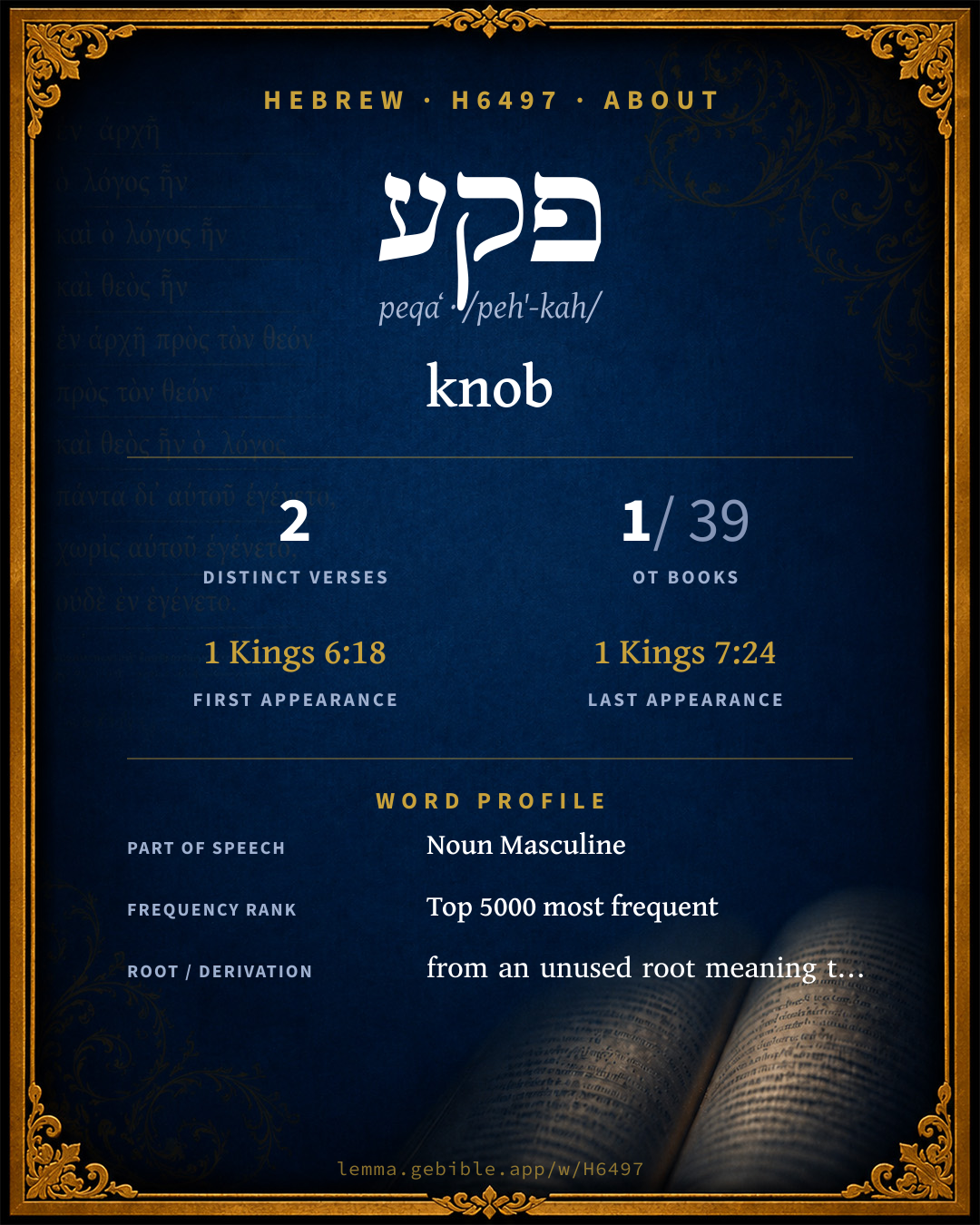
פֶּקָעִים
knob
Full lexicon entry — Brown-Driver-Briggs (BDB)
From Brown-Driver-Briggs (BDB)
Where this word appears
Grammar key — what these labels mean
Part of speech
- Noun
- A naming word — a person, place, thing, or idea.
Noun type
- Common
- A common noun — a general class of person, place, or thing (“king,” “city,” “water”), not a specific name.
State
- Absolute
- The independent form of a noun, not bound to a following word.
Gender
- Masculine
- Grammatically masculine.
Number
- Plural
- More than one (in Hebrew, generally three or more).
Every verse where H6497 appears — 2 distinct verses across 1 book. Click any verse to open its interlinear word-by-word view. Verse text shown in the World English Bible for context — . Each verse’s Hebrew form is shown with its reference; the English is not keyword-highlighted, since the data carries no word-level English alignment. Use “Compare translations” on any verse to read it across multiple English versions. This concordance covers the Hebrew Bible; Septuagint (Greek Old Testament) occurrences are not indexed here.
1 Kings 2 verses
- 1 Kings 6:18 פְּקָעִ֔ים n c mp There was cedar on the house within, carved with buds and open flowers: all was cedar; there was no stone seen.
- 1 Kings 7:24 וּ/פְקָעִים֩ הַ/פְּקָעִ֔ים conj + n c mp ptcl def.art + n c mp Under the brim of it round about there were buds which did compass it, for ten cubits, compassing the sea round about: the buds were in two rows, cast when it was cast.
About this entry
At a glance — auto-summarized from this page’s data, not written by a person. Every figure links to its source below. This summary describes the numbers; it doesn’t interpret them.
The Hebrew noun פקע centers on the idea of “knob.” The Hebrew Bible uses it only 2 verses. The word gravitates to 1 Kings (100%). Its earliest occurrence is 1 Kings 6:18. It shares a root with פקעה. Dig into 2-verse concordance and the renderings breakdown below.
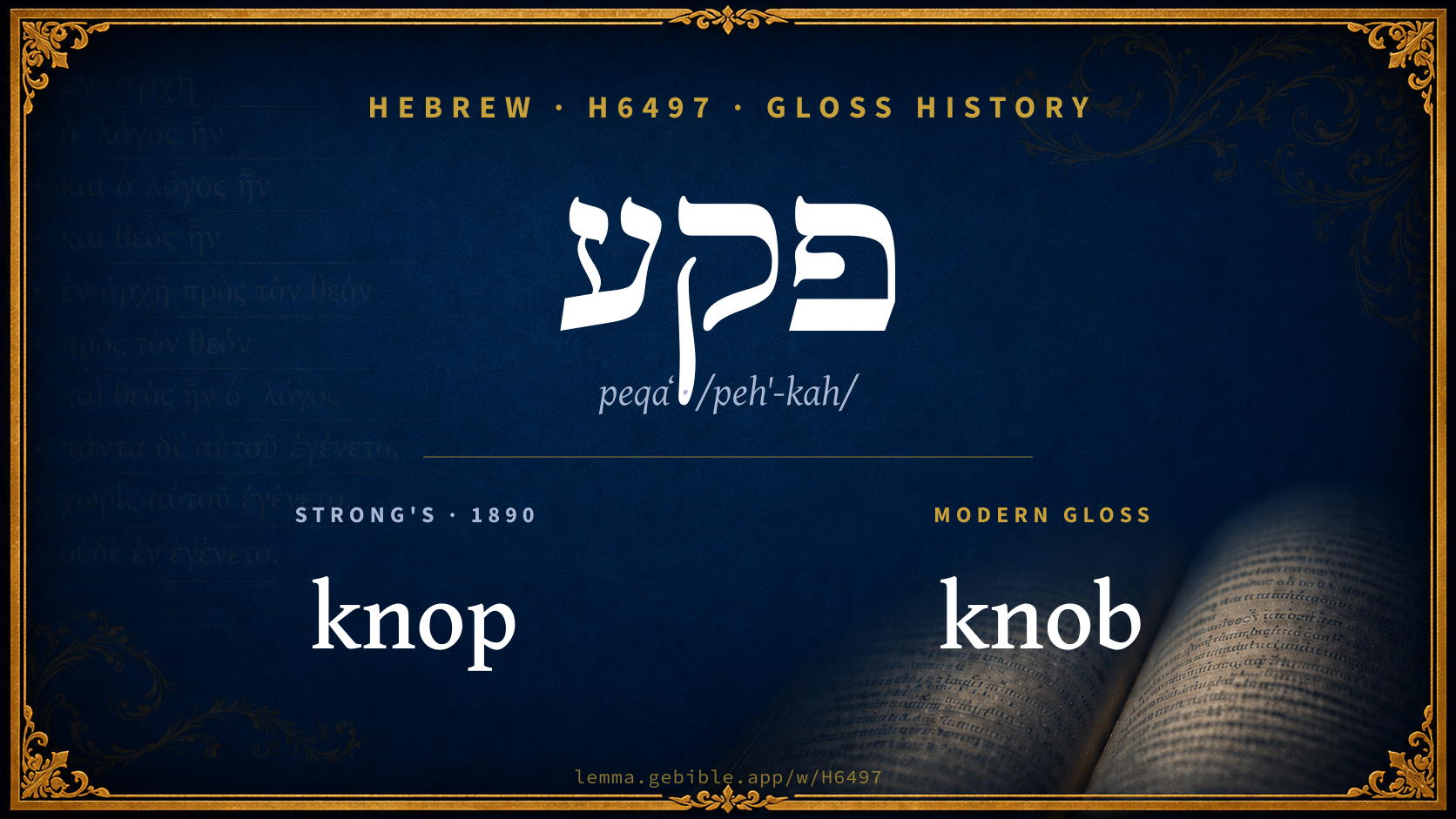
Gloss history
Strong's 1890 vs modern scholarship
About this word
Strong's H6497 catalogs a Hebrew word from the Hebrew Old Testament.
These counts are not copied from any lexicon or concordance. They are computed here, from the morphology-tagged Hebrew Old Testament. What Lemma adds →
- 2
- distinct verses
- The word appears in 2 distinct verses.
- 1 / 39
- OT books
- The word appears in 1 of 39 Old Testament books.
- #4,179
- by frequency
- Top 5000 most frequent Hebrew words (rank 4,179 of 8,640 Hebrew words by occurrence).
View all 2 occurrences in the concordance →
Most concentrated in
- 1 Kings 2 verses 100%
By section of the Old Testament
By traditional corpus
Conventional, traditional groupings — biblical authorship is debated, so this is a traditional corpus grouping, not an authorship claim. Each share is this word’s portion of its verses in that division of the Hebrew canon. Each figure is a share of the word’s 2 distinct verses.
- Prophets (Nevi'im) 2 verses · 100%
How translations render this word
Counts come from each version’s own published word-to-Strong’s tagging or interlinear alignment — an approximate guide to how each version renders this word, not a word-level alignment the data otherwise carries. Because each total is that version’s own tagged count, the per-version totals vary from one another and need not match the appearance or distinct-verse counts above. These counts may also differ from a printed concordance because Lemma counts each distinctly tagged rendering and does not collapse phrase taggings into a single head-word total. This is a fixed set of word-tagged versions (KJV, ASV, BSB, ULT) and does not change with the reading translation you choose elsewhere. Each version’s license is shown beside its name below (and on Sources).
- King James Version: Knops 2×
- American Standard Version: Knops 2×
- Berean Standard Bible: Gourds 1×, Ornamental buds 1×
- unfoldingWord Literal Text: Gourds 3×
King James Version Public Domain
Renders H6497 across 3 tagged occurrences — most commonly:
Plus 1 rendering that appears only once — usually multi-word phrases or single function words the recovered tagging swept in, not distinct renderings.
American Standard Version Public Domain
Renders H6497 across 3 tagged occurrences — most commonly:
Plus 1 rendering that appears only once — usually multi-word phrases or single function words the recovered tagging swept in, not distinct renderings.
Berean Standard Bible Public Domain
Renders H6497 across 2 tagged occurrences — most commonly:
Not rendered by a distinct English word in 1 further occurrence.
unfoldingWord Literal Text CC BY-SA 4.0
Renders H6497 across 3 tagged occurrences — most commonly:
Senses in BDB
The 1 sense BDB distinguishes for this word, in lexicon order (not ranked by frequency or importance). The full entry — with sub-senses — is in the Lexicon Entry tab.
- knob-shaped or ball-shaped or gourd-shaped carved wood or metal ornament
Word origin
n.m. 1 K 7:24 pl. carved wood or metal ornaments, either ball-, knob-shaped (Löwp. 332 f.) or gourd-shaped (so most; cf. foll.; Syriac ܦܩܺܝܥܶܐ flowers [Lexx]);—1 K 6:18; 7:24(×2).
— Brown-Driver-Briggs (Oxford 1906, public domain), digitized via Sefaria, supplemented by the OpenScriptures HebrewLexicon (CC BY 4.0). See Sources.
Origin: from an unused root meaning to burst
Jastrow Dictionary
A second Hebrew/Aramaic lexicon for comparison, covering Aramaic and post-biblical (Talmudic, Targumic, Midrashic) usage that the biblical-Hebrew BDB does not. Matched by lemma rather than by Strong’s number, so a lemma may carry more than one Jastrow headword (shown separately below), and the entries cover usage well beyond the Bible.
פְּקִיעַ I
- (פָּקַע)
- 1. strip; shreds of garments ravelled into threads for wicks. Shek. V, 1 בן בבי (ממונה) על הפ׳ Ben Bebai was appointed to superintend the preparation of wicks from the shreds of priestly garments; Y. Peah VIII, 21ᵃ (interch. with הפתילה).
- 2. a strip of leather, a strap used as a whip. Yoma 23ᵃ לוקה … בפ׳ he is smitt en by the overseer with a strap (expl. מַדְרָא, מְטַרְקָא). Ib. (ref. to Shek. l. c.) אמינא מאי פ׳ נגדא I would now say, p’ḳiʿa means strap (appointed to execute punishment).—Eduy. III, 5 בית הפ׳ (Rabad הפְּקִיעָה) that end of the bow from which the thong is snapped
- 3. [that which is to be stripped or ravelled,] bundle, bunch. B. Kam. 117ᵃ הרשט לי פ׳ זה Ar. (ed. פ׳ עמיר) hand me this bunch (of sheaves). Tosef. B. Mets. VIII, 4; a. e.—Pl. פְּקִיעִים, פְּקִיעִין. Sabb. XXIV, 2 מתירין פְּקִיעֵי עמיר וכ׳ you may untie bundles of sheaves for the cattle &c. Ib. 155ᵃ הן הן פ׳ הן הן כיפין p’ḳiin and kippin mean the same things. Ib. פ׳ תרי bunches are called p’ḳiin, when tied with two bands, v. כִּיפָּה. Tosef. Succ. I, 4; a. e.
- 4. that which has been chipped off, piece.—Pl. as ab., v. פֶּקַע
פָּקַע
- (cmp. בקע) to split; to burst; to break forth, escape. Gen. R. s. 32 אינו מספיק … עד שהיא פוֹקַעַת he scarcely beats it (the bad flax) once, when it bursts; ib. s. 34; Yalk. Is. 350. Gen. R. l. c. שאינו מקיש עליהם אחת עד שהיא פוקעת he knocks at them (the bad earthen vessels) scarcely once, and one is cracked (ib. s. 32 עד שהוא שוברם). Y. Maasr. III, 50ᵈ top פעמים שהיא פוקעת וכ׳ sometimes it (the fig) bursts under the wheel. Zeb. IX, 6 גחלת שפָּקְעָה מעל וכ׳ a coal that sprang from the altar; אברים שפָּקְעוּ וכ׳ chips of limbs that sprang off the altar. Tosef. Par. III (II), 11 פ׳ מעורה וכ׳ if a part of her skin … (in burning the red cow) leaped off beyond the pit. Ib. 12. Yalk. Num. 761 את הפּוֹקְעִין the portions which spring off, v. פֶּקַע; a. fr.—Pesik. R. s. 11 או שמא תִפְקַע האוזן וכ׳ (or תִפָּקַע Nif.) or (I would venture to say it, were I not afraid,) lest the ear of the hearer burst, i.e. it is almost blasphemous to say it; (Mekh. Yithro, Baḥod., s. 2 כדי שתבקע אוזן it is enough for an ear to burst). Y. Yeb. I, 2ᶜ bot. פקעו ממנה קידושין (not ופקעו) the betrothal rebounds from her, i.e. has no legal effect, opp. חלו עליה.—Part. pass. פָּקוּעַ; f. פְּקוּעָה an animal which is ripped open; בן (ה) פ׳ an animal taken alive out of the slaughtered mother’s womb. Ḥull. 69ᵃ; a. fr.
- to cause splitting. Y. Pes. VII, 35ᵇ top שלא לפַקֵּעַ תחת הבשר in order not to cause a splitting of the bone under the flesh, v. פֶּקַע.
- 1. to split, break open. Sabb. III, 3 (38ᵇ) לא יַפְקִיעֶנָּה בסודרין he must not break it (the egg) over a hot cloth, Rashi (oth. interpret.: he must not cause it to crack by wrapping it in a hot cloth and rolling it; v. Tosaf. Yom Tob a. l.).
- 2. to strip, pluck, ravel out. Bets. 31ᵇ מתיר ומַפְקִיעַ וחותך may untie (the knot, v. חוֹתָם), or ravel out or cut through; Sabb. 146ᵃ; Y. ib. XV, beg. 15ᵃ, a. e. ומַפְקִיעִין, v. פִּקְפֵּק. Succ. V, 3 מהן היו מַפְקִיעִין ובהן היו מדליקין they stripped them (the worn-out belts of priests) and used them for wicks; Sabb. 21ᵃ בגדי … מפקיעין אותן ומהן היו עושין פתילות וכ׳ they ravelled out priestly garments and made of them wicks &c.; expl. Y. Succ. V, 55ᵇ bot. מפשילים, v. פָּשַׁל. Esth. R. to I, 6 הכל מפקיעין בחבלי וכ׳ all make straps (for their couches) of woolen or flax ropes, and this wicked man uses byssus and purple; a. fr.—2) [to cause breaking loose,] to release, cancel an obligation. Yeb. 66ᵇ sq., a. fr. הקדש … מפקיעין מידי שעבוד consecration (of a pledged object), leavened matter (on the entrance of Passover), and liberation (of a pledged slave) cause a release from mortgage (cancel the mortgage contract). Bekh. 5ᵃ אין בכור מפקיע בכור a first-born Levite could not serve as ransom for a first-born Israelite; דיו לבכור שיַפְקִיעַ וכ׳ it was enough for the firstborn Levite that he released his own consecration (that he needed no priest to be substituted for him); a. fr.
- 3. ה׳ השער to break up, unsettle the market, to raise prices arbitrarily, create a panic. Taan. II, 9 שלא להַפְקִיעַ השערים in order not to cause a sudden rise of market prices (by creating the impression of impending scarcity). Meg. 17ᵇ כנגד מַפְקִיעֵי שערים a prayer against those who raise prices (speculating on a coming scarcity).
פְּקַע
- , to burst, break, escape. Pes. 85ᵇ פ׳ איגרא the roof burst, v. זֵיתָא I. B. Mets. 20ᵇ פ׳ ארזא וכ׳ the cedar pillar of the school was cracked, v. לָתָא. Ab. Zar. 33ᵇ פַּקְעוּ they (the vessels) burst. Ib. 28ᵇ פַּקְעָא עינא her eye burst (fell out). Y. M. Kat. I, beg. 80ᵃ דלא יִפְקְעָן וכ׳ lest the grain burst (sprout) and go to ruin.—Ḥull. 89ᵇ פ׳ ליה איסור גיד מיניה has the prohibition resting on the nervus ischiadicus gone from it (ceased to affect it)? Ib. 139ᵃ פַּקְעָה קדושתייהו מינייהו their sacred character has ceased; Y. Keth. VIII, 22ᵇ top פַּקְעַת מינייהו קדושתן; a. fr.
- to break; פ׳ מ־ to hinder. Gitt. 44ᵃ מְפַקַּע ליה ממצות (by leaving his slave in the hands of a gentile) he prevents him from living up to the obligations (resting on the Noachidæ, v. נֹחַ); Bekh. 3ᵃ
- 1. as preced. Hif., to cancel, cause a release. Shebu. 48ᵇ אתיא שביעית אַפְקַעְתֵּיה the Sabbatical year comes and causes the cancellation of the debt. Gitt. 36ᵇ אלימי לאַפְקוּעֵי ממונא they have the power to declare a debt cancelled. Keth. 3ᵃ, a. fr. כל דמקדש … ואַפְקְעִינְהוּ רבנן וכ׳ whoever betroths a woman, does so in the sense of the rabbinical law (v. דַּעְתָּא), and for an eventuality like this the Rabbis have annulled his betrothal retroactively (so that no divorce would be necessary at all); a. fr.
- 2. to let go forth, issue, make known. Gitt. 36ᵃ (ref. to בקיאין סימנייהו their pictorial signatures on documents are well known) מעיקרא במאי אַפְקְעִינְהוּ on what kind of writs did they originally issue their signatures (so as to make the public familiar with them)?, v. פְּקִיעַ II.
- to be broken into. Targ. II Esth. III, 7 (ref. to ותבקע, II Kings XXV, 4). e.g. 2 Kings 25:4
פֶּקַע I
- (preced.) split, crack; that which bounds off, splinter, piece. Gen. R. s. 94 לא נמצא … לא קשר ולא פ׳ there was not in the timber either a knot or a crack; Cant. R. to I, 12. Pes. 84ᵇ משום פ׳ because by exposure to the coal fire the bone might crack. Ib. 85ᵃ משום פ׳ by striking at the uncovered part of the bone a split may be created in the covered portion; a. e.—Pl. פְּקָעִים, פְּקָעִין. Sifré Num. 124 (ref. to Num. XIX, 5) להביא את הפ׳ R. S. to Par. III, 9 (ed. הפְּקִיעִים; Yalk. Num. 761 הפּוֹקְעִין, v. פָּקַע) this is to include the fragments that jumped off (that they must be brought back and burned). e.g. Numbers 19:5
פֶּקַע II
- , v. פֶּקָא
A Dictionary of the Targumim, the Talmud Babli and Yerushalmi, and the Midrashic Literature (Marcus Jastrow; London, Luzac, 1903) — Public Domain. Digitized via Sefaria. Digitized via Sefaria. Full attribution on Sources.
Forms in the corpus
The 3 distinct written forms H6497 takes in the Hebrew Bible, most frequent first — each parse links to that state’s occurrences in the concordance. Hebrew forms include their vowel points and cantillation, so a single lemma takes many written forms.
| Form | Parsing | Example | Uses |
|---|---|---|---|
| הַ/פְּקָעִ֔ים | Noun, Common, Masculine, Plural, Absolute | 1 Kings 7:24 | 1 |
| וּ/פְקָעִים֩ | Noun, Common, Masculine, Plural, Absolute | 1 Kings 7:24 | 1 |
| פְּקָעִ֔ים | Noun, Common, Masculine, Plural, Absolute | 1 Kings 6:18 | 1 |
Same root — word family
Other BDB entries built from the same root as H6497, grouped by Strong’s listed origin. These share a root / origin per the lexicon — not necessarily a shared meaning. Each links to that word’s own entry.
Derived from this word
Compare all same-root words → They share a root, not necessarily a meaning.
Septuagint verse parallels
This word appears in 1 verse that also exists in the Greek Old Testament (Septuagint), out of the 2 Hebrew verses it occurs in. You can read those verses in Greek by switching the Old Testament edition to the Septuagint.
Read these verses in the Septuagint
This is a verse-level parallel only — the same verses exist in both the Hebrew and Greek Old Testaments. No word-level Hebrew↔Greek correspondence is claimed: the data carries no such alignment, so no Greek word is shown as this Hebrew word’s translation. Coverage is not total — the Septuagint omits the deuterocanon and renumbers the Psalms, so some Hebrew verses have no direct Greek parallel.