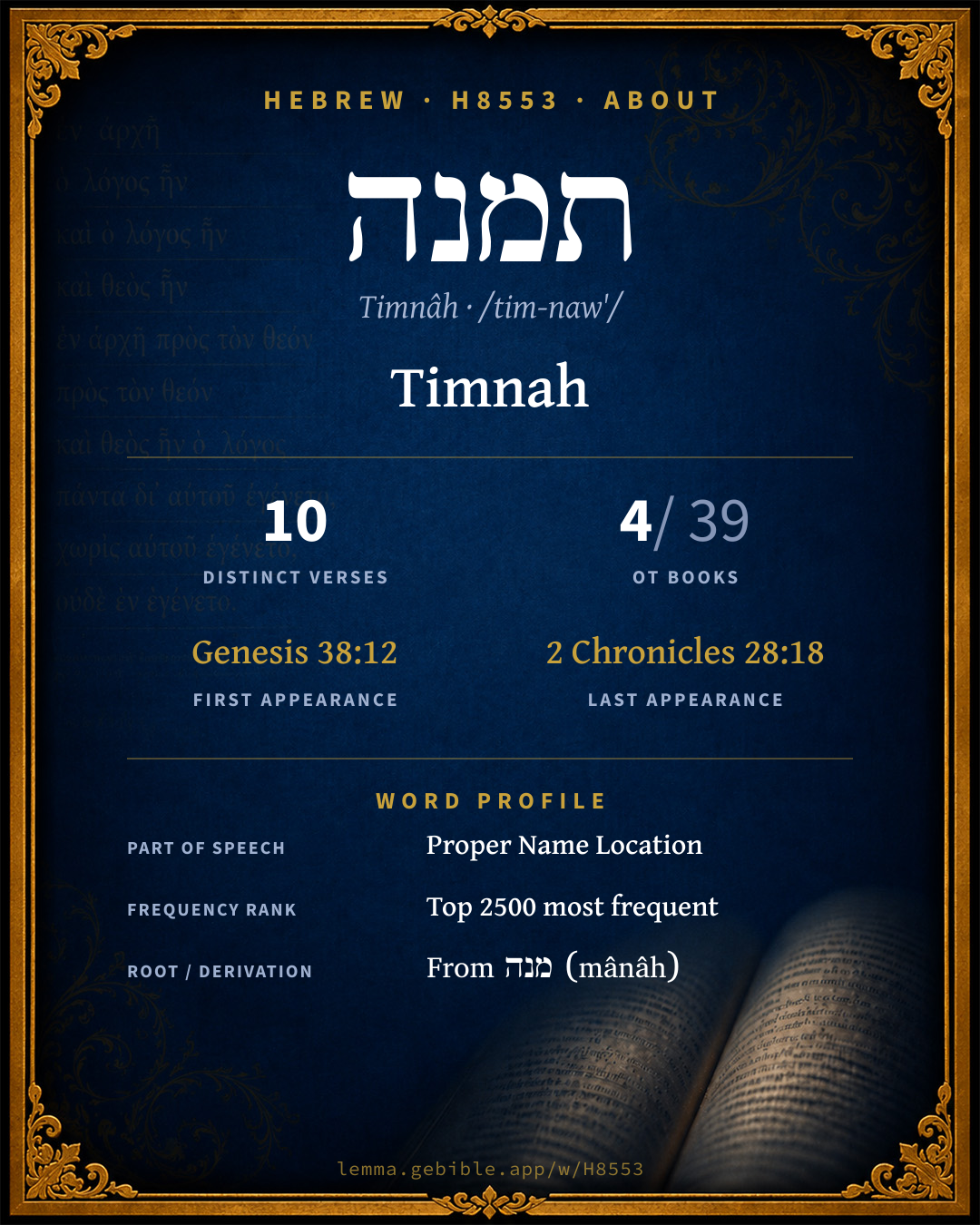
תִּמְנָה
Timnah
BDB lists 3 entries for ‘Timnah’ fuller range ↓
Full lexicon entry — Brown-Driver-Briggs (BDB)
From Brown-Driver-Briggs (BDB)
Where this word appears
Grammar key — what these labels mean
Part of speech
- Noun
- A naming word — a person, place, thing, or idea.
Noun type
- Proper
- A name of a specific person, place, or people (e.g. Abraham, Zion, Israel).
Every verse where H8553 appears in the Book of Genesis — 3 distinct verses. Click any verse to open its interlinear word-by-word view. Verse text shown in the World English Bible for context — . Each verse’s Hebrew form is shown with its reference; the English is not keyword-highlighted, since the data carries no word-level English alignment. Use “Compare translations” on any verse to read it across multiple English versions. This concordance covers the Hebrew Bible; Septuagint (Greek Old Testament) occurrences are not indexed here.
Genesis
- Genesis 38:12 תִּמְנָֽתָ/ה n Proper + sfx dem After many days, Shua's daughter, the wife of Judah, died. Judah was comforted, and went up to his sheep-shearers to Timnah, he and his friend Hirah, the Adullamite.
- Genesis 38:13 תִמְנָ֖תָ/ה n Proper + sfx dem It was told Tamar, saying, "Behold, your father-in-law is going up to Timnah to shear his sheep."
- Genesis 38:14 תִּמְנָ֑תָ/ה n Proper + sfx dem She took off of her the garments of her widowhood, and covered herself with her veil, and wrapped herself, and sat in the gate of Enaim, which is by the way to Timnah; for she saw that Shelah was grown up, and she wasn't given to him as a wife.
About this entry
At a glance — auto-summarized from this page’s data, not written by a person. Every figure links to its source below. This summary describes the numbers; it doesn’t interpret them.
At its core, תמנה (Timnâh) means “Timnah.” First canonically at Genesis 38:12, it enters the text early. It appears 10 verses across 4 books of the Hebrew Bible, among its uncommon vocabulary. The word gravitates to Genesis (30%), then Joshua and Judges. Dig into 10-verse concordance and the renderings breakdown below.
Gloss history
Strong's 1890 vs modern scholarship
About this word
Strong's H8553 catalogs a Hebrew word from the Hebrew Old Testament.
These counts are not copied from any lexicon or concordance. They are computed here, from the morphology-tagged Hebrew Old Testament. What Lemma adds →
- 10
- distinct verses
- The word appears in 10 distinct verses.
- 4 / 39
- OT books
- The word appears in 4 of 39 Old Testament books.
- #2,101
- by frequency
- Top 2500 most frequent Hebrew words (rank 2,101 of 8,640 Hebrew words by occurrence).
View all 10 occurrences in the concordance →
By section of the Old Testament
By traditional corpus
Conventional, traditional groupings — biblical authorship is debated, so this is a traditional corpus grouping, not an authorship claim. Each share is this word’s portion of its verses in that division of the Hebrew canon. Each figure is a share of the word’s 10 distinct verses.
- Prophets (Nevi'im) 6 verses · 60%
- Torah (Pentateuch) 3 verses · 30%
- Writings (Ketuvim) 1 verse · 10%
How translations render this word
Counts come from each version’s own published word-to-Strong’s tagging or interlinear alignment — an approximate guide to how each version renders this word, not a word-level alignment the data otherwise carries. Because each total is that version’s own tagged count, the per-version totals vary from one another and need not match the appearance or distinct-verse counts above. These counts may also differ from a printed concordance because Lemma counts each distinctly tagged rendering and does not collapse phrase taggings into a single head-word total. This is a fixed set of word-tagged versions (KJV, ASV, BSB, ULT) and does not change with the reading translation you choose elsewhere. Each version’s license is shown beside its name below (and on Sources).
- King James Version: Timnath 8×, Timnah 2×
- American Standard Version: Timnah 11×
- Berean Standard Bible: Timnah 11×
- unfoldingWord Literal Text: Timnah 12×
King James Version Public Domain
Renders H8553 across 12 tagged occurrences — most commonly:
Plus 2 renderings that appear only once — usually multi-word phrases or single function words the recovered tagging swept in, not distinct renderings.
American Standard Version Public Domain
Renders H8553 across 12 tagged occurrences — most commonly:
Plus 1 rendering that appears only once — usually multi-word phrases or single function words the recovered tagging swept in, not distinct renderings.
Berean Standard Bible Public Domain
Renders H8553 across 11 tagged occurrences — most commonly:
Not rendered by a distinct English word in 1 further occurrence.
unfoldingWord Literal Text CC BY-SA 4.0
Renders H8553 across 12 tagged occurrences — most commonly:
Senses in the full BDB
What do BDB’s symbols mean?
BDB uses these scholarly abbreviations:
| Symbol | Meaning |
|---|---|
| 𝔊 | the Septuagint (the ancient Greek translation, LXX) |
| 𝔙 | the Vulgate (the Latin translation) |
| 𝔖 | the Syriac version (the Peshitta) |
| 𝔗 | the Targum (the Aramaic translation) |
| ψ | the Psalms |
| √ | root (the underlying root or stem) |
| ‖ | parallel passage (a synonymous or contrasted parallel) |
| † | the dagger: every passage where the word occurs is cited |
The 2 senses and sub-senses the full Brown-Driver-Briggs lexicon distinguishes for this word, in lexicon order (not ranked by frequency), with BDB’s own verbatim wording and sub-sense lettering. Shown in Hebrew script with BDB’s own scholarly abbreviations. The condensed entry is in the Lexicon Entry tab. See also the Forms in the corpus table below.
- 1. place in hill-country of Judah Gn 38:12, 13, 14 prob.=Jos 15:57. Site unknown (cf. Di Gn 38:12 RobBR ii. 17 n.). e.g. Genesis 38:12
- 2. place on border of Judah Jos 15:10; 19:43 (assigned to Dan), Ju 14:1(×2), 2, 5(×2); 2 Ch 28:18. Mod. Tibneh, c. 15 m. S. of W. from Jerusalem cf. RobBR ii.17 BuhlGeogr. 196. e.g. Joshua 15:10
Senses from the full Brown-Driver-Briggs lexicon (Brown, Driver, Briggs; Oxford 1906 — public domain), digitized via Sefaria, supplemented by the OpenScriptures HebrewLexicon (CC BY 4.0). Full attribution on Sources.
Word origin
n.pr.loc. (prob.=portion, territory);—(תִּמְנָה Jos 15:10, 57 2 Ch 28:18; תִּמְנָ֫תָה [as nomin. v. GFM Ju 14:1] Jos 19:43 Ju 14:1, 2, 5; c. ה loc. תִּמְנָ֫תָה Gn 38:12, 13, 14 Ju 14:1, 5; 𝔊 Θαμνα, Θαμναθα):—
— Brown-Driver-Briggs (Oxford 1906, public domain), digitized via Sefaria, supplemented by the OpenScriptures HebrewLexicon (CC BY 4.0). See Sources.
Derived from מנה (mânâh) (H4487) — to count.
Jastrow Dictionary
A second Hebrew/Aramaic lexicon for comparison, covering Aramaic and post-biblical (Talmudic, Targumic, Midrashic) usage that the biblical-Hebrew BDB does not. Matched by lemma rather than by Strong’s number, so a lemma may carry more than one Jastrow headword (shown separately below), and the entries cover usage well beyond the Bible.
תִּמְנָה
- (b. h.) pr. n. pl. Timnah. Sot. 10ᵃ (ref. to Jug. XIV, 1, a. Gen. XXXVIII, 13) חדא ת׳ וכ׳ there was only one Timnah: for him that came from the one side it was ‘going down’, for him that came from the other side, it was ‘going up’; Gen. R. s. 85 תמנתה אחת וכ׳; Yalk. ib. 145 חדא תמנתא הואי (corr. acc.); Yalk. Jud. 69 חדא תמנת; Num. R. s. 924 תמנתה אחת (some ed. תמנת).—Pl. תִּמְנוֹת, תִּמְנָאוֹת, תִּמְנָיוֹת. Ib. שתי ת׳ היו אחת של יהודה וכ׳ there were two Timnahs, one mentioned in connection with Judah, &c.; Gen. R. l. c. תמניות; Sot. l. c. תמנאות; Yalk. Gen. l. c.; Yalk. Jud. l. c. e.g. Genesis 38:13
A Dictionary of the Targumim, the Talmud Babli and Yerushalmi, and the Midrashic Literature (Marcus Jastrow; London, Luzac, 1903) — Public Domain. Digitized via Sefaria. Digitized via Sefaria. Full attribution on Sources.
Forms in the corpus
The 10 distinct written forms H8553 takes in the Hebrew Bible, most frequent first — each parse links to that state’s occurrences in the concordance. Hebrew forms include their vowel points and cantillation, so a single lemma takes many written forms.
| Form | Parsing | Example | Uses |
|---|---|---|---|
| תִּמְנָ֑תָ/ה | Noun, Proper | Genesis 38:14 | 3 |
| בְ/תִמְנָ֖תָ/ה | Noun, Proper | Judges 14:2 | 1 |
| בְּ/תִמְנָ֖תָ/ה | Noun, Proper | Judges 14:1 | 1 |
| וְ/תִמְנָ֑ה | Noun, Proper | Joshua 15:57 | 1 |
| וְ/תִמְנָ֖תָ/ה | Noun, Proper | Joshua 19:43 | 1 |
| תִמְנָ֔תָ/ה | Noun, Proper | Judges 14:5 | 1 |
| תִמְנָ֖תָ/ה | Noun, Proper | Genesis 38:13 | 1 |
| תִּמְנָ֣ה | Noun, Proper | 2 Chronicles 28:18 | 1 |
| תִּמְנָֽה | Noun, Proper | Joshua 15:10 | 1 |
| תִּמְנָֽתָ/ה | Noun, Proper | Genesis 38:12 | 1 |
Same root — word family
Other BDB entries built from the same root as H8553, grouped by Strong’s listed origin. These share a root / origin per the lexicon — not necessarily a shared meaning. Each links to that word’s own entry.
Derives from
Shares the same root
- מנא mᵉnâʼ H4483 to number
- מנה mâneh H4488 mina
- מנה môneh H4489 number
- מנה mânâh H4490 portion
- מנת mᵉnâth H4521 portion
Proper names from this root
People and places named from this root — a name, not an additional meaning of the word.
Compare all same-root words → Showing 4 of 10 — not the complete family. 3 of the same-root words are proper names (people or places). They share a root, not necessarily a meaning.
Bible dictionary
Public-domain dictionary articles matched to this entry by name (Timnah). A biblical name can be shared by more than one person or place, so an article may treat several.
Easton's Bible Dictionary · M. G. Easton, 1897
A portion. (1.) A town of Judah (Josh. 15:10). The Philistines took possession of it in the days of Ahaz (2 Chr. 28:18). It was about 20 miles west of Jerusalem. It has been identified with Timnatha of Dan (Josh. 19:43), and also with Timnath (Judg. 14:1, 5).
(2.) A city in the mountains of Judah (Josh. 15:57)= Tibna near Jeba'.
(3.) A "duke" or sheik of Edom (Gen. 36:40).
Smith's Bible Dictionary · William Smith, 1863
(portion).
+ A place which formed one of the landmarks on the north boundary of the allotment of Judah. (Joshua 15:10) It is probably identical with the Thimnathah of (Joshua 19:43) and that again with the Timnath, or, more accurately, Timnathah, of Samson (Judges 14:1,2,5) and the Thamnatha of the Maccabees. The modern representative of all these various forms of the same name is probably Tibneh, a village about two miles west of Ain Shems (Beth-shemesh). In the later history of the Jews, Timnah must have been a conspicuous place. It was fortified by Bacchides as one of the most important military posts of Judea. 1 Macc. 9:50. + A town in the mountain district of Judah. (Joshua 15:57) A distinct place from that just examined. + Inaccurately written Timnath in the Authorized Version, the scene of the adventure of Judah with his daughter in-law Tamar. (Genesis 38:12,13,14) There is nothing here to indicate its position. It may be identified either with the Timnah in the mountains of Judah No. 23 or with the Timnathath of Samson [No. 1].
Hitchcock's Bible Names Dictionary · Roswell D. Hitchcock, 1869
forbidding
Classic public-domain reference works; full attribution on Sources.
Septuagint verse parallels
This word appears in 10 verses that also exist in the Greek Old Testament (Septuagint), out of the 10 Hebrew verses it occurs in. You can read those verses in Greek by switching the Old Testament edition to the Septuagint.
Read these verses in the Septuagint
This is a verse-level parallel only — the same verses exist in both the Hebrew and Greek Old Testaments. No word-level Hebrew↔Greek correspondence is claimed: the data carries no such alignment, so no Greek word is shown as this Hebrew word’s translation. Coverage is not total — the Septuagint omits the deuterocanon and renumbers the Psalms, so some Hebrew verses have no direct Greek parallel.