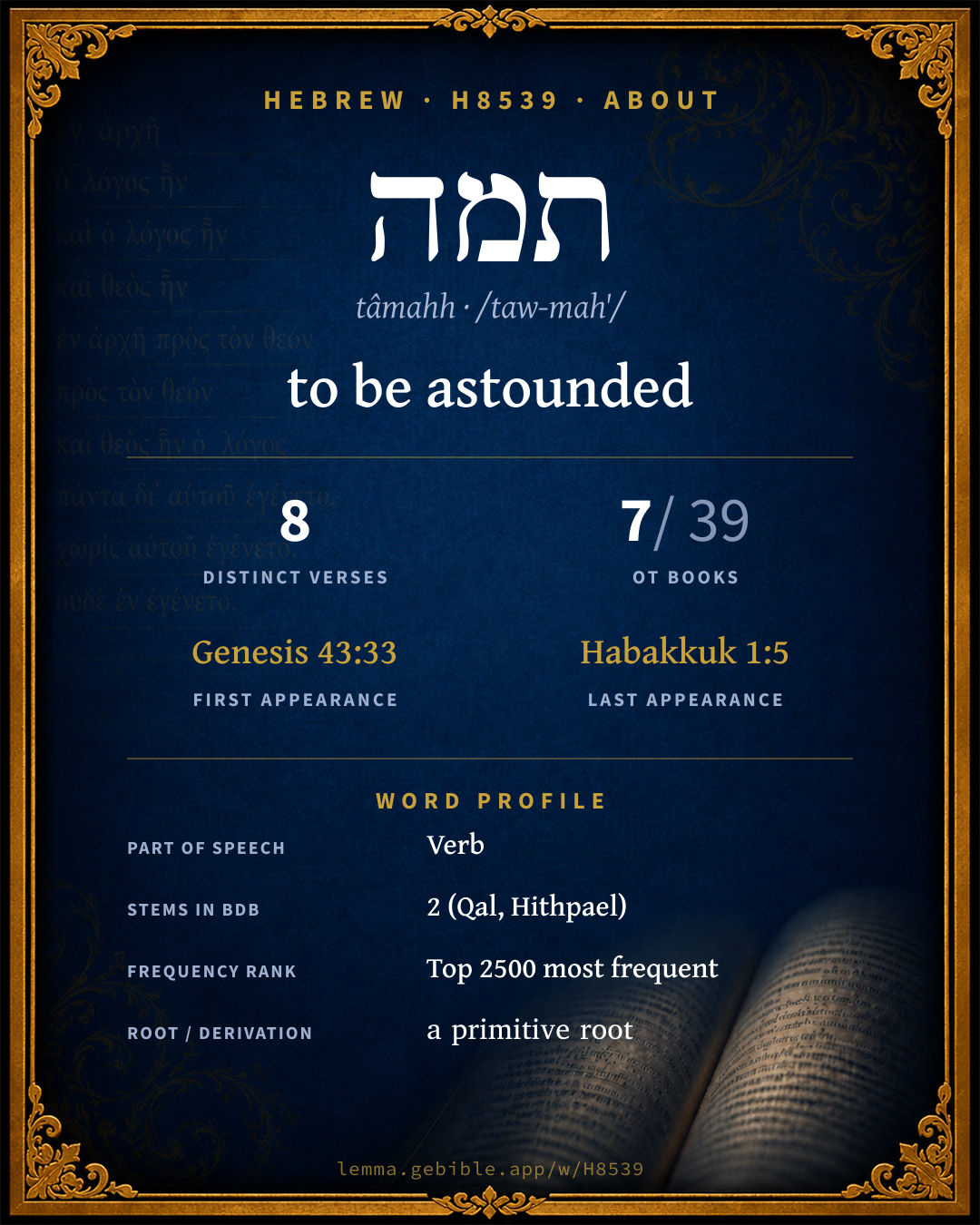
תָּמַהּ
to be astounded
also: be stunned, be amazed, be dumbfounded fuller range ↓
Full lexicon entry — Brown-Driver-Briggs (BDB)
From Brown-Driver-Briggs (BDB)
Where this word appears
See every Hithpael verb in the Hebrew Bible →
Grammar key — what these labels mean
Part of speech
- Verb
- An action or state-of-being word.
Stem
- Qal
- The basic, simple active stem — the plain form of the verb (“he wrote”). Here: ‘be astounded’
- Hithpael
- The reflexive or reciprocal stem (the subject acts on itself).
Form
- Imperfect
- An incomplete, ongoing, or future action (“he will / would write”).
- Imperative
- A direct command (“write!”).
- Sequential Imperfect
- An imperfect with prefixed waw — the standard past-narrative form (waw-consecutive imperfect).
- Jussive
- A third- or second-person volitional form expressing wish or command (“let him write”).
- Perfect
- A completed action or state — Hebrew marks aspect (completeness) more than strict tense (“he wrote”).
Person
- 3rd Person
- The one spoken about (“he / she / it / they”).
- 2nd Person
- The one addressed (“you”).
Gender
- Masculine
- Grammatically masculine.
- Common
- Either gender — not distinguished for this form.
Number
- Plural
- More than one (in Hebrew, generally three or more).
- Singular
- One.
1 verse where H8539 appears in the Hithpael stem in the Book of Habakkuk. Filtered view — show all forms. Click any verse to open its interlinear word-by-word view. Verse text shown in the World English Bible for context — . Each verse’s Hebrew form is shown with its reference; the English is not keyword-highlighted, since the data carries no word-level English alignment. Use “Compare translations” on any verse to read it across multiple English versions. This concordance covers the Hebrew Bible; Septuagint (Greek Old Testament) occurrences are not indexed here.
Habakkuk
About this entry
At a glance — auto-summarized from this page’s data, not written by a person. Every figure links to its source below. This summary describes the numbers; it doesn’t interpret them.
At its core, תמה (tâmahh) means “to be astounded.” Scripture first uses it in Genesis 43:33. It appears 8 verses across 7 books of the Hebrew Bible, among its uncommon vocabulary. The word gravitates to Isaiah (25%), then Genesis and Job. Across 2 stems, its meaning turns on the binyan (Qal, Hithpael). Dig into 8-verse concordance and the renderings breakdown below.
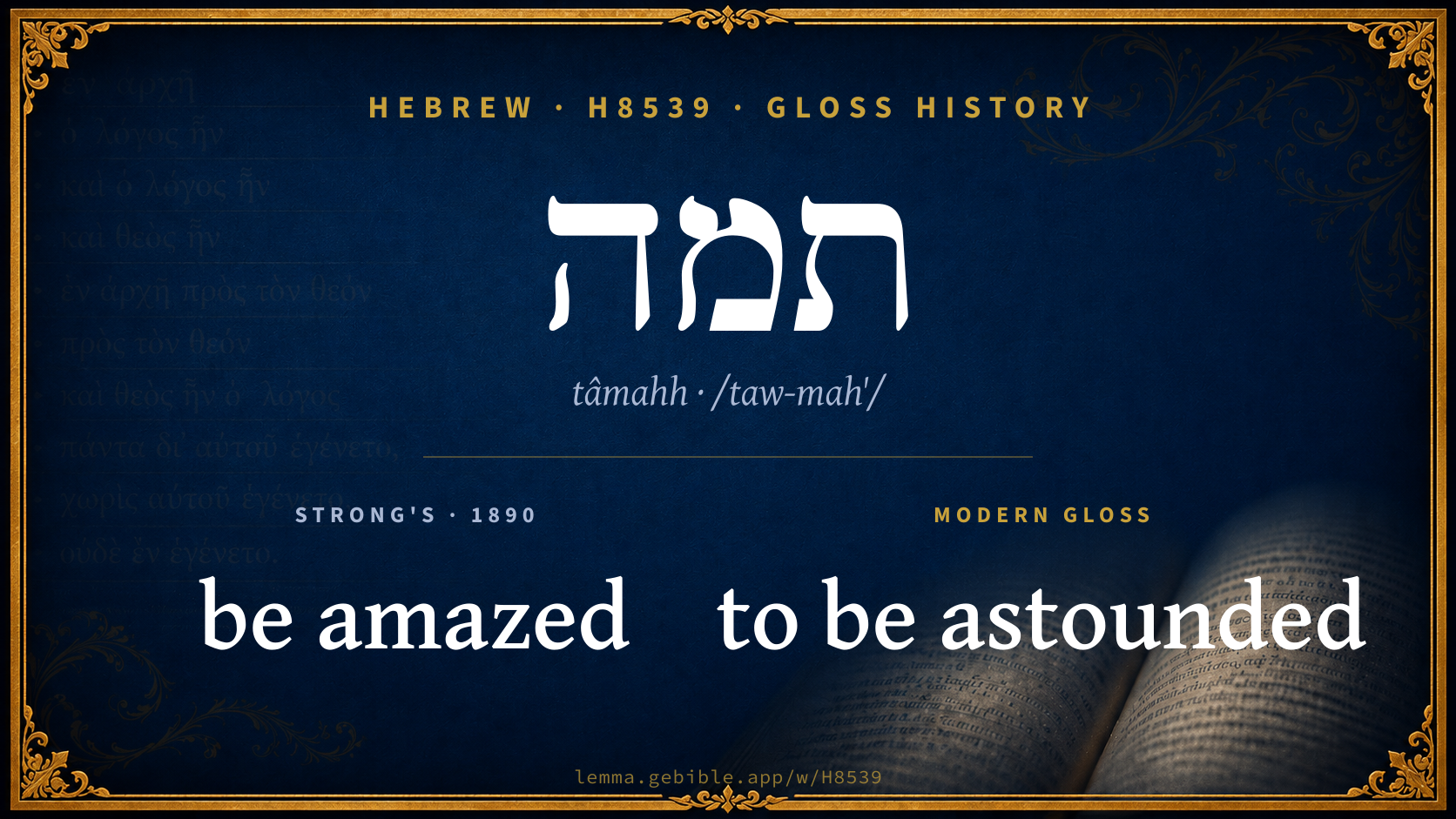
Gloss history
Strong's 1890 vs modern scholarship
About this word
Strong's H8539 catalogs a Hebrew word from the Hebrew Old Testament.
These counts are not copied from any lexicon or concordance. They are computed here, from the morphology-tagged Hebrew Old Testament. What Lemma adds →
- 8
- distinct verses
- The word appears in 8 distinct verses.
- 7 / 39
- OT books
- The word appears in 7 of 39 Old Testament books.
- #2,481
- by frequency
- Top 2500 most frequent Hebrew words (rank 2,481 of 8,640 Hebrew words by occurrence).
View all 8 occurrences in the concordance →
By section of the Old Testament
By traditional corpus
Conventional, traditional groupings — biblical authorship is debated, so this is a traditional corpus grouping, not an authorship claim. Each share is this word’s portion of its verses in that division of the Hebrew canon. Each figure is a share of the word’s 8 distinct verses.
- Prophets (Nevi'im) 4 verses · 50%
- Writings (Ketuvim) 3 verses · 38%
- Torah (Pentateuch) 1 verse · 13%
How translations render this word
Counts come from each version’s own published word-to-Strong’s tagging or interlinear alignment — an approximate guide to how each version renders this word, not a word-level alignment the data otherwise carries. Because each total is that version’s own tagged count, the per-version totals vary from one another and need not match the appearance or distinct-verse counts above. These counts may also differ from a printed concordance because Lemma counts each distinctly tagged rendering and does not collapse phrase taggings into a single head-word total. This is a fixed set of word-tagged versions (KJV, ASV, BSB, ULT) and does not change with the reading translation you choose elsewhere. Each version’s license is shown beside its name below (and on Sources).
- King James Version: Are astonished 1×, Marvel 1×, Marvelled 1×
- American Standard Version: Are astonished 1×, It 1×, Marvel 1×
- Berean Standard Bible: Be astonished 2×
- unfoldingWord Literal Text: Be amazed 3×
King James Version Public Domain
Renders H8539 across 9 tagged occurrences — most commonly:
American Standard Version Public Domain
Renders H8539 across 9 tagged occurrences — most commonly:
Berean Standard Bible Public Domain
Renders H8539 across 8 tagged occurrences — most commonly:
Plus 6 renderings that appear only once — usually multi-word phrases or single function words the recovered tagging swept in, not distinct renderings. Not rendered by a distinct English word in 1 further occurrence.
unfoldingWord Literal Text CC BY-SA 4.0
Renders H8539 across 11 tagged occurrences — most commonly:
Plus 8 renderings that appear only once — usually multi-word phrases or single function words the recovered tagging swept in, not distinct renderings.
Senses in the full BDB
Hebrew verbs can shift meaning by stem (binyan): Qal is the basic action, Niphal is often passive or reflexive, Piel often intensifies or makes it factitive, and Hiphil is typically causative. The senses below are grouped under the stem BDB assigns to each. This entry also uses Hithpael (reflexive or reciprocal).
What do BDB’s symbols mean?
BDB uses these scholarly abbreviations:
| Symbol | Meaning |
|---|---|
| 𝔊 | the Septuagint (the ancient Greek translation, LXX) |
| 𝔙 | the Vulgate (the Latin translation) |
| 𝔖 | the Syriac version (the Peshitta) |
| 𝔗 | the Targum (the Aramaic translation) |
| ψ | the Psalms |
| √ | root (the underlying root or stem) |
| ‖ | parallel passage (a synonymous or contrasted parallel) |
| † | the dagger: every passage where the word occurs is cited |
The 2 senses and sub-senses the full Brown-Driver-Briggs lexicon distinguishes for this word, in lexicon order (not ranked by frequency), with BDB’s own verbatim wording and sub-sense lettering. Shown in Hebrew script with BDB’s own scholarly abbreviations. The condensed entry is in the Lexicon Entry tab. See also the Forms in the corpus table below.
Qal
- be astounded
Hithpael
- . + Qal lit. astonish yourselves, be astounded
Senses from the full Brown-Driver-Briggs lexicon (Brown, Driver, Briggs; Oxford 1906 — public domain), digitized via Sefaria, supplemented by the OpenScriptures HebrewLexicon (CC BY 4.0). Full attribution on Sources.
Word origin
[ תָּמַהּ ] vb. be astounded, dumbfounded
— Brown-Driver-Briggs (Oxford 1906, public domain), digitized via Sefaria, supplemented by the OpenScriptures HebrewLexicon (CC BY 4.0). See Sources.
Origin: a primitive root
Jastrow Dictionary
A second Hebrew/Aramaic lexicon for comparison, covering Aramaic and post-biblical (Talmudic, Targumic, Midrashic) usage that the biblical-Hebrew BDB does not. Matched by lemma rather than by Strong’s number, so a lemma may carry more than one Jastrow headword (shown separately below), and the entries cover usage well beyond the Bible.
תָּמַהּ
- [to stand still,] to be astonished, amazed; to wonder; to be undecided. Pesik. R. addit., s. 1 והבריות תֹּומְהִים לומר וכ׳ and men wondered, saying, is such a thing possible? Ib. על דור המגדל אתם תֹּומְהִין וכ׳ you wonder at what occurred to the generation of the tower: has not such a thing occurred &c.? Yalk. Ex. 166 וַיִתְמְהוּ תמיהא גדולה מאד and they wondered exceedingly. Pesik. Haḥod., p. 43ᵃ היה … יושב ותָמֵהַּ בלבו וכ׳ Abraham sat and was undecided in his heart, saying, which shall I choose?; Gen. R. s. 44. Gen. R. s. 12 מלך … ועמד לו תָּמֵיהַּ a king that rebuked his servant, and he stood there confounded. Ib. תמיה אני איך וכ׳ I wonder how great men … could disagree on &c. Yeb. 96ᵇ תמיה אני אם לא וכ׳ I should wonder, if this synagogue did not become an idolatrous temple. Arakh. 16ᵇ תְּמִיהַנִי יש וכ׳ I wonder if there is in this generation &c. Pes. VI, 2 אל תִּתְמֵהּ על אלו do not wonder at that Y. ib. 33ᵇ bot. תמיהני היאך וכ׳ I wonder how R. El. could accept such an answer. Yalk. Ex. 202 תְּמַהּ על עצמה היאך וכ׳ wonder at the very thing, why should leavened matter be forbidden &c.; Pes. 28ᵇ תמה על עצמך (corr. acc.); a. fr.
- 1. same. Gen. R. s. 98 על אלו אתם מַתְמִיהִין you wonder at that? if you were to see היה לכם … להַתְמִיהַּ יותר (not להתמה) you would wonder still more. Pesik. R. s. 28 מַתְמִיהִין (not מתמהין); a. e.
- 2. to create astonishment, act strangely. Men. 40ᵃ אינו אלא מן המַתְמִיהִין is one of those who make people wonder at their strange conduct; (Ms. M. המוּתְמָהִין Hof. of those wondered at).
- 3. to love miracles, invent miracles. Yalk. Num. 764 אף אתה מן המַתְמִיהִים art thou, too, of the inventors of miracles?
- to be wondered at, v. supra.
תְּמַהּ
- , l) to wonder &c. Targ. Gen. XLIII, 33. Targ. Y. ib. XVII, 17 (h. text ויצחק). Targ. Y. I ib. XVIII, 12 (II חייכ׳). Targ. Y. ib. 15. Targ. Ez. XXXII, 10; a. e.—Part. תְּמִיהַּ; f. תְּמִיהָא. Targ. II Esth. I, 2 ת׳ ומַתְמְהָא.—V. אֶתְמְהָא.—2) to be astonishing. Gen. R. s. 94 אמר לי … והיא תַמְהָא the elder of the Jews told me something, and that is astonishing; [perh. to be read תִּמְהָא, v. תֵּימַהּ].
- 1. same. Targ. II Esth. l. c. Ib. מַתְמְהִין (some ed. מִתַּמְהִין, Ithpe.); a. e.
- 2. to express astonishment, query. Zeb. 113ᵃ אַתְמוּהֵי מַתְמַהּ קרא the text (Ez. XXII, 24) expresses a query: thou, land of Israel! art thou not cleansed &c.? e.g. Ezekiel 22:24
תֵּמַהּ
- , v. תֵּימַהּ
A Dictionary of the Targumim, the Talmud Babli and Yerushalmi, and the Midrashic Literature (Marcus Jastrow; London, Luzac, 1903) — Public Domain. Digitized via Sefaria. Digitized via Sefaria. Full attribution on Sources.
Forms in the corpus
The 9 distinct written forms H8539 takes in the Hebrew Bible, most frequent first — each parse links to that stem’s occurrences in the concordance. Hebrew forms include their vowel points and cantillation, so a single lemma takes many written forms.
| Form | Parsing | Example | Uses |
|---|---|---|---|
| וְ/הִֽתַּמְּה֖וּ | Verb, Hithpael, Imperative, 2nd Person, Masculine, Plural | Habakkuk 1:5 | 1 |
| וְ֝/יִתְמְה֗וּ | Verb, Qal, Imperfect, 3rd Person, Masculine, Plural | Job 26:11 | 1 |
| וַ/יִּתְמְה֥וּ | Verb, Qal, Sequential Imperfect, 3rd Person, Masculine, Plural | Genesis 43:33 | 1 |
| וּ/תְמָ֔הוּ | Verb, Qal, Imperative, 2nd Person, Masculine, Plural | Isaiah 29:9 | 1 |
| יִתְמָ֔הוּ | Verb, Qal, Imperfect, 3rd Person, Masculine, Plural | Isaiah 13:8 | 1 |
| יִתְמָֽהוּ | Verb, Qal, Imperfect, 3rd Person, Masculine, Plural | Jeremiah 4:9 | 1 |
| תְּמָ֑הוּ | Verb, Qal, Imperative, 2nd Person, Masculine, Plural | Habakkuk 1:5 | 1 |
| תִּתְמַ֖הּ | Verb, Qal, Jussive, 2nd Person, Masculine, Singular | Ecclesiastes 5:8 | 1 |
| תָּמָ֑הוּ | Verb, Qal, Perfect, 3rd Person, Common, Plural | Psalms 48:5 | 1 |
Same root — word family
Other BDB entries built from the same root as H8539, grouped by Strong’s listed origin. These share a root / origin per the lexicon — not necessarily a shared meaning. Each links to that word’s own entry.
Derived from this word
Compare all same-root words → They share a root, not necessarily a meaning.
Septuagint verse parallels
This word appears in 8 verses that also exist in the Greek Old Testament (Septuagint), out of the 8 Hebrew verses it occurs in. You can read those verses in Greek by switching the Old Testament edition to the Septuagint.
Read these verses in the Septuagint
This is a verse-level parallel only — the same verses exist in both the Hebrew and Greek Old Testaments. No word-level Hebrew↔Greek correspondence is claimed: the data carries no such alignment, so no Greek word is shown as this Hebrew word’s translation. Coverage is not total — the Septuagint omits the deuterocanon and renumbers the Psalms, so some Hebrew verses have no direct Greek parallel.