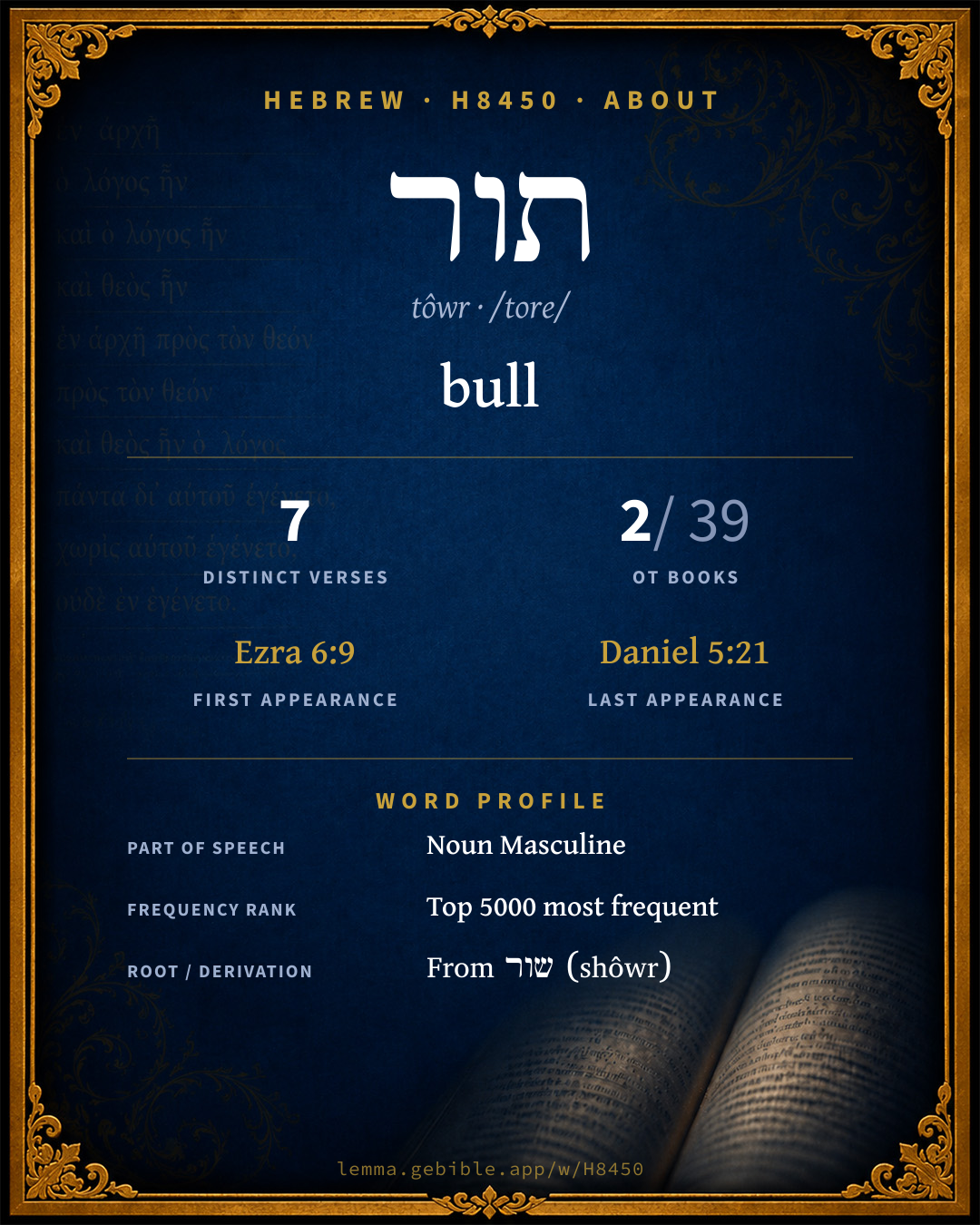
תּוֹר
bull
Full lexicon entry — Brown-Driver-Briggs (BDB)
From Brown-Driver-Briggs (BDB)
Where this word appears
Grammar key — what these labels mean
Part of speech
- Noun
- A naming word — a person, place, thing, or idea.
Noun type
- Common
- A common noun — a general class of person, place, or thing (“king,” “city,” “water”), not a specific name.
State
- Absolute
- The independent form of a noun, not bound to a following word.
Gender
- Masculine
- Grammatically masculine.
Number
- Plural
- More than one (in Hebrew, generally three or more).
Every verse where H8450 appears in the Book of Ezra — 3 distinct verses. Click any verse to open its interlinear word-by-word view. Verse text shown in the World English Bible for context — . Each verse’s Hebrew form is shown with its reference; the English is not keyword-highlighted, since the data carries no word-level English alignment. Use “Compare translations” on any verse to read it across multiple English versions. This concordance covers the Hebrew Bible; Septuagint (Greek Old Testament) occurrences are not indexed here.
Ezra
- Ezra 6:9 תוֹרִ֣ין n c mp That which they have need of, both young bulls, and rams, and lambs, for burnt offerings to the God of heaven; [also] wheat, salt, wine, and oil, according to the word of the priests who are at Jerusalem, let it be given them day by day without fail;
- Ezra 6:17 תּוֹרִ֣ין n c mp They offered at the dedication of this house of God one hundred bulls, two hundred rams, four hundred lambs; and for a sin-offering for all Israel, twelve male goats, according to the number of the tribes of Israel.
- Ezra 7:17 תּוֹרִ֤ין n c mp therefore you shall with all diligence buy with this money bulls, rams, lambs, with their meal-offerings and their drink-offerings, and shall offer them on the altar of the house of your God which is in Jerusalem.
About this entry
At a glance — auto-summarized from this page’s data, not written by a person. Every figure links to its source below. This summary describes the numbers; it doesn’t interpret them.
תור — transliterated tôwr — is a Hebrew noun carrying the sense “bull.” More than half of its appearances fall in Daniel. The Hebrew Bible uses it across 7 verses — uncommon. Debuting at Ezra 6:9, it then recurs through the corpus. See the sense tree, 7-verse concordance, and the renderings breakdown below.
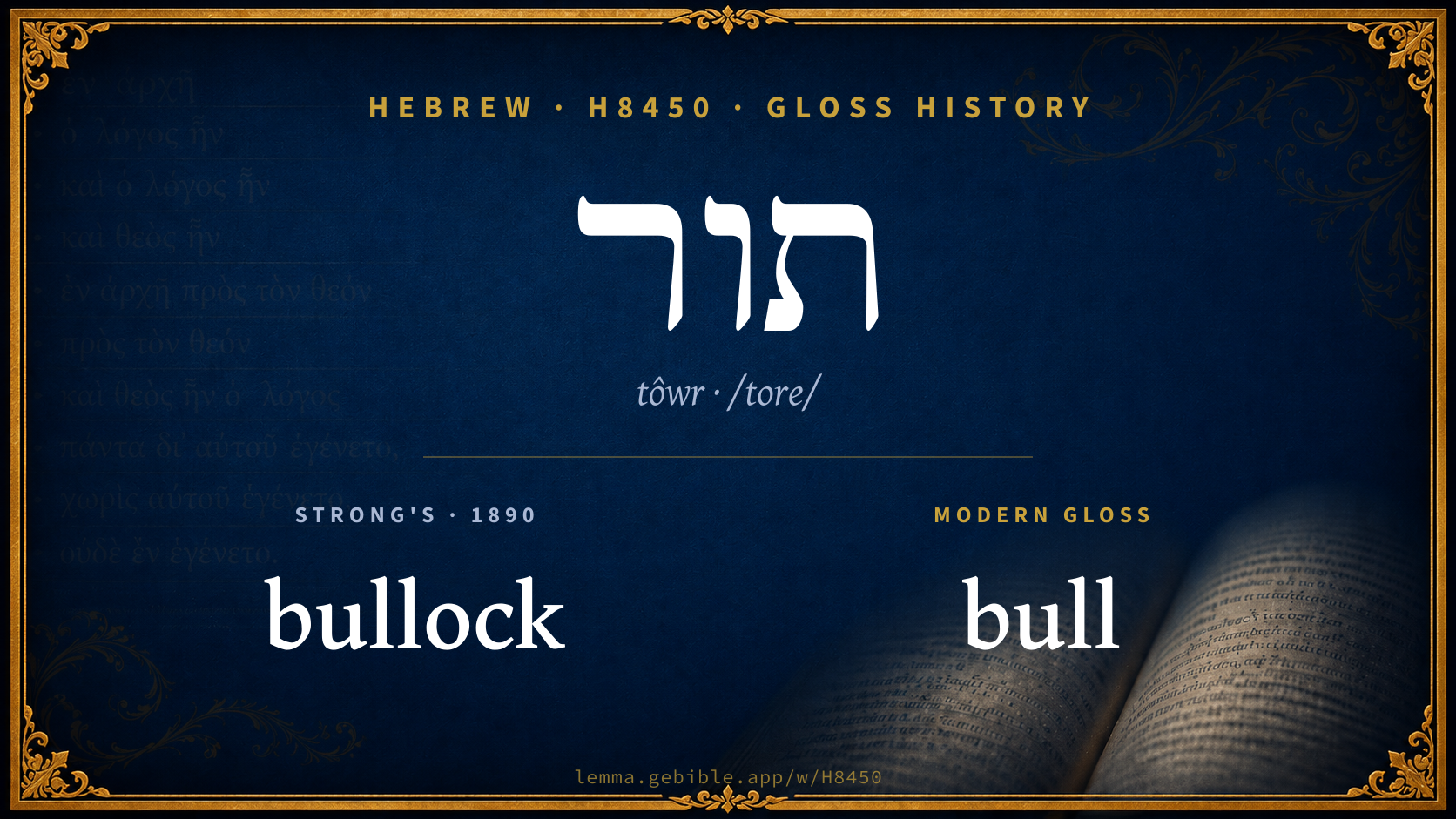
Gloss history
Strong's 1890 vs modern scholarship
About this word
Strong's H8450 catalogs a Hebrew word from the Hebrew Old Testament.
These counts are not copied from any lexicon or concordance. They are computed here, from the morphology-tagged Hebrew Old Testament. What Lemma adds →
- 7
- distinct verses
- The word appears in 7 distinct verses.
- 2 / 39
- OT books
- The word appears in 2 of 39 Old Testament books.
- #2,835
- by frequency
- Top 5000 most frequent Hebrew words (rank 2,835 of 8,640 Hebrew words by occurrence).
View all 7 occurrences in the concordance →
By traditional corpus
Conventional, traditional groupings — biblical authorship is debated, so this is a traditional corpus grouping, not an authorship claim. Each share is this word’s portion of its verses in that division of the Hebrew canon. Each figure is a share of the word’s 7 distinct verses.
- Writings (Ketuvim) 7 verses · 100%
How translations render this word
Counts come from each version’s own published word-to-Strong’s tagging or interlinear alignment — an approximate guide to how each version renders this word, not a word-level alignment the data otherwise carries. Because each total is that version’s own tagged count, the per-version totals vary from one another and need not match the appearance or distinct-verse counts above. These counts may also differ from a printed concordance because Lemma counts each distinctly tagged rendering and does not collapse phrase taggings into a single head-word total. This is a fixed set of word-tagged versions (KJV, ASV, BSB, ULT) and does not change with the reading translation you choose elsewhere. Each version’s license is shown beside its name below (and on Sources).
- King James Version: Bullocks 3×, Oxen 3×
- American Standard Version: Bullocks 3×, Oxen 3×
- Berean Standard Bible: Like an ox 4×, Bulls 2×
- unfoldingWord Literal Text: Like an ox 4×, Bulls 3×
King James Version Public Domain
Renders H8450 across 7 tagged occurrences — most commonly:
Plus 1 rendering that appears only once — usually multi-word phrases or single function words the recovered tagging swept in, not distinct renderings.
American Standard Version Public Domain
Renders H8450 across 7 tagged occurrences — most commonly:
Plus 1 rendering that appears only once — usually multi-word phrases or single function words the recovered tagging swept in, not distinct renderings.
Berean Standard Bible Public Domain
Renders H8450 across 7 tagged occurrences — most commonly:
Plus 1 rendering that appears only once — usually multi-word phrases or single function words the recovered tagging swept in, not distinct renderings.
unfoldingWord Literal Text CC BY-SA 4.0
Renders H8450 across 7 tagged occurrences — most commonly:
Senses in BDB
The 1 sense BDB distinguishes for this word, in lexicon order (not ranked by frequency or importance). The full entry — with sub-senses — is in the Lexicon Entry tab.
- bull, young bull, ox (for sacrifice)
Word origin
Derived from שור (shôwr) (H7794) — ox.
Jastrow Dictionary
A second Hebrew/Aramaic lexicon for comparison, covering Aramaic and post-biblical (Talmudic, Targumic, Midrashic) usage that the biblical-Hebrew BDB does not. Matched by lemma rather than by Strong’s number, so a lemma may carry more than one Jastrow headword (shown separately below), and the entries cover usage well beyond the Bible.
תּוּר I
- v. טוּר) [to go around; cmp. אָלַל,) to espy. Shebu. 47ᵇ (play on ות̇ר̇ג̇נ̇ו, Deut. I, 27) תַּ֗רְֹתֶּם וג̇ינ̇יתם באהלו וכ׳ you have espied (the land) and found fault with God’s tent; Num. R. s. 1620 תרתם גנות א"י you have espied the faults of the land of Israel; Tanḥ. Sh’laḥ 11. Y. Yoma I, 38ᵇ (play on האתרים, Num. XXI, 1) מת התייר הגדול שהיה תָר להם וכ׳ the great spy (Aaron) is dead who espied for them the road (of life); Y. Sot. I, end, 17ᶜ; Num. R. s. 1920. Lev. R. s. 15; Yalk. ib. 554 את מבקש לצאת לָתוּר פרנסתך thou desirest to go out and espy the means of thy sustenance; a. e. e.g. Deuteronomy 1:27
תּוּר II
- (contr. of תער, v. עוּר) to be awake.—V. תִּיר.
- to awaken. B. Kam. 117ᵇ תַּיְּירֵיה אוקמיה he waked him up (from the dead) and made him to stand (live).—[Gitt. 69ᵇ וניתייריה, read: וניתריה, v. תְּרֵי II.]
תּוֹר I
- v. תּוּר I)
- 1. turn, order. — Pl. תּוֹרִים. Cant. R. to I, 10 (ref. to בתורים, ib.) בשעה שקורין … בתוֹרֵיהֶן וכ׳ when they read the words of the Law in their due turn: the Passover laws on Passover &c.
- 2. string, twist. —Pl. as ab. Tosef. Sabb. VIII (IX), 31; Y. ib. VIII, 11ᵇ top; Bab. ib. 90ᵇ תּוֹרֵי דקל strings made of the fibrous bast of the palm, contrad. to צורי דקל, v. צוּר III.
תּוֹר II
- onomatop.) turtle-dove. Kinn. II, 5 האשה … חטאתה ת׳ וכ׳ if a woman brought a turtle-dove for her sin-offering, and a young pigeon for her burnt-offering; a. e.—Pl. תּוֹרִים, תּוֹרִין. Ib. אין מביאין ת׳ כנגד וכ׳ you must not offer turtle-doves in connection with young pigeons, nor young pigeons in connection with turtle-doves (but either the ones or the others). Ḥull. I, 5 כשר בת׳, v. יוֹנָה II. Ib. 22ᵇ; a. fr.
תּוֹר
- = h. שׁוֹר, ox. Targ. Ex. XXI, 28, sq. Targ. Lev. IV, 3; a. fr.—ת׳ בר aurochs (v. תּוֹרְבָּלָא). Targ. Ps. L, 10.—Pirké d’R. El. ch. XXVIII (ref. to וְתר̇, Gen. XV, 9) לא נאמר ת׳ זה בלשון … ת׳ זה השור וכ׳ this tor is not meant in its Biblical (Hebrew) sense (dove), but in its Chaldaic meaning: tor means the ox &c. Y. R. Hash. II, 58ᵇ top; Y. Snh. I, 18ᶜ bot., v. עַדְרָא; Bab. Snh. 18ᵇ. Nidd. 33ᵇ, v. רְמֵי. Lam. R. to I, 7 (prov.) נפל ת׳ סגין וכ׳ when the ox is felled, its butchers are many (when one is in distress, his enemies increase); נפל ת׳ תחדדון סכינוי (not תחדדן) when the ox is down, sharpen the knives for him; Sabb. 32ᵃ, v. חֲדַד. Ab. Zar. 16ᵃ בר ת׳ a young ox; a. fr.—ראש תור, v. רֹאשׁ.—Pl. תֹּרִין, תּוֹרַיָּא, תּוֹרֵי. Targ. Gen. XXXII, 6. Targ. I Chr. XXI, 23. Targ. Num. XXIX, 13. Targ. Y. Deut. XIV, 5 תורי בר, v. supra; a. fr.—B. Mets. 30ᵃ top; 73ᵃ; Ḥull. 84ᵇ, v. תַּיָּרָא.—Fem. תּוֹרְתָּא cow. Targ. Num. XIX, 2 (O. ed. Vien. תּוֹרְתָא; Y. תּוֹרָתָא, corr. acc.); a. fr.—Pl. תּוֹרָתָא, תּוֹרָן. Targ. I Sam. VI, 7. Targ. Job I, 14 Ms. (ed. תורייא); a. e. e.g. Genesis 15:9
A Dictionary of the Targumim, the Talmud Babli and Yerushalmi, and the Midrashic Literature (Marcus Jastrow; London, Luzac, 1903) — Public Domain. Digitized via Sefaria. Digitized via Sefaria. Full attribution on Sources.
Forms in the corpus
The 5 distinct written forms H8450 takes in the Hebrew Bible, most frequent first — each parse links to that state’s occurrences in the concordance. Hebrew forms include their vowel points and cantillation, so a single lemma takes many written forms.
| Form | Parsing | Example | Uses |
|---|---|---|---|
| כְ/תוֹרִין֙ | Noun, Common, Masculine, Plural, Absolute | Daniel 4:32 | 3 |
| כְ/תוֹרִ֣ין | Noun, Common, Masculine, Plural, Absolute | Daniel 4:25 | 1 |
| תּוֹרִ֣ין | Noun, Common, Masculine, Plural, Absolute | Ezra 6:17 | 1 |
| תּוֹרִ֤ין | Noun, Common, Masculine, Plural, Absolute | Ezra 7:17 | 1 |
| תוֹרִ֣ין | Noun, Common, Masculine, Plural, Absolute | Ezra 6:9 | 1 |
Septuagint verse parallels
This word appears in 4 verses that also exist in the Greek Old Testament (Septuagint), out of the 7 Hebrew verses it occurs in. You can read those verses in Greek by switching the Old Testament edition to the Septuagint.
Read these verses in the Septuagint
This is a verse-level parallel only — the same verses exist in both the Hebrew and Greek Old Testaments. No word-level Hebrew↔Greek correspondence is claimed: the data carries no such alignment, so no Greek word is shown as this Hebrew word’s translation. Coverage is not total — the Septuagint omits the deuterocanon and renumbers the Psalms, so some Hebrew verses have no direct Greek parallel.